Behold, the sea

just-oceanBehold, the sea itself,
 and on its limitless, heaving breast, the ships. And in the ocean depths, the ‘things creeping innumerable, both small and great beasts’. Doubtless some of you will be immersing your tired limbs and arthritic joints in the sea at some point, so here’s something to ponder as you lie there sipping your Margaritas or whatever.

It’s a funny thing that we know more about outer space and other planets than we do about the ocean depths on this planet. All sorts of weird and wonderful things live down there. Gigantic single-celled amoebas, bristleworms chomping ferociously through the seabed, as close to the earth’s core as it’s possible to get. Creatures that live with the enormous weight of water pressing down on them, that ‘feel’ their way rather than see (no light down there), that know nothing of greedy bankers or being out of work or feeling depressed. Creatures that adore sulphur and shun oxygen. I suppose all they care about, if they ‘care’ at all, is getting enough food (so do we, if truth be told, though we pretend otherwise).

There are more creatures down there than humans up here, yet we think nothing of chucking our pollutants and radioactive rubbish into their environment. How long before we start to regret our casual disregard for ocean life? How long before the Kraken wakes? How long before our drilling on the seabed causes underwater landslips leading to tsunamis that wipe us out? And some people will doubtless blame ‘God’ for it.

Bristleworm mouth. These things can be a foot long

Bristleworm mouth. These things can be a foot long

When we have nuked ourselves out of existence, sea cucumbers and jellyfish and giant tubeworms will still be there, deep down in the oceans. When we’ve been wiped out by our antibiotic over-use, they will still be there. There’s a prayer I always use at funerals that begins ‘O Lord God, who has made us creatures of this earth’ to remind us that we are exactly that—creatures of this earth, like (other) apes, cattle, insects, amoeba, bacteria and viruses. Psalm 24 says the earth is the Lord’s, and all that is in it. Not ours. We are merely custodians.

My mind is like the ocean depths. I sometimes feel like someone who descends in a diving doodah with a powerful light attached. As the light scans over the depths, it illuminates some fantastic demon-creature that, unused to light, quickly flaps away. The trick is to get the light to stay on it, following it, no escape. Sometimes, then, the creature transmogrifies into something rather sad and loveable. Then it disappears as it becomes part of me.

Depths and deliverance

450px-Agua_de_gelo_Ice_Water_Agua_de_hieloHomily for 23 June 2013 (Proper 7, Year C)

Isaiah 65:1-9. Psalm 22:19-28. Galatians 3:23-29. Luke 8:26-39.

Do you believe in evil? Read the news. It’s hard not to. Why do people do evil things? Do you think that we are all pure, but open to infection by evil ‘out there’, just as we are open to infection by microbes? Since every evil deed begins as a thought, does that mean that evil ‘out there’ worms its way into our brains to create a thought? Or do you think that we have evil ‘in here’, living with us, part of us, and we need constantly to be on guard that it doesn’t grow within us? Do you believe in demons? And if so, do they live in us all the time? Does ‘deliver us from evil’ really mean ‘deliver us from the evil part of ourselves’?

It’s easy, as with all scripture, to get bogged down by the details of today’s Gospel story. Big picture level, it’s about Jesus calming a disturbance. In this case, not the disturbance of a storm on water but a disturbance of mind. All this boils down to the healing of a gentile outcast. And so the sermon could end now, the message being the power of the Lord to bring release from disturbance. As the hymn says:

Turn your eyes upon Jesus, Look full in His wonderful face, and the things of earth will grow strangely dim, In the light of His glory and grace.

If, like me, you think that evil is part of every one of us, then following the advice of this ditty might mean that we allow ourselves to be brainwashed by ‘the truth’ in order to prevent evil from growing within. Not a bad outcome.

End of sermon? Perhaps not. Having said that there’s no need to dwell on details, I find them intriguing. Jesus goes deliberately into Gentile, unclean, territory. Shocking! There’s the strange detail of the man living among the tombs. There’s open talk of demons as causes of psychiatric disease. This is not popular today. Why did Jesus ask the demon its name? Why the pigs? With our tendency to go all doe-eyed at any mention of animals, it’s hard not to feel sorry for the pigs. Why the steep bank? Why the water?

Let’s get some of those details out of the way, remembering that words are used to paint pictures.

Demons were regarded as the cause of disturbing behaviour. And they still are by many of us. The steep bank is the edge of the abyss, and the abyss was the home of all demons: pandemonium. In Holy Scripture, water symbolizes the chaos and disorder of messy life. What about the names? The first thing we want to know about someone is the name. In some small way it gives us power over them, a ‘handle’. By asking the demon its name, Jesus claimed authority over it. It, or rather they, recognized his authority, for they pleaded not to be sent to judgement in the abyss. Jesus, for whom as a faithful Jew pigs are unclean, sends the demons into the pigs, and off they go to drown in water. Water, hydrogen and oxygen combined, is very strange stuff. It is very heavy. It kills. But we need it. It refreshes, it cleanses, it rehydrates and revives. Today is a great day for a baptism. Parents and godparents are asked if they reject the devil and all demons that rebel against God. Then water on the one hand washes away the demons, and on the other, in the words of the epistle, clothes the (usually) child with Christ.

And so the sermon, once again, could end. But I’ve left the best bit to last. What of the tombs? The Greek word used here for tomb is mnema, from which we get mnemonic, memory, memorial. Think about the relationship between psychiatric disease and being stuck in the past. Think about how when we retreat into memories of times past, we get stuck—entombed—there. Like a black hole that sucks everything into it, we start to live in the tomb of memory with the door closed, unable to look outward. Dementia. Locked away. That’s what happens to some people as they age and lose function in part of the brain that deals with recent memory, leaving only the long-ago memory. That’s what happens to people who choose not to let go of the past, and who can’t let go of past grievances. I think water symbolizes not just chaos and disorder but also the human mind. It’s a fact that we humans know more about the stars and the planets than we do about what’s going on in the depths of the oceans on this planet. Likewise, we don’t know what’s going on in the depths of our minds. But we can try to let go of those things that drag up down into them.

Maybe that’s what today’s story is really about: Jesus opening the tomb of memory, so that the man’s demons of the past are banished, like the pigs, into the cleansing water. Rolling away the stone that entombs us in our memories enables resurrection and new life.

Heart water at a meal

40-16Homily for 16 June 2013

Psalm 32. 2 Samuel 11:26-12:10,13,14,15. Luke 7:36-8:3

It’s easy to say that rules apply to others. It’s hard to remember that they apply to me as well. King David was outraged by the story of the rich man stealing the poor man’s lamb. Yet he couldn’t see, until it was pointed out to him, that he had done worse. David had been an adulterer and had ordered a murder, and nonetheless he had the courage to ‘fess up. One can commit enormous mistakes, but one can also acknowledge them, change one’s life and make reparation.

A couple of weeks ago we had the centurion who doesn’t think himself worthy to have Jesus as his guest. Today we have the inverse: Simon the respectable religious man who is positively offhand about welcoming Jesus as his guest. Offensive even. You couldn’t make up stuff like this.

Jesus is known to eat with sinners, thieves, drunkards, gluttons. I wonder why the Pharisee invites him for a meal. Is it so that he can lecture Jesus on what he should be doing? Like those drivers who overtake you and then slow down and ‘show’ you how to drive?  Simon disregards all the normal courtesies. He doesn’t ‘kiss’ Jesus in greeting. He doesn’t allow Jesus to wash his feet, let alone wash them for him, essential and expected in those days with dusty and dirty tracks. He doesn’t offer any means of ‘freshening up’.

Then there’s the meal. Men only, of course. The ‘table’ is lower than knee height. They recline on cushions on the ground, feet out behind them. I’ve been at meals like that in the Middle East. They take a long time. A woman of ill-repute barges in. Imagine, an uninvited woman in a men-only meal. A woman shunned by respectable people. A money-lender perhaps, or a grasping landlady, an informer, a notorious gossip, a prostitute. Maybe she had simply married a Gentile. A mixed marriage. What a sin. The woman doesn’t say a word. She simply acts. She lets her hair down in front of a man who is not her husband. This is sexually provocative. It is ground for divorce. She touches a man who is not her husband. An awful crime. She washes Jesus’ feet with her tears. Why is she weeping? She pours expensive oil over him. She does the things the host should have done, but did not.

The other men at the meal doubtless expect Jesus to be horrified, and to throw her out. Jesus says nothing. When he does speak, it’s not to the woman. It’s to Simon. Jesus lays into Simon the religious man. Jesus coruscates him. No gentle Jesus meek and mild here. No mealy-mouthed platitudes from a House of Bishops. Jesus—horror of horrors—holds up the woman as an example.

  • She recognizes what Jesus is. The Pharisee doesn’t.
  • She knows her shame. The Pharisee doesn’t.
  • She knows she needs forgiveness. The Pharisee doesn’t.
  • She serves. The Pharisee doesn’t.
  • She repents. The Pharisee doesn’t.
  • She gives generously. The Pharisee doesn’t.
  • She loves much and is forgiven much. The Pharisee is mean and unforgiven.

What a contrast! ‘Simon, just because you’re a so-called holy man doesn’t mean that you have anything to teach her. This woman who so disgusts you can teach you a thing or two about being humble, and repentant, and honest, and generous, and serving, and loving, and thankful.’

It’s easy to point the finger at bankers and financiers who exploit others. It’s easy to point to those who ‘kill’ with harsh words, or cruel deeds, or who pay unjust wages, or who do a nixer. But do we apply those same rules to ourselves? Do we realise that when we pass on gossip, we kill? Do we recognize that cheap prices in the shops come from ‘killing’ people in  sweat-shops? Do we recognize that our pension funds are invested in companies that ‘kill’ through exploitation?

lossy-page1-558px-Martin_Luther_by_Cranach-restoration.tif

Martin Luther

Have you ever wept tears over your shame? Martin Luther says ‘All who call on God in true faith, earnestly from the heart, will certainly be heard, and will receive what they have asked and desired.’ How often do we look into our hearts? How often have we tried to bluster and excuse ourselves—I couldn’t help it, I had no choice—rather than ache for forgiveness? The more I look into my heart, the more I recognize my need for forgiveness. The closer the woman in today’s story is to Jesus, the more she recognizes her need for forgiveness. Her tears are what Martin Luther calls herzwasser. The woman’s heart-water washes Jesus’ feet, just as he washes the apostles’ feet on Holy Thursday.

This is one of the most powerful stories in Holy Scripture. And Luke goes on. He describes how women are included in the teaching ministry of Jesus. These women were by no means perfect. Some clearly were from affluent families: they funded his ministry, they followed him. That’s shocking too, in those days in that place.

Religious people can be very cruel. Stiff-necked. If they don’t repent, they’re living a double life. Am I one of them? The woman was lavish in worship, falling at the feet of Jesus. Am I like her? David and Simon are aware of everyone’s faults but their own. Am I like them? Jesus condemns very little, but always complacency and hypocrisy. We say in the Lord’s Prayer: forgive us our trespasses, as we forgive those who trespass against us. If we forgive little we will be forgiven little.

If I draw a line between myself and someone else, Jesus will be on the other side.

We brought nothing into this world …

River Eden at Langwathby

River Eden at Langwathby

… and it is certain we can carry nothing out. I was 63 a few days ago and I have a funeral today, so here’s a contemplative ramble.

At Maryborough school recently we sat in silence for a while, maybe 90 seconds or so. I asked how many felt comfortable in the silence. Very few hands went up. I asked the ‘uncomfortables’ why they felt uncomfortable, and a 7 year old said ‘it’s a waste of time’. I guess that’s a pretty common feeling about silence.

SWMBO and I increasingly sit in silence. My vision and hearing are such that the TV is less and less an option. Even when the words are on, I can’t see them clearly enough. I refuse to get one of them huge screens. I like silence. I suppose you could say that it’s not silence in my head. It’s reading or thinking. It’s still noise, you might say, that distracts me from being conscious of the here-and-now moment. It is true that we spend a great deal of time avoiding solitude and having to confront our inner selves. But sooner or later we must. As we get older and deafer and blinder, and as our friends start to shuffle off this mortal coil, we are increasingly silent and increasingly alone. (I’ve blogged about this before.)

A blissful childhood does not prepare one for life. It makes hardship difficult to come to terms with (for an interesting take on hardship, read this). An unhappy childhood, they say, enables a child to develop psychological resources to cope with the vicissitudes of life and the solitude of advancing years. My happiest memories of my first ten years are of being alone: playing in the sandpit, playing streams and dams in the mud by the river Eden at the bottom of the garden, and reading. I liked being 6: fun without responsibility. I still feel 6 quite often. Does anyone remember a four volume set The World of the Children? Wonderfully politically incorrect (hooray) by today’s standards, but utterly redolent of childhood for me (I got another set from abebooks; they’re by the bed). I remember trying to match the pictures of wildflowers with the ones growing on the slope down to the river.

Is this enjoyment of solitude the beginning of second childhood? Maybe. But it also allows me to recognize the disguises, the onion skins that have collected around me over the years. I begin to see that I don’t need them, they have outlived their purpose—if indeed they had one. I’m rather enjoying confronting myself, warts and all. As the masks fall away, I’m not sure if there is anything inside. The central absence. Schopenhauer wrote of ‘a certain trace of silent sadness … a consciousness that results from knowledge of the vanity of all achievements and of the suffering of all life, not merely one’s own’, and while I understand utterly the point about vanity—yes, all is vanity—I don’t today feel that the central absence is sad. Rather it’s an occasion for delight. Life, the divine joke.

As onion skins are discarded, the view from the eye of the soul in the midst of the central absence becomes clearer and clearer. With fewer onion skins, fewer personae, fewer masks, I see out more clearly. Clairvoyance. Not only that, but others looking from outside can see me more clearly. That’s how it seems to me today. I’m not sure I know who I am any more. This is not in the least frightening or distressing—it’s liberating.

Medical ‘ethics’?

srgry02Recently I’ve posted a few blogs about what some people call medical ethics. The ‘discipline’ is a fairly recent invention, its having grown as the influence of faith and religion in society has diminished. I enclose discipline in quotation marks because for the life of me I can’t see that there is any coherent discipline whatsoever. To my mind, given the infinite variety of medical scenarios, it’s impossible to distil a discipline. There are too many variables.

Perhaps I’m wrong, and lack vision. Perhaps, on the other hand, I see that the Emperor is naked, and that there aren’t any generally applicable principles. Perhaps medical ethics is an illusory codpiece trying to constrain what should hang free. Medical ethicists have increased the number of –isms (if you’ve seen Ferris Bueller’s Day Off, you’ll know that he doesn’t care for -isms. I’m with him there), one of which, coherentism, is a fancy word for taking all things into consideration in the present circumstances, and ignoring what we don’t like. It resonates with the observation I’ve quoted before of Fr Herbert McCabe (1926–2001), a Roman Catholic priest and philosopher, that ‘ethics is entirely concerned with doing what you want.’ Hitler had an ethical code: it just wasn’t one that gains much favour today. I wonder how many ‘medical ethicists’ have been at the sharp end—bedside, operating theatre or surgery. How many have been patients with serious illness, or parents of those with serious illness?

Thomas Merton wrote that the gospel message ‘becomes impertinent and laughable if there is an easy answer to everything in a few external gestures and pious intentions. Christianity is a religion for men who are aware that there is a deep wound, a fissure of sin that strikes down to the very heart of man’s being.’ Rowan Williams writes that ethics ‘is a difficult discovering … of what has already shaped the person you are and is moulding you in this or that direction.’ And there, I think, we have it: whatever ‘ethicists’ say, ultimately the resolution of every dilemma comes down to one or more decisions by an individual. An individual makes decisions not on the basis of texts that someone else has written or –isms that someone else has invented, but on what has shaped and is shaping his or her psyche.

For me, compassionate pastoral action matters more than anything else, and this is as true in ministry as in medical practice. Compassionate pastoral action means prudence and 360˚ watchfulness. It means considering the needs of community. It means self-forgetfulness. It means accepting that I will get things wrong, and this is something the public seems unwilling to tolerate. It means humility—knowing my place on the earth, humus.

Confidence and integrity come not from choosing from someone else’s menu of options, but from sifting out what’s appropriate to the truth of my being, and of the situation in which I find myself. If I call myself a Christian, I must attempt to model my life on Christ’s. That doesn’t mean living a life like his, but rather living my life as authentically for me in my circumstances as he lived his for him in his circumstances. If we could encourage medical professionals along this road, I would be cheered. If we could get people of faith to engage more with those at the sharp-end of medical decision-making, and vice versa, I would be thrilled.

Aim high

618px-Cosmic_Heavyweights_in_Free-For-All-_One_of_the_most_complex_galaxy_clusters,_located_about_5.4_billion_light_years_from_Earth.I was thinking of starting a campaign to get people to stop chatting in church for five minutes before the service starts. I was foolish enough to labour under the apprehension that people come to worship and learn, and for spiritual refreshment, whereas in fact the service is but a short rest from the exhausting rigours of socializing. I don’t even mind people being late: I would hate to think that church attendance was interfering with gossip.

In the Exodus from Egypt the Israelites were freed from slavery not to build an ideal society, not to campaign for FairTrade, not to care about the environment, but to worship freely in accordance with the divine command. We recall this every time we say or sing the Benedictus Dominus in Morning Prayer.

For me, worship should speak of mystery, majesty and glory. It’s not just about how much I love Jesus, or Jesus loves me. There must be a sense of ‘otherness’. However unfashionable it may be to say so, Christianity is a supernatural religion that commands us to look deep into ourselves, and way beyond ourselves, to the invisible and intangible. It is about spiritual things, forgiveness primarily, and self-forgiveness particularly, but such forgiveness is to my mind pretty useless unless we each begin to glimpse our own need for it.

We are right to build up church community—that is, the body of Christ—and pursue justice without which there will never be peace. But our first priority is worship, and worship exists to give us glimpse of the Divine. Liturgy matters. The biggest enemy is mediocrity. If worship is mediocre, then faith is mediocre. If worship is half-hearted, then God becomes a half-hearted creation of our own, not the cosmic Lord. Many modern hymns and choruses are about me (Here I am Lord); golden oldies are principally about God (Immortal invisible). We need both, but we don’t need self-indulgence. We need to lift our eyes out of self and above the humdrum. That is why I’m suspicious of calls for worship to be ‘relevant’. Worship is not about leaving us feeling cosy and comfortable. Energized, yes; smug, no. And maybe slightly unsettled.

Happy ballooning

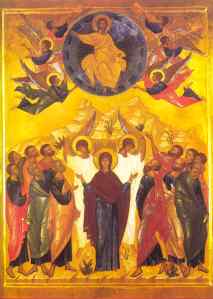
 ascension-pskov-pecheryA sermon for the Sunday after Ascension Day (Year C)

Last week it was  the creator of the cosmos, the hand that ‘flung stars into space’; the big bang,  the idea that the laws of physics are part of God. This week it’s the splendour of God. In the reading from Acts, and the psalm, we hear of God’s mighty acts of liberation. Between these two Sundays, on Thursday we celebrated the Ascension. Some people find the Ascension embarrassing. How can you believe, they ask, that someone went to heaven, disappearing from view, feet disappearing through the clouds? A celestial stair lift. Some people find this even more difficult to deal with than the idea of Jesus rising from the dead. It’s easy to ridicule Christian doctrine if you take everything literally.

So, don’t take it literally. Think instead of the symbolic meaning—of what the story means for you and me. Think of phrases we use: aiming for the stars; scaling the heights. This is what Ascension is about.

Think of the Ascension as Christmas in reverse. At Christmas we celebrate the Divine Lord coming in human form. Heaven to earth. Through Jesus’ life we have Divine and human fused, experiencing all human pains and pleasures. At the Ascension, all this human experience is taken back to the source of Divinity. It was the wounded Jesus who ascended, taking with him all the pains as well as the pleasures of human life. All our human life is made divine.

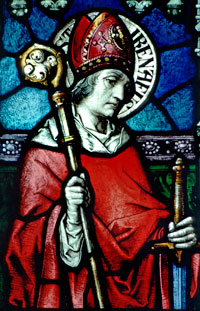
Irenaeus

Irenaeus

St Irenaeus said something like: God became what we are, in order that we may become what he himself is. In the Christmas Gospel, St John says something similar: as many as received him, to them gave he power to become the sons of God. More Irenaeus: The glory of God is a living person, and the life of man fully alive is the vision of God.

The message of the Ascension is that our lives, lived to the full, are a vision of God. By living life to the full we ‘ascend’ toward the heights of divinity, aiming for the stars, scaling the heights. And that is something reflected in today’s Gospel, Jesus says: Father, I desire that those also, whom you have given me, may be with me where I am. The splendour of God is seen in the splendour of human life lived to the full.

See yourself as a hot air balloon powered by the fire of the Divine Lord. What does the balloonist do to become airborne? (1) turns up the heat; (2) chucks out the weights and cuts the ropes that tether the balloon to the ground. Turning up the heat can be left to next week when fire and flames are part of the story. Today, think about chucking out the stuff that weighs us down and tethers us to the ground.

There are things we do that we wish we didn’t. These weigh us down. There are things we want to do but never get round to. This weights us down. St Paul knew all about these when he said that he knew what he should do but often couldn’t manage it, and found himself doing the things he knew he shouldn’t.

401px-Joy_Ride_hot_air_balloonThere are things we carry with us that weigh us down: shame, regrets, guilt. Confess them – bring them to the surface, tell someone else. This is what people often do when they know they are dying. It’s always a relief.

There is pride that makes us think we are better than other people, or that other people or groups or races matter less than we do. There is pride that prevents us seeing ourselves as we are. This pride is not the sort of pride that we take in someone’s achievement, but the pride of hubris – pride and arrogance that shows a loss of contact with reality and an overestimation of our own competence or capabilities. We see it in a few politicians, in some bankers, in all abusers. We see it in people who take delight in shaming and humiliating others. We see it, if we are honest, in ourselves. When we think we are better than others, we belittle them, and this leads to abuse, sectarianism, theft, stealing.

These are some of the things to chuck out of the balloon.

We can also help the balloon to rise by giving things away. We can share our gifts and our love with others. The interesting thing about this is that no matter how much we give away, the reservoir always seems to have more left in it. And these things appear to be weightless. In the words of St Peter: Be generous with the different things God gave you, passing them around so all get in on it. Be content with who you are, and don’t put on airs. As we work on this generous giving and sharing, we ascend towards the divine.

The point of the Ascension is to help us to realise that we approach the divine when we are fully human, each of us playing to our strengths and giving to the world what only each one of us can give. Man fully alive is the Glory of Creation. The divine light is in us all, and as St Matthew has it, Let your light so shine that all may see it and glorify your father in heaven. The Ascension is inside us, the kingdom of God is inside us. Don’t worry about showing off: we are all meant to shine, as children do. We were born to make manifest the glory of God that is within us. And as we let our own light shine, we unconsciously give other people permission to do the same. As we are liberated from our own fear, our presence automatically liberates others. (Marianne Williamson)

Lancelot Andrewes

Lancelot Andrewes

This is why we need the Ascension: to rekindle, restore our sense of hope. The splendour of man is the splendour of God. This is a great gospel for inspiring us for the future.

Hear  what Bishop Lancelot Andrewes saith on Christmas Day 1605: It is most kindly to take part with Him in that which He took part in with us, and that, to no other end, but that He might make the receiving of it by us a means whereby He might “dwell in us, and we in Him;” He taking our flesh, and we receiving His Spirit which He imparteth to us; so we by His might become “partakers of the Divine nature.”

Anabolism and diabolism

hard-heart-wire-frame1-1024x682I’ve been told by a well-wisher that s/he looks forward every month to my writings in the Diocesan magazine. Not only that, they get better each month. This is a comforting message. It builds me up: it is anabolic, and I need that. It comes at a time when I hear that some parishioners scan my every word in the magazine and on this blog for something they can use to have me drummed out. It comes the day after one complaint that parish accounts were not available (a pile of them were in the church porch for over a month), and another, surprisingly vicious, that the pewsheet had the wrong readings in it (year B, not year C). It would have been helpful had the complainant offered to be responsible for pewsheet production.

The well-wisher said that s/he did not know of a Church of Ireland parish in which all was sweetness and light, and knew of several that were riven with discord. S/he wondered how anyone these days could stick the hassle of being a Rector. I knew the Church of Ireland between 1988 and 2003 and then again from 2011. Someone in early 2012 asked me what it was like coming back, to which I replied ‘I forgot just how unpleasant some members of the C of I can be to each other.’ Fortunately, for all the vexatious members there are more delightful ones. Ministering to all is a privilege, and ministering to the delightful is a pleasure.

You would think that the church would be less prone to fault-finding than other organizations. Sadly, the opposite seems to be the case—spectacularly so in the C of I. I recall complaints brought against the Revd Michael Bland, the Rector of Buckland with Snowshill (Gloucestershire), in the 1960s. When asked about the angry emotions felt by some of his congregation, he said: ‘Quite right. Get the violence off the street and into the Church where it belongs.’ Why the aggro? Is it because church is the place for power-games? Is it because church is the tribal totem? I can’t see what the discord has to do with the man in sandals. Perhaps the church has a death wish: they forget nothing, they learn nothing, as it was reputedly said of the Bourbons.

Seeking whom he may devour

Seeking whom he may devour

Grumbling and gossip are diabolical. They splinter—that’s what diabolical means. The shards of glass from the devil’s mirror at the beginning of Andersen’s The Snow Queen turn the heart to ice and corrupt the vision. Guilt and shame harden the heart. As for corrupting the vision, look into the eyes. The retina is the only bit of the central nervous system that is visible to an observer. The eye is the window of the soul: eye structure and personality are linked, researchers suggest, because genes responsible for the development of the iris also influence how the ‘personality part’ of the brain is wired up. And notice how shame and guilt affect the way that people hold their heads and move their eyes.

Hardness of heart is what the psalmist warns us about. It makes us insensitive to the woes of others. It makes us obsess about self. And the harder it gets, the greater will be the mess when it eventually shatters–as certainly it will.

Speed these lagging footsteps; melt this heart of ice.