Summer delights

allergy-eyes1-300x203

Summer’s leaks

The sun is shining. It’s very warm even at 7.30 am.  Og the dog and his minders are on their way to Togher woods for their morning constitutional. The woody fragrances are overlaid by those of bovine ordure, not unpleasant. SWMBO asks if I see the pretty flowers. Then she looks at me. Eyes running, nose streaming, chest heaving to force breaths in and out. ‘No, I suppose you don’t’. She’s right. Everything is a blur. So is the screen as I type, now an hour after we’re back, and after antihistamines, salbutamol and whatever it is that’s in the dark brown inhaler. Prickly eyes, prickly skin, it feels as if there’s a wire brush down my trachea. Oh bliss, summer is upon us.

Here is an extract for today from http://www.met.ie/: ‘Grass pollen affects up to about 95% of hay fever sufferers. The early-flowering grasses will be reaching their peak during the warm weather this week.’ What a joy. This, I suppose, is why bread makes me feel prickly inside, why whiskey and I have a fraught relationship (thankfully), why cakes and buns are not good for me. It’s kind of people to offer me them when I visit. A couple of weeks ago I took one, had a bite, then surreptitiously put the bun it in my pocket. Later that day when I was foraging for coins to pay the M7 toll I forgot about the bun so there was a shower of crumbs all over the front passenger seat. Still there I think.

My childhood in agricultural Cumberland was blighted by corn, wheat and hay. Going with my father into his flour mill was just not on, any notion of following in his footsteps unthinkable. Playing among hay bales soon demonstrated the law of cause and effect. Funny, though, I kept doing it. Wasn’t it Einstein who said that insanity was doing the same thing over and over again and expecting different results? I knew there was a reason why cold and sunny weather suits me best.

Dear Leinster Express …

8xzai1a4l0yexgl9mfivThe Leinster Express has, without my permission, twice taken pieces from this blog and/or from my letters published elsewhere, and printed them as if they were letters to the paper. Naughty, naughty, I would have thought. It would have been courteous of them to tell me, not to say ask. And I would have appreciated a chance to nuance the text for a different readership. They are welcome to use my writings – but with my permission please. I trust that they’ll choose a variety of material from this blog, and not just publish the potentially controversial stuff. I wonder if they might pay me …..

Euro and eurinals

drainOne of Alan Bennett’s Talking Heads monologues was about a lonely middle-aged woman who got herself in trouble by writing letters to the papers. I haven’t written many, but one I’m particularly proud of dates from late 1998, just before Ireland adopted the euro. It was addressed to the Irish Times and read:

Sir, since we shall soon have the euro, may I suppose that cash machines will be installed in eurinals, and that furthermore we shall be able to eurinate on banks instead of, as now, banks eurinating on us? Yours etc …

They didn’t publish it. Pity. It was prophetic, given the extent to which they have since eurinated on their customers and on the state.

Medical school & interviews

St Mary's said no

St Mary’s said no

Interviewing prospective medical students was always interesting in the old days. By old days I mean the days before interviews had to be structured for the sake of introducing what ‘experts’ called ‘objectivity’. Here’s an exchange from the 1980s.

Good afternoon. It’s good to meet you. I hope your journey was comfortable.
It was aw-right.
And how do you like living in XXX?
It’s aw-right.
Can I get you a glass of water before we begin?
I’m aw-right.
You’ve had a tour of the campus, I think. What did you make of it?
It’s aw-right.

And so it went on. Here’s one from the 1990s.

And what do you enjoy in your spare time?
I watch opera.
How lovely. Which opera are you particularly fond of?
Pardon?
Any particular opera?
Sorry?
I thought you said you liked Opera?
Yea, I did. On the TV every afternoon. Oprah Winfrey.

Honest, that’s true. It rather took the wind out of one’s sails, I can tell you. Hard to keep a straight face.

In 1968 I recall a trip on the sleeper from Carlisle to Euston. I arrived in London about 6 am and had to fill in time until the early afternoon for an interview at St Mary’s Medical School, near Paddington station. I thought I’d go to Piccadilly Circus which I’d heard of. I knew nothing of its—let’s say cosmopolitan and relaxed—reputation, and neither was my ignorance challenged that morning. After a breakfast burger at the Wimpy, the height of sophistication, I can’t remember how I filled into the rest of the time but somehow

I did. The only bit of the interview I can remember was the beginning. One of the three interviewers (men, suits, how-now-brown-cow accents) said ‘Tell us, Mr Monkhouse, what are you good at, apart, of course, from passing examinations. haw, haw, haw.’ What. a patronising shit.

They were, it subsequently became evident, mocking the piano and organ exams that I’d taken periodically since 1963. I was not offered a place. Later that year I had an interview at Manchester where we had a good deal of fun. They kindly said they’d have me if Cambridge didn’t. I think they, unlike the rugger-bugger yahoos at St Mary’s, were entertained by my being an organist.
Queens' said yes

Queens’ said yes …

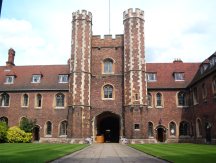
The admission process for Cambridge was strange. I applied for an ordinary place at Queens’ College as well as an organ scholarship to any college that would give me one, the two processes running in parallel. I was interviewed by the then Senior Tutor of Corpus Christi College, a most urbane chemist (academic, not drug store), who sat me down on the chintz sofa opposite him, gave me a sherry (yes, really) and started a fireside conversation that I recall as glittery and great fun. Though details escape me, Shap fell was mentioned, there was talk of Gilbert and Sullivan and organs (musical), though nothing about medicine. The organ scholarship did not materialize (contemporaries were Stephen Cleobury, Ian Hare, Edward Higginbottom: I was never in that league) and although I never actually had an interview at Queens’, the Corpus one must have been passed across, as it were, for after sitting compulsory entrance exams, I was offered a place at Queens’. Escape from Cumberland.

... and so did King's

… and so did King’s

In 1971, it was the normal practice for Cambridge medics to do hospital-based part of the medical course elsewhere. I applied to four London medical schools. I gave St Mary’s the old heave-ho this time. I was turned down without interview by two, turned down after interview by St Bartholomew’s (no recollection other than that it was sticky), and accepted without interview by King’s College Hospital Medical School in Camberwell. So there I went in autumn 1972. Susan and I were married in summer 1973 so I was one of the few married students. I failed the first part of medical finals in 1974, passed them with the second part in summer 1975. Thus ended my days as an unpaid student.

Towards the end of my time as a medical school academic, interviews became more and more structured until in the 2000s we had to ask every candidate the same questions, and were not allowed to follow any leads. This killed the whole process stone dead; there was no room for exploring, no way of probing, just wholesale encouragement of the initiative-stifling tick-box mentality that is rife. As for any quest for objectivity—pish! There is no such thing outside mathematics.

One of the results of structured interviews is that it becomes much easier to advise candidates on what to do and what not to do. If you’d like the benefit of my experience and advice, don’t hesitate to get in touch. My rates are very reasonable, and I could throw in a plenary indulgence or two and an all-purpose blessing.


Jensen

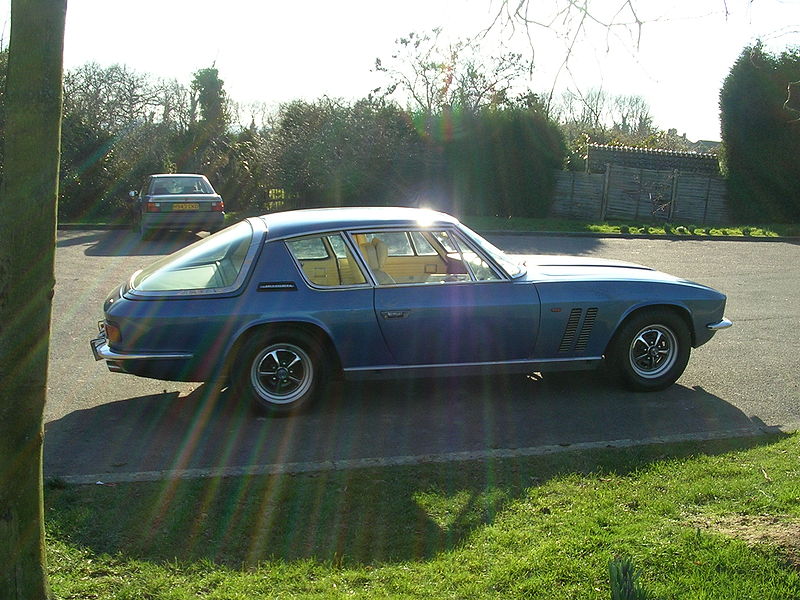
800px-Jensen_FFCardiology outpatients, some time in 1974. The consultant, now long gone to his reward, is an extremely eminent Harley Street cardiologist, pinstripe, bow tie, the works. The patient is a young lad with a heart condition. He is accompanied by his father, an artisan with a pronounced sarf Lunnun accent.

Consultant: Now, tell me my good man, what’s the young chappie’s name?

Father: Jensen, boss.

Consultant: Jensen, eh. That’s a most unusual name. How did you come by it?

Father: Well, yer see guv, the missus and me we like cars, and a Jensen’s a fantastic machine, so that’s what we called im.

Consultant: Oh, I see. That’s rather good. Pause. I must say, it’s as well you don’t like Rovers. Haw, haw, haw.

The Skinners Arms

Skinner's arm

Skinner’s arm

I promised here a story of a performing lady and her abdominal scar. Here it is.

The year is 1973, the place south London. The time is Friday evening, and the story concerns four young men attending King’s College Hospital Medical School who were taking an evening stroll. As they proceeded from Camberwell in a north-westerly direction towards The Oval, a thirst descended upon them somewhere in salubrious north Brixton.

Behold, seest thou yonder hostelry?
Yea, verily. Let us thither hie to slake our thirst.
Aye, aye. Come, make haste.

It was—you’ve guessed it—the Skinners Arms (there is no information concerning whether or not there was an apostrophe, and if so where it went) on the corner of Vassall Road and Camberwell New Road. According to Wikimapia it is no longer in existence, having doubtless succumbed to town planners. Anyhoo … the four knights did enter.

If it be thy pleasure, fair serving wench, we parchèd wanderers each desire a tankard of thy most toothsome nectar.
Most certainly, wandering lords, quoth she.

Some time and several flagons later, behold the lights did dim. Music rang forth and lo, a performing lady materialized on the podium. This surprised the knaves. Nevertheless, they steeled themselves to witness a spectacle. The performing lady, they were astonished to see, gradually divested herself of her habiliments until she stood before the assembled company wearing only a two-piece bikini. She had a midline scar below the umbilicus.

Ah, comrades, espiest-ye the scar? Perhaps the lady hath undergone an hysterectomy.

It was not that the utterance itself was foolish, but rather the volume at which it rang forth, for the intended whisper cameth more as proclamation. If thou understandest that, thou dost apprehend the nub of the issue.

Thou art mistaken, fair friend, quoth the lady, for ‘tis an appendix scar.

And having uttered those very words the bikini-clad performer hied herself to the bench at which the knaves were seated, and sat on the knee of one of them, and polished his spectacles with one of her removèd garments.

Now, the knaves were, admittedly, junior medical students, but they possess’d enough knowledge to know that appendicectomy does not normally require a midline incision in the lower abdomen. Nevertheless, they sensed that circumstances were not propitious for further discussion of the issue. They felt that discretion was in their best interests, and without further quaffing or quoting they legged it onwards, returning to their lodgings to prepare for the rigours of the weekend. The young men were lucky, methinks, not to be set upon by the lady’s supporters.

The moral of this story? To draw conclusions from observations is good, but any proclamation of the same should be timely rather than immediate. The youth learnt a lesson.

Every sinner has a future, and every saint a past (Cardinal Hume, I think).

A salutary tale

399px-WLANL_-_MicheleLovesArt_-_Museum_Boijmans_Van_Beuningen_-_Eva_na_de_zondeval,_RodinThe south London children’s hospital again. Another story that does not reflect well on me.

Admission from Casualty. Young lad, about 6. A few bruises and a couple of broken bones. Once again, his name and his face are etched upon my memory. I shall call him Jason. A suspected battered ‘baby’ (the term used at the time). I examined him as best I could. He was apprehensive, watchful and suspicious of me. His father later came to visit as I was tending Jason in the glass-walled cubicle. I could hardly bring myself to speak to him—it would only have been ‘good evening’ anyway—and I could only just stop myself launching into a tirade. Fortunately I managed to control myself. Weeks later I was called to Camberwell Magistrates Court to give evidence, my first appearance in a court room. It was curiously low-key and inconclusive. I remember few details of that, other than that it happened. Not long afterwards, my job ended and I moved to Nottingham to become an Assistant Lecturer in Anatomy.

I assumed the parent(s) were guilty. They may not have been. Perhaps, as in one of Alan Bennett’s Talking Heads monologues, the child bruised easily because of leukaemia, and/or had brittle bones. I am ashamed of my rush to judgement. I was very young and our daughter was about 6 months old at the time. I worked a two-in-three rota, and was home only every third night.

Please don’t underestimate the emotional pressures on doctors, young doctors especially and those working with children in particular. I can say that the emotional pressures on pastoral clergy are similar, though less intense. This experience, and many others, make me pretty sure that it is just not possible for a sentient human being to be ‘neutral’ about anything, Our own experiences colour what we see and hear and how we think and react, and our emotions cause us to do extraordinary things, some of which we will regret.

It’s called being human.

Where the bee stings, there sting I

bee-sting-1717_2Another story from the south London children’s hospital. It doesn’t reflect well on me.

It was a lovely balmy summer evening in 1976 (remember, dear reader, that I qualified as a doctor in June 1975). The air was scented with the sweet odour of traffic fumes from the adjacent A3 and A23. The occasional subterranean rumble signalled a passing Northern line tube. Passers-by gaily shouted greetings to one another as they merrily made their way to the Skinner’s Arms on Camberwell New Road for an evening’s intellectual exchange over a pint of golden nectar. [Sorry to intrude here, but I’ve another story about the Skinner’s Arms that could be told. It involved a performing lady and her abdominal scar. Maybe another time. Back to the plot]. The day was ended, ward rounds, theatre sessions, drips inserted, consultants humoured, parents talked to, emotion drained. I was the only doctor in the hospital, and I’d gone to bed.

In about the 40th hour of a continuous shift lasting three working days and the two intervening nights, the phone rings about 11.30 pm. It was the night porter.

Go to A and E, there’s a child in distress.

Indeed there was: a boy about 8 years old. He’d been stung by a bee (maybe a wasp, but the blog title wouldn’t be as good) that morning, and the resulting inflammation was bothering him. I tended the child as best I could. Painkillers, emollient cream and so on. Then I made my big mistake. I said to mama:

I’d gone to bed. I’ve been on duty for over 36 hours. Why have you waited till now to bring your little darling [well, I didn’t say that, quite] to hospital?

The mother, who worked as a nurse in St Olave’s Hospital, elsewhere in London, was outraged. She blustered:

I won’t be spoken to like that.

She obviously felt guilty and was embarrassed. She continued:

I wouldn’t be spoken to like that at St Olave’s.

My turn now.

Then you’d better go there next time.

And off she and the heir apparent stomp.

The moral of the story? There are several. They include (1) take your complaint to the doctor before the crepuscular fall in endogenous corticosteroids makes it worse; (2) remember that doctors are human too; (3) choose a hospital that is properly staffed by doctors rather than administrators. If you can find one.