Farewell, dear friend

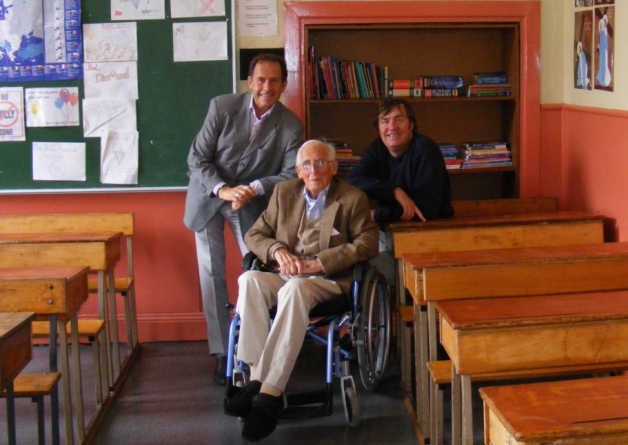
Harold with two of his sons

Harold with two of his sons

This is Harold who died earlier this week. He is the only person I know who had a lecture theatre named after him while he was still alive.

Unusually for a Dublin surgeon, Harold was not one of the Dublin medical ‘masonry’. He was one of nine children born to Fred and Nellie Browne of County Longford, and earned his medical and surgical qualifications through application and skill rather than family connexions and the sense of entitlement that comes with them. He was one of the first Irish surgeons to collect a BTA qualification (‘been to America’ – in his case the prestigious Mayo Clinic), after which he had a long and distinguished career at The Richmond Hospital in Dublin. He retired from full-time surgery in 1987.

Harold’s care for his patients was exemplary and his surgical ‘nous’ second to none. Those who knew him in those days describe him as a hard taskmaster. Severe is a word that has been used. His standards were high and his expectations higher. I suspect that such demands would cause him problems in today’s more precious environment. Despite this, or perhaps because of it, there is no doubting the affection, admiration and respect in which he was, and is, held by those now eminent professionals who have been through his hands.

This is the man I met in when I arrived at the Royal College of Surgeons in Ireland in January 1988. In retirement he had been given the job of Surgeon Prosector involving teaching anatomy to students two days a week in term time. I was told on the grapevine that he’d been appointed partly to keep the new Professor of Anatomy in line. That did not augur well for our relationship. Not only did I bridle at the prospect of a restraining hand, but also I doubted that a famous surgeon would be famous for being willing to submit to a 38-year-old pimply youth from Albion.

The country boy from Cumberland met the country boy from Longford. The sport-averse young Englishman met the Arsenal obsessed sagacious Irishman. We loved each other. Harold never once admonished or contradicted me, never once disagreed with anything I said or did. And so I confided in him. He admired my propensity to call a spade a bloody shovel. He loved, nay admired, my intolerance of gobbledygook: ‘we’re right behind you, Stanley’ he’d say grinning widely when I was fulminating about the latest manifestation of jargon-laden managerialism, and his face creased with laughter at what he called my ‘Rabelaisian wit’.

He was not without his own ‘Rabelaisian’ tendencies. In his teaching there poured from him a stream of aphorisms and mnemonics that would certainly have him up before the politically correct thought police today. There was plenty opportunity of course: hernias, breasts, the naughty bits, back passages and so on. A particularly memorable one was his likening the descent of the testis into the scrotum to the Israelites being led to the promised land. And this to a substantially Muslim student body still having wet dreams, or their female equivalent. Did they object? They did not. They regarded him with the same filial affection that he inspired in the rest of us.

I knew only the Father Christmas, teddy bear Harold. And I am so glad I did. My spirit will be at Merrion Church in Ballsbridge on Friday for his obsequies.

Courageous Pope

Pope_Francis_2013Il Papa needs to watch his back. He is ‘courageous’. Francis has listed fifteen ailments from which he thinks the Vatican Curia suffers. Here is my interpretation of them.

  • They treat the church as a private club. They form cliques. They show off. They suck up to people more ‘powerful’ than themselves. They think the more they have the better off they’ll be.
  • Everyone thinks he is in charge, so without coordination, nothing gets done.
  • They confuse looking miserable and/or pompous with seriousness of purpose.
  • They build walls around themselves and their own creations. They are inclosed in their own fat, and their mouth speaketh proud things. ( Psalm 17:10, BCP 1662)
  • They think that driving a computer is more important than dealing with real people.
  • They are hard-hearted. They are delighted when a rival comes a cropper. They ‘kill’ others by gossip and backbiting because they lack courage to speak face to face.
  • They plan too much so become inflexible, they think activity means progress, so they never reflect on what they have done or what the consequences might be of planned action.

Sound familiar? Entitlement. Masonic intrigue. Petty rivalries. PCC meetings. Church processions. Church politics. Mission Action Plans. Fawning to bishops. Church flower rotas. Church choirs—oh Ye Gods, church choirs, may the Lord save us and protect us.

I spent three years of my life dealing with a particular manifestation of such as this. I resolved when I got out of it that I would never again tolerate such self-obsessed behaviour. And I mean it.

Back in the fourth century AD Evagrios the Solitary wrote that the demons that fight us in the front line are those entrusted with the appetites of gluttony, those that suggest avaricious thoughts, and those (worst of all) that incite us to seek the esteem of men.

Nothing has changed. I’m with the Pope.

Church parasites

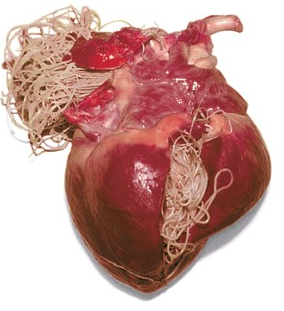
Heartworms

Heartworms

Today’s Church Times announces that the good old C of E is thinking about using human resources managerial strategy to train people for high office. Nothing has quite spoiled my Friday morning as much as this has – not even the prospect of a politically correct Christingle for a non-church and significantly Muslim school later in the day.

I know from selection conferences when I was an Assistant Diocesan Director of Ordinands that people, even at that very early stage, are labelled as potential high fliers. This is woeful enough in an institution that claims to be about service. But to institutionalize it is shameful.

The problem about wearing the clothes of other creatures is that one picks up their parasites, and in this case the parasites that come with the coats of corporate managerialism will at best disable and at worst consume the host. This is the sort of policy that drives me towards the former ‘flying’ bishops for a vision of the church that accords with what has been handed down to us.

I suppose the people that come up with this are so struck with guilt about what they have allowed to happen to the church – or rather, they should be – that they now flail about like headless chickens. ‘Something must be done’ they say. Maybe, but Ye Gods not this.

It’s like medical education. You qualify as a doctor (it’s a conveyor belt – don’t let anyone tell you otherwise – there’s no intellectual content, it’s all memory), then you train in obs & gynae, GP, physician, surgeon etc. Then you get 8-10 years under your belt and find yourself approaching divorce, middle age etc. And you are BORED. You have done 5 gall bladders a day every day. You have looked up the orifices of 7 zillion people and you are NUMB. So then you take to the bottle, or whatever, and start to attend meetings (with expenses of course) at the Royal Colleges where you sit around in panelled rooms on committees that interfere in things that don’t need interfering with. You impose your ‘new’ ideas and force reorganizations and generally foul things up even more. But at least you are not bored any more, and you can wait in line for your gong.

Now put all that in the context of the church. I’m long enough in the tooth to say to Church apparatchiks that I shall go on as I am. By the time they get round to disciplining me for not going along with unimaginative fads I shall be either dead or retired. But I pity the poor souls who are at the beginning of their ministry.

Retreating with dignity

pizza_snackThe door yields to a gentle push. Fragrance wafts outs. Aetherial choral singing is faintly audible. I step inside. Seraphic smiles greet me. Scrubbed faces, headscarves, Barbour jackets, hushed conversations.

Is it a National Trust shop? No. I see why you might think so, but no.

Maybe a Cathedral shop? Getting warm.

It’s a monastery shop. Stanley is on retreat.

‘Will you be getting up at three for Vigil?’ Hollow laughter. ‘How about Lauds at seven?’ I think not. As it happens, I slept most of the three days.

I had hoped not to have to speak much, but words were forced out of me at meal times, for others were nosey. There was a large dishevelled old man (other than me) who managed silence—I rather warmed to him as he shovelled food into his oral cavity at a rate that beat even me (you learn to eat fast as a hospital doctor between bleep calls). Though there was a bit of camaraderie over the Fairy liquid (we had to wash up; no pampering here), I did my best to say as little as possible. As is my wont.

I’ve not been on many retreats, but what will stay in the memory about this one was watching the retreatants serve themselves at meal times. Movements were slow and deliberate, as if on the moon, and accompanied by smiles and nods of the head. One extremely ‘nice’ couple—let’s call them Candice-Marie and Keith—similar age to me, were so very eager to help everyone else. Frankly I find that sort of thing majorly irritating, almost patronizing, but hey that’s just me.

As I was leaving, Keith happened to be in the vestibule (had he been waiting for this?) and said ‘I wonder if I can have a word with you’ in a very gentle and breathy voice, very meaningful. Then, with his head slightly inclined to one side, a gentle smile on his face, and a very caring wrinkled forehead, he said ‘It’s Stanley isn’t it?’ Without waiting for confirmation he continued ‘I’d just like to say I’m a nurse, and I think you should know that eating your food with your hands [can you eat pizza with cutlery?] can be dangerous, what with allergies and infections. There are bacteria on your fingers and they can cause disease.’

What do you think I did next?

I tell you, I am very proud of myself. I said ‘Thanks a lot. Bye’. Then I turned round and left the building,

Proud to be pleb

805629Four letter words often come to mind, but pleb isn’t one of them. I am without doubt a pleb. I have no connexions to the ruling classes. I am not of a landed family and have no land myself. Which reminds me: I heard a story, maybe apocryphal but still telling, of a man now a bishop who, when asked what his father did for a living responded ‘he doesn’t do, he owns’. As I say, I’m not one of them.

If pleb means someone from the lower social classes, then that’s pretty meaningless since in east Cumberland in the 1950s social classes didn’t really feature much. In the village there were farmers (Methodist) and there were people who lived in council houses (largely no religion). Within 10 miles there were landed gentry (C of E of course) such as the Vanes of Hutton, Whitelaws of Ennim, and Hasells of Dalemain. In Penrith it was rumoured that there were some very strange and exotic creatures: Catholics. Irish came in the 19th century to build the railway over Shap and Poles came in WW2. According to father, these people caused mayhem on Friday nights, and went to confession on Saturday, so it was all OK. There was a bit of forelock tugging. Father had been a policeman in Bradford in the 1930s, and through his work in later years with the Special Constabulary he was proud of his friendship with Lord Inglewood. But despite these later notions, we’re all thoroughly pleb so far.

Family history is still pleb. The Monkhouses were farmers and butchers; the Dobinsons (father’s mother) had aspirations certainly, but no land and no significant connexions. The Cranstons (mother’s father), a border reiver family, were butchers (and still are, famously so), and the Reids (mother’s mother) were Fife coalminers. So I’m still pleb.

I can’t remember having used the word in the playground to denigrate someone else. This is not because I was particularly virtuous—as a fat child I’d say I was more of a watchful performer—but because even though I did Latin it wasn’t a word that had any traction either way.

Of course, it’s the word playground that sums up this whole episode. It doesn’t speak well of Andrew wotsisname who comes across as a bit of a prat, and it doesn’t speak well of whoever objected to the word pleb: they should, as SWMBO says often enough to me, ‘grow a pair.’

I wondered what adjectives might I object to? Fat, smelly, untidy, ignorant, stuck up, insecure, stupid, degenerate, determined, stubborn, reactionary, unprincipled, pliable? They all leave me unmoved: some are accurate some are not. (Nice? Oh God, no, not nice, I will not tolerate being called nice.) I recall a party in Nottingham in the 1980s at which a woman, trying to insult me as gravely as she could, said I was a Conservative voter. She was a soggy champagne socialist and—of course—a Vicar’s wife. I think I told her to do something with a four letter word, not pleb.

For the record, I am not a Conservative voter. I am a Communist with me in charge.

This sanctuary of my soul

Great_Mass_in_C_minor_(Mozart)_p1We were in Hugh’s truck on the way from San Antonio to Fredericksburg in the Texas Hill Country. A day out. Muzak was oozing from the speakers. Quite without warning Mozart’s C minor Mass Kyrie began. I can’t quite find words for the effect it had on me at that time in that place, but it was something like being jolted by an electric shock in an instant into the fullest sort of life imaginable.

‘This is the best thing he ever wrote.’

‘They used it in A Very British Coup, with Ray McAnally.’

‘There’s a bit in the Sanctus that quite bowls me over.’

‘Doesn’t it all?’

University Methodist Church, San Antonio

University Methodist Church, San Antonio

The following Sunday we were at the local church. Plush, wealthy, comfortable, striking modern stained glass, acolytes in albs, candles to gladden my heart (yes, Methodist candles!), a lovely two-manual mechanical action organ by Rosales of Los Angeles—and they let me play it. The church orchestra featured. I must say, though, it was rather like a diet of honey both musically and theologically. Not soporific exactly, but certainly tending to make me wonder if I was in Stepford.

The contrast between the two musical experiences was remarkable. Mozart electrifies, muzak stupefies. Mozart—that Mozart in particular—exposes in an instant that central vacuum in my being that longs to be embraced. It tears apart the layers of ‘show’ that collect like dental plaque. It brings home to me, yet again, that all ‘this’ is vanity. It explains, yet again, why my best sermons are written under the influence of music, for it’s not long before whatever comes through the headphones bypasses conscious hearing and unlatches the sanctuary of my soul. The sad thing is that it is so expensive of emotion and self that I don’t do it often enough. My kingdom is an inner kingdom.

I was 13 when I first heard Patrick Hadley’s I sing of a maiden. ‘However long I live’, I thought then—as now—’I shall never be able to produce anything quite so concentratedly beautiful.’ I wonder what it felt like to be Patrick Hadley—actually, quite fun by all accounts, for there are lots of stories about him. I wonder what it felt like to be Mozart.

Do justly, love mercy, walk humbly

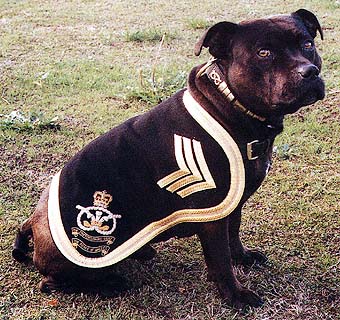
See the mascot?

See the Mascot?

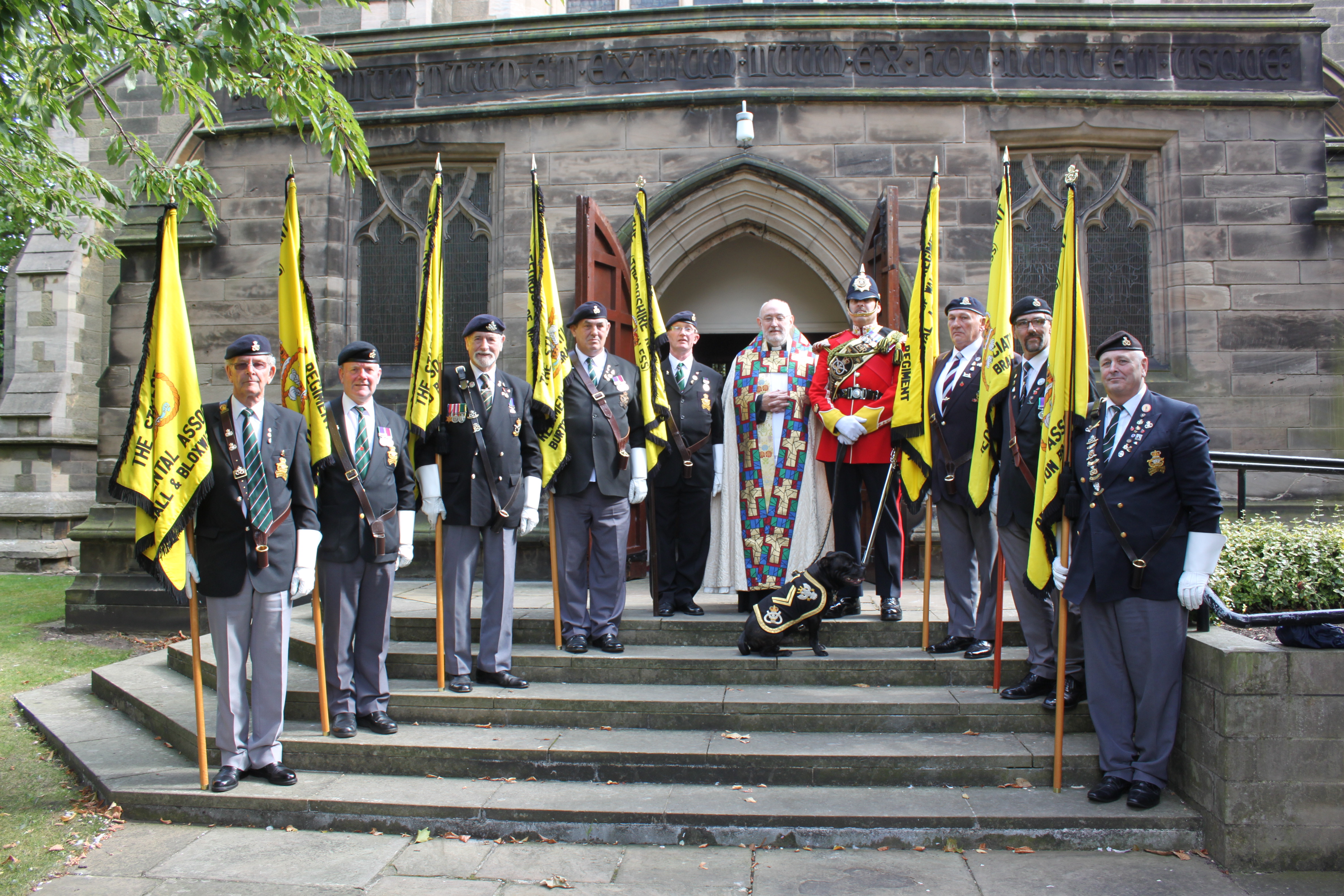
Homily at the Annual Commemoration Service for the Staffordshire Regiment at S Paul’s Church, Burton upon Trent, 13 September 2014

I have no military connexions other than a father-in-law who served in the Royal Navy, an uncle who served in the Royal Air Force and a father who served as a batman to a General in the British Army. Born in 1950, I am one of the pampered post-war generation who have never had to fight for anything and for whom everything has been free, including education to third level. What can I say to you who have served, to you who have suffered, and to you who have lost comrades, or confidence, or loved ones? What can I say to you who through your training learnt the hard way that personal preferences were irrelevant when you trained and worked together in the service of something bigger than you? What can I say to you who through all this were forced to think about justice and mercy, and who had a certain sort of humility drilled into you?

Although others have called me morally and intellectually courageous, nobody has ever called me physically courageous. I am a coward. I am always willing to stand right behind someone else, physically. So I need people like you who I can stand behind. I thank you!

Regimental Mascot

Regimental Mascot: he sings when we sing

I have been transfixed these last few Monday evenings watching the training of Marine Commandos. It is wonderful to see how in the service of something bigger than themselves these young men learn about justice and their attitudes to it, men who see by example when mercy is called for, and men who learn that their own preferences and desires count for nothing when it comes to the wellbeing of the troop. When one of the company failed in an exercise there was none of the derision that I suffered in PE classes in school, but rather a remarkable level of sympathy and support. You might even call it prayer.

All this has obvious biological parallels in the cooperative communities of creatures like ants, termites and marine invertebrates, where each individual knows its place in the big scheme of things—a scheme of things that to each individual must surely be incomprehensible, but which must, one supposes, be hard-wired into what passes for a brain.

You men know what it is to have to put your ‘self’ aside for the sake of something bigger. In the church calendar, tomorrow we celebrate the Holy Cross. There is a tendency to think that the death on the cross is only about what happened 2000 years ago. This is nonsense. It is of course about that, but it is also about what happens every moment of every day as we gradually realize that the energy we spend in trying to be individuals yields altogether more wonderful fruit when we divert it into trying not to be individuals—when we give up ‘self’ for the sake of something bigger. That is what happens in your military training. At some point in the pursuit of individualism we will ‘hit the wall’, and, as in training, we can, if we set our face to it, break through into resurrection life.

Commemorations such as today’s are ambivalent occasions. You know people who were injured, you know people who are still suffering, you know relatives who suffer, you have comrades who were killed. But you know the excitement, the comradeship, and the singleness of purpose as many hands are put to the plough.

I know some of you, having been at home in community, find it difficult upon leaving to cope with the individualistic society that you find yourself thrown into, but I hope most if not all of you can look back with satisfaction on what you learnt in training together. Young men these days lack opportunities like this. There is nothing, or very little, set apart for them. We have organizations for women only, and women are certainly encouraged to be women, but men aren’t allowed to be men, from early childhood onwards. Schools and society tend to emasculate. Society needs more opportunities for men to be men—I’m not talking about boorishness or the dreadful hail-fellow-well-met insincerity of golf-clubs where ‘you scratch my back and I’ll scratch your BMW’—but opportunities for the naturally occurring testosterone to be expressed in male bonding, adventure and service.

You, gentlemen, have a wonderful opportunity to help today’s young men to learn how to be men, and to learn the benefits of working for a cause that is bigger than any individual. That perhaps is your job now: to show others how to do justly, love mercy, and walk humbly.

Once again, I thank you and I commend you in your service, past, present and future.

T’interweb meedja

JesseRight, so. I sorted out how to do a Facebook (? FaceBook) page for the churches. I managed to do it for an organization rather than for an individual so was quite pleased with myself. This is in preparation for a website.

It took me a while because I’m 64 and these things don’t come naturally at an age when many of us are worried about letting angels prostate fall around our ankles. And, it has to be said, in my former lives I’ve always had people to whom I simply had to utter a command and lo, it cameth to pass. Not now I fear. So gird up your loins, young man, or what’s left of them, and show the virtual world what you’re made of.

So I did.

I emailed my many friends and asked them if they would be kind enough to ‘like’ the Facebook page so that it would begin to be noticed by the great noticer of things in the firmament of heaven which must now be stuffed full of things jostling to be noticed. So full, in fact, that the aether is getting thicker and thicker—have you noticed?—and moving is more and more difficult. Either that or gravity is getting stronger by the minute. Anyhoo, back to the plot. As I say, I emailed friends and asked them to like it.

You would be astonished, Bruce, just how many darlings responded by saying something like ‘well actually, I don’t do Facebook’ or ‘I can’t get the hang of these twitter things.’ Astonished. You can, I hope, read the smell under their noses. All of these hoity-toity people, be it noted, were English, not Irish. It is noticeable that clergy colleagues in Ireland were on Facebook much more often than English clergy. Perhaps this is because Church of Ireland clergy have fewer calls on their time (seriously, this will get another blog), but whatever the reason, Irish folk are much more meedja savvy than English folk of similar age. What d’ye make of that?

Now to the website. The possibility that I might do one (‘seek to do one if it is the will of God’ in C of E speak) was dumped upon by a whole load of nay-sayers. I can understand that church people of an age when incontinentia buttox begins to loom might feel that such things are not for them, but unless they grasp the concept that the church has to deal with the world as it is and will be, rather than as it was when they were young and Napoleon was in Paris, we are more likely to be, as Private Fraser used so eloquently to say, doomed.

On the grounds that there is a tide in the affairs of men. which, if not taken at the flood, leads on to extinction, I thought the best thing was simply to JFDI. WWJD? He’d JFDI.

So Website-Ho! as Charles Kingsley would have said.