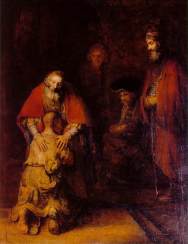
Christus Rex

prodigal_son33

The welcome

Homily for the Feast of Christ the King 2017 

Ezekiel 34:11-16, 20-24; Ephesians 1:15-23; Matthew 25:31-46

Stir up, we beseech thee, O Lord, the wills of thy faithful people; that they, plenteously bringing forth the fruit of good works, may of thee be plenteously rewarded; through Jesus Christ our Lord.

In Latin it begins, Excita, quaesumus, Domine … This, sad to say, is not about Christmas puddings, but is about asking to be excited.

The Christian life is not easy. It’s not about blindly following a pre-established rulebook or imposing rules on others. Jesus did not write an arid rulebook for his followers. Jesus did not think that belief in him could be attained through imposition. He did not come to establish a new religion. In fact more and more I think he came to abolish religion—to set us free from rules for their own sake, by showing us how to renounce all the vain things that charm us most. He came to show us wisdom that has no need of the rules of jobsworths, no need of prosperity and security for ourselves, no need of always having to be right. Then we are free to live selflessly, ego-free, for others.

A Vicar comes in contact with all sorts and conditions. People who are recovering from illness, people who have been in and out of hospital, people who are out of work, homeless, hungry, at their wits’ end, people who’ve endured more hardship in life that I would wish to endure. I witnessed dignified behaviour from people at their most exposed, most vulnerable, weakest. Regal, king-like.

Is this the kingship of Christ the King? If so, it involves accepting stuff that happens. Being passive: the passion. It involves rising above desolation in the hope of a fresh start. Resurrection and ascension. It’s not comfortable: we have to cope with the darkness of the deeps before we can rise to the sunlight. But the gospel readings of the last few weeks have not been comfortable. All of them have spoken of judgment, of exclusion, of condemnation for those who are late, or lazy, or easily satisfied, or who—as today—are hard-hearted.

********

Conquering kings their titles take from the foes they captive make: Jesus, by a nobler deed, from the thousands he hath freed.

Who do you remember from your past? Do you remember with gratitude those who punished you, who tried to impress you, who imposed on you? Do you remember with gratitude those who showed you, taught you, encouraged you, goaded you to action perhaps by words that rankled at the time, and then left you to get on with things?

Christ the King never uses power to his own advantage. He shows, teaches, encourages and then lets us get on with it. He is a team captain who works with the team rather than imposes on them; a captain who uses power for the benefit of others rather than for his own self-interest. He is the sort of king who leads us, pushes us, to places we fear to go. He stirs us, excites us, to action. He provokes us to realize that we don’t need to be fearful and ashamed of the past, but that we can move on with the past behind us to great new things. He doesn’t burden us with expectations and rules and shoulds and oughts. He takes them away from us and carries them himself. He is the sort of King who makes our loads lighter, not heavier. Christ the King lifts us from the rut and excites us to look to the future.

Conquering kings their titles take from the foes they captive make: Jesus, by a nobler deed, from the thousands he hath freed.

********

Kings have kingdoms.

When Christ the King was on trial for his life, he said his kingdom was not of this world. This is NOT about the afterlife. He was telling Pilate that his kingdom was an inner kingdom—a kingdom of outlook, of attitude, of motive—that powers Godly action here and now. It’s a recognition that the trappings of the material world are part of the layers we surround ourselves with in order to make ourselves look big. Vanity. Illusion. Look at Robert Mugabe and his millions, his palaces, his jets, all the people he has conquered and maimed and killed and humiliated.

We make the ideal kingdom—the Kingdom of heaven—here NOW. Life before death, not life after death. It’s about you and me making a world where we show, we teach, we encourage. A world where we don’t impose. A world where we don’t sit back criticizing others and looking down our noses at them. It’s not a kingdom where we stifle and suffocate and kill, but a kingdom where we excite and inspire others to action.

The Kingdom includes children, who were nobodies in that world—children who take risks, who listen, who experiment, who play, who are uncynical. The Kingdom excludes the pompous jobsworths. The Kingdom stands in judgment of the elites who create and shape things so that they can grow richer and fatter at the expense of the rest of us. Mugabe again.

It’s a kingdom where we seek the lost, bring back the strayed, bind up the injured, strengthen the weak. Where those who had trampled the weak are brought down. A kingdom where people are brought in, and community is restored. Where the tendency to entropy is reversed, where chaos is transformed into cosmos as in Genesis 1. Continuing creation.

********

We live messy lives. The mess of holiness. God bless this mess. We honour the King

  • when we forgive others and let go of resentments.
  • when we feed the hungry, give drink to the thirsty, welcome the outcast, clothe the naked, visit the prisoner—thus helping to free them from their pasts.
  • when we realise that the hungry, the thirsty, the naked, the imprisoned, are all parts of us that we have lost contact with—parts of ourselves that are strangers to us. And as we forgive others, we begin to forgive ourselves. This is truly the key to liberation from the past. Harden not your hearts ….
  • when we grow up, and take responsibility for ourselves.

We do all this to refresh and re-empower ourselves in order to do what we say we will do at the end of Mass—that we go in peace to love and serve the Lord, to bring about his kingdom here on earth as it is in heaven.

Advent 2017

Orante_Panagia

Great Panagia of Yaroslavl

St Paul’s Magazine, December 2017

Mary’s uterus: wider than the heavens

From the Liturgy of Basil: he made your womb a throne and caused it to become wider than the heavens.

Margaret Barker’s first seminar drew almost 40 people. I was worried that we might not get double figures. The subject matter, the virgin shall conceive, touched upon early Hebrew images of God, one of which is the veiled (as in the veil in the Temple Holy of Holies), eternal queen mother of god. Accordingly, it is she who conceived, not a young girl from the sticks. These images have come into Christian traditions as variously Mary, spirit, and wisdom.

We heard how, before the book of Deuteronomy was written, a reformation expunged the feminine from the scene. Above all, I saw afresh that every detail in Luke’s story of the nativity had meaning for those who knew the traditions, swaddling clothes, for example, signifying the garment in which the King is wrapped at anointing (look on YouTube at videos of the 1953 coronation and you will see many of the same traditions).

The more you know, the more interesting it becomes and the more you want to know. It doesn’t matter that the stories might be fiction. If they are, they are intended to convey the importance of someone impressive and remarkable, whose message is life-changing.

I sometimes hear people say “I don’t think …” or “I don’t believe …” this that or the other. What I want to hear are the opinions of people who are well informed by research and study, not those who rely simply on prejudice or Sunday school pap. Nobody can say that Margaret is not well informed, so I’m intrigued by her views, and can let them kick about in my head. When it comes to ideas, I’m not an either/or person, more of a both/and. I love ideas.

None of this changes the doctrine of the incarnation. It enriches it. As the infant grows in the mother, her uterus is the entire cosmos nurturing this new way of looking at the world—the infant. This is an image in Wesley’s hymns and Orthodox theology. As we sing every Christmas, the infant can, must, should, “be born in us today” and every day. Every single one of us is, or can be, Mary—a god bearer. (Gents, if you’re worried that you don’t have a uterus, fret not. You do. It’s a little recess in the prostate gland called the prostatic utricle, a remnant of the thing that becomes the uterus in females. Never let it be said that you don’t learn a bit of mammalian embryology).

This is the Christmas story. It has nothing to do with making yourself sick on Quality Street and war films, or stuffing your face with dry turkey and fart-making sprouts, or Morecambe and Wise (never liked them). By all means celebrate the pagan festival and the end of the year and the winter solstice and spring not too far away; enjoy the hangovers and family rows and fallings out and being bored with each other, but remember the real meaning.

Consequences

A recent Church Times article reports good news about church choirs. In places where they are nurtured, congregations grow and priests of the future are produced. Nurturing of course means spending money—you have to spend in order to earn dividends. A new organist at Modwen’s has reinvigorated music there. Summer concerts raised over £1500 for local charities, and drew in about 50 people every week, many of whom had not been before. It shows what can be done in just a matter of months when one puts one’s mind to something.

There seems to be no such enthusiasm at St Paul’s. This is a shame. I hear it said that church musicians should not be paid. Architects, plumbers, roofers, electricians, solicitors can be paid, but not musicians, despite the need for tuition, hours of practice, hard work. The organists we have do splendidly, but they’re not going to be around for ever. Actions, or in this case inactions, have consequences. Draw your own conclusions.

We’re at that time of year when people come to St Paul’s to get out of the warmth. I gather that recently one lady stayed for all of four minutes, reducing the congregation by one twentieth when she left. That was the Sunday I was preaching at Riverside Church on the High Street. Comfortable chairs and comfortable temperature are obviously a turn-off, for there were about 80 people there. Circumstances have consequences. Draw your own conclusions.

As it happens, I quite like the cold, but then I’m a man. Or a dog. Bedrooms should always be cold. It keeps down the germs multiplying. Maybe people come to St Paul’s to sleep—my eyesight is such that I can’t be sure from the pulpit. If I saw a student asleep in a lecture, I would pause, point him out (usually him), wait until he awoke, then ask if I could get him anything like a pillow, and tease him. Didn’t happen often.

Future

Anyhow, back to the plot. We have a problem with the huge building that is St Paul’s. It’s difficult to know what to do about it. All ideas will be considered. But remember that what worked when you were young, pterodactyls flapping about the sky, is not necessarily appropriate now. So think. Pray if you like (actually, praying is thinking), and try to imagine a future even though you won’t be around to enjoy it.

I’m 70 on 6 June 2020 and am obliged to say bye bye if I haven’t gone before. Will I be replaced? That’s doubtful given that my three churches together don’t support the cost of a fulltime cleric—you are subsidised. That may well be appropriate, for I can’t see that this parish will ever be self-sufficient, but the diocese/deanery may take a different view. What sort of clerical service do you want? What sort does this part of town need? Do you care? Maybe all that matters is having a priest for Sunday mass.

The YMCA approached us about hosting a night shelter for Burton homeless, December 2017 to March 2018. The PCC agreed. Of course, there are concerns and I share them. But YMCA are professionals and it’s not in their interest to get it wrong. And the truth is that if we never took risks we’d still be scrabbling round in caves. It’s absolutely right that as well as learning and beauty and worship we should be concerned with social action. It’s a gospel imperative. It might help carve out a role for this church in this part of town.

Finally

Gregg’s made headlines recently with an image of a manger with a sausage roll instead of the infant. It offended some Christians for obvious reasons, and Jews and Muslims because at least in theory a sausage has pig in it. But it has to be said that “Lord Jesus” backwards is susejd rol. So maybe it was a satanic plot. Anyway, it just shows how crass Gregg’s advertising team is, and confirms that all advertising is satanic.

Happy Christmas or nativity or solstice or sausage roll or end of year or whatever. In obstetric terms (back to the uterus), happy celebrations of the delivery of the infant King from the uterus of the veiled queen mother of God. And remember above all else that Christ is born in you today and every day. Raise a glass or six to that.

A lack of moderation

Frank-Bridge-Profile-687x1024

Frank Bridge 1879-1941

I wish I could remember the quote, or even the source, but I have a clear memory of reading in a biography of Enoch Powell that he found church music dangerously affecting, so had to stop listening to it. He had been a supporter of St Peter’s, Wolverhampton, and its great musical tradition.

He’s right. For me, music in general, and organ music in particular, is dangerous indeed.

Thursday is my usual day off. I spent the morning exploring organ music I’d had for decades but never looked at. I know and play the first, third and fifth of Six Organ Pieces by Frank Bridge, written variously between 1901 and 1912, but for whatever reason I’ve never looked at the second, fourth and sixth. Until today.

I am almost overwhelmed by the fourth, Andante con moto. Why? Never having heard or played it before, it’s not because it reminds me of events or times or places or people.

It’s not difficult. It’s in D flat major, 5 flats, a key that I find very comfortable—the disposition of the black notes suits the anatomy of my hands beautifully. It’s a key with lovely warm feel to it, and lovely and warm sum up the piece too, for it’s not sad or sighing or astringent or unsettling. Wagner is there, unquestionably—I hear him in other Bridge pieces too—in the chord progressions and the discord resolutions, or lack of them.

So wherein lies the danger?

It melts my shell. It leaves me unprotected. It removes me from time and place – ec stasis, ecstasy. I want more and more. It’s a drug, an addiction. I would do almost anything for a fix of more of the same, to stay in that place of delight. It creates dependency. It paralyzes. It intoxicates. It enchants.

I am not good at moderation.

Cathedrals: Annuntio vobis gaudium magnum

28A recent report from the C of E tells us that cathedrals are “amazing” places doing awesome things. Leaving aside the inflation of language that I so deplore, it occurs to me to wonder how well ordinary churches would do if they had access to at least half the resources thrown at cathedrals.
One of my churches is about the size of a small cathedral, such as Derby, Birmingham, Carlisle. It is staffed not by several paid clergy, paid musicians, paid administrators, paid finance directors, paid fabric managers etc—none of these—but by one third of a Vicar—that is, girls and boys, me (only a third of me because I have two other churches, one almost as big). That’s it. End of. Its regular congregation is about 30 who give of their time, energy and resources generously and sacrificially.

Of course, I don’t begrudge the cathedrals their worldly success, and I’m not in the least envious. Not at all. Not one iota. It’s important for the C of E to serve, as cathedrals undoubtedly do, the people who already have so much. Ministering to the middle classes is what the C of E is for, after all. (On first typing that last sentence my autocorrect had not middle classes, but idle classes. I should have left it.)

I have a cunning plan.

In order that cathedrals might be even more successful, I propose that without further shilly-shallying at least half the parish churches in the country should be closed—I’m quite happy to make the decisions—so that even more funds can be directed to cathedrals to help them do even better.

Furthermore, the clergy of the churches that will under the Monkhouse plan be closed can be redeployed in Diocesan offices thinking up more initiatives and demands to dump on the fewer and fewer parochial clergy that are left. This will result in an all-round increase in job satisfaction and wellbeing.

My final thought on this matter concerns the press release announcing to the world this great joy, and all similar spin. It’s taken me a long time—dunce that I am—to realise what they call to mind. They are like media reports from Pyongyang. Similarities don’t stop there, of course, for it’s well known amongst North Korean cognoscenti that Kim Jong-il’s birth took place on a mountainside and was heralded by inter alia a bright star appearing in the sky.

I’ll get my coat. And my P45.

Dr Wadely

FWWSince 2003 we’ve moved house six times. Six downsizings, with sheet music a casualty. Once I got over the initial shock of ditching music that I thought in my pride I’d learn one day, I got into the swing of things and worked on the principle that if I hadn’t learnt it over the last twenty years when my eyesight and hearing were good, I wasn’t going to master it now. That rule has served me well in other contexts too. Don’t worry, musicians, I gave it all to good homes.

A particular casualty was Messiaen and ‘forearm smash’ stuff. The surprise is that I kept it so long, for years ago after learning Dieu parmi nous I worked out that mastering one Messiaen piece took about the same time as learning at least ten by anyone else, so it was a bit of a no-brainer really.

One benefit of the great chucking out has been the discovery of gems I forgot I had. Wadely gems, in particular: ‘Three Short and Easy Postludes’. Short they may be, but easy? Well, not particularly so. I learnt them, then I looked online for more, and found three more short and easy postludes – or maybe preludes (so that’s six now). These are easier, almost sightreadable—kind of FRCO test standard, maybe a bit more demanding.

Of course, the reason I take to them is the Carlisle connexion. Wadely was organist at Carlisle cathedral for fifty years, retiring in 1960. I never knew him, for I didn’t start lessons there until 1963 with his successor. By that time, the organ had been modified, but the basic sounds were as he knew them: Willis choruses underpinned by a 32 foot metal open, early (1907) Arthur Harrison soft stuff and a huge Tuba (organ anoraks will know what I’m talking about). When I’m playing the Wadely pieces I feel a certain affinity with them through having reasonably clear ideas of what sounds he expected. His pieces are similar to, but I think better than, Stanford’s preludes and postludes which, apart from the last one in D minor, are overrated.

2386291210_de213538b0_zThe music is beautifully written. Like Bairstow, eight years his senior, he preferred flat keys to sharp keys. Like Bairstow, there is that use of progressions, discords and suspensions that gives a gentle, plaintive, yearning feel, redolent of the Edwardian era. Like Bairstow, he calls upon the full resources of a large organ for choral accompaniment. Wadely’s tunes have gone right into my brain, with dratted earworms that I can’t get rid of.

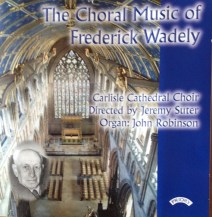
They are pieces of real quality. His successor’s successor, Jeremy Suter, recorded a CD of his choral music sung by the cathedral choir. It’s good stuff. There are lovely miniatures and a couple of very fine extended anthems: There shall be signs in the sun and There shall come forth a rod. All this, and the Communion Service in F minor, are every bit as good as Stanford or Charles Wood. The Carlisle chant book, as you’d expect, has lots of Wadely, only a few of which have found their way into published collections. Given that he was a pupil of Stanford at the Royal College of Music, am I too fanciful to hear a bit of Brahms now and then?

I wonder what might have come of Wadely if he’d moved somewhere less remote than the Border city. He was active in the wider musical scene of the area and his output includes many works for schools and secular choirs, so maybe having carved out that niche for himself he was content. He lived on Brampton Road, one of the posher parts of the city, and became a musical doyen of a substantial part of northern England. In his heyday his nearest colleagues would have been Armes, Dykes Bower then Conrad Eden at Durham, Bairstow then Jackson at York, Cook at Leeds and I suppose Goss Custard at Liverpool. Different days altogether.

Apart from the Suter CD there are no recordings as far I know, so I’m inclined to make one on the St Modwen’s organ here in Burton, perhaps also with works by some of his contemporaries (Bridge, Dyson for example).

CarlConsole

Not the console FWW knew, but many of the sounds the same

I saw the great man once at a performance of Messiaen’s La Nativité du Seigneur by Philip Dore in St Cuthbert’s, Carlisle. I was in my early teens and he was in his eighties, a small stooped figure who by invitation gave a vote of thanks. He added that Messiaen’s music was not to his taste. Can’t say I’m surprised—it’s less and less to mine.

Even in my youth, after his retirement, Wadely’s name was spoken in hushed tones in Carlisle. To this day the Carlisle Music Festival’s F W Wadely Trophy proudly adorns victors’ shelves. Those were the days when cathedral organists were aristocracy, even in Carlisle. So to finish with, here’s a jewel overheard during a conversation between two Carlisle musicians (imagine the flat vowels, properly enunciated consonants, and tinges of Scots and Geordie that make up the Carlisle accent):

First musician, in reflective mood: “You know, Stravinsky was born the same year as Dr Wadely” (he was always Dr Wadely).

Longish pause.

Second musician, similarly reflective: “Aye, is that a fact?”

       Another pause.

“Whatever happened to Stravinsky?”

Frederick William Wadely, born Kidderminster 1882, died Carlisle 1970.

Postscript: I’ve just seen that Ian Hare recorded two Wadely postludes (which set?) on this CD.

In Flanders fields

images

Poppy seeds – natural narcotics

A Vicar is in bother for reportedly banning Onward Christian Soldiers on Remembrance Sunday (he didn’t actually – see here – but why let facts confuse the issue?). Other ministerial bêtes noires include Jerusalem (And did those feet, not the other one), I vow to thee my country, and O valiant hearts.

I won’t ban any of them. I like Onward Christian soldiers. It’s a great tune, and the words and images that so offend the PC brigade don’t offend me. We need to be more assertive—how can others have respect for people if they don’t stand up for what they believe? How can we have meaningful theological dialogue if all we believe in is Jesus is my sentimental lover, chocolate, pet services and holding stones?

I vow to thee is my least favourite of this lot. The words are daft. All very stiff upper lip and Bertie Wooster but meaningless piffle. The tune is not one of Holst’s jewels and its span of over an octave makes it difficult to sing. But if people want it they can have it. Maybe one of the reasons I dislike it is the image it conjures up in my mind’s eye of the horsey set in their Barbours and jodhpurs and Alice bands and jolly hockey sticks. And that’s just the blokes.

And did those feet is wonderful sing. The music is real quality, as you’d expect from Parry. But what about Blake’s words? How to describe them? For starters, they don’t mean what most people think they mean. The dark satanic mills have nothing to do with the mill towns of the north—the poem predates them. They almost certainly refer to the institutions that attempt to brainwash people into being Orwellian slaves of the establishment: anything that keeps the rich man in his castle and the poor man tugging his forelock by the gate. In other words, the Church of England and the degree mills of Oxford and Cambridge. Despite being employed by one and a graduate of the tech college on the edge of the Fens, I’m inclined to think Blake was on to something. Or perhaps on something.

And did those feet in ancient time, walk upon England’s mountains green? No they didn’t. And was the holy Lamb of God on England’s pleasant pastures seen? No he wasn’t. And did the Countenance Divine, shine forth upon our clouded hills? No it didn’t. And was Jerusalem builded here, among these dark Satanic Mills? Absolutely not, so gird up your loins, no point waiting for the powers that be to do it; let’s do it ourselves—and the second verse tells us how.

It’s deeply radical and breathtakingly subversive. We need it at least as much now as they did then. Revolution, Comrades. Next time you see Toby and Tristram and Tasmin and Jocasta with their scrubbed faces and telephone number bonuses belting out Jerusalem, have a good laugh. (In Dublin I suppose it would be Ultan, Fiachna, Fionnula, and Derbhla, but they wouldn’t be belting out that hymn and Remembrance Sunday has an altogether different feel.)*

As for O valiant hearts, it’s incredibly moving. There’s no other hymn that for me expresses the stupidity of war in general and WWI in particular: the stubborn pride of military leaders, their callous duping of recruits, the pointless deaths. Never mind the questionable theology (if I banned hymns for that reason there’d be precious few left). Why does this affect me so? Maybe it’s the time Arkwright’s poem was written, 1919. Maybe it’s Harris’s music, Edwardianism dripping from every note. If you’ve read Vera Brittain’s Testament of Youth you might have seen in the text a piece of music by Vera’s brother Edward written I suppose about 1913 with a similar yearning feel.

I’ve always had O valiant hearts at my Remembrance Day services, and always will. It makes me angry and tearful in equal measure, so I have it as the offertory hymn when I go the altar to receive the gifts—which takes my mind off things. This time of year is difficult enough for Vicars with All Souls and Remembrance, and I really don’t need a blow upon a bruise to remind me of the deaths of young people who had their lives in front of them.

The only hymns I really can’t bear are: (1) There is a green hill – terrible theology; (2) All things B and B – words fail me; (3) the middle two verses of Once in royal – Christian children should never be mild and seldom obedient. I’m more inclined to ban tunes than words. But when our generation is dead and gone, nobody will know hymns at all. They are simply not sung any more at schools, other than some posh ones. Funerals and weddings often opt for canned music. They just want a CD of favourite tunes. I’ve stopped caring I’m afraid.

* thanks to my friend Eric for the names. He’s good at that sort of thing.

In Flanders fields the poppies blow
Between the crosses, row on row,
That mark our place; and in the sky
The larks, still bravely singing, fly
Scarce heard amid the guns below.

We are the Dead. Short days ago
We lived, felt dawn, saw sunset glow,
Loved and were loved, and now we lie
In Flanders fields.

Take up our quarrel with the foe:
To you from failing hands we throw
The torch; be yours to hold it high.
If ye break faith with us who die
We shall not sleep, though poppies grow
In Flanders fields.

John McCrae, May 1915

Saints and souls

800px-Votive-candlesHomily for All Saints and All Souls

Colossians 1: 15-20. Matthew 5: 1-12

Today’s gospel, the Beatitudes, takes on a startling immediacy in The Message. I shall read it to you.

You’re blessed when you’re at the end of your tether. With less of you there is more of God. You’re blessed when you feel you’ve lost what is most dear to you. Only then can you be embraced by the One most dear to you. You’re blessed when you’re content with just who you are—no more, no less. That’s the moment you find yourselves proud owners of everything that can’t be bought. You’re blessed when you’ve worked up a good appetite for God. He’s food and drink in the best meal you’ll ever eat. You’re blessed when you care. At the moment of being ‘care-full,’ you find yourselves cared for. You’re blessed when you get your inner world—your mind and heart—put right. Then you can see God in the outside world. You’re blessed when you show people how to cooperate instead of compete or fight. That’s when you discover who you really are, and your place in God’s family. You’re blessed when your commitment to God provokes persecution. The persecution drives you even deeper into God’s kingdom. Not only that—count yourselves blessed every time people put you down or spread lies about you to discredit me. It means that the truth is too close for comfort, and they are uncomfortable. Be glad when that happens, for though they don’t like it, I do! And all heaven applauds. And know that you are in good company. My prophets have always been in that kind of trouble.

This is how to be a saint. It’s not about piety and being seen to do the right thing. It’s about persistence, carrying through, determination, self-knowledge. It’s about disturbing the comfortable and not being swayed from the cause of right. It’s about being real and authentic, and giving your self away.

I’m not keen on saints. They’re too perfect. The nearest thing to saints I’ve come across are those who live with the most awful grinding problems day by day, hour by hour, minute by minute, yet still manage to keep their heads above water, if only just, smiling and glad to be alive.

Prophet Micah says do justly, be merciful, walk with humility. Humility is the key. Prophet Stanley says Micah is right, because one day you’ll be dead – and it could be very soon. Live life to the full. Those who do that, who use their gifts and lives to make the world a better place are saints in his book.

If you want to be remembered as a saint, you’ve no chance. If you don’t care how you’re remembered other than as someone who did their best, then you might be—if that matters which it shouldn’t. It’s trite to say that every saint has a past and every sinner a future, but its true. Prophet Stanley goes further and says that you’ve no chance of living life to the full unless you’ve cocked up in the past. Often. And learnt from it. The words of the hymn we shall sing in a few minutes—we feebly struggle, they in glory shine—are wrong. They shine, and we shall shine, because they and we have feebly struggled, and are feebly struggling.

As I say, humility is the key. Humus, earth. Feet planted firmly on the earth, living in the here and now, not in some la-la-land of your imagination, or someone else’s imagination, or of how things used to be when you were young and vicars knew how to be vicars. Earthed. We are creatures of this earth. From the earth we come and to the earth we return.

In Colossians we hear of the cosmic Christ, present at the moment of creation with the creative force. Begotten of his Father before all worlds. The Christ that comes to show us the way, who in the Greek comes to save not just you, not just me, not just humanity, but the cosmos. The Christ, that is the anointed one, the Messiah, who is always and everywhere present.

We are creatures of the cosmos. The Christ is of the cosmos, always and everywhere. We come into being as biology gathers up particles and atoms and molecules into what you see when you stand with no clothes on in front of the mirror. A frightful sight, I know. And when you pop your clogs you disintegrate as molecules and atoms and particles return to the cosmos for reuse. It’s the same for everybody and everything. Always was, always will be.

Think about that. Some might say it’s a kind of reincarnation. Whatever. Certainly, nothing is wasted. But however you look at it, people come, people go, but particles, atoms, molecules remain. Importantly for today, we are never not in the presence of the particles, atoms, and molecules of those we mourn. The particles, atoms and molecules that constituted them are all around us. We are never not in the presence of those whom we remember today.

We are never not in their presence, and they are never not in ours.

Their names will be read out. Candles will be lit. What do we think we’re doing? Praying for their safe crossing across the sea of purgatory? Well, if you like. That doesn’t float my boat though. There might be some kind of reckoning in which we see ourselves for what we really are, naked, rather than as what we in our delusional pride think we are, but I doubt that a few scrappy mutterings on days like today will make much difference.

No. What today’s about is us, not them. Reading out names and lighting candles is about our coming to terms with loss. Today’s ceremonies are intense. And so they jolly well should be. Our love for the dead was—and is—intense. Our grief is—should be—intense and painful.

The grief will of course have different hues. Loss of a spouse, loss of a parent, loss of a son or daughter, loss of a friend: different shades of intensity. Recent loss, distant loss: different shades of intensity. Different people have different feelings today, and cope differently. You can’t judge another person’s grief by the standards of your own. Susan and I know that full well.

As well as all this, there’s something else, and this comment comes from deep within me. When somebody dies we lose not just them, but also part of ourselves. That is particularly so with the loss of someone younger than us. We have had ripped from us the emotions we projected onto that person. In my case, I wish I had been more like Hugh in his fearlessness, so I saw him as making up for my own inadequacy. We have had ripped from us the plans we tentatively made. No chance now of driving with him from Denver to Las Vegas. Loss of potential, waste of life, destruction of dreams. All this we must grieve—for them and for us.

Finally, I ask you particularly today to remember a group of people often forgotten. Remember women who have lost embryos through miscarriage or induced abortion. Pregnancy, however brief, changes a woman. It is not widely known that fetal cells invade the mother in the first week of pregnancy—before she knows—and change her ever so subtly. The notion that her body is the hers to do with as she likes is biologically questionable. The loss of an embryo should never be trivialized, and we should treat women who have suffered such loss with utmost compassion and tenderness. There are countless numbers of them, many of our nearest and dearest.

When you light candles, remember that you’re lighting them for yourself as much as for the dead. And remember that they are never not in our presence.