A life of contrasts

Guinness not good for Diana

This was the title of Diana Mitford’s autobiography, the story of a member of that extraordinary family who lived (one of them still lives) life to the full. Diana’s contrasts included marrying into the Guinness family, divorce, marrying Mosley the politician, embracing Fascism, imprisonment during the 1939-45 war, friendship with the Duke of Windsor, and kind-of self-imposed exile in Paris (there are worse places). Life is not plain sailing. All our lives are lives of contrasts.

I minister to men and women who find it difficult to cope with the contrasts that life throws at them—indeed, I am such a person. I’m struck time and again by the way that men feel unable to talk about their troubles, sometimes with tragic consequences. Of course, women find themselves in difficult situations too; it’s just that society allows women to talk about them in a way that men feel unable to. What can we do about this? Be attentive, and listen. Provide the environment where people feel safe to unwind without being condemned. And don’t expect men to be less sensitive than women.

Personal health issues provide more contrasts. Discovering a suspicious lump can turn what begins as a good day into something quite different. Hearing deteriorates, vision deteriorates, joints deteriorate … and it’s not just older people who suffer these slings and arrows of outrageous fortune. What can we do to help? Same again: be attentive to people’s needs and do what we can to help—but help in a way that they find useful, not in a way that we think they would find useful because it makes us feel good to do it.

In amongst all these contrasts, hope springs eternal. I’m cheered by the resilience and good heartedness of people I meet. Life is indeed full of contrasts: contrasts in our inner selves and our emotional responses as we go from elation to despair and back again time and time again. We need to be attentive to ourselves and listen to our hearts. Even if we can’t do what exactly our hearts tells us, we can at least approach it as best we can. If we don’t, we kill off part of ourselves—often with disastrous consequences.

Seeking approval

Harry Williams

When I was ordained, I vowed that I would only ever say what was true for me personally. In this I am following the example of Anglican theologian and monk Harry Williams. I never met him, but to read his writings is to get some idea of the man. You can glimpse his inner turmoil, his difficulties in finding God (his autobiography has the inspired title Some day I’ll find you), and his struggles with society, religion, and the church. He wrote that after a difficult time in a London parish he vowed he would never say anything that was not wrought from his own experience. I admired that when I first read it, I admire it still, and I vow to stick to it.

It’s in struggling that we get down to the real you and me. Not by hiding the difficulties, but by acknowledging them, like so-called doubting Thomas. You can’t cure an abscess by ignoring it. The problem with hiding our problems is that we then put on a false front. We pretend that things are better than they are. Propaganda. Spin. This is very familiar to us as we read and listen to the news.

Why do we give into this temptation to ‘spin’? At its root is seeking the approval of others. Evagrios (AD 345-399) wrote that the demons that most sap away our strength are gluttony, avarice, and the need to seek the esteem of others. Interpret gluttony wider than just gluttony for food, and interpret avarice broadly as wanting what is not yours— itself the root of pride.

Now, look at the world; look at the mess we’re in. The advertising industry is built upon our inability to resist gluttony and avarice for possessions. We are avaricious for perfection. This is in part a noble longing: we ache for things to be better.

The trouble is that we forget that what is perfection for us is likely to mean making things worse for someone else. Our latest fashions come at the price of people in sweatshops elsewhere. Our quest for the perfect body, or the perfect anything, can lead us to neglect or harm our families and friends, and ourselves. And I write this bearing Harry Williams’s advice in mind: this is first hand experience from my past. We are surrounded by the three things that Evagrios warns us against. This is the sin of the world.

What do we do about it?

Of course, things will never be just as we want them, and we have to live with this imperfection. But we also need to speak out and bring it into the open. This is prophecy, and the Hebrew root of the word prophecy is ‘to make things bear fruit’. It is revolutionary.

Jesus was both spiritual and revolutionary—two sides of the same coin. Prophets ask real, often painful and upsetting questions to show what the true situation really is. Children are prophets by their openness and honesty: The Emperor’s New Clothes. People who speak against governments are rarely thanked. Whistleblowers are often prosecuted. But healthy society needs dissent. We need look no further back than the twentieth century to see what happens when prophets are silenced. When something is wrong, we need people to say so, and we can’t do this if we want the approval of the majority.

As a minister of religion, I have only one message really, and it’s that we all have Christ within—the divine core. We begin to get glimpses of the Divine only when we start to know ourselves through self- examination. This involves distressing internal turmoil as Harry Williams well knew. It involves soul-searching, discarding images from the past, discarding expectations of others and the need to seek approval from them.

My experience is that however far down into myself I go, I never seem to reach the bottom of the barrel: there’s always yet more muck hiding in a corner. I trust it’s worth it. Letting the divine core within take over our whole selves makes us all divine. That’s what the two recent festivals of the church are all about. The Ascension (21 May) is taking our human-ness into the realms of the divine, and Whitsuntide (31 May: Pentecost if you must) is about the divine accessible to everyone, everywhere. That’s something to look forward to as we struggle with the daily irritations and frustrations that life brings.

My Ascension resolution is to try and stop seeking the approval of others. This is very difficult. If we work for someone else, our job often demands that we do things for the boss’s approval, whether or not we’d like to. But let’s try anyway: seek divine will, not human will. If you doubt what it’s all for—and who doesn’t—you might recall Churchill’s words during the Second World War: suffering, blood, sweat and tears, but then glory.

Harry Williams on God

The joy which a man finds in his work and which transforms the tears and sweat of it into happiness and delight – that joy is God. The wonder and curiosity which welcomes what is new and regards it not as threatening but enriching life … the confidence which leads us to abandon the shelter of our disguises and to open up the doors of our personality so that others may enter there, and both we and they be richer for the contact … the compelling conviction that in spite of all evidence to the contrary, in spite of all the suffering we may have to witness or to undergo, the universe is on our side, and works not for our destruction but for our fulfilment – [all this] is God. 

Stuff happens

Chaos theory

The randomness of life is brought home to us again as we deal with the shock of the death of a 19 year old man, and the agonizing deterioration of those with recently diagnosed painful terminal disease. We need to be clear about one thing: whatever else we may be, we are just machines: structure (bones etc), electrics (nerves), plumbing (blood vessels) and padding (too much for many of us). And all this goes wrong from time to time, just as ceilings drip.

When things go wrong, we are not being punished, despite what some religious nutters say. We are simply witnessing the fact that, in the words of the well known philosopher Homer (Simpson), stuff happens. Let us be tender and compassionate with each other, and live this day as if ‘twere thy last—because it jolly well might be.

What a welcome

Unwelcoming rock

The son and granddaughter from Texas are with us for two weeks. We went to Cashel. At the reception desk at the Rock we were met with bored looking staff who told us quite sharply that they did not take cards, only cash. It is clearly a privilege for us to pay money to Heritage Ireland, and we must do it on their terms, not ours. Whatever happened to the notion that the customer might sometimes be right? This must be a great experience for foreign visitors.

I wonder what sort of welcome visitors to our churches get? Are they confronted by a group of people in conversation in front of the books? Do they have to fight their way through people blocking the doors? Is the pre-service atmosphere one of socialising or reverence? Is the organ music actually audible? Are newcomers confronted by a sense of the Divine glory and joy, or simply a group of people who are intent on maintaining the attitudes and resentments of the past? Does any of this matter? If it does matter, for how much longer will it matter?

Resurrection as homecoming

The welcome

Christ is risen, so it’s all OK, hunky dory and we can all get on with being nice to each other as Christians are. No, no, no, Christ having risen is rather a challenge.

Imagine how Judas must have felt when, having agreed to give information to the Romans, he came face to face with what he’d done to his friend by kissing him. Imagine how ashamed Peter must have been to have to look into the face of the man he thought was dead and who he’d denied three times. Imagine how ashamed the disciples must have been to have to look into the face of the master that they’d deserted. Imagine how ashamed Thomas must have been to have to eat humble pie the week after he’d been so definite. Imagine the shame.

Shame is a great motivator. It gives away our guilt by making us protest too much. It makes us think of walking away from awkward situations when we would be better to face the shame. It makes us fill our lives with activity to distract us from facing the shame. Read Charles Dickens’ Great Expectations and see how shame motivated Pip. Read the biography of Dickens to see how shame motivated all his frenetic activity as social reformer. It’s interesting that Dickens regarded himself as ‘very small and not-over-particularly-taken-care-of boy’. Think of how many of Dickens’ books are about small and not-over-particularly-taken-care-of boys: Great Expectations, David Copperfield, Oliver Twist, Nicholas Nickleby …

The Easter experience – new life – means that we all must confront uncomfortable truths about ourselves, our pasts, our behaviour—the people we have hurt intentionally or unintentionally, the things we have done that we wish we hadn’t, and the things we have not done that we wish we had. The Risen Christ forces all our baggage, our guilt and shame, to the surface. The Resurrection means having to confront who we actually are.

When we meet someone else, we put on a façade: bumptious, or aggressive, or submissive or charming, or whatever. When we confront Christ, he sees us as we really are, and when we realize that, we are overawed, even ashamed. It is too much to bear. When we glimpse ourselves as the Lord sees us—or even as others see us—we can get an awful shock. This is not something that is reserved for the after-life, it is something that can hit us here and now. It is part of conscience, though conscience is not a big enough word for it.

We look in the mirror and see not the urbane, charming, well manicured and scrubbed person we present to the world, but instead the ordinary fallible human being. And it is so much easier to love the ordinary fallible human being than the scrubbed up image, because in the ordinary fallible human being we are the real thing rather than the pretentious deception. As your Rector, I would rather deal with the ordinary fallible human being who shouts at me, or loses his temper with me, than with the charmer who says one thing to my face and another behind my back.

Jesus stands before these frightened disciples who had all wronged him in some way. He stands before us, the ordinary fallible human beings, and says ‘peace to you.’ Shalom. Salaam. Salvation. Having been brought up sharp to the reality of shame, the disciples Peter and Thomas, and you and I, are accepted. We are forgiven. The great thing is that the reality of Peter’s denials, and Thomas’s doubt are not in the least condemned by Jesus. Peter is the rock on whom the church is built. Thomas’s need for evidence was affirmed by Jesus.

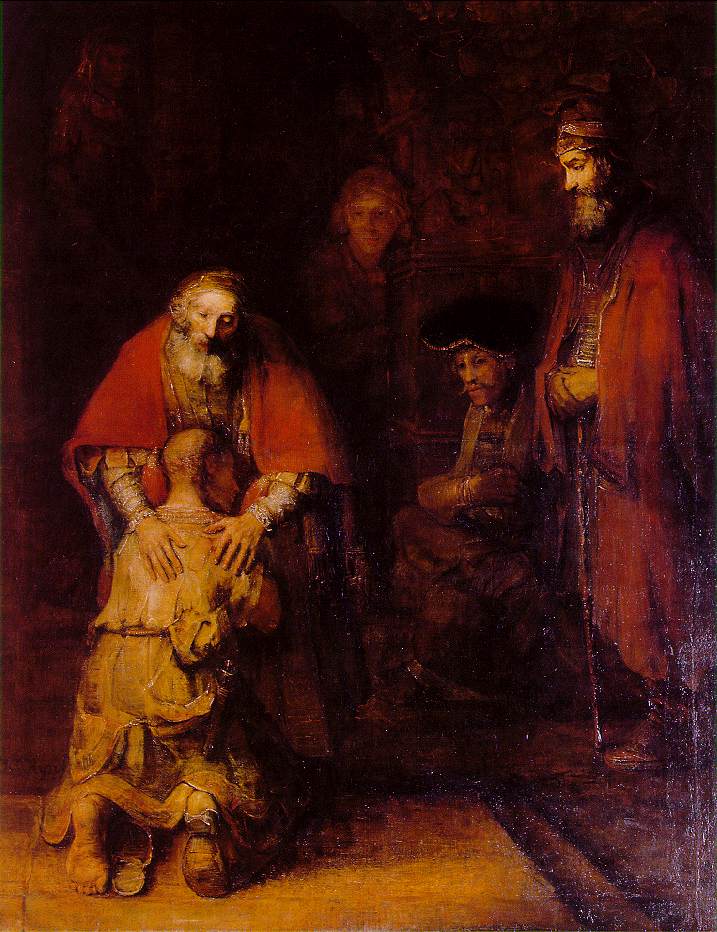
And that is a homecoming. Like the younger son in the Prodigal Son parable returning when he realized what an idiot he’d been. The door is never shut. This door of this church is never shut. The door of the Rectory is never shut.

In truth, we have God inside us all. That sanctuary of the soul that is hidden within, that we need to let fill us from the inside out. We sometimes choose to keep it locked up and pretend it is not there. That is when we are driven by pride and self-obsessedness. When we open that door, the divine light floods out. It might make us shed tears of joy that melt the heart of ice (O my Saviour lifted). This is forgiveness. We do not have forgiveness because we acknowledge our sins. We have forgiveness therefore we acknowledge our sins, our human frailty.

The younger son saw himself as the Lord saw him. He chose to take the first step. He could have chosen not to. He came home, forgiven. This is resurrection. We can choose to exclude ourselves, or we can choose to be a part of God’s kingdom here and now. The choice is ours as to whether or not we stay in the cold and become bitter and twisted, or we come home acknowledging our imperfections, and enjoy the divine presence and the divine warmth of divine light and love.

Resurrection or wilderness is the choice facing each one of us. A pretty easy decision, you would think, but one demanding openness, honesty and courage.

Resurrection as imagination

An architect’s imagination

In his novel ‘The Power and the Glory’, Graham Greene has one of his characters say ‘hate was just a failure of imagination’.

The theme of Easter is renewal. The Holy Week and Easter story is about a group of people who were so threatened by new ideas that they put Jesus to death. A failure of imagination that resulted in hatred. Looking at the world today, we see the same forces at work. North Korea might be a long way away, but its threats have the power to destroy the world—and all because the governing clique of old men lacks the ability to admit that new ideas could make things better. A failure of imagination.

If you look at the photos of the installation of the new Dean of St Patrick’s in Dublin, you will see pictures of an institution that appears to be ruled by old men, stuck in the past and with little interest in preparing for the future. Is this what our church looks like? Here are some questions for you.

  • How many of our offspring attend church? What is there to attract them? Do they see a group of people who live with hearts and minds fixed on the Gospel?
  • Where will the clergy of the future come from? Some recent clergy appointments in this diocese have been even older than I am. Already, we are in the position where one post is unfilled because of a shortage of trainee clergy.
  • What is your vision of the future for this church? Do you think it can be business as usual, as it has been?

Many people seem to want the church to remain as they think it always was. The thing is, memory plays tricks. They want things to conform to a romantic notion of how they think things used to be. That was not Jesus’ way: there was nothing romantic about flights to Egypt, childhood in Nazareth, stomping around the Judean desert, the blood and gore of torture and crucifixion. Like him, we live in a messy world and we must confront it and get our hands dirty, like Thomas. Like Thomas we need to ask questions and push at boundaries to see how best to put our Lord into action. What will the church be like in 10 years’ time if we don’t do some fresh thinking?  We need the courage to ask questions and seek evidence, Thomas-style, and then act on it, Jesus style. We need, in the message of the epistle, to let light triumph over darkness.

We need renewal. We need to experiment. We need to cooperate. We need imagination. Without imagination we would still be scrabbling about in caves. Our future, as the Acts of the Apostles makes crystal clear, lies in togetherness, in openness, in being willing to try new things. Our churches are dying because of constipation from yesterday’s diet and yesterday’s resentments. Dietary ingredients must remain the same as they always have been—the word of the Lord—but the recipes need the roughage of altering circumstances.

I met a man in hospital, in his 80s, who said to me that the church had lost its way because it had forgotten what love was all about. We need to let God work in us. It’s not so much that we need actively to cooperate with God, but rather that we need to stop resisting God. The divine blueprint is there within us. We let it fill us and squeeze out the evil. This means letting the resurrected Jesus point out to us those assumptions and behaviours that are based on fear and hatred, and get rid of them.

Hatred is a failure of imagination. Love is the blossoming of the imagination. Love is expensive. Love demands a letting go. Love is renewal. Love is resurrection. Love is God. Let imagination and love triumph over hatred.

Thursday in Holy Week: party – come!

Foot of a Python

The foot party

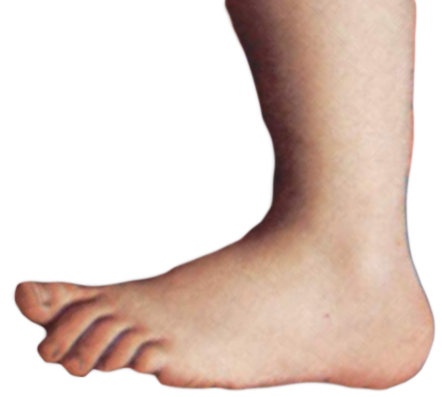
The last few days have seen us considering unattractive aspects of human nature: lying, deceit, evasion, denial. Today, thanks be to God, we have a party. The ability to have fun, to play, to party, to celebrate—shared with other mammals—is one of our attractive characteristics. And, what is more, it’s a party where the host honours the guests. Just as it should be. Washing feet nowadays might seem a less than appealing activity. Who knows what you might find under the socks and stout brogues? Bunions, nodules, sores, ulcers, fungi …. (Footwear is bad for feet). But think back to sandal wearing, dusty, car-less and bike-less times. Think that for most people on the planet today, unhealthy feet mean no food. Foot care is important. Washing feet was a real act of welcome and charity. An act of service. You might like to consider how our churches welcome visitors and deal with strangers. It may be inappropriate to tell them to shed shoes and socks for a relaxing foot bath, but there are other ways that we can enhance our hospitality and service to others.

Renewal of the cosmos

Curved space-time

Do this in remembrance of me. These words take us back to Jerusalem two thousand years ago. But they work the other way, too: they bring Jerusalem of two thousand years ago here today, to this place. And not just the words, but all the action and the whole occasion: the meal, the togetherness of the disciples, even those who had something to hide. Do this in remembrance of me brings it all into the present. And all the intervening years as well: all the Christians of the past, all the joys and sadnesses of history. The whole of the past concentrated into the words and action of the consecration prayer: we open the door of Dr Who’s Tardis and find ourselves in the vastness of history. This notion of space-time is a bit at odds with western European linear time, but it is inherent in folk-memory, in community-memory, and is very much a living part of middle-Eastern culture, even today. It is Hebrew zikkaron. It has something in common with modern concepts of space-time. Every time the Lord’s supper is celebrated, the past is gathered up and presented to us. And then in the banquet, past and present are launched into the world transformed. Rebirth. The universe compressed into the infinitely dense black hole of the crucifixion, then dispersed with infinite acceleration into the new universe. This is a magnificent vision. All Christian theology and history concentrated into the moment at every Eucharist. No wonder we should celebrate it with all possible splendour and theatre and solemnity and joy.

Come

Each of us has all our past within us. We are the sum of our memories. All our past is included in our genes – genes from the primeval soup at the moment of creation are in every one of our cells. All this past is received and affirmed tonight. We are cleansed. We are fed. We are, and heaven knows I need this, forgiven. We have the meal set out by the gracious father for the prodigal son. We are accepted, and we are launched for future service. Come to the feast. Everyone is invited. No matter what you think of yourself, come and receive grace. You are welcome.

Lancelot Andrewes: a beautiful mind

Listen to the words of Bishop Lancelot Andrewes, written in 1620.

In the old Ritual of the Church we find that on the cover of the canister, wherein was the Sacrament of His Body, there was a star engraven, to shew us that now the star leads us thither, to His body there. And what shall I say now, but according as St. John saith, and the star, and the wise men say, ‘Come.’ And He, Whose the star is, and to Whom the wise men came, saith, ‘Come.’ And let them who are disposed, ‘Come.’ And let whosoever will, take of the ‘Bread of Life, which came down from Heaven’ this day into Bethlehem, the house of bread. Of which Bread the Church is this day the house, the true Bethlehem, and all the Bethlehem we have now left to come to for the Bread of life, – of that His life which we hope for in Heaven. And this our nearest coming that here we can come, till we shall by another venite come, unto Him in His Heavenly Kingdom to which He grant we may come, That this day came to us in earth that we thereby might come to Him and remain with Him for ever, ‘Jesus Christ the Righteous.’

Wednesday in Holy Week: betrayals

Wisdom sage?

‘I’m not coming to church: you’re all a bunch of hypocrites.’ I usually respond: ‘well, there’s always room for one more, so you’d be in good company.’ We hear a lot about Judas in Holy Week, and Judas is, amongst other things, a hypocrite. On Monday we heard him say that money used to buy oil should be given to the poor, whereas in fact he wanted to filch it for himself.

There’s an element of ‘it wasn’t me, guv, honest’ in the Judas story. It puts me in mind of Homer Simpson’s advice to Bart. Homer says:

I want to share something with you: the three little sentences that will get you through life. Number 1: Cover for me. Number 2: Oh, good idea, Boss! Number 3: It was like that when I got here.

For all his faults, Homer is a kind of innocent, and he certainly loves his family. But enough of these insights into my depraved televiewing habits. I want to talk tonight about the demons that assailed Judas, and because there’s something of Judas in us all, about our human nature. We left Jesus on Sunday standing at the gates of the city, facing death in the city of wrong. Jesus faces his demons. As we go with him, we must face our demons, our fears. These demons are the enemies within, enemies of spiritual growth, enemies of resurrection. Jesus tells us to love our enemies, but we can’t love these demons until we see them, and we can’t see them until we look them full in the face.

What are our demons? Let’s look at the demons in the Passion narratives. There are three obvious headings:

  • Failure to confront reality, that is to say, denials
  • Mob justice
  • Evasion of responsibility

And of course Judas. I don’t think Judas wasn’t a particularly bad man. He was, like many of us, weak. He sold information. His weakness is part of the story, just as Peter’s denials are part of the story. Maybe if Judas hadn’t killed himself he’s be a saint like Peter. Anyway, let’s look at those three.

  • Denials. Peter’s denials saved his skin—but only for that moment. Later, he wept, overcome with remorse. It’s hard to hear today’s news without being confronted by denials that turn out to be lies. Is anyone guilt-free? Who has not tried to get something for nothing, or used work time for personal business?
  • Mob justice. There are so many stories that illustrate this. One from 2007 sticks in my mind. In March of that year, The London Times reported, a young man was surrounded by a gang with wooden sticks. Witnesses say that teenage girls egged on the attack with shouts of “Kill him, kill him.”
  • Evasion of responsibility. Judas said ‘it wasn’t me’. Pilate wriggled out of responsibility and washed his hands. Pilate needed to please his superiors. How often have I felt like that? Look at bankers and politicians evading responsibility. We all make mistakes. We all are greedy. We all want the advantages of investment dividends if we are lucky enough to have money invested, and our pensions depend on them. We are all complicit in the problems that afflict us, and our children and grandchildren will have to bear the burden of the mistakes our generation has made. I accept all that, and I can’t and don’t condemn anyone for faults that also afflict me. However, the arrogance and lack of remorse that we see in public life at the moment is something beyond all this. According to the Gospels, Jesus was censorious about very little, but always, always, always about hypocrisy and complacency. Even Josef Fritzl, who kept his children locked up in a basement for 24 years, seems to have acknowledged, eventually, the enormity of his actions after being confronted by his daughter’s account of their effects on her and her children. But not, it seems, the powerful of today.

Kiss of friendship

We betray others. We betray ourselves. Judas realised that—that’s why he topped himself. Magnus Pym in Le Carré’s A Perfect Spy realized that, and he topped himself too. Greed, avarice, and seeking the approval of people whose approval is not worth having: the three most pernicious demons. Maybe they can be compressed into one: the sin of Adam—trying to be what we are not. The fig leaf has nothing to do with covering up our genitals, but is about covering up our naked selves by putting on a mask, a persona to hide our true faces. We deny the truth because of our need to save face, but it’s not the face that suffers. It is the inner self that I harm when I deny what is evident to others. This inner self that is the Christ within, the Divine within. When we harm others, we wound the Christ within as surely as any nail on the cross.

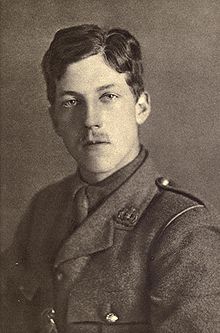
Here is a poem that tells of this inner kingdom, the holy of holies within that I suggest needs to be allowed to expand  from within so that the brittle shell of self will be shattered. It was written by 20-year old Charles Sorley who died weeks later in 1915 at the Battle of Loos. I marvel at the self knowledge possessed by this young man.


C H Sorley 1895-1915

From morn to midnight, all day through,
I laugh and play as others do,
I sin and chatter, just the same
As others with a different name.
 
And all year long upon the stage,
I dance and tumble and do rage
So vehemently, I scarcely see
The inner and eternal me.
 
I have a temple I do not
Visit, a heart I have forgot,
A self that I have never met,
A secret shrine—and yet, and yet
 
This sanctuary of my soul
Unwitting I keep white and whole,
Unlatched and lit, if Thou should’st care
To enter or to tarry there.
 
With parted lips and outstretched hands
And listening ears Thy servant stands,
Call Thou early, call Thou late,
To Thy great service dedicate.