Laois, Langwathby and lips

Langwathby and the railway

Langwathby and the railway

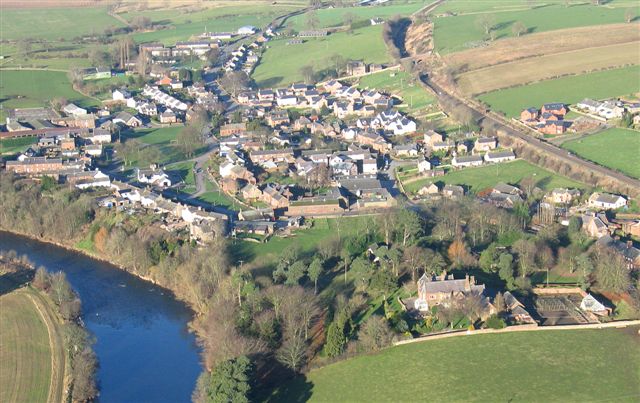
When people ask where I come from, I usually answer ‘north-west England, almost Scotland’. If there’s a flicker of  recognition in the listener’s eyes, I narrow it down a bit more to ‘Carlisle’ (I was born in the City General Hospital) on the basis that they may have heard of that. The next level of detail is ‘a village in the Eden Valley near Penrith’, and if they have heard of Penrith, I say ‘Langwathby’—the settlement (by, as in Danish) at the long (lang) ford (wath, Irish ath). My mother was brought up nearby in Kirkoswald and married my father from Langwathby. Both were children of butchers, Cranstons butchers (her dad’s firm) still going strong.

072713_dbf41d3c

Settle-Carlisle and Helm tunnel

The  Eden is one of the few north-flowing rivers in the British Isles. It makes its way from the source in Yorkshire (you can understand the hurry to get out of Yorkshire) to the Solway Firth between England and Scotland, passing on its way Kirkby Stephen, Appleby, Langwathby, Lazonby, Armathwaite and Carlisle, and joined by the rivers Lowther and Eamont bringing water from Haweswater and Ullswater. Its 70 mile journey provides a home to the Settle-Carlisle railway from Ais Gill summit to almost sea-level at Carlisle. It is surprisingly untouristed compared to the miniature Switzerland of the Lake District less than 10 miles to the west, and the Pennine moorlands to the east. It is gentle, rolling, pastoral, farming and growing land. It’s a surprisingly red area, not politically (Willie Whitelaw country, remember him?) but geologically. Red sandstone buildings, walls and outcrops. A ‘warm’ stone, not the cold blue-grey of Keswick or Kendal.

Eden Valley - or is it Laois?

Eden Valley – or is it Laois?

It’s a bit like the area round Portlaoise. Hills not too far away, drumlins dotted about, good views, farming, damp windy weather much of the time. When I was in my teens I couldn’t wait to get away from the Eden Valley, and here I now am in an area quite like it. Karma I suppose. Both places are windy. The local wind in the Eden valley is the Helm, the only named wind in the British Isles (according to Wikipedia, so it must be right). It’s a fearsome force, capable of inflicting great damage.  I think that the windiness there and here leads to a rather surprising similarity in the way the locals speak, for in both places they seem unwilling to open their mouths much. Sometimes, in fact, you can hardly see the lips move. This makes it quite difficult for me, for I rely on lip-reading to an increasingly large extent. It’s not the volume, but the articulation, the diction (or lack of it), that catches me out. This morning the GP told me to get a new hearing aid.  I have one, but it tickles, and magnifies everything. I had two but the dog ate the other.

Why should there be this lack of dictional lip activity? I conclude that were people to open their mouths any wider when they spoke, the fierce winds would blow into their oral cavities, inflating the cheeks like balloons, and the poor dears would be borne aloft, never to be seen again. Somewhere over the rainbow ….
Carpe diem, humanity and Holy Week

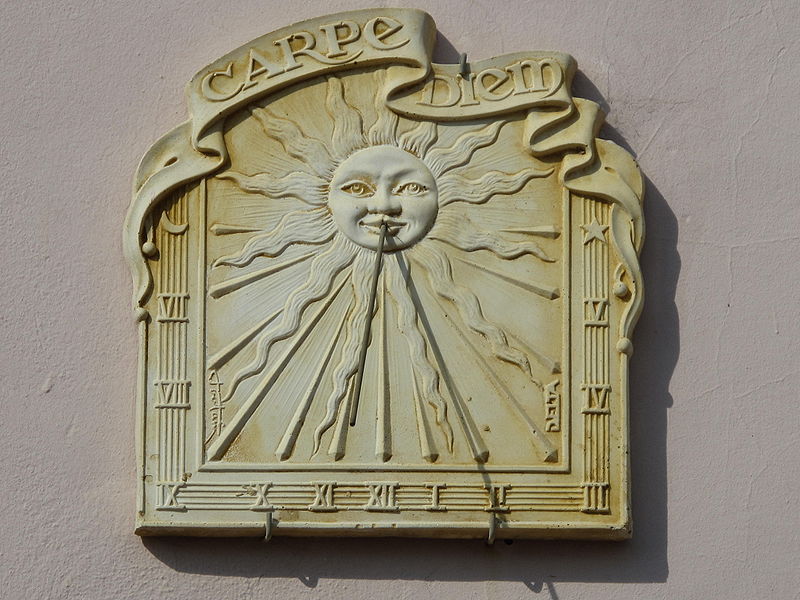
800px-Carpe_DiemTwo people have told me in as many days that they wish they had made more of their youth. They wish they had not squandered opportunities that came their way to finish this course, or take up that hobby. Telling them that squandering opportunities is what young people do didn’t seem to help. I wish that I’d taken up rowing more seriously when I was at Cambridge. I very nearly did, but it was fear that stopped me. Fear of jumping into the unknown, fear of stepping into a milieu populated by those who’d rowed at school and who all spoke with posher accents than my flat-vowelled Cumbrian voice. Cowardice, ambivalence, fear of being ridiculed.

We are too hard on ourselves. We have reasons for doing, or not doing, what we do, or don’t do. Our choices may reflect disordered thoughts, faulty logic, or fear, but they are nevertheless entirely understandable given our circumstances and the forces that have shaped us.

Not long ago I was the invited speaker at a medical school reunion: people I’d taught when I was in my late 20s and early 30s, barely ten years older than them. At the time of the reunion, they were in their mid-40s and well-established in their careers, on astronomical salaries, living in gaffs with tennis courts and swimming pools. It’s always the ‘successful’ ones that go to reunions. Can’t think why. I started my speech by commiserating with them that they were just about to find that they were at a difficult time of life: all has gone well so far, in the main, but trouble will soon start as kids hit adolescence, as relationships start to creak and as confidence begins to wane. Oh, how confidence wanes.

And how would you describe yourself?

And how would you describe yourself?

I was at a job interview recently at which someone asked me how I would describe myself. That rather took the wind out of my sails. (Interviews, by the way, get much harder as one ages. You would think the opposite would be the case, but not for me.) It’s difficult to answer because I need so many qualifying clauses and verbal explanatory brackets, and a few seconds were all I had. A fatuous question, of course, but interviewers are full of fatuous questions. Anyway, the question set me thinking.

The first thing I remember wanting to be, and howling at the top of the stairs because I wasn’t, was a boy singing on the TV. Then I ‘wanted’ to be a doctor—but that was to please my parents, especially my mother. Then I wanted to be a cathedral organist. That lasted a long time—indeed, it’s still there inside me: in my darker moments I’m still a failed cathedral organist. Next, I wanted to go to Cambridge (managed that one, God only knows how, since my A level results were spectacularly mediocre: an E in biology, I ask you). I’m conscious that I never lived up to parental expectations: they saw me as a wealthy GP living in a big house on Beacon Edge in Penrith, or as a medical consultant with rooms in, say, Portland Square, Carlisle. All I managed was a second rate academic with a poky office in Nottingham medical school. I certainly was a teacher, and a good one too in the sense that I provoked people to think. Since I taught them, I moved on to a good job in Dublin by charming the selection panel, and then managed to write two textbooks, neither of which sells terribly well, for they are too gloriously idiosyncratic to appeal to those responsible for recommending them to students. And now I am a clerk in holy orders in the Irish midlands.

Some people look at this story and say: ‘he likes getting qualifications, he must have an inferiority complex’. Others say: ‘he likes dressing up and lording it over others’, and hint at some dark secret. Some think ‘he’s restless and can’t settle at anything.’ Yet others say ‘he’s a dilettante’ (not a compliment). Well, all I can say is: guilty as charged on all counts (except for the dark secret, of course, depending on what you call dark). My life has been rich, and it ain’t over yet.

At the interview, I mumbled something about other people seeing me as gifted, but that I didn’t see it that way, for I am just me. I have all these fears and insecurities, and lots more. I am just me, like all humans, wonderfully and deeply flawed. At the risk of sounding complacent, I’ve stopped worrying about lost opportunities, and now wish only to make the best of what comes my way. Perhaps that’s the product of being 62 rather than 42. I’ve stopped worrying about my ‘kids’ as much as I used to: when I was their age, I managed without parents worrying about me, because they were both dead.

It’s Holy Week. One of the risks of being churchy in Holy Week (and there are many) is that we will feel, or be made to feel, guilty about the fact that we betray like Judas, we deny like Peter, we squirm like Pilate, we are cruel like Herod, we are economical with the actualité like Pharisees, we sometimes follow the mob. In other words, we are human. I have a Judas, a Peter, a Pilate, a Herod, a Pharisee, a mob, living inside me. They are part of me. I hear the passion stories no longer as guilt-inducing because I’m not perfect, but as comforting (that is strength giving) because I will never be perfect and I can stop trying. No matter how hard I try, I will never be able to stop being human. If I say hello to all the different parts of me—the Judas, the Peter, the Pilate, the Herod, the Pharisee, the mob—and give them a hug and look them in the face, then divine light can love the hell out of them, out of me, and out of you if you do likewise. There is nothing to fear, and everything to gain.

Whatever happens, there is something bigger than me, and you, and we are not in control. Despite this the world keeps on turning and the sun keeps on shining. A happy Holy Week to you all.

A pastoral riddle

The perfect pastor

The perfect pastor

In a letter to the new Archbishop of Canterbury, Pope Francis wrote that the pastoral ministry ‘is a call to walk in fidelity to the Gospel of our Lord Jesus Christ.’ Good grief!  Has the Pope made his first error of judgement? What has the Gospel of our Lord Jesus Christ got to do with pastoral ministry? We must investigate!

What do parishioners want of their pastors?

  • Someone to baptize, marry and bury. This is a statutory duty. It is a pleasure and a privilege.
  • Someone to, in the words of the 1662 ordinal, ‘search for the sick, poor, and impotent people of the Parish’. So is this.
  • Someone to lead public worship. As is this. Even though they don’t often come, most of them like to think that it’s happening.
  • Someone to maintain the tribal temple in exactly the same state as it was when they were children. God forbid that the colour scheme be changed, or that pews be removed.
  • Someone nominally in charge of the burial ground where they can go to talk to the people they feel guilty about having misjudged (or worse) when they were alive.
  • Someone nominally in charge of the burial ground where they themselves want to end up.
  • Someone they can complain about in other meetings and gatherings. This is a popular pastime in the Church of Ireland, and seems to be the cause of church-hopping. Catholics seem less bothered about it.

What don’t parishioners want of their pastors, though the Gospel says that they should?

  • Someone who treats new arrivals the same as long established members. Body armour required.
  • Someone who encourages parishioners to look into their own hearts before they start pointing out faults in others. It is one of the greatest pastoral joys to help people with this, and to see as a result more and more of the hidden murky depths of one’s own heart.
  • Someone who challenges bullying in church meetings. Bullying takes many forms; it is insidious and malign.
  • Someone who delivers parishioners of demons. Well, good luck with that, girls and boys.
  • Someone who knows that the church is in law a charity and so insists that church affairs be conducted in a business-like fashion in accordance with the law of the land. Fortunately, there’s no argument with this, however much resistance one encounters – and one most certainly does.

Are there any clergy like Dick Emery’s character? Wouldn’t it be lovely if pastoring were merely a matter of drinking tea and agreeing with people? Perhaps not. It would be very boring, that’s for sure. The sermons that have brought me most trouble have been those that uncompromisingly preached the Gospel. I regret not one word of them.

Gender biology, Aristotle and theology

OLYMPUS DIGITAL CAMERAI have a dear friend who developed leukaemia about 20 years ago. He is a male of the species. Or is he? His leukaemia was treated by a bone marrow transplant, the donor being a woman. Were he to commit some heinous crime, ‘his’ blood cells left at the crime scene would appear to have come from a female. What delicious opportunities abound for him to exact revenge on those who have offended him, and yet evade detection. Has this possibility yet been explored by a crime novelist? This man has the body of a male but the blood of a female. How do we define gender?

Some species change sex mid life. Males become females—and I’m not talking man-boobs here. Clownfish do it, though that’s something that Finding Nemo didn’t explore. Things can go the other way too, female to male. These phenomena seem to happen naturally when a population deems it necessary (how?) to restore a particular male/female ratio. Do you think this might happen in say, primary school teachers, where men are woefully under-represented? Some hormonal diseases cause men to develop female characteristics, and others cause women to develop male characteristics. Is the more laid-back outlook that some men acquire as they get older a result of falling levels of testosterone, a kind of natural feminization? Are we males being feminized by the increasing oestrogen levels in the water supply?

It’s widely held that the ‘default setting’ of the mammalian embryo is female: the embryo will develop into a female unless male things are switched on a certain time of development. The female, then, is the basic form, the male the experimental (more advanced? less stable?). SWMBO says this explains why flu is more ‘serious’ in a man, since he is the less robust sex. We all have within our bodies male and female bits and pieces in various stages of development. The ovary and testis come from the same thing. The penis and clitoris likewise.

Peter Paul Rubens

Peter Paul Rubens

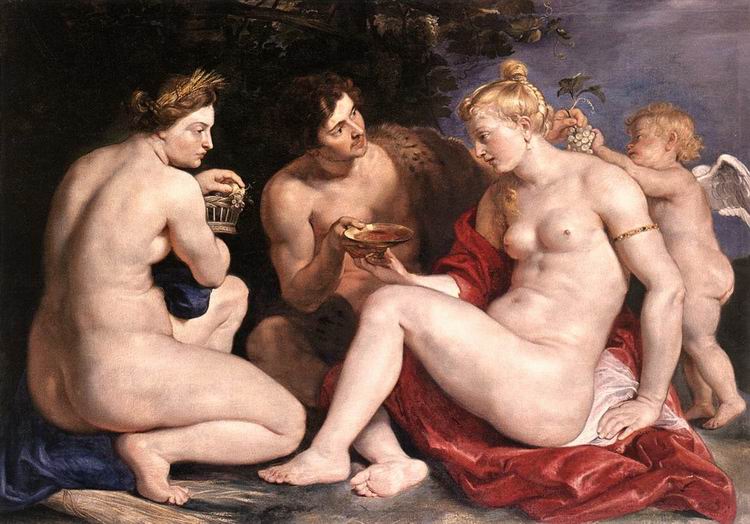
Then there’s the matter of psychological gender—what we think we are, what we feel like in our heads. How does it affect our personalities, the way we express our sexuality, the way we respond to art, for example? What does a generously proportioned Rubens nude broad do for you? or one of Michelangelo’s representations of God, looking for all the world like a steroid-crazed bodybuilder who pumps iron in a spit-and-sawdust gym? What do your physical and/or emotional responses to these images say about you and your psychological sexuality? Our knowledge of how psychological sex is determined in the brain is very sketchy indeed. A spectrum is more likely than either/or.

I could go on. Suffice it to say that things are not as simple as some would wish. I think there’s a bit of both in all of us. Hermaphrodites (functioning male and female organs in the same creature) are common in plants and animals. Homosexuality occurs in nature. And so do intersex states—organisms that are neither male nor female, but somewhere in-between, to put it crudely. Physical abnormalities of the penis are common in humans, and nearly all of them reflect a kind-of intersex state in which there is some degree of reversion to the basic female anatomy. Some human newborns appear to be of indeterminate gender, and the nature of their upbringing is a matter of choice by parents/professionals. And God loves all her creation.

The church gets into a terrible tangle about this. The reason is, I think, that it hasn’t quite grasped the fact that  biology has moved on from Aristotle, The role of semen as seed (and no more than seed) was appreciated at least as early as about 1400 BC. Later on, Hindu scriptures of the sixth century BC accept that the female is essential, with menstrual blood (from the mother, of course) forming the basis of the embryo, and semen merely the provoking agent for things to happen. Then along come others who thinks that the sperm from the male contains the miniature human, and that all the woman provides is the ‘oven’ for incubation. This faulty biology might at least in part explain the Vatican’s aversion to condoms. I suppose they think the used condom is full of miniature humans desperately clamouring to find an oven in which to bake. Extending this, the catholic view should be that intercourse is permissible only when conception is likely. Using the safe period for contraception, therefore, should be frightfully sinful.

070522_sharks_hmed_5p.grid-6x2It gets even better! New Scientist, 2 March 2013 tells us that virgin births are commoner than we thought. Though not yet recorded in mammals, except once about 2000 years ago in the Middle East, sharks, snakes, and turkeys, to name but three, can do it, and in the wild too. If this is a sign of things to come, men will no longer be required. Perhaps—and this is a long shot, I know—clerical celibacy is actually prophetic, pointing to the ultimate biological uselessness of the male of the species. In the Garden of Eden when the snake was talking to the woman, as they do, the man was nowhere to be found. Perhaps he was in his garden shed, recovering from surgery. Well now, lads, you can stay there. Is this not good news? I urge you to read Consider Her Ways by John Wyndham, and The Children of Men by P D James.

Fascinating stuff, raising all sorts of questions. There are doctorates to be written on the theology of gender and reproduction. Theology has to fit biology, not the other way round.

Passion, Patrick, Pope, Persevere

saintpatrickA sermon for St Patrick’s day, Passion Sunday, 2013

Passion. Jesus passively bears what must be borne, in order that new life will blossom. The passion story illustrates that refreshment and renewal come only after we’ve gone through the painful process of killing the past, or letting it be killed. Renewal comes when we let go of things we once held dear, of attitudes and attachments that once sustained us but now hold us back and tether us to the ground. Jesus said: in three days I will destroy this temple, and then I will build a new one. This applies to our church life as much as it does to us as individuals.

What might constitute the ‘old’ that needs to be relinquished in order that new life may flourish? What puts people off the church as an institution? There are lots of young people in the vicinity, but few come on Sundays. Why not? If they did, would they be welcomed and treated as equals, or would they be whispered about, left to flounder, and glared at they sat in ‘our’ pew? Would we be delighted to see them, or would we feel threatened as they invade territory that we consider our own?

Something needs to happen if the church is not to wither and die. If you saw the Pope’s election (you were probably glued to it), you might have witnessed a TV commentator, ignorant of the Lord’s Prayer, having to depend on the translator. At weddings and funerals in England, few people under the age of 50 know the Lord’s Prayer, and hardly any under the age of 40. That is coming here. There is now so much hostility to the church from the young people of Ireland that the outlook is bleak. The new Archbishop of Canterbury has given the church a decade before implosion. Why don’t the bishops of the Church of Ireland ever speak plainly? God forbid they offend their friends and relations.

The church is entering its own Passiontide. It must go through painful times before it can be reborn. And when it is reborn, maybe it will look nothing like what it replaced. In the gospel, expensive oil is used on Jesus’ feet. To wash someone’s feet in those days and in that culture was (and is) something that only the lowest of the low would do—it is beneath one’s dignity for any respectable person to wash someone’s feet. We need to lose our dignity and get our hands dirty. As the psalm has it, those that sow in tears shall reap with joy. This is the only way that renewal will come.

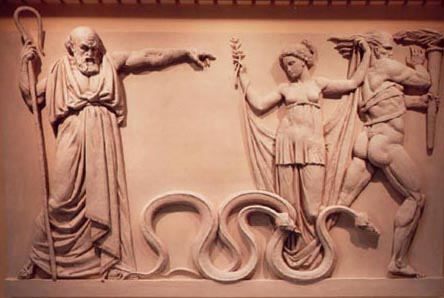
Patrick. Legend has it that Patrick banished snakes from Ireland. This is absolute tosh, of course, like so much about Patrick. Nevertheless, there are plenty snakes to be banished. The snake that tempts us to lying, to pride, to thinking that we know best—just as it tempted Adam and Eve. The snakes in church that cause people to find fault and go off in a huff rather than putting differences aside and working together. The snakes of sloppiness in church: lateness, ill-prepared readings, carelessness in presentation. The snakes in society: consumerism, advertising, celebrity. The snakes in self: hardheartedness, lack of humility, lust for power  and possessions. We are part of a society in which a garda who threatens to prosecute a pub owner for after-hours drinking is told ‘either join us or be transferred’? And people think it’s amusing. We are part of a society in which the rich and famous are lauded for slithering out of being prosecuted. We are part of society in which justice seems to be reserved only for the wealthy and well connected. Why do we tolerate this evil? People seem to admire those who lie and cheat. As faith has decreased, greed has increased.

Pope. The Pope has said that unless the church concentrates on its message, it will become simply a compassionate NGO. God knows his church needs renewal. It’s a huge organization, and its problems are huge. But let’s not be complacent: their problems are our problems, only our organizaton is smaller, so our problems are smaller. They all stem from the same human ‘snakes’: avarice, envy and seeking the approval of the wrong people. The Pope is right: we must turn away from these ‘snakes’ and turn towards the message and example of Jesus Christ: love, compassion and selflessness.

Persevere. The message of Jesus is that letting go of the past leads to hope. Letting go of the past is a matter of forgiveness. We forgive others, we ask for their forgiveness, and we forgive ourselves – self-forgiveness. It’s such a waste of energy to carry around grudges and resentments. When we lay down these burdens, the stone that entombs us in the past rolls away, and we go on our way lighter. We have more energy to engage our imaginations. We become more attractive: radiators rather than drains. When we put the past to death on the cross, we ascend to the heavens. The balloon takes off. This is salvation, resurrection.

Here are some suggestions for this coming fortnight as we reflect on church life and personal life.

  • Look back at the last year and ask: what have we as a church done that attracts people? Let’s do more of that.
  • What have we done that repels people from joining us? Let’s stop it.
  • Let’s focus on the message and pull together to be agents of grace and delight. Life is too short for anything else.

Alternatively, let’s pack up.

Splutter snotter headache

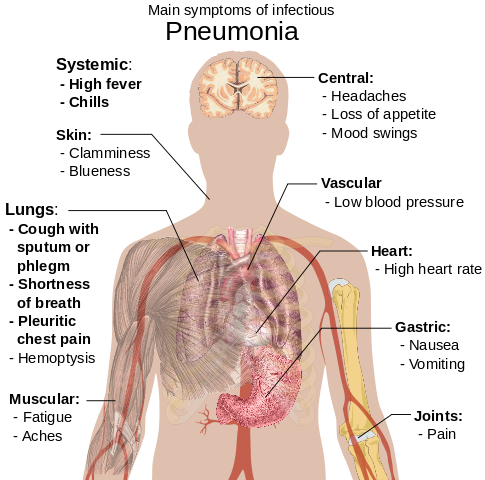
485px-Symptoms_of_pneumonia.svgChest infection again. I’m prone to them, nearly always developing just as some stressful period has ended. The immune system senses that danger is over and relaxes, only to let the cunning little microbes get a toehold. It’s like the story about cleaning out the demons from your mind, then just when you’re relaxing into smugness, they come back bringing their friends with them. My chest infections always begin with a whooshing pulse in my ears. This is different from the normal ear noise that I have all the time (so don’t notice any more). ‘High BP’ thought I, so out comes the trusty sphygmomanometer. BP 128/82, not unusual for me. ‘How can he have a blood pressure like that when he’s so fat and takes so little exercise and likes eggs?’ It’s because—and I’m reluctant to tell you this—I’m so fat and take so little exercise and like eggs. Good God, surely, you don’t expect life to be fair, do you? Maybe it’s because I once was fit, and thin, and lifted weights, and the body is stuck thinking that. Anyway the sphygmomanometer might be bust. So then, going on the basis of the usual course of events, I suspect that a chest infection might be on the way, and, lo and behold, it is. Joy, joy.

Always the same. Tickly throat, swarm of bees in my larynx. Unsteadiness when I stand. Timpani in my head. Then blocked nose. Next, a hammering on my upper teeth from inside the maxillary sinuses. The cough starts. The chest hurts. The cough gets worse, and worse. Now it really hurts to cough. Then it gets better and I feel absolutely knackered for two weeks. Then all is hunky-dory again. That’s the way it is. That’s the way it was when I was a child. As it was in the beginning, is now, and ever shall be.

People are very kind. ‘Go and see the doctor’ they say. And they tell SWMBO that I must be made to visit the GP. What do they think the GP can do? What I want to say to them is: ‘Why? This is viral. You can tell that because of the symptoms, because it usually is, and most of all because the sputum I’m splattering over the carpet and the bedclothes, and perhaps the handkerchief if it gets there in time, is frothy and clear. If it were green, or yellow, or had blood in it, I might think otherwise. Nothing the doctor can do will be worth €50.’ But I don’t say that. It’s not worth the not inconsiderable effort. I’ve tried saying all that, and people don’t want to hear it. They think that GPs, having replaced clergy as people to be looked up to, are omnipotent, and if they’re not, they can be sued (so can clergy in certain circumstances, but let’s not go there just now). Anyhoo, I say, ‘Yes, good idea. If I’m not better by Monday, I will go and see the doctor.‘ Knowing that usually I will be somewhat better, and so won’t go. Some people treat me as if I were an imbecile and talk to me as if I were a decerebrate puppy (if I were, I wouldn’t be able to hear, but that escapes them). They mean well.

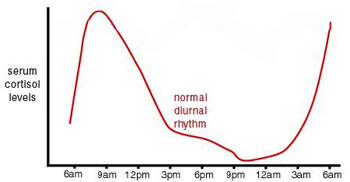
diurnalws1There are times when one must listen to one’s body, and one just knows that nature must take its course. I wonder: ‘if I didn’t allow myself to get worked up, would the infections not happen?’ Maybe there is something that demands illness like this twice  a year. If I didn’t allow myself to get worked up, then I wouldn’t be me (whatever that is, see here). So, grin and bear it. I remember the words of Homer Simpson to his children: ‘Kids, kids, I’m not going to die. That only happens to bad people.’ I’m still at the coughing stage, though it’s better than it was yesterday. The reason that the cough is worse in the afternoon than the morning is because of what SWMBO wittily refers to as the arcadian rhythm in the levels of endogenous steroids. That’s the way it is. And if you don’t know what some words mean, look ’em up.

Judas, spies, Polo mints and donuts

6a00d83454b21e69e20168e9543645970c-800wiHave you read or seen John Le Carré’s A perfect spy? Magnus Pym, the glittering image who is so many things to so many people, doesn’t know who he is any more as a result of his father’s manipulation. When his father dies, Magnus begins to see what he has allowed to happen to himself, and he kills himself. Judas: a similar story? I think of poor Cardinal O’Brien whose mask has been nudged off, and feel nothing but sympathy for the poor soul underneath. Another case of allowing oneself to be duped by a dream and manipulated, in his case by an organization. Those who shout loudest are usually trying to drown the pleading within.

We are all spies, we all change faces, we all use charm or bluster to betray our true selves. I’ve done that with all my bosses, pretended that things are other than they are, put on a good face. Everyone does it. Men in particular do it, for they are not encouraged to expose their innermost selves face to face. They might do so shoulder to shoulder, that is, while both are engaged on some project—soldiers, team mates, colleagues—but not face to face.

So much of our energy is wasted putting on faces that we had in our adolescence as we try to recapture the feelings of those times: the awakenings of emotional and physical pleasure, of delight and self-gratification. We so easily become slaves to fashions and attitudes of those years. I’m pretty sure that’s why fetishism of any sort (not just sexual) develops, and indeed for some people religious observance is a form of fetishism. Idolatry. The attempts to recapture first loves evoke emotions that are incredibly strong, strong enough to thrust aside realities, and strong enough to neutralize any fear of adverse consequences. And there are always some adverse consequences.

homer-for-web-712765I’ve got to the stage after 62 years where I don’t know what or who I am. I know about some of the influences that have created the masks, but I think there is a hole right in the middle of me. Polo mint. Donut (it’s shocking how Homer Simpson gets everywhere). What is the essence of me-ness? Is there one, in fact? Everything is persona. Recognition of the central ‘lack’ is something that I find liberating. All passion spent. I am nothing. But there’s a real and ever-present danger that it means there’s nothing to withstand my being buffeted by emotions, by my wanting to regain the ‘buzz’ of adolescent excitement. Self is illusion. Letting go of self is what the crucifixion is about. To love our life is to loose it—the self-centred ego, the me, me, me attitude. To step into reality is resurrection. This is the eternal truth told by The Buddha and demonstrated by Jesus.

Some people on seeing the central ‘absence’ kill themselves, or drown themselves in booze or drugs or religion, itself so often just another drug that people use to help reduce the pain of their existence. Magnus Pym topped himself. Judas topped himself. So why don’t I? Biologically speaking I’m entirely redundant (tubes cut 30 years ago). I occasionally glimpse the hole that is at the core of my being. I start to crawl round in it, exploring nooks and crannies to see what creatures lurk there. A bit like a potholer in an underground cavern with a light strapped to my head. A bit like a doctor with a suction probe cleaning out an abscess cavity. I have to confront that black hole and realize that the emptiness is real and that all else is illusion. What keeps me going? A sense of ridiculousness I think. We come from nothing and we go to nothing. Expand and contract, like the universe. Twinkle in the eye rather than the sky. A cosmic joke.

The three demons that lead to all the others (Evagrios, 4th century) are (1) that of avarice, (2) that of greed, (3) that which incites us to seek the approval of others. And the third is why we betray ourselves. Judas, for the approval of the  Sanhedrin, short term gain, money. Of all the disciples, Judas is the one I like best. He seems to have glimpsed himself. The trouble is, he couldn’t bear the sight.

Life, the universe and everything – again

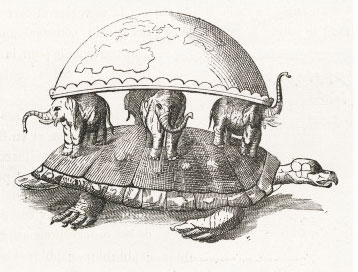
turtle-earthScientists have announced that the universe may be inherently unstable. Billions of years from now, a new universe could open up and replace the one we’re in at the moment. I picture a tiny pinprick of matter expanding so that our universe is squashed up against the edges of the cosmos and then disappears in a puff of something or other. Does the universe have edges? It’s never been clear to me what exactly the universe is in. What’s outside it? It’s a well known fact that the earth is flat and rests on at least one turtle and maybe some elephants. But what is the turtle sitting on? It’s also been suggested that the cosmos is cyclical and that the Big Bang Universe we think we know is just the latest version in a permanent cycle of events.

I find all this uncertainty quite delightful. We’re a cosmic joke. It reminds me that there is really no point fretting. What will be will be. When the cosmos returns to chaos we won’t be in it because the sun will long since have run out of steam, or helium, and before that we’ll either have frozen to death or been wiped out through our own silliness. So don’t worry, even if we don’t succeed in planetary annihilation, cosmic physics will. What a joy.

Gort and Klaatu (Mr Carpenter)

Gort is really big but far away.
Like the cows in Fr Ted.

Did you ever see The Day the Earth Stood Still? The 1950s version with Michael Rennie, not the recent one with Mr Woodenface Keanu Reeves. Yer man Rennie plays Klaatu, a Christ-like figure who gives himself the earth-name Mr Carpenter (geddit?). He comes from another planet with his robot Gort to tell our leaders that if they don’t stop being so fractious, the cosmic powers will sort us out. They don’t listen of course. Klaatu and Gort disappear off into the great unknown and the film ends. Spooky. It’s a terrific film. Next time it’s on the box, watch it. But for God’s sake avoid the Keanu Reeves version. That will seriously damage your health and your aesthetic sensibility.

So, boys and girls, live in the moment. Enjoy what you can when you can. Klaatu barada nikto.I bet a fair few Rectors could do with Klaatu and Gort to sort out their contradictious parishes. Do you think scientists will ever be able to explain everything? I hope not.

My daughter threatens not to speak to me again. She prefers to see the positive in Mr Reeves.