Pillars of salt

The Dead Sea

The Dead Sea

Part of my job as Rural Dean involves visiting local churches for ‘stocktaking’. I’ve been church crawling since I was about 13 and have seen most large churches and many small ones in England, Scotland and Ireland. I’ve seen more than a few in France and some in Germany.

The great churches of the Cotswolds, Norfolk and Somerset tend to be open. Likewise in France and Germany. They show signs of being used by the community, often with evidence of activities that wouldn’t be regarded as ‘churchy’. People drop in throughout the day. The churches are certainly treasured.

Local churches here are treasured too. But in the main the ‘treasuring’ takes a different form. It seems that the focus is on preservation—as if people are saying ‘churches must remain as they were when I was young. The last thing we should do is share these buildings with outsiders.’

Many of them are pretty much as they would have been 100 years ago, apart from electricity and nasty carpets (they ruin the acoustics—chuck ‘em out). One of the Laois churches seems not to have changed a jot since 1750. I can’t decide whether this is charming or sad. I don’t need to decide: it’s both charming and sad. But everything is about looking back, and nothing about looking forward.

I drive to Limerick and see signs advertising 1000 (I think) years of history in Roscrea. Soon after that there’s the sign near Moneygall advertising ‘President Obama’s ancestral village’. It’s all about the past. Does this matter?

If people and places and churches fix their eyes on the past, looking back like Lot’s wife, they risk becoming pillars of salt. Much as I like salt, it’s not a fate that appeals to me. Is this obsession with the past one of the reasons that young people emigrate?

One thing I’ve picked up from my peregrinations is thankfulness for the three churches I go to week by week. They’re clean and bright. There are some signs of present and future.

Deafness and ploughing

AudiogramA man wandered up to the joint RC/CoI tent at the National Ploughing Championships today and came over to our table. He was warmly and loudly greeted by my colleague. If she had looked at him, she would have seen him respond by pointing to his ears and mouthing ‘deaf’. My colleague burbled on some more, louder this time, so he did it again.

I handed him a pen and a pad of post-its. He wrote: ‘the C of I does nothing for deaf people.’ I wrote: ‘Well, it should, I am pretty deaf myself, and am tired of people thinking it’s my job to listen harder, rather than theirs to speak more clearly.’ And so I am. I now work on the principle that if people can’t be bothered to speak clearly and with deliberate enunciation, it must be because in their heart of hearts they realize that they’ve nothing worth saying.

We had an interesting ‘conversation’. I’m inspired to learn sign language. It will do me no harm, and it might even do some good.

What else happened?

Well, I was accosted by a gentleman who told me that there will never be church unity, for any church that re-enacts the Lord’s passion on the altar, and indulges in paedophilia, was damned to hell-fire, and that only the blood of Christ can save the world. I thanked him for his kind words and he stomped off. Quite a few people commented on the Bishop-designate of Meath and Kildare, and one or two wondered how the horsey set and the masons would take to her.

It was striking to note how many young adults of both sexes wrote prayer requests. I had good chats with the parish priests of Myshall and Killeigh. I shook hands and exchanged blessings with countless visitors. And the new (RC) bishop of Kildare and Leighlin came over for a chat. It’s good to have another bishop to look up to, for like my bishop he is well over 6 feet tall. I suppose they must have stood for long periods in fertilizer when they were young.

Lost and found

prodigal_son3Exodus 32:7-14; 1 Timothy 1:12-17; Luke 15:1-10.

I suspect many preachers will use these texts to exhort us to seek out and tend the hungry, the homeless, the poor, the destitute. And so we should. But I think there is something else too.

These are stories of restoration. They come before that most moving tale of restoration – the man with two sons, the gracious father, the so-called prodigal son. Another story of lost and found. One son is lost in recklessness and wilfulness, the other in envy and resentment. The gracious father welcomes the wanderer home, and is ready to ‘welcome’ the sulker back to grace.

Homecoming is the theme. Homecoming is what Christianity is all about: forgiveness, shalom, reconciliation, restoration.

Getting lost, however distressing, is necessary. We can’t seek something until we realize that we’ve lost it. We need to miss something in order to welcome it home. Although we’re often like the a-wandering and a-squandering son, and often like the begrudging son, we need to move beyond them, and  become the father: compassionate, welcoming, forgiving. This is how we find eternity and peace – when we are ready to welcome back home.

And what is it that we need to welcome home? What is it that, like the shepherd and the woman, we need to seek?

I wonder if inside each of us there is something that we think we’ve lost. Maybe we begin to realize that there is part of us that we’ve covered up with fig-leaves of pride, arrogance, and the certainty that we are right. It was never lost, of course, just hidden from view. The sanctuary of the soul. If only we knew it, what we seek is what we already have: the Divine within. We can’t reach this inner self unless we have been lost. We re-turn, and return as we strip away the leaves of amour propre, the dignity on which we are so ready to stand.

I suspect that nearly all our spiritual sickness comes from trying to bolster up a false self-image, together with a sense of guilt or shame about it. We’re reluctant to accept ourselves as the maimed creatures we are. When we acknowledge that we are imperfect, and see the full extent of our imperfections, we come home. We find ourselves. We relax into ourselves. When we confess our sins, we feel great liberation, a great sense of being at home.

I turn with groaning from my evil ways, and I re-turn into my heart, and with all my heart I turn to thee. God of those who turn, and saviour of sinners, evening after evening I will re-turn in the innermost marrow of my soul. (Lancelot Andrewes 1555-1626)

In today’s stories about lost and found, and in Exodus, we are assured that the Lord is never indifferent. The shepherd seeks out the lost sheep and brings it home. The lost sheep is part of self. We are no use to anyone, least of all ourselves, unless we recognize our own need for homecoming.

Coming home to the Divine. Through re-turning we return to the divine by surrendering.

Nil illegitimi carborundum

Before

Before …

Local clergy met this morning to hear a talk about stress in clergy families.

Stress provokes growth and adaptation. Stress keeps us alert and on our toes and enables us to respond to emergencies. In short, stress in sharp doses is good. But when it’s prolonged, it leads to ill-health, immune system depression, gastrointestinal problems, cancers, mental burnout, and more.

Clergy stress results from all sorts of things: lack of boundaries, unreasonable expectations of, and by, self and others, feeling one has responsibility without authority, living in a goldfish bowl (‘I demand to know the colour of your bowel movements today, Rector’). In some cases, clergy bring stress on themselves by wanting to be needed – in itself a personality disorder. But worse is the effect of stress on clergy wives, clergy husbands, and clergy children. A clergy spouse effectively becomes a one-parent family in a busy parish. The phone rings at unsocial hours. ‘I know it’s the Rector’s day off, but ….’ Well, you might know it, but clearly you don’t respect it. Get off the phone now this minute, and ring tomorrow at a reasonable hour.

None of the things that have caused me grief in seven years of ordained life was dealt with in theological training. All of them are largely ignored by the organisation, such is its corporate hypocrisy and its ability to pretend that black is white. Here are some of them.

  • Enquiries about ancestors and complaints about graveyards. I was ordained to serve the living not the dead. I do not care about graveyards.
  • Legal matters about buildings and land. I have no legal training and am not a property manager. I am not interested in title deeds, and if I have to be, I want the proper fee.
  • Conflict between mission demands, such as, the organist is so bad s/he needs to be sacked, and pastoral demands, if s/he is, the rest of the community will be offended because s/he’s related to them all.
  • People choosing to take offence.
  • Being dumped on by those higher up in the food chain who seem to justify their existence by finding hoops for increasingly hard-pressed parish clergy to jump through. This is a Church of England thing. Thankfully, the structure and finances of the Church of Ireland mean that the few people up the food chain are so busy that they don’t have time for this.
  • People thinking that everything is the Rector’s job. If you want it done, do it yourself, and stop bellyaching at me.
  • People thinking that it only counts if the Rector does it. Ordination is magic.
  • Petty squabbles. Some people need to grow up.
  • Self-appointed ‘royal’ families in a parish. These cause awful problems.
  • Refusals to accept that the law of the land means that old ways of doing things are no longer legally acceptable.
  • Refusals to accept the church’s regulations.

Over the last seven years, these are some of my experiences:

  • phone calls at unsocial hours about ancestors;
  • mother in law moaning about wedding arrangements;
  • stroppy letters about the state of the graveyard;
  • nuisance calls, several at 2 am;
  • being shouted at and shunned in public;
  • complaints about preaching the gospel;
  • a threat of physical violence;
  • callers ‘needing’ a bus fare to somewhere or other, stinking of booze (lots of these, and actually, I don’t mind them – at least these souls know they are needy);
  • powerlessness and perplexity about legal affairs;
  • sleepless nights, anxiety, diarrhoea, stress-related gobbling, incipient despair …. and more.
I hardly think a caption necessary

… and after

I have it easy compared to some, who are driven to resignation or early retirement. Some clergy find meetings and minutes and agenda and rules difficult to cope with. I do not. But all this nonsense detracts from my caring for the sick, helping the afflicted, reading, reflecting, preparing teaching and sermons, burying baptizing, marrying, and making sure worship is seemly and inspiring.

Fortunately, my pre-ordination life experience has given me the buoyancy to keep my head above water most of the time. Maybe putting this in writing will help others.

One Sunday, three sermons

VladimirThis Sunday, 8 September 2013, really needs three homilies.

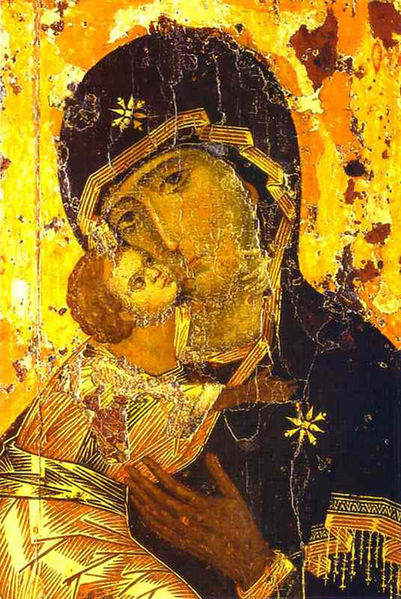
Firstly, it’s the Feast of the Nativity of the Mother of God. Contrary to what many RCs think, Mary is held in high regard in the Anglican churches. In the C of I calendar there are three festivals for Mary: the visit by Gabriel, Mary’s visit to Elizabeth, and her Nativity. No other saint has three festivals. Whether or not we intercede through her is a matter of personal decision: some do, some don’t. You can read the Mary homily here.

Second, this Sunday falls in the middle of Mental Health week. I’ve blogged about this before and will not do so again, yet. But it too is worth a homily, so if you’re interested, try here.

And third, the lectionary readings set for today, Proper 18 Year C, are certainly worth a homily, and a long one too. Jesus is trying to sell his way of life to others. He’s not like any salesman that would be given a job nowadays. He’s an anti-salesman. He doesn’t ‘embiggen’ his product; he’s brutal about what it will mean. ‘Don’t buy into this unless you’re prepared to take the flak. It’s going to be hard’. You can read this homily here – and I thank Mark Driscoll of Mars Hill Church, Seattle, for his inspiration. He’s unlikely to read it, but if he does he will see that I’ve plagiarized him mercilessly.

The gist is that we give up too easily. Disciples need discipline. At school this morning, we touched on how discipline enables achievement and goals. The little and not-so-little darlings appreciate this with their hobbies and sport. Our children went to a primary school in Nottingham where pupils were, as the Headmaster proudly wrote, so busy exploring different cultures that there just wasn’t time for the 3Rs. I still have the letter in which he said so. Soon after that he became an Inspector.

As I’ve said before, I taught Anatomy to medical students for 30 years. It’s one of those subjects where it’s possible to be wrong. To give an obvious example, the thing at the end of the lower limb is a foot not a hand, and its nerves are the tibial and common fibular, not the median and ulnar. Here’s another: the pulse you feel in the neck is the carotid, not the femoral. On one occasion, when I was dealing with a student in his early 30s at the new medical school in Derby, I was asking questions as part of a teaching session. I asked him one question, he replied, and I said ‘no, that’s incorrect.’ He was stunned. He said to me ‘you’re the first person ever to have told me I’m wrong.’ I was stunned.

There is absolutely nothing in Holy Scripture that encourages the malign view that putting up with second best, or error, is to be encouraged. Certainly not the gospel for Proper 18 Year C. Love is not to be found in toleration. Quality is not incompatible with compassion.

Eyes have they, and see not …

Communication problems

Communication problems

I’ve been fiddling with fonts and colours.

I was ‘short sighted’ by the time I was 8 and I’ve had specs ever since. About 10 years ago I found I needed them less and less for distance vision, and could often do without them altogether. Now they’re most likely perched on my forehead, and I forget about them. I go looking round the house for them for ages before realizing where they are. Like Mrs Richards in Fawlty Towers.

In 2008 some of my left retina became detached. It was operated on fairly pronto, but despite that most of it died within 6 months, leaving me with only a central field of view. This might have been OK but for a subsequent cataract on the same side. It too was operated on, but with no perceptible improvement.

So it’s right eye only. Fortunately, I was told there was no risk of retinal detachment there. As eyes go, though, it’s not what it used to be. Now, I need a magnifying glass, especially in the evening. I’m thankful for computer screen and Kindle where text can be ’embiggened’.

I’m conscious of the legibility (is that the right word?) of websites. I need contrast. I prefer dark type on light background than light type on dark background. I find sans serif fonts like this easier to read than serif fonts, though I think the serif fonts more elegant. Nobody with even the slightest smidgeon of good taste would tolerate jokey fonts, and I don’t find it easy to read italics. Size matters, of course. If it’s too small, I don’t bother with the website; if it’s too big, it’s like being in the infant class, and if it’s CAPITALS it’s like being shouted at. It’s no easy matter to get things right.

What about colour? Bright white is, well, too bright. I’ve gone here for a sort-of Cambridge blue—not for any reason of loyalty, but because SWMBO said it looked well and went with Wider than the heavens (see the bar at the top).

Something’s going on with the hearing too. Is it me, or do people talk too quickly and without proper enunciation? Mangled vowels, inaudible consonants. I’m not talking accents here – I like the Birmingham accent, the Dublin accent etc – but about articulation. People could start by opening their mouths a bit more. Speech discrimination, I suppose, is what the audiologists might call my problem. Or maybe I’ve got a brain tumour. Or maybe I’m just a grumpy sod.

If you have any constructive criticism about fonts and colours on this blog, I’d be glad to have it. Comments about my grumpiness you can keep to yourselves.

Letter from Malawi

Ryall's - not this posh when i was there

Ryall’s – not this posh when I was there

I’ve been to Blantyre three times, once to discuss setting up a new medical school, and design the science building, once to see the first graduates, and once as external examiner. The first time was in Hastings Banda days. I stayed at Ryall’s Hotel. On the second, Banda still alive, Susan was with me and we stayed in a hospital house just off Mahatma Gandhi road with some postgrads from the US. Servants lived in a shack at the bottom of the garden. The third time was after Banda. I was on my own at Ryall’s again.

Tuesday 14 November 2000, room 33, Ryall’s Hotel, Blantyre. Sunny, breeze outside, blue sky, white clouds like Simpsons opening credits. Yesterday was thundery; the plane from Lilongwe couldn’t land and had to return to wait for an hour before setting out again. Second time lucky.

I’ve just read about the botfly that lays its eggs on clothes, then larvae burrow into the skin and after 8 weeks or so of growth and development, they wriggle out of what seems like a pustule. Oh joy. The bedroom walls don’t reach the ceiling, I’ve just noticed.

Tuesday evening. More thunder. I’ve been marking exam scripts all day and now find – quite inexplicably – a Malawi gin and tonic inside me. I seem to have sleepwalked across the road to the Africa Commodity Traders ‘superstore’ where my eye lit upon a bottle of the said substance at 414 Kwacha (approx £3) labelled ‘drink me.’ Quite delicious. Is it the gin or the tonic or both? There must be importers somewhere.

Medical College now

Medical College now

Wednesday evening. 22 candidates, mostly very good or good. Nobody inadequate. Why spend a lot of money on educational resources when people who have so little are every bit as good? Another majestic thunderstorm. No tap water in the hotel or, more importantly, no bog-flushing water. The electric sockets in the bedroom don’t work today though they did yesterday.

Thursday morning. When it rains, water pours through the roof of the hotel corridor. So they move all the pot plants under the leaks. Brilliant! Water off again after a brief window of opportunity for bog flushing. Day off today, exam conference tomorrow. Writing this is displacement activity: I should be getting on with work that I brought that must not be allowed to wreck the Christmas break (again). Never quite fathomed why, when we are so near the equator, it’s not hotter than it is. We are high above sea level – perhaps that has something to do with it.

Saturday. No thunder since Thursday. Economy grim, set to get grimmer. Racial tension mounts – not blacks/whites, but blacks with money/blacks without. Bring back Banda from the grave say some. Home soon, Air Malawi south to Jo’burg in a plane with propellers and elastic bands, then sardine tin to London with my knees in my chin. Queasy belly. Something suspiciously like dysentery gurgling away.

Monday. Jo’burg check in, asked for aisle seat so I could rush to bog if necessary. Lady says perhaps you should stay here until you’ve recovered. Had a bit of a job (no pun intended) to persuade her that I was well enough to travel. Should’ve kept my mouth shut. I must have looked better than I felt because I’m just about to board the London flight. Fingers crossed. And legs.

Scars, octopuses and trouts

450px-Finger_with_granulation_tissueA sort of homily for Proper 17, Year C

Sirach 10:12-18. Psalm 112. Hebrews 13:1-8, 15-16. Luke 14:1, 7-14

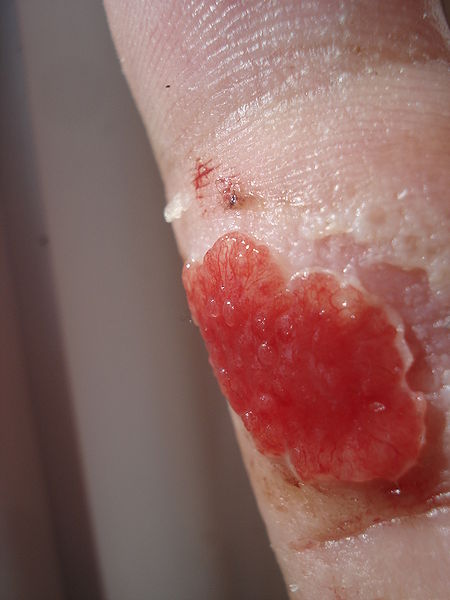
Being proud of someone else is one sort of pride. This can be a selfless pride. I am proud of my children. I hope this is selfless. Then there is being proud, standing over, putting oneself above. We talk about the ‘proud flesh’ of a healing wound. In the healing process, granulation tissue ‘stands proud’ of surrounding tissue and gradually forms a scar. Scar tissue is functionally useless.

You might say that people who are proud in this sense are functionally useless. Hubris: overweening pride, pride before a fall. Hubris kills.

A Pharisee and a tax-gatherer prayed in the temple. The Pharisee prayed, ‘God, I thank you that I’m not like other men.’ The tax-gatherer said, ‘God, be merciful to me, a sinner.’

It’s tempting to say ‘Lord, thank you that I’m not like that Pharisee.’

When the Titanic set sail, someone reportedly said ‘Even God couldn’t sink this ship.’

Pride test

Do you long for attention? Do you make a scene? Are you needy and clingy? Have you learnt to look pathetic?
Are you a begrudger? ‘They didn’t deserve that!’ ‘That’s not fair!’ ‘I could do better than them.’ Maybe you could, but you don’t!
Do you always have to win? Some people even cheat at Scrabble.
Do you tell porkies? Do you tell lies to make yourself look bigger than you are, or to belittle someone else? It’s all pride.
Do you refuse to admit it when you’re wrong? And when you’re caught, do you try to wriggle out of it? You blame something else, bring on the waterworks, blame the drink, or the tiredness or whatever?
Do you pick fights? Is this because you stand up to bullies? Or is it because you are a bully and must win?
Do you push in when you’re in a queue: ‘I’m very important, I have important things to do. The rest of you can wait.’
Do you get upset when people don’t recognize your worth?
Do you believe that dreadful advert where the lady says ‘Because I’m worth it’? No, you’re not!
Do you feel you’re basically a good person, but others are not?

One point for each yes. I scored 362.

Octopus_tool_useHumility

Humus = earth. Humble people are earthed in the reality of being human. We are creatures of this earth. Octopuses can assemble coconut shells to make a ‘house’. And humans think invertebrates are stupid! I know a zoologist who worked with octopuses, and she was quite certain that they were clever. I tell you, invertebrates will be around long after humans are gone. 

Pride versus humility

Pride covets others’ success. Humility says ‘I’m delighted for you’ and means it.
Pride is about being selfish. Humility is about being selfless.
Pride is about getting glory. Humility is about giving glory.
Pride is about independence. Humility is about dependence.
Pride says to itself, ‘My will be done.’ Humility says to the Lord, ‘Thy will be done.’
Pride leads to dishonour. Humility leads to honour.
Proud people make terrible spouses, parents, friends, colleagues, bosses, church members. Humble people, by the grace of God, can be a good spouses, parents, friends, colleagues, bosses, church members.
Are you going to start high and end low, or are you going to start low and end high?

Forget me me me. Take stock of your gifts and skills and faults. Accept them, be earthed, then focus on the Divine. Never mind competing with others. Make the best of what comes your way and pass it on.

When’s the last time you were on your knees? Some say, ‘I never get on my knees.’ When was the last time you acknowledged your pride to someone else? ‘I would, but what will other people think?’ Never mind other people. As Evagrios said, the worst demon of all is that which incites us to seek the approval of others.

cantankerous-old-troutLook at the news. Syria. Egypt. People gouge out a child’s eyes in China. People abuse children. Politicians screw their people. However much we may be horrified at the behaviour of those in the news, it hurts to acknowledge that it is but an extreme version of our own. It all comes down to supposing that ‘my’ wishes are more important than anyone else’s.

I need to remember that when I’m sitting at traffic lights, cursing some old trout in the car in front who seems to be waiting for a particular shade of green.

This is the sin of the world.

You pet a dog, the dog wags its tail and thinks you must be a god. You pet a cat, and the cat purrs, shuts its eyes and thinks it must be a god. What about you? How do you think?

If you should ask me what are the ways of God, I would tell you that the first is humility, the second is humility, and the third is humility. St Augustine.