I love all beauteous things

CarlBoss

Eyes that see shall never grow old

At last, Herbert Howells speaks to the sanctuary of my soul. Or, more truthfully, at last his music has penetrated the fat inclosing it.

Over the years, I’ve thought and said some dismissive things about Howells. That when you’d heard one of his Evensong settings, you’d heard them all (like Haydn String Quartets, and Palestrina Masses). That his organ compositions were little more than quiet-loud-quiet or loud-quiet-loud. That—ye Gods, how I am ashamed of this—he never let go of the death of his son. Mea culpa, mea culpa, mea maxima culpa.

It’s tempting to say that his loss released energy in his work that speaks to my loss. But the Requiem that I now find so poignant was written in 1932, three years before his bereavement. Howells certainly channelled his grief into creativity, but early compositions speak to me just as powerfully, so there is something more than the outworking of his grief that penetrates to my Holy of Holies.

I wonder what it is. Is it perhaps no more and no less than the pursuit of beauty?

I found beauty in the early 1960s in Carlisle.

The biology teacher shouts “don’t you know which side your bread’s buttered?” when I bare my soul about music or medicine. The organ teacher borrows money from my parents, so can hardly encourage me to go against their wishes. I finally let hold of my grip in 1972 when I went to medical school. I don’t think I’ve ever recovered from that loss. I’ve been chasing and mourning it ever since. Is my addiction to the church merely a vain attempt to cling to that first love?

Today I’ve discovered Howells’ I Love all Beauteous Things written in 1977. Like the anatomist’s knife it slices open my insides in one stroke. It exposes my soul to the world. An unprotected soul is mortally vulnerable, but better wounded than icy, for the wounds do the work. Gerda and Kay in The Snow Queen, different parts of me, tears of love melting heart of ice.

We see events in the world that demonstrate, yet again, the three groups of demons (addictions in modern parlance) that Evagrios in the fourth century AD identified as responsible for the ills of the world: “those entrusted with the appetites of gluttony, those that suggest avaricious thoughts, and those that incite us to seek the esteem of others. All the other demons follow behind and in their turn attack those already wounded by the first three groups.”

“We cannot solve [the attacks in Paris] problem only through prayers. I am a Buddhist and I believe in praying. But humans have created this problem, and now we are asking God to solve it. It is illogical. God would say, solve it yourself because you created it in the first place.” These words of Dalai Lama shout at me.

Take responsibility for your actions: your overeating, your overuse of antibiotics, your exploitation of other people, your consumption of natural resources … Face your grief for your sins, and for the hurts done by others. Then your tears will flow. Tears that come from the heart: herzwasser. The woman’s herzwasser that washes Jesus’ feet. Herzwasser that flows when we are forgiven, and when we forgive. Herzwasser that flows in the presence of beauty in all its manifestations: sounds, sights, smells, handiwork, openheartedness, and above all else sacrificial love: “O my son, my son, my son! would God I had died instead of thee, O my son, my son!”

The Kingdom of God is not about life after death. It is not about an ideal political system. My kingdom is not of this world: it is an inner kingdom, here and now.

It is certainly not a kingdom of control. It is a kingdom of liberating beauty in its protean manifestations. Beauty does not conquer by forcing, but by freeing.

I love all beauteous things,

      I seek and adore them;

God hath no better praise,

And man in his hasty days

      Is honoured for them.

I too will something make

      And joy in the making;

Altho’ to-morrow it seem

Like the empty words of a dream

      Remembered on waking.

Robert Bridges, 1844–1930

Comfortable words

1We’re not the first and won’t be the last, but I don’t know what I think until I write it down, and writing is therapeutic, so …


We need to lick our wounds. We’re not straying from the nest.

I find solace in liturgy and the offices of the church. A funeral visit yesterday was truly moving, and I heard and saw that the family found it so too. Officiating at Evensong sung by Lichfield Cathedral choristers was like being wrapped in a sucky-rug woven by strands from Carlisle, Southwell, Ripon and Dublin. Mostly Carlisle: great east window, celestial ceiling, mediaeval misericords, organ. Emotional certainly, but good emotional not bad emotional. This kind of professional activity is somehow real. It’s just about all that matters at present other than family and close friends. Come unto me, all ye that travail and are heavy laden, and I will refresh you.  

Anything that requires a response from me is out of the question. I should be at two coffee mornings today. There’s no chance. I can’t face any sort of social interaction except with those who know the value of silence. This is nothing new, but what is new is the pain of being talked at. Pious platitudes provoke an only just resisted thrusting of index and middle fingers into the speaker’s eyes. They may mean well, but that doesn’t make it any better. Wise people say “there’s nothing I can say.” Even some clergy have responded thus. If in doubt, say nowt.

Some people say they will pray for us. A few years back while driving up the M1 I heard a radio play in which Almighty God, overwhelmed by prayer requests flooding in by heavenly fax, asked his secretary to hand him the next in line for action. It was—a bit of a backlog—from someone whose family had been wiped out by the Black Death. I doubt that any fax about us would make it to the top pretty soon. My notion of the impassible Divine isn’t that of a celestial GP doling out analgesic pastilles on demand.

The new dog entertains despite sharp baby teeth. It’s impossible not to be amused at a Boxer pup, though I suspect amusement will soon become tarsomeness and irritation. Irritation: yes, the rawness of grief makes me even more intolerant. I can hardly bear to engage with arguments about trivia, and let’s face it, it’s all pretty trivial. I know that people like the Vicar to make decisions so that they can blame him when stuff goes wrong, but Hugh’s death has made me determined not to engage with this kind of childishness. Is this intolerance of trivia temporary? I sure hope not.

I’ve been taken aback by some people’s responses in two ways. First, some persistently ask prurient questions. Ed pointed out that what they really want to know is: was it suicide? (Hugh “died suddenly”). That had not occurred to me. Now when people do this, I say “it wasn’t”. Second, a few people who’ve made precious little effort for decades to keep in touch with Hugh or us suddenly become very “caring”. Perhaps they are sincerely trying to help, but I can’t help feeling it’s just guilt.

It’s a lovely day: cold, sunny, my favourite. The sort of day for a train journey down the Rhine to a Christmas Market. Mainz perhaps, or Limburg (that was good). The Germans know how to do Advent.

A rare privilege

North Bend, WA, 2004

North Bend, WA, 2004

Three weeks ago I never imagined that I would say this, but — it’s a rare privilege for a father to speak at the obsequies of his son. It’s rare for obvious reasons. It’s a privilege because over the last three weeks I’ve come to know Hugh as never before, from hearing and reading what his colleagues and friends have said about him.

It’s customary not to speak ill of the dead so that what is said about them bears little relation to the truth – de mortuis nil nisi bunkum. I shan’t fall into that trap: I am more familiar than most with the anatomy of the gonads, so am well able to recognize balls. But I know what I saw in Houston when I visited Hugh’s work place. I know the shock, the glazed expressions, the crumpled faces of his workmates. I heard what they said. I read what they, and others, wrote. Those manifestations of grief were so very moving because of their patent sincerity. You can read some of them in the US funeral leaflet.

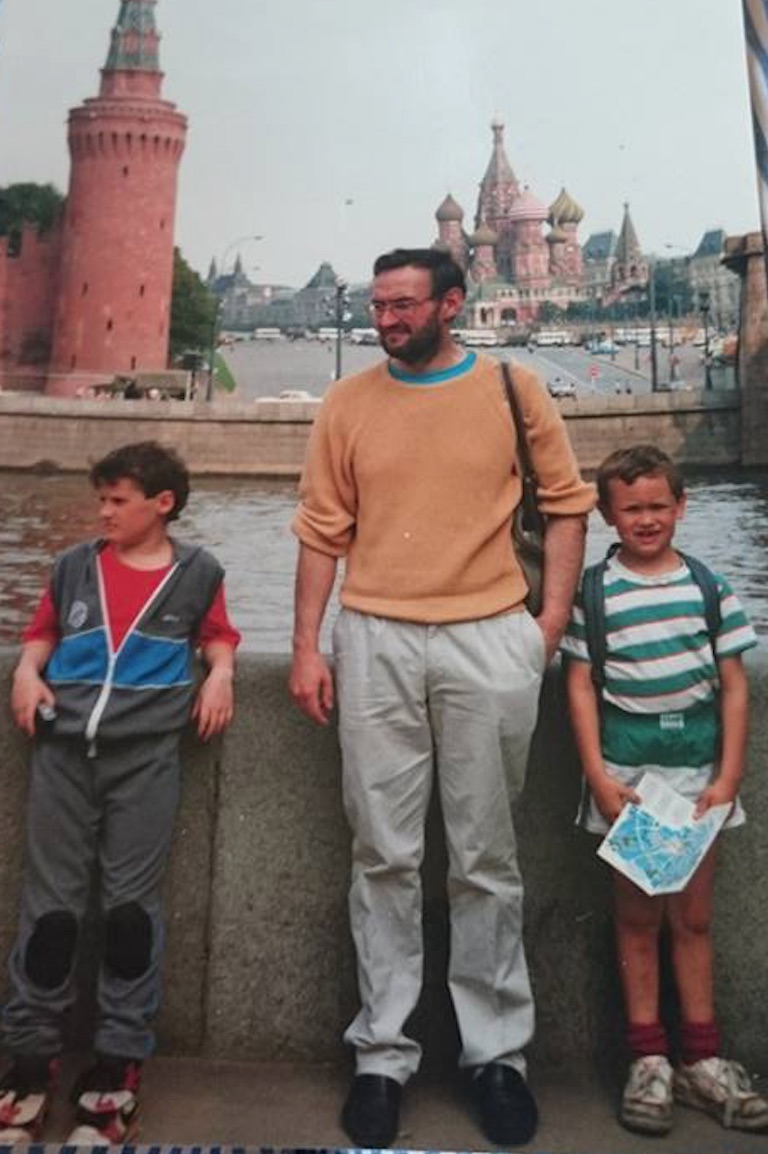
Boys in Moscow, 1987

Boys in Moscow, 1987

At the funerals of both my parents thirty years ago I was struck by how little I knew them, and how little they knew me as anything other than their grown up child. Thankfully, over the last fifteen years, I came to know Hugh as a man, a fellow explorer, not just a son. Now in the last three weeks, as in a whirlwind, I’ve had the privilege of seeing him as a teacher, an example, a beacon. It’s taken my relationship with him to quite a different plane. I wish, O how I wish, that it were not so. Like King David when his son Absalom was killed, I have wept, “O my son, my son, my son! would God I had died instead of thee, O my son, my son!” But it is so, and I must live with that.

It is a truth universally acknowledged that people can be divided into two categories—not sheep and goats, but drains and radiators. In pastoral ministry – and as a medical school teacher, which is a form of pastoral ministry – one comes across a lot of drains. Churches are full of them. They suck the life force from you as they enjoy ill health, or enjoy finding fault. They try to draw you into their jaundiced world view. They think that because you drink tea with them you give your and the church’s approval to their prejudices. They are, in short, full of crap.

About 1980

About 1980

Hugh was no drain.

He radiated mischief. Eyes were open and alert minutes after birth. He prized open Susan’s eyes, “wake up mummy” as she was taking a nap between ministrations to a 4 year old, a 2 year old (him), and a newborn. “Don’t sit on the bike – you’ll fall off into the pit and break your arm”. So he did, and he did. And then “don’t go swimming with your arm in plaster, or the cast will fall off” – so there’s a memory of Hugh running up to the pool at a campsite in the Dordogne, and jumping in with his plastered arm held high. There’s a photo somewhere.

He radiated cheek: not many Wesley College second formers would say to a huge sixth form rugby jock—Leinster triallist—who collided with him in the corridor, “watch where you’re going, you fat fecker”. Hugh’s alliterative skill was not enough to protect him from retribution.

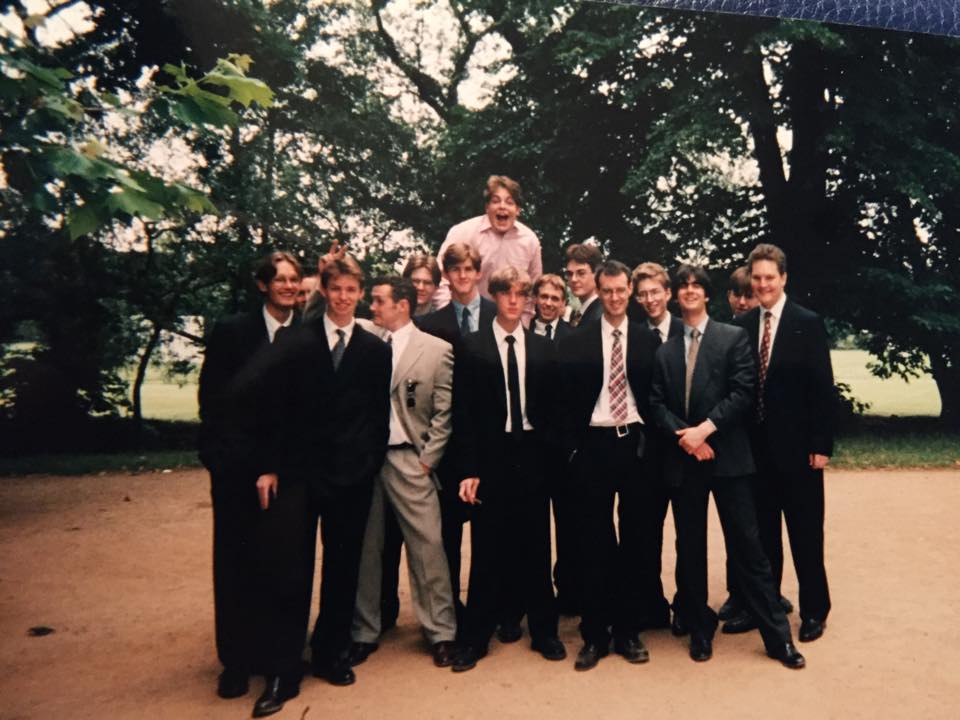
Eton Choral Course about 2000. Guess which is Hugh

The man in the white suit. Eton Choral Course about 2000

He radiated energy. He loved an argument. He had a profound sense of justice that made him provocative, dogged, and protective. He was intellectually quick so did not make himself popular with pedestrian Wesley College staff: he agreed with the psalmist “I have more understanding than my teachers”. He did not make it easy for his parents. But I comfort myself with the knowledge that there is nothing worse for an adolescent boy than to have a father who understands him. Hugh had no time for people who should know better, and he told them so. He was utterly intolerant of humbuggery. He comforted the disturbed and disturbed the comfortable. I am so very proud to be his father.

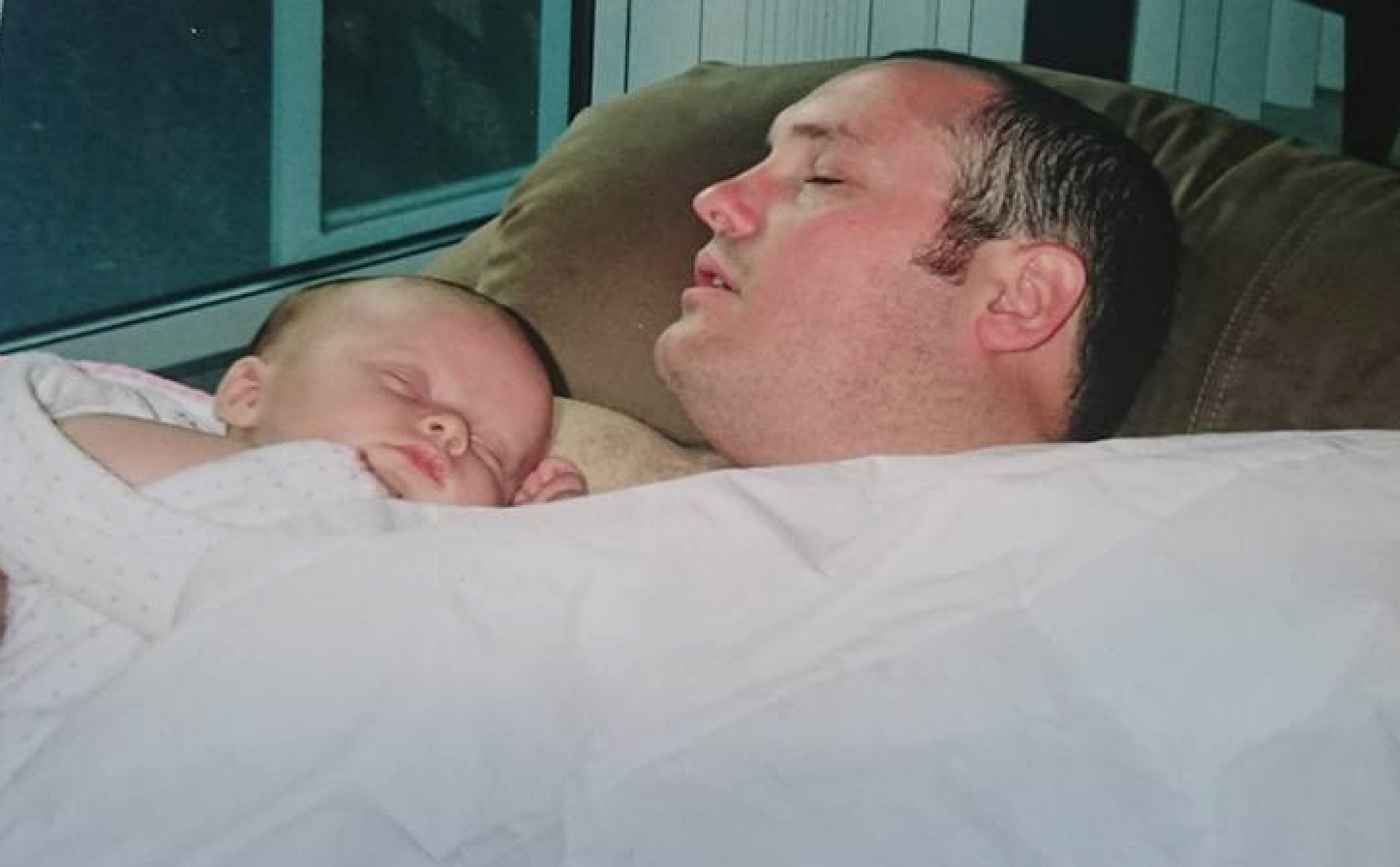
Asleep

2005

It’s the job of a priest in a funeral homily to put a life into a theological context. I recall something said by the Archdeacon of Chesterfield as we chatted before my ordination as priest 8 years ago. We were talking about “sin”. He said, “quite simply, sin is life unlived”.

Sin is life unlived.

You are sinning if you don’t make the best of what life throws at you. You are sinning if you don’t use your gifts and skills to increase delight. You are sinning if you don’t use your personality to put a smile on people’s faces. You are sinning if you sit in the corner and wait for other people to serve you. I could go on.

2014

2014

Hugh was never a sinner! You just had to mention his name and faces would light up. And if you found him irritating, you deserved to be irritated. St Irenaeus had it spot on 2000 years ago: The Glory of God is a human being fully alive. Hugh was fully alive. I could go on with other learned quotes, but one more will do the trick: Jesus said I came that all may have life and have it in abundance.

Hugh had it in abundance. He shared it with the world. He helped people who received him convert old wine to new. He packed more into 38 years than some people pack into twice that time. I’m sad to think that maybe in the last 10 years he was worn out as he valiantly and sacrificially endured a series of hardships for the sake of his daughter and wife, but I’m so grateful to the people of Independence Oilfield Chemicals that with them for the last year Hugh found a place where he was appreciated and cherished. It’s not everyone who finds a music degree to be the perfect entrée into lab work in the Texas oilfields. Talk about charm.

Bahamas

Bahamas 2015

I shall wrap up as I always do at funerals with an admonition. It’s particularly apt in this case because Hugh’s death was so unexpected. Remember, all of you, every one of you, that you will one day go the same way. And it might be tomorrow. So please, please use Hugh as your example: live your life to bring delight to others; live it so that when your time is up you leave behind as few regrets and as little unfinished business as possible.

Hugh. I am so desperately sad you’ve gone. I miss you every minute of every day, but thank you for letting your light so shine that we may glorify your Father which is in heaven. You are for ever with me.

Hugh Stanley Robson Monkhouse RIP. 20.10.1977 – 23.10.2015

They also serve who only stand and wait

testament-of-youthThe Civic Service on Remembrance Sunday 2015 at S Modwen’s Church, Burton upon Trent

Micah 6: 6-8. Matthew 5: 1-12

Last year I told you how moved I had been by the valour, comradeship and courage of trainee Marine Commandos seen in the 2014 TV series. I lamented that those values are so lacking in the narcissistic society that we have created. This year I’m looking at the valour, comradeship and courage in a different group of people affected by conflict.

It was a woman of Staffordshire and Derbyshire who alerted me to the valour and courage of those who waited, supported and loved from afar. I’m talking about Vera Brittain and Testament of Youth. At the risk of boring you with more of my viewing habits, I refer you to the 1979 BBC TV production, available on YouTube if you’re interested. I remember two of its most powerful scenes: Vera at the telephone hearing of Roland Leighton’s death, and later, so sadly near the end of the war, Mr Brittain reading the telegram informing him of his son’s death.

My wife and I went to Texas in September to see our son and his family. One of the few pleasures of breathing recycled farts for half a day is the possibility that there might be a decent film to watch, and so there was: the 2014 film version of Testament of Youth. I thought as I watched that my theme for this 2015 Remembrance Day sermon would be those who, like Vera Brittain and her parents, “also serve who only stand and wait”.

So as well as those who have died and those who have been maimed, physically and psychologically, we remember the bereaved: the Vera Brittains, the mothers, fathers, lovers, sons, daughters, and friends. Those who wonder “what was it all for?” We remember that behind the ceremonies of this week there are countless stories of real human tragedy.

Now, please allow me a personal note. I decided on this theme about six weeks ago. Then, just two Fridays ago at 9.15 in the evening I had a telephone call from Texas telling me that my son had died in his sleep. He was 38 years and three days old. He leaves a wife and a daughter, a sister, a brother, a mother, countless friends on at least two continents, and a father. Now I am Vera Brittain receiving the phone call, I am Mr Brittain reading the telegram. Now I begin to understand what it was like, and is still like, for those who feel that part of them has died when they receive that shocking news. “Stop the clocks” does not even begin to express it adequately.

But among the desolation, I glimpse shoots of new life. I see that entombing oneself in memories and glorifying the past will not do. I see that the best way of trivializing an event and refusing to learn from it is to arrange an act of commemoration, then forget about it. This must not happen to me, or to us.

Nationally and individually, shoots of new life grow when we look into ourselves. We are all warmongers on a small scale: we think our opinion more important than someone else’s, we seek revenge, we won’t let go, we think we need to get the better of someone at Scrabble, or win petty arguments. I sit impatiently at traffic lights fulminating about why the old trout in front is waiting for a particular shade of green. Magnify that and put it in a different context, and we have war. We should remember how every evil act begins as a thought in someone’s head, and how every one of us must keep guard over our thoughts to nip the problem in the bud.

Today I urge you to think of the word remember in a different way. If dismember is taking apart, remember is putting it back together again. The King’s horses and King’s men couldn’t put Humpty back together again, because Humpty has to do it for himself. We must—I must—acknowledge the grief of loss, but then let go so that unlike Miss Havisham we are not trapped in the past. This is just as important for nations as for individuals. Look at the world and you will see.

We have the key to this in the first reading: Do justly, love mercy, walk humbly. And how do we walk humbly? Hear the second lesson: look into your own heart and see your poverty, your perplexity, your sadness at past hurts. These are your enemies. Love your enemies. They are inside you. Love them and you will move beyond them.

Today is about more than remembrance. It is about resolution to work for justice, and release of past grievance.

This is hard work, but in the words of Dorothy Fields, alluded to by Barack Obama at his inauguration:

Will you remember the famous men / Who had to fall to rise again? / So take a deep breath / Pick yourself up / Dust yourself off / And start all over again.

Fragrant chaos

censer-incense-burner-01There’s a fuss in Burton about a proposed new Mosque. The far-right are planning a protest march.

I had a lift from a Muslim taxi driver. I invited him into S Paul’s. He took his shoes off at the door, stood and gazed, wandered around. I said I wished that some of our people were more like him and other faithful Muslims, respectful and with a sense of the Divine. Churches might be thriving.

If there is a protest about the plans for a new Mosque—and I hope not—I pray that the protestors will repent. But idiots are idiots, whatever their idiocy.

It is a fact, though, that church is irrelevant to many people these days. What does ‘church’ mean to those who’ve never set foot inside, whose parents and grandparents have never set foot inside?

In the film Chocolat there are two visions of church. The first is cold, gloomy, repressive, and governed by people who use power to oppress and control. Then, the wind blows open its doors. God the disturber exposes unhappiness and hypocrisy hiding behind a façade of judgmental pomposity. ‘Church’ that was an oppressor becomes a liberator.

As for the faith, it’s seen by most people as life-denying and over-regulated. This is criminal. The mission Jesus gave the apostles was simply to teach others what he had taught them. Rather than making dogmatic statements about how to get to heaven, Jesus modelled and taught how to live now—here on earth, and he said that this was heaven! Despite this, neurotic church people have made Jesus’ death and resurrection into a bookkeeping tally, good behaviour rewarded with the promise of a kind-of club class after-life. We make his love too narrow by false limits of our own; and we magnify his strictness with a zeal he will not own. No wonder people dismiss church.

I think Christianity is really quite simple:

  • Every one of us has the divine light within, a bit of the Divine, like a pilot light on a gas stove.
  • All we need to do is let that inner pilot light grow to fill us from the inside. That’s the incarnation. We don’t need to do anything; we just let it happen. O holy child of Bethlehem … be born in us today.
  • As the flame grows it brings to light our egotistical desires and all the vain things that charm us most, then consumes them, often very painfully – that’s the crucifixion …
  • so that we ascend to the heights, unburdened, unshackled, to be lighthouses lighting the path for others and lightening their burdens.

That’s it. All the rest—doctrine, dogma, rituals—is poetic window dressing, some of great beauty, and some well past its sell-by date.

During my ordination training I visited a Hindu Temple in Leicester. It quite took my breath away. Smells, colour, activity, incantations, devotions – quiet and not- so-quiet murmurings soaking the Temple. People coming and going. A family having a blessing here, people preparing a meal over there. Children playing here, adolescents chatting there. Religious bric-à-brac that knows nothing of middle class notions of good taste or the stifling conservation police. Facilities for hospitality, pastoral care, social action, learning and devotion. No moaning about how things used to be, but rather living in reality.

The building is used. There’s no scruffy notice apologizing for the Church being locked outside the one service every fortnight. There’s no rivalry between flower arrangers or intercessors. There’s nobody saying ‘you can’t sit there, that’s my seat.’ The temple is a place where people talk to each other, listen to each other and acknowledge the presence of something infinitely bigger than themselves. It’s life affirming. I suspect that heaven—if I ever see it—will be fragrantly chaotic like that Hindu Temple. I hope it will.

Is this an unrealistic dream: a church that is fragrantly chaotic, open in every respect? Not simply beauty of craftsmanship, but beauty of the human spirit, open and saying ‘yes’, like Mary was open, saying ‘yes’? Is it an unrealistic dream that Christians might learn from other faiths?

Let’s celebrate life abundant, not life resisting, life enabling not life denying. Let’s be a church, as Pope Francis says, that like a Mother always seeks the good and salvation of all her children.

A liver of lilies

white-water-lilyDoes being a C of E parish priest advance the Kingdom of God at all?

I am the curator of listed buildings, the administrator of diocesan regulations, the community shaman and witch doctor for rites of passage for people rarely seen again, the chaplain to an offshoot of the Evergreen club. I am expected by many to be the upholder of middle class prejudices as they try to suck me into agreeing with them. Sod that for a game of soldiers.

Some people who knock at my door for this and that are, I think, genuine. One of them has just been – with a child in a buggy – wanting money. He went off with tins of baked beans. I am a softy, but only, I fear, because I don’t have the courage to say ‘no’, so I chide myself about that.

SWMBO is much more robust—like when we were at Penrith Grammar School, and I used to ask her (a prefect like me) to tell the boys to get out because I didn’t want to. It’s true that I didn’t see why they should have to get out, but that’s another matter.

I recall being told to chuck some boys out of the bogs where they were smoking. I went to the Headmaster (a good man and a wonderful Maths teacher) and asked why I needed to: ‘if they want to kill themselves, let them’. He said ‘do it, or resign as Prefect.’

Guess which I did.

A woman of no importance

1A homily for 6 September 2015

Proper 18 Year B. Isaiah 34.4-7. James 2:1-10, 14-17. Mark 7:24-37

The image of the child drowned trying to flee Syria will stay in my mind for a long time. I wonder why that image is so much more powerful than hearing of Rwandan children suffering similarly, as they are at this moment, or of Burton children suffering abuse at the hands of adults, as they are at the moment.

It makes me realize what a privileged and easy life I have. This is not my fault, and I’m not trying to make myself or anyone else feel guilty: it’s not my ‘fault’ that I was born on a European island in the mid-20th century. But it makes me question the job I’m doing in the face of suffering. Am I really advancing the Kingdom of God as the Vicar of these parishes? Should I not be doing something, using my medical or political skills, or my ability as a provocateur to disturb the comfortable?

It brings us face to face with our powerlessness and our mortality, and so how important it is for us to get out priorities right now before it’s too late. Squabbles about church stuff such as who can lay hands on whom at an ordination, or who may or may not take communion, are put into perspective. I see yet again the importance of taking risks for the big things of life and not sweating the small stuff. Compared to the drowned boy it’s all small stuff.

Look at today’s Gospel. Jesus taking risks—yet again. Goodness me, a sense of humour in the Gospels. How shocking. Jesus teases a woman—shock horror, a gentile woman—swoon, likening her to a dog—sal volatile please. If he said that today, he’d be in court on a charge of abuse. The woman was no pushover. She answered back and stood up for herself. Then he went on to the Decapolis, most definitely not among the chosen people. Pushing at boundaries, ignoring the conventions of the day. Stepping outside the comfort zone and getting our priorities right – loving neighbour as self.

In talking to the woman, Jesus paid no heed to the Levitical laws for hand washing. He seems to ignore those rules a lot when he’s eating on the hillside, on the lakeshore, across the lake on Gentile land. He pays no heed to where and with whom he eats—despised tax collectors and sinners. He talks about food with a Syrophoenician woman—certainly a woman of no importance (was he crucified because of the way he ate?). Jesus—cautious? I think not. Although meals are ritual events where social order and rules of the tribe are reinforced, he doesn’t let rules stand in the way of a party.

Look at today’s epistle. It’s easy to think this is the argument about faith versus works. It’s not about that at all, though some may say so. It’s not about comparing the relative sinfulness of murder and adultery either. It’s about getting your priorities right. Stop fawning over the powerful, the influential, the well dressed. Stop sucking up to the Masons, the members of the Burton Club, the MP, the Mayor, the doctor, the Vicar. Start ministering to your neighbour as yourself, no matter how they speak, or smell, or appear. Don’t let convention stand in the way of compassion. Don’t let duty stifle initiative.

We need to guard against being so concerned to keep our lives, our churches and our religion ‘pure’ or ‘just the way we like it’ in a way that excludes others, or welcomes them only on our terms. Being open-minded and willing to explore and do new things is expensive. It leads others to criticize us. It leads to a kind of crucifixion as we see the death of all we once held dear.

When I see pictures of refugees dead and dying I know that none of our conventions and rules is important enough to go to war over. Faith without works is merely self-indulgent narcissism.

Harden not your hearts. There’s a wideness in God’s mercy that seems to elude mere mortals.

Keeping up appearances

article-1029700-001533AB00000258-694_468x383Homily for 30 August 2915. Proper 17, Year B. Deuteronomy 4: 1,2,6-9. James 1:17-27. Mark 7: 1-8,14,15,21-23

Last week Martin told us that when Paul said that we should fasten the belt of truth around our waists, the word he used which is translated as ‘truth’, alètheia, means openness, reality, authenticity, the opposite of lie or appearance. Martin said: “many people hide behind a façade, never really allowing others to get to know them. Like Adam and Eve covering themselves with fig leaves, many believers dress themselves in man-made realities that are easily penetrated, their weakness quickly exposed in times of intense spiritual onslaught. Paul exhorts us to be honest, to live with integrity and be real with God. Dishonesty is an open door that will wreak havoc in our lives, especially during any kind of enemy siege.” I suppose that’s saying, in short, the trouble with telling lies is remembering which lies you’ve told to whom: it gets so complicated that before long you’ll be found out.

Look at today’s Gospel: Pharisees concerned only about appearances, about doing the right thing, or rather being seen to do the right thing. Do you know people who are always finding fault? Do you know people who are always and only concerned with what the neighbours think? Do you know church people like this?

Look at the Epistle. Paul says: do it, don’t just listen to it, or think about it. JFDI. “If any are hearers of the word and not doers, they are like those who look at themselves in a mirror; for they look at themselves and, on going away, immediately forget what they were like.” I’ve preached so often about looking in the mirror and asking yourself what you see? Do you see yourself as you would like to be seen? Or as the Lord sees you?

It’s hard work to sift through our facades, our appearances, our pretensions, our notions. Look at Hyacinth Bucket keeping up appearances. It takes so much energy to pretend, just as it takes so much effort to remember to whom we’ve told which lies. The result is that we don’t have the energy to live life to the full.

There’s a word in today’s Old Testament reading that’s important in this respect: discernment. It comes from two Latin words, dis and cernere. Dis– means apart, and cernere means to separate. In his book God of Surprises Fr Gerry Hughes writes “The words ‘shit’ and ‘discernment’ have the same root – the word ‘shit’ being related to the Old English sceadan meaning ‘to separate out’! The billions of cells in our body continuously practising ‘discernment’ on the food and drink we consume and on the air we breathe. Each cell accepts what it needs for the good of the whole body and rejects or passes on the remainder. Cancer cells could be described as a failure of discernment on the part of individual cells. They ‘forget’ the good of the whole body and concentrate only on their own individual good. As a result, the whole body suffers … In human society, individuals, groups, nations and religious bodies are all liable to act within the narrow parameters of their own immediate interests. Such behaviour brings oppression, misery, starvation and death to other human beings … Discernment is as necessary for survival as air, food and water.”

Sifting through our attitudes and actions to get rid of the masks, the notions, the pretences. It’s such hard work.

Let me tell you a story. Are you sitting comfortably? Then I’ll begin.

I was a regular visitor to the biggest men’s prison in the Republic of Ireland. One of the gentlemen there said something that impressed me very much: “it’s such a relief be found out.” Now he was caught, he didn’t need to pretend any more. Such liberation, lightening of the load. I became aware of the energy we waste trying to put on a show, to pretend to be what we are not. The energy we use and the trouble we go to hide from ourselves and from each other. We become enslaved to pretence.

We – all of us –  need to find that same sense of relief in the liberation of being found out. It’s almost completely absent from ordinary lives because we try so hard not to be found out. The result is that we never find true freedom because we can’t bring ourselves to give up our addictions to pretending, even though it costs so much. It’s like being trapped in OCD (did you see the TV programme the other night – a young man weeping because OCD was ruining his life?)

If only we could expose our burdens to the light, as it were, instead of hiding them away. If only we could accept ourselves, warts and all. St Paul, the patron of this church, continually talks about the past he was ashamed of. He does this to show God’s mercy and he uses it to power his own work. It would be self-indulgent of me to do likewise, though I have no objection to doing so, and not now. But I know that until we’ve seen the dark places of our own hearts, the evil that comes from avarice, envy, pride … and so on, we will never be free and never be fully ourselves. Just think what could happen if instead of using energy to keep up appearances, we use it to bring healing and delight to the world, the last mask shed as we emerge from the chrysalis of old habits into the fully adult form, the imago. Imago Dei in whose image we are made.

If only we could pass our burdens to someone else. This is what talking with a trusted friend is about. I like Cardinal Hume’s image of God: someone into whose ear you can whisper all the things you’re afraid and ashamed to tell anyone else, and know that you will not be rejected. If you know of anyone who needs to talk in confidence to someone, tell them that I shall be in the Lady Chapel every Friday between 5 and 6. Nobody will be rejected.

***************

Much of this meditation has been inspired by the writing of Metropolitan Anthony Bloom of the Russian Orthodox Church in London. I finish by quoting someone whom he greatly admired, the Latvian Elizaveta Yurievna Pilenko (1891-1945), later Skobtsova, murdered in Ravensbrück Concentration Camp, who became known as Mother (Saint) Mary of Paris.

It would be a great lie to tell searching souls “go to church because there you will find peace.” The opposite is true. Go to church because there you will feel real alarm about your sins, about your perdition, about the world’s sins and perdition. There you will feel an unappeasable hunger for Christ’s truth. There, instead of lukewarm, you will become ardent, instead of pacified you will become alarmed. Instead of learning the wisdom of this world you will become foolish in Christ.