KBO

parody-of-the-famous-scene-by-a-basil-lookalike_542319Homily for Proper 22 Year A by Phillip Jefferies

Isaiah 5: 1-7. Philippians 3: 4b-14. Matthew 21: 33-46.

Since the world appears on the whole to work according to reason, it would be logical to expect reasonable outcomes from things. You get in your car, turn the ignition and, if it’s got fuel and the battery’s not flat and it’s not flooded or damp, then it starts. That’s a fairly reasonable expectation – unless you’re Basil Fawlty. If your logic is like that of the owner of Fawlty Towers then when your car doesn’t start, you count to 3 and if still nothing happens you give your car a thorough thrashing.

But that is an unreasonable expectation. In the readings today we’re bracketed by vineyards – it could be a rollicking prospect, but it’s not! The parables of the vineyard in today’s readings from Isaiah and the Gospel of Matthew (and separated by about 800 years) disappoint and confuse.

It would be reasonable to expect good outcomes, perhaps euphoric even. In the first instance Isaiah’s poetic and ballad-like vineyard, against all reason, only produces a barren acidity that stinks. Matthew’s allegory of the vineyard of Israel results in the skewering of their long awaited Messiah, Jesus, by their leaders, the very defenders of the faith.

And then, in between, comes S Paul’s experience. Paul, Hebrew to the core, as to the law, faultless—a good Pharisee, no less! However, against all expectation, Paul seems to have lost everything and, what’s more, finds himself in prison. Now that doesn’t seem fair. Not a reasonable outcome you might think, for either a Roman citizen or a faithful follower of Jesus Christ—nor, within the justice of God, does it appear reasonable either. What is going on?

My Classics master with a crystal-clear mind, with 25 years as a sidesman, who never missed an 8 o’clock, was seriously confused when the frost took all his chrysanths. Stuff happens! Perhaps he’d imbibed too much vintage Greek because Greek philosophy, on the whole, centred on perfection. Greeks loved the circle with its symmetrical completeness. They loved the perfection of the universe swirling round the earth in perfect concentric circles.

They loved mathematics: Pythagoras’ Theorem of the square on the hypotenuse fame was wonderful, perfectly divine when it produced an integer, as with a 3, 4, 5 triangle. But when the answer was not a whole number, as with a 5, 5, 7.0710678 …  triangle, or was expressed as a fraction, Mr P was unhappy. Imperfection and infinity didn’t fit in with the divine.

Mr P couldn’t cope with imperfection; he tried to suppress his discovery. If it’s not whole then it’s not perfect and it’s not divine: there was no closure, no completeness. On top of that, the planets, it was discovered in due course, revolved not in perfect circles, but at best in ellipses. And nor did they go round the earth. What a mess.

We seem to be making an awful mistake expecting perfect outcomes. I don’t know what expletives Paul used: pious Christians would say “none whatsoever”. But Paul was doing all the right things and was in prison. He’d at least say: “This isn’t quite going to plan, my word!” You can say that again! And on top of a pretty blameless life, Paul was a Roman citizen, to boot. “Sod this for a game of soldiers”, as the Vicar might say, would be more appropriate.

But Paul soldiers on. He’s got his feet on the ground—well, to be more accurate, he’s got his feet in prison shackles. He knows stuff happens—stuff that, in all reasonable justice should not. He does, however, have a coping philosophy to see him through: he says, “I press on”. I expect there was a prison mug telling him to Keep calm and carry on. And what else can you do? Stuff happens and you have to get on with it. This is the language of hope, not of assurance, certainly not of certainty.

Paul says something else. He says that he lets go of what has gone before. That is what we are frequently urged to do: to let go—and it is essential from a practical point of view. You can’t withdraw from the track because, now and again, you come a cropper. That, it seems to me, is the awful stupidity of the present hysteria of calling people victims and, even, to expect closure on anything unpleasant from our past. We deal with it by getting on with things. I mean, our historic life is an essential and rich part of our present life.

All of us have a past, with good and bad stuff back there. It is part of the truth of who we are. Sometimes it is less manageable than others – and even the marvellous memories can upset us. That’s life: neither pretend it didn’t happen nor let it stop you dead in your tracks (well not for long, anyway). Press on—not with closure or with perfect or even satisfactory outcomes but in hope.

In the desolation of the dreams for our vineyard, God doesn’t make it all right. Rather, He reminds us who actually owns this vineyard we occupy: first, last and all stations on the line, the landowner is God.

Liturgical dyspepsia

frjack

The ideal pet

There are two occasions in the liturgical year that I heartily dislike.

The first is Mothering Sunday, or Mother’s Day as people call it these days. Its original incarnation as the time for a pilgrimage to the mother church might have been OK. Its modern incarnation, with the gooey stickiness of sentimental femininity, I can hardly bear. No wonder some men find church too girly. And what about women who’d love to have had kids but can’t? It’s an excuse to get a visiting preacher.

The other is harvest. As you know I was brought up in an agricultural community and the farming year mattered greatly. At this time of year there was tatie-picking week, which coincided, deliberately—thanks to Cumberland County Council, Latin motto on school exercise books Perfero, I finish what I start—with school half term. I have some memory of rosehip week when we scoured the hedgerows for the bulbous scarlet objects to take to school for collection—3d/lb. In an urban context I see no point in harvest. In Burton upon Trent wouldn’t we be better off having some festival celebrating beer or Marmite or light engineering or Rolls-Royces or Toyotas or trains?

Harvest festival is a recent invention, 19th century. A Cornish vicar decided that the church was irrelevant to most of his people (nothing changes), and that having a harvest festival to connect church to the lives of his agricultural parishioners might do the trick. It didn’t work.

The thing I really find distasteful about harvest festivals is the sense that because the land has yielded its increase, we are especially favoured by God. One implication is that God looks with disfavour on those people living in places where the land is barren and infertile—as if the people who live there are inferior to us in northern Europe, where the climate is governed by the gulf stream that arises from the same set of phenomena that yield hurricanes in the Caribbean.

Never mind. We bring our packets and boxes and tins for distribution to the homeless by the YMCA and so feel good about ourselves. Bollix to that.

You may think this is just a dyspeptic vicar writing. You may be right. Another excuse for a visiting preacher.

A few days in Texas

_MG_7019

2014

Susan, Ed and I had a few days with granddaughter Abby, Hugh’s widow and her extended family. It was lovely to see them. I was with Hugh’s former colleagues, and some friends of his came from Seattle to see us. All very moving, but poignant because of—I’m sure Hugh would relish this metaphorical mess—the absent elephant in the room.

I crumple up very easily. One of his mates, a Seattle fire fighter, has lost too many of his colleagues and friends in the course of jobs and military service. He copes by remembering the good things and the good times, for life moves on. And so it does. But not for me yet: it’s a matter of getting the clocks to start ticking again. Or waiting.

Anyway, enough of this. What I want to comment on in this piece is the contrast between the image of what, according to the Bolshevik Broadcasting Corporation, life must be like under President Trump, and the reality. I tell you, life there is pretty much as it was under Obama. Surprisingly, immigration at Houston was quickest ever. Whataburger is still Whataburger. IHOP* is still IHOP, and I’ve gotten to like waffles and pecan syrup with my eggs and b, though as with the carfee Amurcans don’t know what “hot” means. And the number of fat people on mobility scooters seems much the same as it was two years ago (Burton is catching up).

This last comment puts me in mind of a 1973 episode in surgical outpatients at King’s College Hospital. The consultant was the Professor of Surgery, a lovely, gentle, lowland Scot who lived in modern architect-designed residence in Sydenham, regarded by cognoscenti as important enough to be illustrated in Buildings of England, London volume II (as it was then). He was not in the least like Lancelot Spratt, though he was well known for a fondness for the products of distilleries—say no more. On this particular afternoon he walked into a cubicle where on the couch was an enormously fat man with acres of flab wobbling over both edges. The worthy professor stopped, turned his head towards us, and with a terrifically wide grin on his face said in his gentle burr “hmmmm, a trifle obese, I see”, after which he conducted the rest of the examination with a joyful expression on his face.

But I digress. What of the floods? I hear you ask.

Nothing. We were in north Houston—Northampton, Tomball and Magnolia to be precise. We didn’t venture south to the mosquito-infested swamps on which central Houston is built. But we heard about the heroism and neighbourliness of people who were not affected as they dealt and deal with those who were.

And the wall?

When you live as close to the Mexican border as they do, and when you’re relieved that Mexican drug cartel bosses are being rubbed out, you might well be delighted at the prospect of a wall.

* International House of Pancakes. Don’t laugh. I think there’s a branch in Mexico. Or possibly Canada.

Placentas and pizzas

mod-pizza-maddy-default-e1479167621575

Placenta

Mrs Windsor née Middleton is pregnant. It’s in the newspapers so it must be true.

First, I have to get this hobbyhorse off my chest. The correct spelling of fetus is fetus, not foetus, the word being related to felix, femina, etc. The incorrect spelling occurs first in the late writer Isidorus (570-636 AD) who fancied that the word could be derived from foveo (I cherish) instead of feo (I beget). So there.

Now to the hard stuff.

Is it an embryo that is taking root in Mrs Windsor’s genital system? Yes indeed. Is a fetus? Is it a baby? Is it a child? Embryo and fetus are defined by convention: you can look them up if you like. Baby is a meaningless term. Is it a parasite? Well, it steals mama’s nutrients and dumps its rubbish on her. It guzzles into her flesh so that its placenta can plug itself in to mammy’s tissues and get up close and personal with her blood vessels. It consumes the contents of parental wallets for at least two decades. Make up your own mind.

Some people worry about when the fetus becomes human. Not I. It’s human because the spermatozoön and ovum that produced it came from gonads belonging to humans. Reputedly. Anyhoo, however royal this fetus may be, it’s also a chordate, a vertebrate, a mammal, an ape and a primate. This is much more important than royalness.

The royalness will doubtless induce the Church of England to produce a prayer for the royal products of conception—it may already have done so—the usual crass, meretricious, tendentious, wordy drivel that comes from Lambeth. Products of conception include placenta, amnion, chorion, umbilical cord. Are they royal too? Are we to have a prayer for the royal placenta? Will a specially consecrated pair of scissors be used to cut the royal umbilical cord?

Killing the fetus

When do you think it should be permissible to kill the fetus? Or perhaps, when should it no longer be permissible? Well here’s the thing as I see it. Despite what the law may say, there is no single moment during the whole course of pregnancy at which the fetus is significantly different from what it was the moment before. There is no event that takes place that sufficiently differentiates what the fetus was before that event from what it is after the event. Fetal development is a continuum. From this point of view, if it’s permissible to kill a fetus at 18 weeks, then it’s permissible to kill a postnatal child or an adult. For those of us who have a little list of people not one of whom would be missed, this is comforting.

Why are we born when we are born?

The short answer is nobody knows. Brain size must have something to do with it. If we stayed inside any longer, our heads would grow so big that we wouldn’t be able to get through mama’s pelvis. But like I say who knows?

We are born very immature. A newborn horse can canter off pretty soon after birth, but not a newborn human. Unfortunately. Neurologically (spinal cord tract myelination—look it up), some of us mature more quickly than others. If earlier, we shall be better at physical activity and sport at an earlier age. If later (like me, dear reader), we shall have the shit kicked out of us at school for being physically inept.

fba2cd05fc45ce91813c523805979006--human-placenta-medical-pictures

Pizza

Placenta

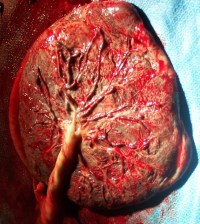
Placenta in Latin means flat cake. It is a most interesting organ, much under-researched. Its evolution is fascinating. Some mammals have lots of little placentas. Some, like mice and humans, have a single placenta. A primate (therefore human) placenta is about the size of a small pizza. Looks like one too. Some twins have separate placentas, some share.

A mouse placenta is similar in size to the head of a small drawing pin. Believe me, I know. I’ve dealt with hundreds of them in my time. When our three products of conception were little, the eldest drew a picture of me at work with the caption “my daddy studies mices kidneys”. Adrenals, actually, and fetal ones at that, but the gist was spot on. She had not mastered the apostrophe by that stage (like an increasing number of adults, but don’t get me going), but had grasped that plurals are normally formed by the addition of a terminal s, and that in conjugating the verb ‘to study’, y sometimes becomes ies. Pretty good, huh?

Please understand, dear reader, that the placenta is fetal. Entirely fetal. The only bit of maternal tissue that comes out with the placenta is that which is torn away from the uterine lining when the placenta detaches itself, hopefully after birth. This is why bleeding may occur.

The placenta, like the infant that it nourishes, is a foreign organism as far as the mother’s immune system is concerned. Why is the placenta, which comes into intimate contact with maternal tissue, not rejected? Well, sometimes it is. And so arise spontaneous abortions and other obstetric headaches.

A bit of history

In the fourth, fifth and sixth Egyptian dynasties the placenta was held to be the seat of the external soul. There existed the ceremonial position of Opener of the King’s Placenta. Some have suggested that in Abigail’s flattery of King David (1 Samuel 25:29) she calls on this image, the ‘bundle of life’ (KJV) being the placenta, though this is not mentioned in recent Biblical commentaries. Some societies suppose the placenta to be ‘the twin brother or sister of the infant whom it follows at a short interval into the world’ — and in a way, it is. In central Africa a belief in reincarnation leads to the afterbirth being buried at the doorway, or under the threshold of a hut, practices connected with the divine doorkeeper and the widespread custom of carrying the bride over the threshold.

The great fry up

And now, children, finally for today’s “Listen with mother”, remember that the placenta is a most nutritious organ. It’s not that different from black pudding: blood, connective tissue and other bits and pieces.

Fried with eggs, mushrooms bacon and tomatoes it would make a right royal breakfast.

Questions and answers

1-langwathby-5891b

Langwathby. River Eden left, Settle-Carlisle right

I’ve recently been asked to answer questions about my life. Here are some of them with my responses.

Family and growing up

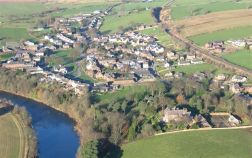
I suppose I’m a border reiver, a hybrid Cumbrian Scot. I was born in Carlisle and brought up 20 miles south along the river Eden in Langwathby. I retain Cumbrian flat vowels as evidence.

Arthur, my father, was the second of five children of William, a Langwathby farmer and merchant, and Janet (née Dobinson) his gentle, somewhat patrician north Cumbrian wife from Roman Wall territory. Jeanne, my mother, was the second of five daughters of the Kirkoswald butcher Stanley Cranston and his wife Nellie (née Reid), a miner’s daughter from Fife. My sister was born during the Second World War when things were very tight. I was born in the expansive post-war period when we’d “never had it so good”. So essentially we were both only children with childhoods that were quite dissimilar.

We lived in a house where my paternal grandparents had lived before they moved across the road next to Arthur’s sister’s family. Up the hill were Arthur’s youngest brother with his family, lording it over the rest of the village more than just geographically. To complete this vignette of the Monkhouses, Arthur’s eldest brother was a Methodist minister in Carlisle, and another worked in a bank in Carlisle and sang tenor in the Cathedral choir.

Nellie was reputed to be the youngest of 16 children. She went into service in Edinburgh in her teens. My cousin told me that she, a somewhat statuesque lady, was more than occasionally to be found in the pub dragging her husband out. Typical Methodists. Stanley liked to be called Stan by his grandchildren, and I assumed that was another nickname for a grandfather, like Pop or Papa. It never dawned on me that it was short for Stanley until I was a teenager.

CranstonsNellie and Stan had five daughters, from left to right Stella, Anne, Helen, Jeanne, Margaret (Stella and Margaret were twins—I might have them wrong way round). Anne,the eldest lived in Carlisle, Jeanne my mother came to Langwathby after nursing at Wrightington and Bradford Royal Infirmary, Helen went to Darlington, and the twins ended up in Warwickshire. I have photos of the Cranston sisters, most striking with high cheekbones and almond eyes. Like Nellie when she was young, they look Slavic, oriental almost. I wonder about Nellie’s ancestry, and whether a sailor from the east contributed to their—and my—gene pool. Maybe that accounts for my interest in Russian Orthodoxy.

1950s Langwathby

11My father was fascinated with all things automotive, and spent the Second World War as driver and batman to a General in Greenock on the Clyde. We had a green Morris MRM 261 and so were able to get away from time to time, but with few private cars in the village, most of my school contemporaries were not so fortunate. There’s a picture of my sister and me in Trafalgar Square: she looks about 12 so I must have been about 4.

The village school was next to the railway station on the Settle-Carlisle. You could get trains from the village to Leeds, Bradford and Blackburn as well as, of course, Carlisle and Skipton. There was maybe even a stopping train to Edinburgh that went up the Waverley line. The daily passing of the Thames-Clyde and Thames-Forth expresses was eagerly awaited especially if school playtimes coincided.

Despite living less than 100 yards from school, I was made to stay for school dinners. The emetic qualities of the tapioca, rice pudding and semolina, were memorable: great globules of pearly snot in a mixture of vomitus and semen, not that I could have put it like that then. I never ate puddings, so as punishment was kept in the whole dinner break, deprived of playtime. I found books to read.

OLYMPUS DIGITAL CAMERADaily assembly consisted of a hymn and a prayer. It was a C of E school, though I don’t remember the Vicar ever visiting, and prayers were from the Book of Common Prayer. This Methodist child was bowled over by the language, especially the one that goes “defend us in the same … neither run into any kind of danger … ordered by thy governance”. The words, the syntax, the poetry, the other-worldliness—entrancing to this 6 year old. It didn’t feature every day, but as soon as the Headmistress began “O Lord and heavenly father” my antennae twitched. And they say the BCP has no mission value.

Eden Valley in the 1950s

It was isolated. There was no M6. The Pennines to the east meant that for much of the dark year we were cut off from Hexham and Scotch Corner. When my aunt and family visited from Darlington, they were gone by 3 pm to ensure safe passage over Stainmore. The road over Shap with snail-pace nose-to-tail traffic, impassible for much of the winter, meant that journeys south were fraught and slow. I still think southerners begin at Lancaster. To the north was Scotland, and we went that way more than south or east, not least because of friends in Greenock. Trips west to Keswick don’t feature much on my radar. My abiding images of the Lake District are of gloom, pines, rain and hills that fence me in.

So it was part of England, but detached from England. At school we sang songs about the Scots ravaging Carlisle, and about dreadful Sassenachs. It was almost Scottish and had been Scottish, but it was not Scotland. It was fiercely independent-minded and self-reliant. But—and this affected me deeply—intensely closed minded, anti-intellectual, socially conservative and oppressive.

Tilter

Tilting train near Penrith

And this did not begin to change for two decades, when the M6 snaked its way up through the Lune gorge (I was in the third year at Cambridge by then), and electrification of the West Coast Main Line a couple of years later, Penrith and Carlisle gaining a rail service undreamt of by 19th century engineers.

Studies and work as an anatomist

I was moulded into medicine by my parents. I’m not aware of ever having had any choice. I qualified as a doctor in 1975 after three years at Queens’ College Cambridge where I read Medical Sciences (2 years) and History of Art (1 year), and three years clinical studies in King’s College Hospital, London.

Things that stand out in my intellectual formation include (1) realising that as human beings we are apes in the long line of evolution from primaeval soup; (2) embryology—we carry our structural and genetic history with us; (3) the year spent in History of Art where I began to learn to think (as opposed to remember) at the feet of such luminaries as Anthony Symondson and David Watkin. It was a most entertaining and transformative year in all sorts of ways.

In 1975 as a final year medical student it became clear that the practice of medicine was not for me. I spent much of my time fearful that I would do the wrong thing; the responsibility was terrible. I can’t remember things unless I have a framework to hang them on, and in medicine there’s an awful lot of random stuff to remember. But I never forgot my fascination with the history of the human form—evolution and embryology—so I approached several medical schools to see if there was any scope for a job in that. I ended up as Anatomy Demonstrator, or Temporary Lecturer as it was called, at the then new medical school at Nottingham. That grew into a permanent Lectureship.

I must have been a disappointment to the Professor, the late great Rex Coupland, because I was interested in teaching and student welfare—pastoral stuff—and he pointed out that I had no future unless I made a research name for myself. This was not what I wanted to hear. Nevertheless I managed to get a PhD and a few papers published.

In the mid 80s, when the Universities were being squeezed by the Thatcher government, I saw that my future at Nottingham after Rex’s imminent retirement would be precarious. In early 1987 I saw an advert for Professor of Anatomy at the Royal College of Surgeons in Ireland, which despite its title is the biggest Irish medical school, and I applied. On 3 January 1988—not a great time of year to be arriving in a foreign jurisdiction for a new job—we rolled off Sealink ship St Columba at Dun Laoghaire: Susan and me, with Victoria (12), Hugh (10) and Edward (8). Hugh and Edward were choristers at Southwell and Ripon respectively, where they remained until secondary school in south Dublin. With ferries and airports and one thing and another that was a very fraught few years. It affected our wellbeing. I wouldn’t do it again.

As a result of death, resignation and retirement, I found myself as essentially a one-man show. The arrangements for handling cadavers for dissection were redolent of Frankenstein’s laboratory in a Hammer horror, and having come from the new set-up at Nottingham, the medical course was if anything worse. I set about modernising both, and had some pretty awkward fights for money and for the place of anatomy, not only from colleagues begrudging the quality of our teaching, but also from educationalists who were beginning to maintain that medical students didn’t need to know facts so long as they could look and act ‘caring’. It was hard work.

The other thing that got me into trouble with my colleagues was the strange notion that since the medical students paid our salaries (which they did at RCSI), we should actually listen to their concerns.

In about 2000 I was in my office in Dublin thinking what next? I’d had two textbooks published, still in print, and it came to me that it was time to move on. I took a sideways step into computer-assisted learning, but that did not turn out well for me, and after a couple of years I was back in UK as foundation anatomist at the new medical school in Derby.
6a0120a7aae27b970b01538f6cdea3970b-800wi

The perfect pastor

How has this affected ordained ministry?

I see theology and pastoralia through the lenses of evolution, embryology and medical science. It’s incarnational, of course, and I have no hesitation in saying that if theology and biology disagree then the theology needs to be modified or ditched. I’ve come to the view anyway that Jesus shows us the way to abundant life—no more, no less—and that doctrine is at best poetry and at worst oppressive nonsense. Theology is a human construct, so if our brains are evolving, theology must evolve too.

My training also leads me to value straightforwardness and candour. I am told that I’m frighteningly blunt. Telling the truth seems to be the most serious sin a priest can commit, for people expect a vicar merely to confirm their prejudices while drinking their tea.

What did you most enjoy in medical studies and practice?

In medical studies it was seeing that we humans, primates (apes not archbishops), mammals, vertebrates, chordates, all fit into the procession of life. I wonder how we will continue to evolve, or whether we’re the end of a road. I rather hope the latter, for we’ve so cocked things up that mass extinction would give the opportunity for a fresh start, Noah’s flood wise, with evolution doing a better job next time round. As I get older (I’m 67) I think it must be quite nice to be an orang-utan picking fleas out of a friend’s fur.

In my year as a full time medical practitioner one of my jobs was in Ear, Nose and Throat and Plastic Surgery where I enjoyed doing mucky stuff like wound cleaning and sucking out pus from mastoid cavities, and such like.

.. and most difficult?

Not letting people die with dignity. I’m haunted by an infant with biliary atresia who was repeatedly operated on merely, as I saw it, to provide practice for surgeons. Though I was at the bottom of the food chain, I was not without opinions, and one day I—a 26-year-old neophyte—had the temerity to voice them to the assembled professors and consultants, knowing that the parents were on my side. I think the response is best left to your imagination. I’m not a natural respecter of rank.

What was your first experience of God? How has that developed?

Beauty. I’ve already told you about my response to poetic language. For a boy who was fat, asthmatic, uninterested in football or cricket, and without any aspiration to spend his adult life knee deep in cow shit, life in 1950s Langwathby was universally grey and often cruel. When, through organ lessons at Carlisle Cathedral in the early 1960s, I discovered beauty, I was transfixed. I was able to combine this with what I’d learnt about beauty of humanity from Bible stories, and this began to forge a notion of the Divine. I was repelled by Christian Union types at Cambridge, confirming me on a theological journey towards what I have come to understand as the apophatic and mystical incarnated into the pragmatic and practical.

When did you take on ordained ministry?

I remember discussing the itch to seek ordination with the biology teacher at Penrith Grammar School. Back in Derby in 2003 someone who had known us in Nottingham asked me what plan I had for the future. I could hardly answer, and knew that that was the time to scratch the itch. Every door opened. I started training with the East Midlands Ministry Training Course in 2004, was deaconed in 2006, and priested in 2007.

The two years with EMMTC were intellectually the most stimulating of my life. I was fortunate to have as course Principal Michael Taylor, a former Catholic priest who had been through the hands of Ratzinger and Rahner amongst others, and provided a perfect stimulus for me. So for two of the three years I was setting up anatomy at Derby, I was also studying theology out of hours.

Grief at Hugh’s death

It’s not two years yet, and I still find grief at the death of my elder son to be fierce and bitter. We don’t really have the verbal images for this, but it’s like being covered in a blanket that blots our sun, moon and stars, that makes it impossible to move, that extinguishes delight. For 18 months there was never a day without my hearing King David’s lament at the death of Absalom, 2 Samuel 18:33. That voice has largely faded now, but the aching lassitude, exhaustion and apathy persist.

If one accepts that a father’s role is to protect his offspring, and if one manifestly has failed to do that, then one deserves to die. That is the logic that I had to confront, and if I had to confront it, then it may be that other people in my position must have to deal with it too.

Parishioners and colleagues are unobtrusively supportive, but a woman from another parish said to a colleague after 9 months that it was time I got over it. After all, she said, she’d buried two husbands. I can’t say I’m surprised. I didn’t want to be signed off, and indeed the regular weekly liturgy gave a structure to my life that I couldn’t have done without.

In the end you have to navigate the turbulence of grief for yourself, because it is yours alone and nobody else’s. There is very little to help fathers who lose adult offspring, most literature being concerned with mothers and the loss of babies or children. The only book I found helpful—very helpful indeed— is Inside grief, edited by Stephen Oliver.

Music

I learnt to play hymns in Methodist chapels, so I know how to use the organ to control a congregation—not a skill that many organists have. I’ve been organist and singer at churches in central London, Nunhead, Nottingham, Dublin (St Ann’s in the city centre) and Derby. Along the way I picked up a prize in the ARCO diploma, and managed to pass FRCO. I doubt I’d do either of those things now. My hearing is poor and my one functioning eye glaucomatous. Nevertheless, I recently gave a concert as part of a series at St Modwen’s and I was pleasantly surprised. As the organist said—he was turning pages for me—“you’ve not lost the magic”.

The blog

I can’t remember why I started the blog. It’s a mixture of autobiography, criticism, prophecy, theology, provocation and puerility. The muse scarpered when Hugh died and she hasn’t reappeared, though sometimes I think I glimpse her skulking round the corner. I’m so enraged by the crassness of the bishops and much that goes on in the church that were I to write about them the blog would soon descend into dyspeptic vitriol, so I promised myself that when I do start again it’ll not be about church stuff. Anyway who cares any more?

Favourite sound?

There are so many, all musical. Fauré Dolly; Bach 6 part Aus tiefer (BWV 686) – is there anything so profound? I play it over and over again and find something new each time; the opening of Handel Dettingen Te Deum—when the choir enters it’s like a rocket launch, at least under Simon Preston’s baton; Bartok Concerto for Orchestra, Dvorak Slavonic Dances. Russian church music. I could go on.
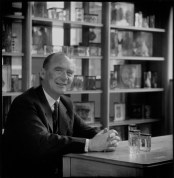
NPG x104740; Maxwell Marsden ('Max') Bull by Antony Barrington Brown

Max Bull, ten years before I knew him

Greatest influences?

Max Bull, anatomist in Cambridge, Andrew Seivewright, Carlisle organ teacher. And most of all my beloveds: Susan and the three people who have taught me most about myself, Victoria, Hugh and Edward.

What do you pray for most?

I’m not sure what prayer is other than a journey into one’s inner being. If pushed I’d say I ache for justice without which there will never be peace (John XXIII, Pacem in terris). I’m not sure that peace in the sense that we use that word is a Christian concept. We need to fight.

What makes you angry?

  • Political correctness, particularly that which sees working class white people marginalized.
  • People in government who live behind electric gates in the Cotswolds or the Home Counties and have no idea what ordinary people have to endure.
  • The anti-intellectualism and corporate managerialism of the church. Of course, I yield to no-one in my admiration for bishops, especially those to whom I have pledged canonical obedience. Anyway, as a cradle Wesleyan I’m not sure what bishops are for.
11693848_858965777491271_7579100299443984576_n

From our Tree of Life carpet (Qum)

What makes you happy?

I don’t think anyone has the right to be happy. We have a duty to contribute. But if you press me:

  • Intellectual eye-twinkling vitality.
  • Vibrant colours, especially red, in gardens, glass and fabrics.

What gives you hope for the future?

  • Biological processes that should wipe us out for a fresh start.
  • The intellectual suppleness and open-mindedness of young people. So of course the church is the ideal working environment for me … not.

A Swiftian circular argument

wmNone for ages, then three at once. Like buses. Funerals I’m talking about. And what a trio: the 20-year-old murdered in Jerusalem, then two from the same extended family with strong church and business connexions—big funerals.
They don’t half take it out of you. Or rather me. The 20-year-old’s last week was excruciating for personal reasons, nails hammered in wounds still raw, but the most difficult that I’ve ever had to do, Hugh excepted, was about 10 years ago, very soon after ordination. A thirty-something-year-old mother of four dropped dead as she was preparing supper. No warning, just kerplunk. I was just about doing OK at the funeral until, during my address from the pulpit, my eyes rested upon the four year old weeping into her teddy bear. Ye Gods.

It’s not easy to process all this—at least I don’t find it so. I asked for some advice from an experienced colleague about coping mechanisms and he said that he imagined the emotion passing down his body into his feet and thence into the earth. He’s something of a Buddhist Christian, and I see that that might do the business for him, but it doesn’t work for me. I’m not sure what does. Sleep possibly.

All jobs have their stresses. I don’t pretend clergy stress is worse than that of any other occupation. After all, we have a free house even though the kitchen is dire, a non-contributory pension (for how much longer?), about £24K a year (no, we don’t get to keep wedding and funeral fees), and, as has been so frequently pointed out to me, we only work one day a week. This remark retains its freshness even on the 137th hearing. So amusing.

Notwithstanding, parochial ministry brings stress of an unusual and peculiar intensity of emotion. Funerals illustrate one aspect, but there’s the stress that comes from the disconnect between the expectations of others, for example that the Vicar will always be smiling and willing to agree with whatever loopy and self-serving notions that fall on his ears, and the demands of the organization and—dare I say—demands of the Gospel to confront hypocrisy and injustice. Like a former Vicar of Chesterfield and Archbishop of Cape Town, Geoffrey Clayton, I was determined when I was ordained that nobody should ever say of me “our nice new Vicar.” Nobody ever has. Or will.

Is this the reason why there is so much fallout from parochial ministry? They are leaving it in droves for such as chaplaincies (much better pay, defined hours of work, protection against exploitation) or civil employment. One of the curates ordained the year before me stuck it for about 18 months, then said she wanted her weekends back.

Anyhoo, it’s time for a palate cleanser, a tart lemon sorbet to mop up the funeral emotion and start the salivary juices flowing again.

I see that novelist Ian McEwan is in the soup for suggesting that before long all the old people who voted Brexit will be dead so we can vote again to stay. Let’s take it a step further. Does it not strike you as a waste of NHS resources that so many old people have expensive hip replacements and then die soon after? Maybe the surgery is too much for them. Maybe they’re shoved downstairs by some avaricious trout who wants their money or house or whatever. It may be practice for the surgeons, but would it not be better to spend the money on getting young people back to work? And what about all the mobility scooters? Would it not be better to force the occupants to go to the gym three times a week and tone up, shed flab and strengthen the heart? There is no better medicine than human sweat. It might be cheaper.

But wait a minute—they might live longer. We can’t have that. Such a drain on the national purse. Maybe we should be forcing cream cakes down people’s throats to send them to the starry heights sooner. Or feeding them antibiotics so that they’ll be carried off by superbugs, leaving only the genetically resistant to repopulate the earth. This is a most attractive notion. It grows on me. A government commission should surely be set up. I shall chair it.

Bearing in mind how I began this piece, you might say “but it will mean more funerals for you”. I doubt that. More and more funerals—sorry I mean Celebrations of Life—are in the hands of non-religious celebrants. Well, I say non-religious, though I gather that they have prayers and very often the Our Father. It’s important to retain a bit of folk religion even though Christianity is actually a middle-eastern religion and it might be more English to go for the pure pagan. Have you seen The Wicker Man with Christopher Lee? There’s something to think on: why wait for people to die?

I’ll get my coat.

Hannah Bladon: life abundant cut short

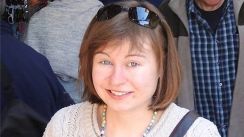
_95649795_mediaitem95649794Hannah Bladon was killed in Jerusalem on Good Friday. Here is my eulogy delivered at her funeral today, 

I met Hannah soon after I came to Burton in 2014. We were waiting for mass to begin in St Paul’s. Although we’d never before set eyes on each other, Hannah, characteristically direct, came over and made some intelligent remark about the liturgy. I was dumbstruck. The thought that a young person in today’s Church of England might be interested in liturgy was intoxicating.

We chatted some more. Within seconds it became clear that this was a most unusual young lady: bright, intellectually supple, intellectually resilient, intellectually fearless and completely open-minded. I had to reach for the sal volatile before I fainted, for this was almost too much for my system. An intellectually supple and open minded Anglican. Can you imagine such a thing? I said so and we dissolved into laughter.

It seems that not only did I instantly take to her, but she also took to me. I think this is the reason I have the heart-rending honour of speaking to you on this desperately sad occasion. I thank everyone who has told me about Hannah, but particularly Stella and Max.

Not only intellectual resilience

Hannah was born with a dislocated hip undiagnosed for 18 months. Treatment involved hip traction, the wearing of heavy boots, and frequent hospital visits. But never a word of complaint. In fact it was those visits, usually accompanied by Granddad Colin that resulted in ‘granddad’ being Hannah’s first spoken word.

Hannah knew what she wanted. Parents wonder is this determination or pig-headedness? She was the first player to sign for Burton Ladies rugby club juniors. Even though she was quiet and slightly built, you learned to underestimate her at your peril, as her opponents discovered. She was a winger—nippy, a different sort of resilience. She was the first girl to come off the pitch with blood on her shirt, but soon bounced back.

In Jerusalem Hannah was up at 5 am to get to the dig site by 6. Her friend said that Hannah would arrive back in the evening filthy and exhausted—often too exhausted to shower—and go straight to bed. One of the people Hannah worked with was Bob Henry, a retired chemist from Alabama. Bob flew home at Easter, but when he heard about Hannah he was devastated, and flew back to Israel to meet Stella and Max when they went to bring her home.

Hannah knew justice, mercy, humility

Prophet Micah advises us to do justly, love mercy and walk humbly with God. Hannah did not need to be told any of that. Her last act of kindness on the day she died—one that according to friend Christina was common for Hannah—was to give up her tram seat to a young mother. She was not political, but believed all people should be equal. She had a profound sense of justice for the underdog. She did not think she was special. She lacked self-confidence. She never expected to get the HSBC scholarship that enabled her to go to Birmingham University in 2015. She never expected her application to the Rothberg International School at the Hebrew University of Jerusalem to be successful. The assessors could see what she did not: what a wonderful ambassador she could be.

An upward trajectory

Hannah was a member of a local archaeology group, and had a great interest in history. During the dig that was completed on Maundy Thursday, she excavated a vase of a type not previously known to have existed at that time. She was interested in the past but did not live in it: she used the past to inform the present for the future. One of her lecturers in Jerusalem described Hannah’s career as being on a ‘steep upward trajectory’, and said that he would have given anything to work with her when she’d completed her doctorate. Others have said that whatever came out of Hannah’s mouth was worth listening to—certainly my experience. Her impact on others was recognized by Mr Netanyahu, the Israeli Prime Minister ,who mentioned Hannah in his Remembrance Day address on 1 May, and by the Archbishop of Canterbury who was with the Bishop of Lichfield and the Chief Rabbi in Jerusalem a couple of days ago. The Bishop told me that he sensed that Hannah was regarded with awe by her colleagues.

Drains and radiators

It is a truth universally acknowledged that people can be divided into two categories—not sheep and goats, but drains and radiators. In pastoral ministry one comes across a lot of drains. They suck the life force from you as they enjoy ill health, or enjoy finding fault. They try to draw you into their jaundiced world view. They are full of ordure. Hannah was no drain. She radiated energy. She loved a discussion. She had, as I’ve said, a sense of justice that made her dogged and protective. All these characteristics say something profound about the family. Quite clearly they recognized the extraordinary young lady that Hannah was. To their credit never once did they try and mould her into something less challenging, as many parents would have done. They marvelled at her.

In conclusion, some personal remarks

Let me offer you all some advice. You will not know what to say to Stella and Max, to Colin, June and Malcolm. There is nothing you can say that makes any sense. The best thing that people said to my wife and me when our son died was ‘there’s nothing I can say’. Don’t say ‘I know how you’re feeling’ because you don’t. Don’t say ‘time heals everything’ because it doesn’t. Don’t say ‘she’s in a better place’ for I suspect that she’d rather be up to her armpits in sand. Much better to do something than to say anything, so give them a cuddle and weep with them. Often. And when you meet them in the street, don’t go out of your way to avoid them, but take them for a coffee. Or a gin.

And finally to Stella, Max, Colin, June and Malcolm. Grief at the loss of an adult child is in my experience fierce, bitter, and overwhelming. It is malignant and insidious. It blots out heaven. Your psyche has suffered the most violent attack imaginable. You will need all your energy to look after yourself, so do not waste it on other people. Be kind to yourselves and to each other, indulgent even. Have no expectations. Don’t do anything you don’t want to do. Don’t let anyone tell you what’s good for you—they’re just trying to make themselves feel better. Learn from dogs. When a dog is injured it retreats to its basket and there it stays until it feels better. After 18 months my basket remains the place of safety where I find solace. And when you’re in your basket, you will weep for the loss of that glorious creature whose life was taken in a random act of violence by a sick man.

Sacramental assurance

247f11754cd5847ddbc149fb2acdc2beI’m intrigued by the frequency with which different people receive Holy Communion. Some receive daily, some twice or thrice weekly, some weekly, fortnightly or monthly. Some receive only three or four times a year. I suppose it’s a matter of personality, tradition and upbringing. Even theology too. But I can’t help my mind wandering. So bear with me in this gentle meander.

First, let’s consider those who receive three or four times a year. Clearly they don’t feel the need of the sacrament in that form any more often. Perhaps they are pure, holy and incorruptible,. Maybe there is nothing more to be said. Or perhaps the sacrament that they receive so infrequently has been so powerfully consecrated by a minister so virtuous that its efficacy is so very long-lasting, despite the havoc wrought by gastric acid and intestinal and hepatic enzymes. If so, I can see how three or four times a year would suffice.

Or perhaps it could be that the gastric acid and digestive juices of this group are weak, thus having little effect on the mystical power inherent in the consecrated bread and wine, which are thus largely unaffected by natural secretions. There is another possibility, namely that these people are all recovering alcoholics and so not permitted wine more often than three or four times annually. Of course they shouldn’t have it at all unless, as in the case of a former King of Saudi Arabia, the alcohol turns into fruit juice as it passes the cricopharyngeal sphincter. Frankly, I think this argument is stretching things a bit, and it seems to me that one could never establish the truth since if one asked such people of their boozing history they would almost certainly tell fibs.

At the other extreme there are those who take the sacrament daily. How might this be explained? Perhaps they are very, very wicked indeed and need constant mystical reinvigoration. Or maybe the priest who consecrates the elements is a very naughty boy or girl with as a result such weak powers that the efficacy of the sacrament is ephemeral. Or maybe these priests have been ordained by a bishop who is not a member of the right club, or has the wrong sort of genitalia. Or maybe, just maybe, these people have such powerful gastric secretions and intestinal enzymes that the spiritual power of the elements stands no chance whatsoever.

A research project calls. It would involve volunteers of course, together with physiologists, lab technicians, geneticists and theologians: a multidisciplinary project to elucidate a tricky issue.