Blessed are the cheese makers


bavaria-blu-self-2Homily for Year B, Proper 14

1 Kings 19:4-8. Psalm 34:1-8. Ephesians 4:25-5:2. John 6:35, 41-51.

I am the living bread that came down from heaven. Whoever eats of this bread will live forever; and the bread that I will give for the life of the world is my flesh.

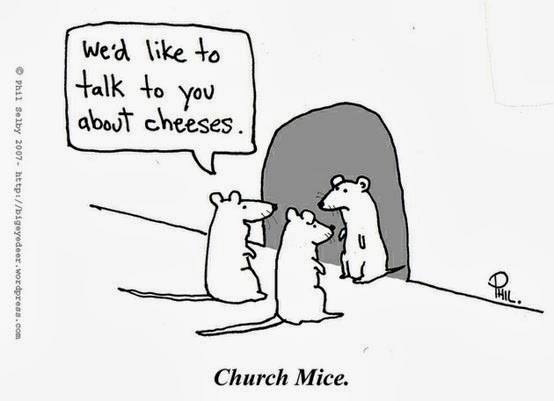
I’m talking about dairy products this morning, but before I do, I ponder the problem that cheese lovers have when it comes to spreading the word.

People sneer at virgin birth, resurrection, ascension, eating flesh and drinking blood. They laugh at the notion that the world has been saved by an angry God who has his own son murdered to satisfy that anger. They ridicule the idea that people might pray for someone to get better, or for something not to happen. They laugh at an imaginary friend.

People—all of us—are losing the ability to read between the lines. We are inclined to take the printed word literally. We are inclined to think that if it’s printed it must be true.

Scientific ways of thinking have schooled us to think that unless we can see it, touch it, feel it, measure it, it is of no importance. We think in terms of yes, no; right/wrong; true/false. We began to feel that we are right, and that those who disagree are wrong. We lose the ability to cope with both/and, with ambiguity. We lose the willingness to consider that there might be grey areas. We lose the ability to think in pictures.

This matters when we read Holy Scripture. It was written in languages that are not now spoken. It was copied by hand again and again. It has been translated into Latin, then English. Do we allow for ambiguities and mistakes that are therefore inevitable? Do we allow for not being able to see the facial expression of Jesus, or Paul, or whomever, so that we can’t know when they’re being ironic, or have a twinkle in the eye? Scriptural idioms have been torn from their cultural and geographic contexts. Do we allow for that? What would a visitor from, say, Vladivostok make of our expressions such as raining cats and dogs; scales fell from my eyes; wet behind the ears; green with envy?

With all that in mind, let’s talk about cheeses. Look at the last sentence of today’s Gospel: Whoever eats of this bread will live forever; and the bread that I will give for the life of the world is my flesh.

First, what does “live forever” mean?

The Greek for forever is aion, from which we get aeon. It has several meanings, such as lifetime, generation, destiny. Is it to mean for all eternity? For ever? Or is it about a quality of life beyond time in which time is of little importance. Does it perhaps mean something like what we mean when we say “to the ends of the earth”? A declaration of intent, of commitment. Is it about destiny, that is, our inclination towards God, our home?

Exploring like this enables us to move beyond a literal meaning of Scripture and move into something altogether more exciting and imaginative. It enables us to engage with people who dismiss the simplistic notion of life after death.

Next, in the same verse in the Greek, we have “I shall be giving over the bread which is my flesh for the sake of the ‘cosmic’ system of life. Whatever else cosmos may mean, it is also about good order. So the bread of life, the flesh of Jesus, is about order, as opposed to disorder. This is wisdom. Or, if we want to think about cosmos in terms of the universe, then the Jesus event is about more than simply humanity. It’s about the transformation of the whole existing order. It’s about a worldview that is far more exciting than the self-obsessed me me me of personal salvation.

My third point for this morning is “I am the living bread.” The living bread is all that Jesus and his message encapsulate: recognition of our dependence upon something much greater than us, our dependence upon one another, our need to let go of attachments, our need to accept that we are not in control, that we are here today and gone tomorrow, that there are cosmic forces not dependent upon us, that we have urges and inclinations that can yield great beauty and others than can lead to immense harm. All this is the living bread.

If we wish to share our faith with the sceptics of today, we need to engage our brains for new ways of talking about God and Jesus that sidestep issues like virgin births and the doctrinal stuff that’s hard or even impossible for 21st century westerners to swallow.

I am the living bread that came down from heaven. Whoever eats of this bread will live forever; and the bread that I will give for the life of the world is my flesh.

The Divine (“God”) is all that is beautiful, delightful, lovely, creative and ordered (i.e. just and true). There is a bit of God in everyone and everything: we are all broken off bits of God. “What is not God is nothing; what is not God is no thing.”

God is the laws of science (logos), of physics, of the cosmos, … and much more. God is love. The perfect human manifestation of logos is Jesus the Christ whose example and life we emulate as best we can in the circumstances in which we find ourselves.

Since none of us, despite God within, is perfect, we cock up. This is part of the human condition. Sometimes we do this intentionally and sometimes accidentally; sometimes by things we do that we wish we hadn’t, and sometimes by things we fail to do. We acknowledge our own mistakes, our own imperfection and our own helplessness. This is not to grovel, but simply to accept that we are not perfect and not in control, but that we will bash on doing our best.

The Divine within is like a pilot light. Incarnation. For us to be fully human that light needs to fill our skins from the inside. What stops it from doing so are things like pride, greed, avarice and showing off. To let it shine and fill us, it’s not that we need to DO something, it’s simply that we need to relax into ourselves, to recognize our pride, greed, avarice and showing off tendencies, and then let them melt away. When you lift up the lid of your psyche, you begin to see all sorts of grubs wriggling around. But then, in the warm light of love, they can begin to melt away as you love the hell out of yourself. This is at least a lifetime’s work.

“And if you want to know the way, be pleased to hear what he did say.” And what Jesus demonstrated is that we rise to the heights – we approach The Divine – when we let go of pride, greed, avarice, showing off – that is, when ego dies, and selflessness replaces selfishness. Crucifixion followed by ascension.
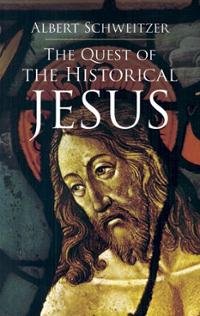
quest-historical-jesus-albert-schweitzer-paperback-cover-artAll the rest, the dogma, the doctrine, is poetry that has collected around the message. Much of it is of great beauty and psychological authenticity. Much of it is past its sell-by date and should be ditched.

Schweitzer: He comes to us as One unknown, without a name, as of old, by the lakeside, he came to those men who did not know who he was. He says the same words, ‘Follow me!’, and sets us to those tasks which he must fulfil in our time. He commands. And to those who obey Him, whether wise or unwise, He will reveal Himself in the toils, the conflicts, the suffering that they may experience in his fellowship, and, as an ineffable mystery, they shall learn in their own experience Who He is.
The Kingdom of God is like …

Fimble

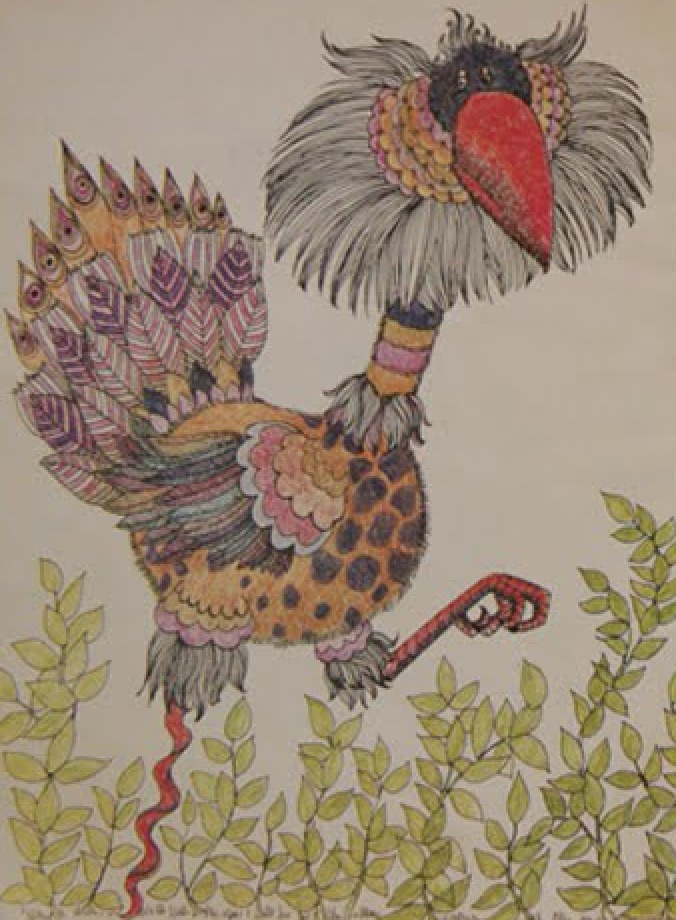
The Fimble Fowl (one of Helen Oxenbury’s wonderful illustrations)

The Quangle Wangle’s Hat

Homily for Trinity II, year B. Ezekiel 17: 22-24; 2 Corinthians 5: 6-10, 14-17;   Mark 4: 26-34

On the top of the Crumpetty Tree
The Quangle Wangle sat,
But his face you could not see,
On account of his Beaver Hat.
For his Hat was a hundred and two feet wide,
With ribbons and bibbons on every side
And bells, and buttons, and loops, and lace,
So that nobody ever could see the face
Of the Quangle Wangle Quee.

The Quangle Wangle said
To himself on the Crumpetty Tree, —
“Jam; and jelly; and bread;
Are the best of food for me!
But the longer I live on this Crumpetty Tree
The plainer than ever it seems to me
That very few people come this way
And that life on the whole is far from gay!”
Said the Quangle Wangle Quee.

But there came to the Crumpetty Tree,
Mr and Mrs Canary; And they said, —
“Did every you see
Any spot so charmingly airy?
May we build a nest on your lovely Hat?
Mr Quangle Wangle, grant us that!
O please let us come and build a nest
Of whatever material suits you best,
Mr Quangle Wangle Quee!”

And besides, to the Crumpetty Tree
Came the Stork, the Duck, and the Owl;
The Snail, and the Bumble-Bee,
The Frog, and the Fimble Fowl;
(The Fimble Fowl, with a corkscrew leg;)
And all of them said, — “We humbly beg,
We may build out homes on your lovely Hat, —
Mr Quangle Wangle, grant us that!
Mr Quangle Wangle Quee!”

And the Golden Grouse came there,
And the Pobble who has no toes, —
And the small Olympian bear, —
And the Dong with a luminous nose.
And the Blue Baboon, who played the Flute, —
And the Orient Calf from the Land of Tute, —
And the Attery Squash, and the Bisky Bat, —
All came and built on the lovely Hat
Of the Quangle Wangle Quee.

And the Quangle Wangle said
To himself on the Crumpetty Tree, —
“When all these creatures move
What a wonderful noise there’ll be!”
And at night by the light of the Mulberry moon
They danced to the Flute of the Blue Baboon,
On the broad green leaves of the Crumpetty Tree,
And all were as happy as happy could be,
With the Quangle Wangle Quee.

Edward Lear (whose works are, I hope, in the public domain)

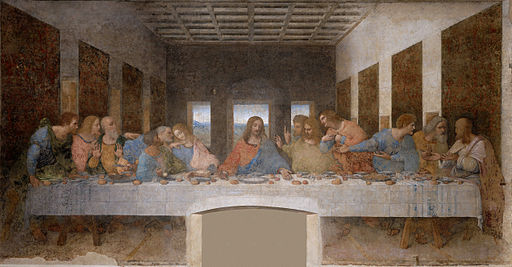
This do in remembrance of me

Leonardo_da_Vinci_(1452-1519)_-_The_Last_Supper_(1495-1498)Homily for High Mass on the Feast of Corpus Christi at S John the Divine, Horninglow, Burton upon Trent,

These words take us back to Jerusalem two thousand years ago. But they work the other way, too: they bring Jerusalem of two thousand years ago here today, to this place, in this place. And not just the words, but all the action and the whole occasion: the upper room, the meal, the celebration despite impending doom; the companionship of the disciples, even the one who had something to hide—and who doesn’t? ‘This do in remembrance of me’ brings it all into the present.

That is what sacraments do. They bring with them all the intervening years as well: all the Christians of the past, all the joys and sadnesses of history. The whole of the past concentrated into the words and action of the consecration prayer: we open the door of Dr Who’s Tardis and find ourselves in the vastness of history.

Every time the Lord’s supper is celebrated, the past is gathered up and presented to us, just as a snowball rolling down the slope incorporates the snow it has rolled over. Then in the heavenly banquet, past and present are refreshed, and launched into the world transformed. In an instant, the larva of the past becomes the imago of the future. Rebirth. Or, if you prefer astronomy, the entire universe is compressed, sucked into the infinitely dense black hole of crucifixion—the bloody, dirty hole of crucifixion—and propelled with infinite acceleration to create the glorious new universe.

This is a magnificent vision. All Christian theology and history concentrated into the moment at every Eucharist. No wonder we should celebrate it with all possible splendour and theatre and solemnity and joy. The entire cosmos gathered up and borne for an instant by the priest.

Each of us is a sacrament. Each of us has all our past within us. We are the sum of our memories. All our past is included in our genes: material from the primeval soup at the moment of creation are in every one of our cells. All this is sanctified in this sacrament. We are cleansed. We are fed. We are forgiven. We have the meal set out by the gracious father for the prodigal son. We are accepted. We are loveable and loved. We are launched for future service.

Lancelot Andrewes: a beautiful mind

Lancelot Andrewes: a beautiful mind

In the old Ritual of the Church we find that on the cover of the canister, wherein was the Sacrament of His Body, there was a star engraven, to shew us that now the star leads us thither, to His body there. So what shall I say now, but according as St John saith, and the star, and the wise men say ‘Come’. And he whose star it is, and to whom the wise men came, saith ‘Come’. And let them that are disposed ‘Come’. And let whosoever will, take the ‘Bread of Life which came down from heaven’ this day unto Bethlehem, the house of bread. Of which bread the Church is this day the house, the true Bethlehem, and all the Bethlehem we have now left to come to for the Bread of Life – of that life which we hope for in heaven. And this our nearest coming that here we can come, till we shall by another Venite come, unto Him in His Heavenly Kingdom to which He grant we may come, That this day came to us in earth that we thereby might come to Him and remain with Him for ever, ‘Jesus Christ the Righteous’.  (Bishop Lancelot Andrewes, Christmas 1620)

Life abundant

A little brown bird

A little brown bird

A homily for the Sunday after Ascension

Did you enjoy the reburial of Richard III down the road at Leicester? What a load of claptrap. Is that what the church is for now: heritage industry, pageantry, posh dresses, and anodyne addresses? That’s what people seem to want. Is this worship of the past all that we’re about. I hope not.

Evidently not for Jesus. In St John’s account of Easter morning, he says to Mary Magdalene ‘Don’t cling to me, Mary, for I have not yet ascended to the Father.’ I would be ashamed to confess how recently it dawned on me why this matters. I used to think that it was in Mary Magdalene’s interest not to cling to Jesus, and couldn’t work out why. Then I realized. It’s not for her sake, but for his (which in the long run is hers, but bear with me). ‘If you cling to me, you’ll stop me doing what I have to do’. Not for Jesus any idea of sticking with the past or even the present, but for him—and it could have been said brusquely—‘let go of me, I have work to do.’

We’ve waited 40 days since Easter to celebrate the Ascension and now, thank God, we’ve done so with great joy. Life that has been on hold, as it were, for 5+ weeks now resumes. I’d like to look at the Ascension in three ways.

First, the cosmic event. At the incarnation, God takes human form and enters into all human experience. These events take place at one time and in one place. At the Ascension the Christ-event becomes available to the entire cosmos, unlimited by space and time. Outside time—ex stasis. The cosmos is redeemed.

Second, the personal event. God returns into the Godhead. God returns to Godself, goes deep inside himself. This is a model for the way we can journey into ourselves, a call to searing self-examination, the better to gain wisdom and insights in the service of others. Paradoxically the more one goes into oneself, the more one is free from oneself. It is painful, as the crucifixion was. The blackening of the forge (Jung’s nigredo) before the transformation to new creation. Personal blackening, personal crucifixion, personal resurrection, personal ascension as we learn to fly—yes, fly. We become unlimitedly available for service to others, as Christ was unlimited by the Ascension. We do not impose ourselves on others, as Christ never did. It is a leaving behind of self, just as Christ left behind human flesh. An ascension beyond self.

Third, the salvation event. We are human beings. There is nothing shameful about this. If there were, why would the Ineffable God have taken the trouble to become one? At the Ascension all human experience was lifted up into the Godhead. The ascended Christ is the wounded Christ, the wounded healer, insulted, spat at, nailed, kicked, beaten, thirsty. By his wounds, we are healed. Through our woundedness we can act as channels of healing for others. We do not need to pretend to be what we’re not—that’s the sin of Adam and Eve in the garden where they tried to cover up who they were. Humanity with all its imperfections is divinized: ‘God became man so that man might become divine’—the interpenetration of divine and human. Rising above is always a metaphor for release, for a yearning (eros) for better things. Such yearnings are part of the human condition. The abused people I have dealt with ache for better things, and look forward to a better life. Ascension as something to aim for.

So what?

God became man in order to raise man to God. Christ takes human-ness to the Divine Godhead. The Ascension unites earth to heaven, humanness to divinity: sanctification, divinization, redemption, theosis, call it what you will.

We are too obsessed with the puritan mentality of the BCP, miserable sinners and so on. We wallow too much in self-flagellation. This is self-obsession, a kind of inverted pride. We are obsessed with what we are saved from. We need to lift our eyes to what we are saved to: glory and splendour of Ascension. This is why we need the Ascension: to rekindle, restore, our sense of hope in a world where we hear and see too much of the nastiness of humanity, where we hear of people who ignore that longing for the divine, who shut it out. We need this when we hear the bad news that the media seem to like to concentrate on and when we are, as I have been this week, dealing with people for whom life is not worth living.

God the Logos became what we are, in order that we may become what he himself is. The glory of God is a living person and the life of man is the vision of God.

Harry Williams, author of

Harry Williams, author of “Life abundant or life resisting?”

The mission Jesus gave the apostles was simple. It was to teach others what he had taught them. So what are you going to do about it?

Let’s put heaven on earth. Let’s ascend to new possibilities. Let’s do what we can to enable others ascend to the heights of humanity. This is sharing in divinity.

You write a new page of the gospel each day, through the things that you do and the words that you say. People will read what you write, whether faithful or true. What is the gospel according to you?

What is the gospel according to you? Mine is life abundant, not life resisting.

False Prophets

This is not mine. It comes from the website of the Association of Catholic Priests http://www.associationofcatholicpriests.ie. If I knew whom to acknowledge, I would.

It contains this wonderful line: Often the gospel is diluted to accommodate the prejudices and lifestyle of the parishioners.

Oscar_Wilde_portraitAdmirers have suggested that the brilliance of Oscar Wilde’s plays was only surpassed by that of his conversation. He was a superb raconteur whose conversational offerings were heavily laced with irony. He had a particular penchant for parables, often recounting them in the style of the gospel narrative. Here is one of them. “One day, an unknown man walked down the street. It was the first hour of daylight and people had not yet gathered in the market place. The man sat down by the wayside and, raising his eyes, he began to gaze up to heaven. And it came to pass that another man who was passing that way, seeing the stranger, he too stopped and raised his eyes to heaven. At the second and third hour, others came and did likewise. Soon word of this marvellous happening spread throughout the countryside and many people left their abodes and came to see this stranger. At the ninth hour, when the day was far spent, there was a great multitude assembled. The stranger lowered his eyes from heaven and stood up. Turning towards the multitude, he said in a loud voice: “Amen, amen~ I say unto you. How easy it is to start a religion!”

To start a religion, as Wilde observed, may not be that difficult, but to ensure its survival is quite another matter. People are gullible. Futurists predict a growth in religious activity in the 21st century. For them it forms part of the leisure industry which is expected to expand dramatically. Whether one should greet this prediction with joy or apprehension is a matter for debate. A purely statistical increase in church membership is a dubious gain. What counts for Christianity — indeed, what ensures its survival — is not external but internal growth. What is required is not more members of the Catholic Church, but better disciples of Jesus Christ.

Mere membership and full discipleship are worlds apart. Christianity has always suffered from a surfeit of members and a shortage of disciples. Humans are social animals and crave to be associated. In a world grown cold and depersonalised the churches offer a comfortable ambiance of friendship and security. Often the gospel is diluted to accommodate the prejudices and lifestyle of the parishioners. Few preached fearlessly enough, like St Paul, to risk their livings, let alone their lives. The radical Christ is made into a benign bishop and the collection plate registers members’ approval. Too many withered branches remain un-pruned.

St John tries gently to prod us into discipleship. “My children, our love is not to be just words or mere talk, but something real and active.” You won’t meet Christ in your Sunday liturgy, if you haven’t rubbed shoulders with him in the office, in the factory or in the kitchen. You won’t hear his message from the altar, if you were deaf to his call at your office desk. Jesus put it simply and bluntly: “It is to the glory of my Father that you should bear much fruit and then you will be my disciples.”

The difference a day makes

Fruits of imagination

Imagination yields beauty

Say Not the Struggle Naught Availeth

Yesterday everything was gray and dull. There was no point living. Why struggle when death comes as the end and a great future has been behind me ever since I passed the 11-plus?

Perhaps it is indeed, as Acorn Antiques has it, God’s way of telling me to watch Gardener’s World.

But today, after a good few zeds, what a turnaround! Still the infection, still the breathing difficulty, still the feeling that all my bones are out of joint. But gone the continuous snot, the sore upper lip, the throbbing sinuses, the aching teeth. No longer is my strength dried up like a potsherd; no longer doth my tongue cleave to my gums; no longer am I a worm, and no man; no longer is it that many dogs are come about me. Only Og, as it happens, beside me on the sofa, busy with an avian osteological specimen.

The Kraken waketh. The brain sizzleth. The eyes sparkleth. I’m feeling Rosie all over.

Is this what happens after celebrating the Holy Mysteries twice? Is it the combined effects of good sing, good liturgy and clouds of the billowing Basilica and Pontifical mixed?

All of the above.

Spring is sprung, de grass is riz, I wonder where dem boidies is? Dem boids is on de wing. Ain’t dat absoid? De wing is on de boid.

My Easter message is: imagination.

In his novel ‘The Power and the Glory’, Graham Greene has one of his characters say ‘hate was just a failure of imagination’. He is right, Now, turn that the other way up. Love is the blossoming of the imagination. Love is resurrection. Love is renewal. Imagination comes even after bacterial and viral toxins have done their worst.

Let imagination explode. Without it, we would still be scrabbling about in caves.

Blood, flesh and bread

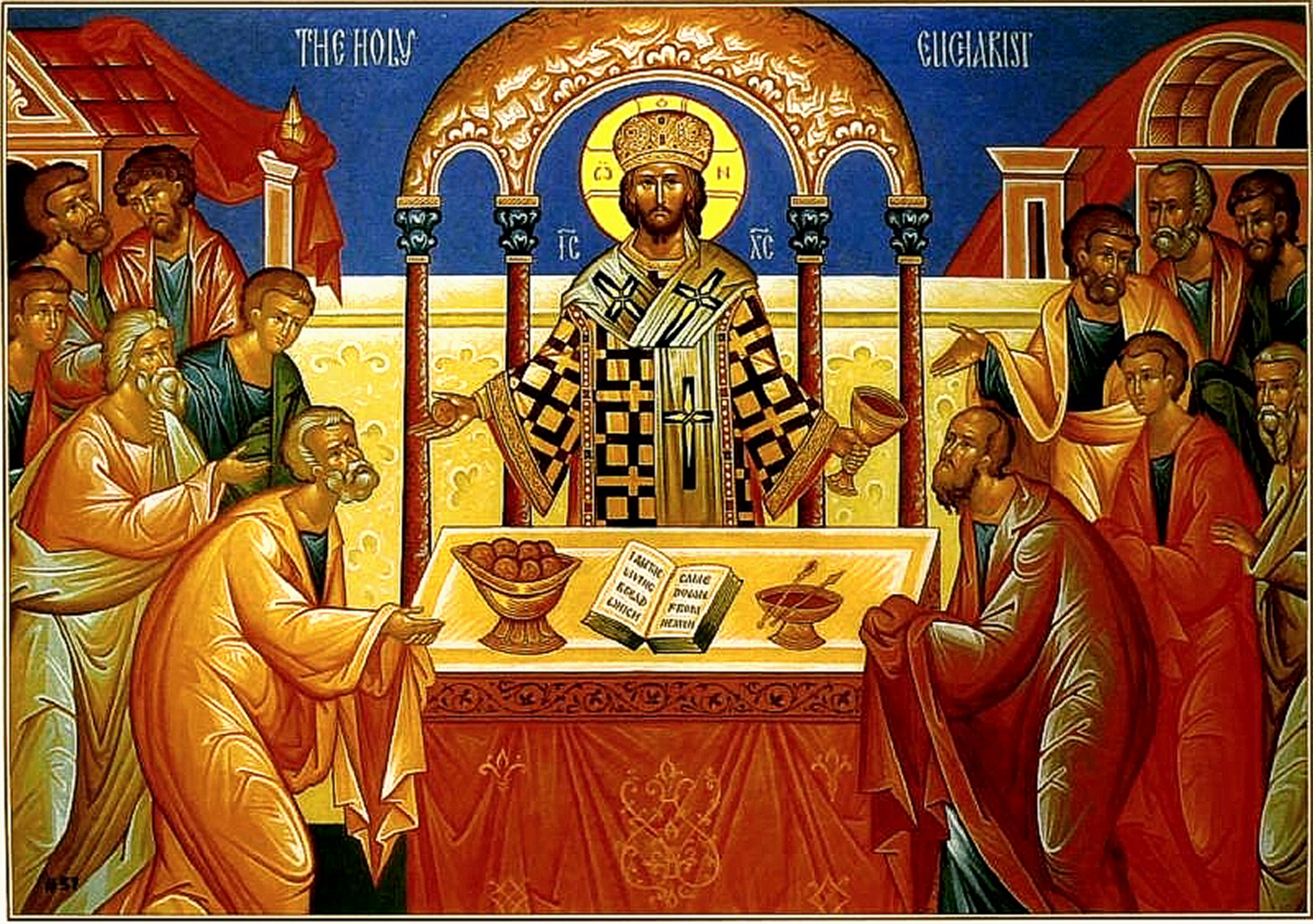
The-Holy-Eucharist4People of the Book are much more at home with parts of the body and bodily functions than we are. They think nothing of talking at length about blood, guts, wombs, circumcision, hearts, body, eyes, ears. They are much less prissy and much more down to earth than respectable Anglicans are.

Let’s start with blood.

The film Gandhi has Charlie Andrews on a crowded train, hauled up to sit on the roof. An Indian says to him ‘I have friends who are Christian: they eat flesh and drink blood every Sunday.’ It’s a friendly greeting, though with today’s flesh-eating zombie and vampire films and video games, people might think otherwise.

We can bleed to death. As the blood seeps away, so does the life-force. Lack of blood equals death, so blood equals life. For Jews and Muslims, ritual preparation of meat to eat involves draining all the blood so that they are not guilty of consuming the God-given life force. (I like black pudding so am doomed I suppose). The blood that marks the doorposts in the first Passover signifies that the house will be preserved: blood equals life. The blood of Jesus, the blood that flows from his crucified side, gives life to the world.

Blood brings nutrient to the cells of the body. What more nutritious than the Sermon on the Mount?

Blood contains red cells that bring oxygen to the tissues. Get rid of the polluting smoke of duty and should, and instead take up the oxygen of freedom from worldly burdens. We are in the world, but not of the world.

Blood has white cells that fight disease and maintain health. Think about that.

Blood removes rubbish from tissues of the body, and contains platelets that plug holes in blood vessels. The resources of the church are there for us when we feel burdened, and life overcomes us. Come unto me all that labour and are heavy laden, and I will refresh you.

When I hear of the ‘blood of the lamb’, I understand it as, quite simply, the life of the Divine. As St John’s Gospel has it: ‘Unless you eat my flesh and drink my blood, you shall not have life within you’ (John 6:53). And in the passion gospel we hear that when Christ’s body was pierced, blood and water flows out to sanctify the earth.

Now body, specifically on Holy Thursday, feet.

For most of the people on the planet, feet are even more important than they are for us. Bad feet = no work. Feet need to be cared for. Washing feet an example of service and kindness. And naked feet of the very rich look pretty much like naked feet of the very poor.

Imagine Jesus and the disciples’ feet. No stout brogues, and I doubt that they would have been so lacking in fashion sense as to wear socks with their sandals. Who knows what they trod in. So in washing their feet, Jesus was taking a bit of a risk.

This is a cleansing, like Baptism. A washing away of the dust on our feet, that is, washing away the past. It’s a confession. And as we wash each other’s feet we might confess our weaknesses to one another. In truth, we should be washing each other’s feet as a preparation for every mass.

Now bread.

Companion means [taking] bread together. That is a sermon in a sentence. Bethlehem, Bet Lahm, means house of bread. Another sermon.

Finally, an invitation

I could end with George Herbert’s invitation (Love III: Love bade me welcome …), but instead I opt for Bishop Lancelot Andrewes’ play on the word ‘come’ in his Christmas Sermon of 1620.

Lancelot Andrewes

Lancelot Andrewes

In the old Ritual of the Church we find that on the cover of the canister, wherein was the Sacrament of His Body, there was a star engrave, to show us that now the star leads us thither, to His body there.

And what shall I say now, but according as St. John saith, and the star, and the wise men say, ‘Come.’ And He, Whose the star is, and to Whom the wise men came, saith, ‘Come.’ And let them who are disposed, ‘Come.’ And let whosoever will, take of the ‘Bread of Life, which came down from Heaven’ this day into Bethlehem, the house of bread. Of which Bread the Church is this day the house, the true Bethlehem, and all the Bethlehem we have now left to come to for the Bread of life, – of that His life which we hope for in Heaven. And this our nearest coming that here we can come, till we shall by another venite come, unto Him in His Heavenly Kingdom to which He grant we may come, That this day came to us in earth that we thereby might come to Him and remain with Him for ever, ‘Jesus Christ the Righteous.’

Holy week here and now

Agony

Plenty people tell me they don’t need an imaginary friend to help them get through life. I’m not sure I do either. There’s nothing imaginary about the events of Holy Week: they happen all the time.

Take the Passion narratives—three obvious headings: (1) failure to confront reality, that is to say, denials; (2) mob justice; and (3) evasion of responsibility.

Denials. Peter’s denials saved his skin—but only for that moment. Later, he wept, overcome with remorse. It’s hard to hear today’s news without being confronted by denials. How can a head of state deny his part in a situation that sees the bulk of his people starve while he lives in luxury? How can a politician say what is self-evidently not the case? Is anyone guilt-free? Who has not tried to get something for nothing, or used work time for personal business?

Mob ‘justice’. Men fighting in Manchester car parks on the news yesterday. FaceBook bullying. One story from 2007 sticks in my mind. In March of that year, The Times reported, a young man was surrounded by a gang with wooden sticks. Witnesses say that teenage girls egged on the attack with shouts of “Kill him, kill him.”

Evasion of responsibility. Pilate wriggled out of responsibility and washed his hands, the act of appeasers everywhere. Pilate needed to please his superiors. Sound familiar? Do you know a public service that is quick to take responsibility for its cockups? A politician? A banker? It’s easy to pick on them because they set themselves up for it.

We all make mistakes. We’re greedy. We want the dividends if we’re lucky enough to have money invested. Our pensions depend on them. We’re all complicit in all this, the sin of the world, and the consequences will run and run for generations. I accept that, and I can’t and don’t condemn anyone for faults that also afflict me. But the arrogance and lack of remorse that we see in public life is something else. According to the Gospels, Jesus was censorious about very little, but always, always, always about hypocrisy and complacency. Do you remember Josef Fritzl who locked up some of his family for almost 30 years? Even he seems to have acknowledged, eventually, the enormity of his actions after being confronted by his daughter in court. If you want Fritzl on a big scale, think of North Korea, where people are walled up for their entire lives.

The three headings can in truth be compressed into one: the sin of Adam—trying to be what we are not. The fig leaf has nothing to do with covering up our genitals, but is about covering up our naked selves by putting on a mask, a persona to hide our true faces. We deny the truth because of our need to save face, but it’s not the face that suffers. It is the inner self that I harm when I deny what is evident to others. This inner self that is, in my theology, the Christ within, the Divine within. When we harm others, we wound the Christ within them and we wound the Christ within ourselves, as surely as any nail on the cross.

Life is a struggle, and for most people on the planet it’s more of a struggle than it is for you and me. I look around and see the beauty and fragility of creation. One man’s illness results in the death of a plane load of people. Creation is constantly beset by terrible acts of evil, appalling events everywhere. Hundreds of innocents are slaughtered in power struggles: one group of people trying to control others. I hear of it even in my own land, my own town: abuse, slavery of one sort or another. “At times it almost seems as if the very stars are being wrenched from heaven by some evil force” * — which is exactly how the events of Good Friday are described in the Gospels.

This urge to the inhuman is in us all somewhere. Evil, badness, cruelty all begin as a thought in someone’s mind. When someone decides to support the things that evil people do, that decision begins as a thought in someone’s mind. When we are tormented by what to do, when beads of sweat start forming on our foreheads and drop like grapes to the floor, we are experiencing something of the mental agony that we hear of in the Garden of Gethsemane.

All this because we have the power to choose, wisely or unwisely. The power to choose actions that might fracture (diabolic), or might build up (anabolic). The power to choose actions that might increase the amount of misery in the world, or that attempt to decrease it.

The story of Adam and Eve in the Garden of Eden attempts to explain why we humans so often get it wrong. It illustrates that when we choose for selfish reasons rather than for selfless reasons, we disturb the cosmos. It explains why we so often hide behind masks, spiritual cosmetics, spiritual fig leaves, rather than stand in full frontal nudity before the Divine.

Every choice begins as a thought. We need to be aware of our thoughts because we need to choose wisely, to have courage to stand for truth and right, to have courage to be nonconformist, and stand up to those who try to persuade us to do what we know we should not. We may be laughed at, scorned, cast out, sneered at. But from this suffering we grow in self-knowledge, and growing in self-knowledge, with all the shame and joy that such growth brings, is a step towards growing into the Divine. We have a guide.

* thanks to The Revd Elizabeth France