Lost and found

prodigal_son3Exodus 32:7-14; 1 Timothy 1:12-17; Luke 15:1-10.

I suspect many preachers will use these texts to exhort us to seek out and tend the hungry, the homeless, the poor, the destitute. And so we should. But I think there is something else too.

These are stories of restoration. They come before that most moving tale of restoration – the man with two sons, the gracious father, the so-called prodigal son. Another story of lost and found. One son is lost in recklessness and wilfulness, the other in envy and resentment. The gracious father welcomes the wanderer home, and is ready to ‘welcome’ the sulker back to grace.

Homecoming is the theme. Homecoming is what Christianity is all about: forgiveness, shalom, reconciliation, restoration.

Getting lost, however distressing, is necessary. We can’t seek something until we realize that we’ve lost it. We need to miss something in order to welcome it home. Although we’re often like the a-wandering and a-squandering son, and often like the begrudging son, we need to move beyond them, and  become the father: compassionate, welcoming, forgiving. This is how we find eternity and peace – when we are ready to welcome back home.

And what is it that we need to welcome home? What is it that, like the shepherd and the woman, we need to seek?

I wonder if inside each of us there is something that we think we’ve lost. Maybe we begin to realize that there is part of us that we’ve covered up with fig-leaves of pride, arrogance, and the certainty that we are right. It was never lost, of course, just hidden from view. The sanctuary of the soul. If only we knew it, what we seek is what we already have: the Divine within. We can’t reach this inner self unless we have been lost. We re-turn, and return as we strip away the leaves of amour propre, the dignity on which we are so ready to stand.

I suspect that nearly all our spiritual sickness comes from trying to bolster up a false self-image, together with a sense of guilt or shame about it. We’re reluctant to accept ourselves as the maimed creatures we are. When we acknowledge that we are imperfect, and see the full extent of our imperfections, we come home. We find ourselves. We relax into ourselves. When we confess our sins, we feel great liberation, a great sense of being at home.

I turn with groaning from my evil ways, and I re-turn into my heart, and with all my heart I turn to thee. God of those who turn, and saviour of sinners, evening after evening I will re-turn in the innermost marrow of my soul. (Lancelot Andrewes 1555-1626)

In today’s stories about lost and found, and in Exodus, we are assured that the Lord is never indifferent. The shepherd seeks out the lost sheep and brings it home. The lost sheep is part of self. We are no use to anyone, least of all ourselves, unless we recognize our own need for homecoming.

Coming home to the Divine. Through re-turning we return to the divine by surrendering.
One Sunday, three sermons

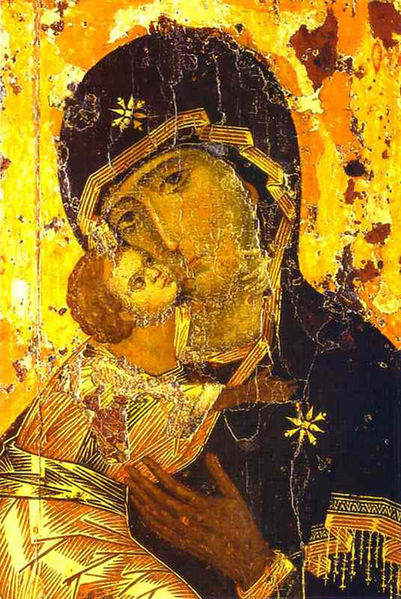
VladimirThis Sunday, 8 September 2013, really needs three homilies.

Firstly, it’s the Feast of the Nativity of the Mother of God. Contrary to what many RCs think, Mary is held in high regard in the Anglican churches. In the C of I calendar there are three festivals for Mary: the visit by Gabriel, Mary’s visit to Elizabeth, and her Nativity. No other saint has three festivals. Whether or not we intercede through her is a matter of personal decision: some do, some don’t. You can read the Mary homily here.

Second, this Sunday falls in the middle of Mental Health week. I’ve blogged about this before and will not do so again, yet. But it too is worth a homily, so if you’re interested, try here.

And third, the lectionary readings set for today, Proper 18 Year C, are certainly worth a homily, and a long one too. Jesus is trying to sell his way of life to others. He’s not like any salesman that would be given a job nowadays. He’s an anti-salesman. He doesn’t ‘embiggen’ his product; he’s brutal about what it will mean. ‘Don’t buy into this unless you’re prepared to take the flak. It’s going to be hard’. You can read this homily here – and I thank Mark Driscoll of Mars Hill Church, Seattle, for his inspiration. He’s unlikely to read it, but if he does he will see that I’ve plagiarized him mercilessly.

The gist is that we give up too easily. Disciples need discipline. At school this morning, we touched on how discipline enables achievement and goals. The little and not-so-little darlings appreciate this with their hobbies and sport. Our children went to a primary school in Nottingham where pupils were, as the Headmaster proudly wrote, so busy exploring different cultures that there just wasn’t time for the 3Rs. I still have the letter in which he said so. Soon after that he became an Inspector.

As I’ve said before, I taught Anatomy to medical students for 30 years. It’s one of those subjects where it’s possible to be wrong. To give an obvious example, the thing at the end of the lower limb is a foot not a hand, and its nerves are the tibial and common fibular, not the median and ulnar. Here’s another: the pulse you feel in the neck is the carotid, not the femoral. On one occasion, when I was dealing with a student in his early 30s at the new medical school in Derby, I was asking questions as part of a teaching session. I asked him one question, he replied, and I said ‘no, that’s incorrect.’ He was stunned. He said to me ‘you’re the first person ever to have told me I’m wrong.’ I was stunned.

There is absolutely nothing in Holy Scripture that encourages the malign view that putting up with second best, or error, is to be encouraged. Certainly not the gospel for Proper 18 Year C. Love is not to be found in toleration. Quality is not incompatible with compassion.

Simple

Layers

Layers

Homily for 4 August 2013 (Proper 13, Year C)

Ecclesiastes 1:2, 12-14; 2:18-23. Psalm 49:1-12. Colossians 3:1-11.Luke 12:13-21

Simple.

Not simple as in lacking, stupid, inadequate, unsophisticated, not quite all there. Not that sort of simple, the sense in which the word is often used. A somewhat derogatory meaning.

But simple in the way that it is properly used. In Latin, simplex: single, whole, having one ingredient, plain. Simple in the way that mathematicians and philosophers use the word: indivisible, incapable of being splintered—the opposite of diabolical. Innocent, modest, free from ostentation, unmixed.

Here is an image of our psychological development. We begin simple and whole in the Garden of Eden. We see the world around us and begin to make judgments. We begin to clothe ourselves with finery (fig leaves) to make ourselves look more and more impressive. We surround ourselves with layer after layer, like a Matryoshka doll. Each hurt brings more and more scar tissue. We become heavier and more complex, weighed down, more and more rigid, less and less adaptable. There’s more to break down. Like electric gadgets in the car, they’re more difficult and more expensive to fix. The opposite of simple.

Simple is a beautiful word. A restful word even.

It’s easy to read today’s Gospel story as if it were about redistribution of resources. I am nervous about preaching such a message because it soon sounds sanctimonious: look how good I am because I ‘graciously’ give my stuff away. When I attack the mega-rich, it sounds suspiciously like envy. The Archbishop of Canterbury recently said that if he’d been working in the financial services he couldn’t say that he would have behaved any better than the sharp suited barrow boys who’ve got us into this mess. And neither could I. As has been said: ‘it is possible for the rich to sin by coveting the privileges of the poor.’

We live in a society where governments and the advertising industry encourage us to indulge ourselves with what we don’t need. The Lotto! How would you deal with winning millions? Go round the world? Buy this and that? Buy posh clothes? Eat and drink fine food and wine? So what? After all this, you are the same you, but now with new sensations behind you. Your quest for new experiences—for that’s what it is—means that it’s now harder for you to experience the same degree of novelty. You need more and more of whatever it is to get the same degree of stimulation. There’s plenty of biological evidence for this: the biology of addiction. The more we have, the more we want. This is greed. It becomes dangerous for the community when we wilfully accumulate so that others are deprived. We possess – a terrible word. We think we are self-sufficient. If we have enough in the barn, we won’t need anyone else. We become lonely and paranoid. Greed shows a lack of love and trust.

Psalm 17:10: They are inclosed in their own fat and their mouth speaketh proud things.

My precioussssss

My precioussssss

It seems to me that today’s gospel story is not about renunciation, though there is plenty in Jesus’ message about exactly that. Today’s story seems more about how to cope with good fortune. It’s not about giving it away: it’s about sharing it. By sharing we demonstrate our connectedness, our not being separate. The Good Samaritan shared his wealth. When we keep things to ourselves we become wizened and twisted and consumed, like Gollum. We become being inclosed in our own fat, behind electric gates and security fences.

The alternative is to stop trying to accumulate goods and feelings and emotions. Simply exist and enjoy. Simply. Living with trust, directed towards the Divine, reminds us that there’s no point thinking that possessing more and more will  make us immortal and invincible. Let’s share what we have—time, talents, money—before it’s too late. That’s what the men in today’s story need to be doing.

St Paul recommends that we kill everything that belongs to the earthly life, especially greed, which is like worshipping a false god. To attempt to keep possessions and memories locked ‘in a barn’ is like chasing after wind. Vanity of vanities. We can not recover the feelings we once had, we can not find the same stimulation we once found. All passion spent. This is a great blessing: I can relax. It doesn’t matter what I have or what I’ve done. What matters is who I am and how I share what I am.

A rich woman dies. Where there’s a will, there are relatives! How much did she leave? She left everything.

In our lives we move from simple to complex and hopefully to simple again. The wisdom of age.

‘Tis the gift to be simple, ‘tis the gift to be free
‘Tis the gift to come down where we ought to be,
And when we find ourselves in the place just right,
‘Twill be in the valley of love and delight.
When true simplicity is gain’d,
To bow and to bend we shan’t be asham’d,
To turn, turn will be our delight,
Till by turning, turning we come ‘round right.

I want to be alone

apple-and-snake_1280x1024_2988So you’re in the Garden of Eden, right, and you’re watching the drama of Adam and Eve unfold, with the talking snake and the scrumping of apples. There’s something very strange. The snake talks to the woman who seems to be alone. The big question is: where is the man? We’re told that Eve was created from Adam’s rib, surgery having been performed while yer man was asleep. Biologists have recently managed to grow rudimentary teeth from cells in human urine, so I suppose the woman-from-rib story has something going for it even if cell biology labs in the Garden of Eden weren’t like the ones we have now. A different version of the story from Hebrew literature goes like this: when the Holy One created Adam, the creature had a female aspect facing one way and a male aspect facing the other. The Holy One then sawed the creature in half giving the (now two) creatures a back for one part and a back for the other. So both man and woman were created from a hermaphrodite first creation. Now, that’s more likely, isn’t it? It explains why men and women see things differently—they look in opposite directions, the push-me-pull-you. Anyhow, back to the question: where was Adam? Well, it’s universally acknowledged that men make more fuss of being ill than women, so he was probably taking longer to recover from major surgery than Eve, thus unable to engage in intercourse with the snake. On the other hand—and I think this much the more likely explanation—he was where any self-respecting man would be: hiding from the missus in his garden shed.

Up to now, gentle reader, you might think I’m taking the micturition (though the Hebrew commentary story is authentic). But I have a serious point to make, and it’s this. We all need time alone, and men in particular do. As we get older, we need our solitude more and more. It’s an unfortunate fact that in today’s world success is judged by ‘outgoingness’ and extraversion. The go-getters and self-publicists are rewarded, and the more retiring folk are not. We are required by economic demands to join in the culture of back-slapping hail-fellow-well-met seminars and team exercises and confrontational ‘discussions’ at meetings where testosterone wins. For many of us, this is a real effort. For those of us whose energy comes not from company but from solitude, it’s exhausting to play at being an extravert for any length of time. After a while we long to back home with a book or listening to music or whatever. In my case, my groove on the sofa sings a siren song.

I never said, 'I want to be alone.' I only said, 'I want to be left alone.'

I never said, ‘I want to be alone.’ I only said, ‘I want to be left alone.’

The terms extravert and introvert are used for, respectively, those whose energy comes from interaction with others, and those whose energy comes from rich inner resources. Many of us who seem to be extraverts are actually introverts who have learnt to put on an act as required. And I’m pretty sure that there are more introvert men than is commonly thought.

In my former career, I was disturbed to find important decisions being forced at the meetings at which the issue had first been raised, thus without considered reflection. The idea that we might defer decision until we’d had time to think about the issue was derided as indicating a lack of purpose and courage and commitment. People in power tend to be extraverts—after all, they do better at interview, are better at selling themselves, and are more likely to charm interviewers. And so the cycle perpetuates itself.

A new book Quiet by Susan Cain explores this issue. The author points out that the world needs introverts. We need people who say ‘just hold on a minute, we must think about this’. We need people who don’t just rush into decisions without considering implications.

Our culture makes it easier, I think, for women to recharge than for men. Boys and men who like to be alone, who have solitary pursuits, are looked upon strangely. They are urged to ‘come out of their shell’, to ‘pull up their socks’, to ‘stop shilly-shallying’, to be more like your cousin ‘who climbed Everest when he was six’. This displays more than a little intolerance. It’s not easy for anyone, let alone a child, to say ‘this is me, you will have to accept that I’m not the person you’d like me to be—I am as I am.’

As Susan Cain says, it’s time that we acknowledged the value of introverts. Without them we would have no theories of gravity and relativity, a good deal less technological innovation, and next to no music, art and literature. With more of them I suspect we’d have had far fewer disasters caused by impulsive risk-taking.

Our ways

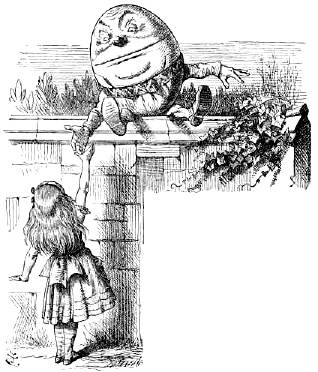
'When I use a word,' Humpty Dumpty said, in rather a scornful tone, 'it means just what I choose it to mean — neither more nor less.'

‘When I use a word,’ Humpty Dumpty said, in rather a scornful tone, ‘it means just what I choose it to mean — neither more nor less.’

Following a letter I wrote to the Church of Ireland Gazette a few weeks ago, which was a shortened version of this, a retired bishop responded in that worthy publication by intimating that as a recent English import I should not presume to express my views because I do not know what he called ‘our ways’.

Since then, that same publication printed a story in which the Church of Ireland rejected President Obama’s description of education in Northern Ireland as ‘segregated’, particularly since that word had resonances with apartheid in South Africa. Indeed it does.

It’s people’s perceptions that we have to deal with, and until we do, facts are almost irrelevant. If President Obama perceives education in NI as segregated, then presumably others do too, and simply denying those perceptions is not a realistic strategy. (If the Laois Nationalist is to be believed, funeral care in this town might soon be segregated too.)

If I want a fresh opinion, I will seek it from a critical friend – someone who is not part of the club. Is it really the case that the Church of Ireland is so insecure that it responds to such critical friends by belittling them? The parable of the good Samaritan tells us, amongst other things, that we do well to accept all help, no matter whence it cometh.

Perhaps I am indeed as yet unfit to serve in the Church of Ireland. How long will it be before I have absorbed enough of what the retired bishop, of whom I yield to no-one in my admiration, refers to as ‘our ways’ to be allowed to express my views? Until then I shall remain silent. On the other hand, when I see in the news what ‘our ways’ have been responsible for, perhaps I shan’t.

Why did the Samaritan cross the road?

800px-Moose_crossing_a_roadHomily for 14 July 2013 (Proper 10, Year C)

Deuteronomy 30: 9-14. Psalm 25: 1-9. Colossians 1: 1-14. Luke 10: 25-37.

What is there to say fresh about such a famous text? Perhaps it will do no harm to hear it again.

Duty versus love. Placing duty over love is what the priest and Levite did. There are times when we’ve all done that. There’s a scene in John Le Carré’s Smiley’s People where George Smiley is writing to Karla to confront him with evidence of his duplicity. Karla, the Russian secret service boss, demands loyalty to the system above all else, and anyone who transgresses is imprisoned or worse. But he has a secret. He has a daughter, supposedly with psychiatric illness, hidden away in a clinic in Switzerland. He channels some of his budget into secret accounts to support her. He is not living by the standards of duty that he exacts from others. George Smiley writes to Karla: ‘you have placed love above duty’. Karla has at last done right, but at the cost of having to leave home, lose respectability and become an outcast. This is the penalty that comes of doing the right thing. And the longer we delay, the heavier the penalty.

Who is my neighbour? The lawyer wants a definition of ‘neighbour’ so that he can do things by the book and keep his nose clean. If you’re a Liverpool supporter, the neighbour in need could be a Man U supporter. If you’re a Laois supporter, the neighbour in need could be a Carlow supporter. If you’re an ardent republican, your neighbour could be a royalist. If you’re out of work and in negative equity, the neighbour in need might be a banker.

It’s easy to fall into the lawyer’s trap. You could say ‘central Africa is a long way away and I don’t come across the starving millions in my daily activities, so they are not my neighbours. Anyway, I wouldn’t know about them if it weren’t for modern communications.’ This is being like the lawyer, wanting to define ‘neighbour’ so that you can draw lines in order to do things by the book and keep your nose clean. Or you might say: ‘is he really in need? I saw that so-called beggar arrive round the corner in a Mercedes.’ Or you might say: ‘she’s got a medical card and is better off on benefits than I am.’ These are distractions, I think. I have sympathy with those observations—there is nothing in Scripture that says we should not be responsible for ourselves and there is nothing that says we should expect a free ride (the opposite, in fact)—but to draw lines like this is to be like the lawyer. If you see someone in need, help them. End of. When I come into your presence I become your neighbour.

Think about the Samaritan. Did he stand to gain by crossing over and helping? He would have been delayed, and he was certainly out of pocket. Everybody helps friends and people they like. But are we willing at some personal cost to help anyone who needs it? It’s easy to chuck cash into a church gate collection. You feel better about yourself. I feel uneasy about such collections. It’s like having a fix of chocolate, or toast and butter. They lull us into a self-satisfied glow, at least for a short time. Love in practice means action, something personal. Throwing coins into a bucket is cosmetic and spiritually dangerous for it induces complacency.

Teach us, good Lord, to serve thee as thou deservest; to give and not to count the cost; to fight and not to heed the wounds; to toil and not to seek for rest; to labour and not to ask for any reward, save that of knowing that we do thy will, through the same Jesus Christ our Lord.

Think about the victim. What does he, a Jew presumably, feel about being even touched, let alone helped, by a Samaritan? Would he allow it if he were healthy? Are there people you don’t want to touch you? Are there some people you will not sit next to? Do you know someone who refuses help from certain people? That kind of pride, to which we are all prone, harms only the proud. When you’re at death’s door, you will accept help from anyone. When you’ve lost everything, you’ve nothing else to lose. If I refuse someone’s help, I haven’t suffered enough yet.

The Samaritan is Jesus. The priest and Levite represent Jewish law that advises people to avoid sin. This is a bit like advising chocoholics to avoid chocolate, or me to avoid salt. No use at all. It’s help we need! The help, the healing comes from someone—the enemy in the story—who has crossed to the other side (God to man). An unlikely source. The Samaritan/Jesus takes the victim to the Inn. The Inn is the church and its sacraments: the cleansing waters of Baptism, and the Body and Blood, ‘the spiritual medicine of the People of God’. All of us who have been baptized, very members incorporate in the mystical body, can be Christs, ministering to the world. In Colossians we hear of Jesus (the Samaritan in this story) as the image of the Divine. God is love, and Jesus is love in action. In God there is no un-Christlikeness at all.

Part of me is a world-weary cynic, worn down by slithering and slimy politics of academic life, church life, government scandals, bureaucratic nonsense, trials of daily life and the shame and mistakes that come after 63 years of consciousness on this planet. This part of me is the priest, the Levite, too busy, too weary, too impatient to stop. But part of me is still a wide-eyed mischievous 6-year old, open to the world, trusting and naïve, who thinks that people are basically good despite our inevitable cock-ups. This part of me is the Samaritan, and this part of me is the bit that I can concentrate on. We are all called to be Samaritans. As the writer of Deuteronomy says: the word is in your mouth and your heart.

When I come into your presence, or you into mine, we become neighbours.

Heart water at a meal

40-16Homily for 16 June 2013

Psalm 32. 2 Samuel 11:26-12:10,13,14,15. Luke 7:36-8:3

It’s easy to say that rules apply to others. It’s hard to remember that they apply to me as well. King David was outraged by the story of the rich man stealing the poor man’s lamb. Yet he couldn’t see, until it was pointed out to him, that he had done worse. David had been an adulterer and had ordered a murder, and nonetheless he had the courage to ‘fess up. One can commit enormous mistakes, but one can also acknowledge them, change one’s life and make reparation.

A couple of weeks ago we had the centurion who doesn’t think himself worthy to have Jesus as his guest. Today we have the inverse: Simon the respectable religious man who is positively offhand about welcoming Jesus as his guest. Offensive even. You couldn’t make up stuff like this.

Jesus is known to eat with sinners, thieves, drunkards, gluttons. I wonder why the Pharisee invites him for a meal. Is it so that he can lecture Jesus on what he should be doing? Like those drivers who overtake you and then slow down and ‘show’ you how to drive?  Simon disregards all the normal courtesies. He doesn’t ‘kiss’ Jesus in greeting. He doesn’t allow Jesus to wash his feet, let alone wash them for him, essential and expected in those days with dusty and dirty tracks. He doesn’t offer any means of ‘freshening up’.

Then there’s the meal. Men only, of course. The ‘table’ is lower than knee height. They recline on cushions on the ground, feet out behind them. I’ve been at meals like that in the Middle East. They take a long time. A woman of ill-repute barges in. Imagine, an uninvited woman in a men-only meal. A woman shunned by respectable people. A money-lender perhaps, or a grasping landlady, an informer, a notorious gossip, a prostitute. Maybe she had simply married a Gentile. A mixed marriage. What a sin. The woman doesn’t say a word. She simply acts. She lets her hair down in front of a man who is not her husband. This is sexually provocative. It is ground for divorce. She touches a man who is not her husband. An awful crime. She washes Jesus’ feet with her tears. Why is she weeping? She pours expensive oil over him. She does the things the host should have done, but did not.

The other men at the meal doubtless expect Jesus to be horrified, and to throw her out. Jesus says nothing. When he does speak, it’s not to the woman. It’s to Simon. Jesus lays into Simon the religious man. Jesus coruscates him. No gentle Jesus meek and mild here. No mealy-mouthed platitudes from a House of Bishops. Jesus—horror of horrors—holds up the woman as an example.

  • She recognizes what Jesus is. The Pharisee doesn’t.
  • She knows her shame. The Pharisee doesn’t.
  • She knows she needs forgiveness. The Pharisee doesn’t.
  • She serves. The Pharisee doesn’t.
  • She repents. The Pharisee doesn’t.
  • She gives generously. The Pharisee doesn’t.
  • She loves much and is forgiven much. The Pharisee is mean and unforgiven.

What a contrast! ‘Simon, just because you’re a so-called holy man doesn’t mean that you have anything to teach her. This woman who so disgusts you can teach you a thing or two about being humble, and repentant, and honest, and generous, and serving, and loving, and thankful.’

It’s easy to point the finger at bankers and financiers who exploit others. It’s easy to point to those who ‘kill’ with harsh words, or cruel deeds, or who pay unjust wages, or who do a nixer. But do we apply those same rules to ourselves? Do we realise that when we pass on gossip, we kill? Do we recognize that cheap prices in the shops come from ‘killing’ people in  sweat-shops? Do we recognize that our pension funds are invested in companies that ‘kill’ through exploitation?

lossy-page1-558px-Martin_Luther_by_Cranach-restoration.tif

Martin Luther

Have you ever wept tears over your shame? Martin Luther says ‘All who call on God in true faith, earnestly from the heart, will certainly be heard, and will receive what they have asked and desired.’ How often do we look into our hearts? How often have we tried to bluster and excuse ourselves—I couldn’t help it, I had no choice—rather than ache for forgiveness? The more I look into my heart, the more I recognize my need for forgiveness. The closer the woman in today’s story is to Jesus, the more she recognizes her need for forgiveness. Her tears are what Martin Luther calls herzwasser. The woman’s heart-water washes Jesus’ feet, just as he washes the apostles’ feet on Holy Thursday.

This is one of the most powerful stories in Holy Scripture. And Luke goes on. He describes how women are included in the teaching ministry of Jesus. These women were by no means perfect. Some clearly were from affluent families: they funded his ministry, they followed him. That’s shocking too, in those days in that place.

Religious people can be very cruel. Stiff-necked. If they don’t repent, they’re living a double life. Am I one of them? The woman was lavish in worship, falling at the feet of Jesus. Am I like her? David and Simon are aware of everyone’s faults but their own. Am I like them? Jesus condemns very little, but always complacency and hypocrisy. We say in the Lord’s Prayer: forgive us our trespasses, as we forgive those who trespass against us. If we forgive little we will be forgiven little.

If I draw a line between myself and someone else, Jesus will be on the other side.

Being shot, stuffed and put in a glass case

pulled in so many dimensions

pulled in so many dimensions

One of my readers sent me this comment in response to Church militant? Church irrelevant, the blog about the recent Church of Ireland General Synod: ‘You seem to be carving out a reputation for being the St John the Baptist of the C of I. I admire you for that; though it is a lonely calling. … You are a rare breed and will probably suffer the fate of such species, i.e. being shot, stuffed and put in a glass case for the purposes of mildly diverting amusement!’

St John the Baptist was beheaded. Does that fate await? The church, like many organizations, has another way of dealing with ‘troublemakers’. Promotion. In the Church of Ireland, I suppose this means a bishopric—the equivalent of being stuffed and put in a glass case. The bishopric of Meath and Kildare is still vacant. Perhaps that would keep me out of trouble. The advantage of having me is that I wouldn’t be there too long: I am 63 this week, so death or decrepitude would limit any damage I could do. The C of I already has two courageous bishops so we don’t need any more. The last thing the church—any church—needs is realism. The church thrives on good news only. Read any church or diocesan magazine: churches are always full, people are always charitable, and sun always shines on the tray-bakes. I would wear a mitre that at first covers my eyes that I see not, then my ears that I hear not, then my mouth that I speak not.

Can you imagine how frustrating it must be to be a bishop? Having no spiritual centre, no ‘home’ church and congregation, clergy bothering you morn, noon and night, dealing with complaints from ‘disgusted of Tunbridge Wells’, criticized for being courageous, criticized for not being courageous enough, pulled in infinite dimensions. Responsibility without power. Having to be a focus of unity when what the church cries out for is prophetic disturbance.

We are blessed here with a bishop with courage, integrity and vision. Deo gratias.