The Water of Life

The-Water-Of-Life-65Just back from a week in Gran Canaria. Terrific. Never been before. Hired a car. Mega-scary road from La Aldea to Agaete. Lots of twisty corners and places where all I could see to the left was sky. I am not exaggerating, It’s as well that I didn’t know when I set off what I know now. I never used to suffer from what people call vertigo when I was younger, but something happened in early middle age.

I took the trusty Kindle with me. I was looking through Aesop and Grimm and Andersen for some stories for school Assemblies, and came across The Water of Life (Grimm). It might or might not be suitable for Assembly (stories tend to need shortening) but, ye Gods, it’s spot on for life in general and parochial life in particular. It quite bowled me over. It begins thus.

Once upon a time in a land far away there reigned a king who had three sons. The king fell ill. His sons were grieved at their father’s sickness; and as they were walking in the palace garden, an old man met them and asked them of their woes. The princes told their tale. ‘His Majesty must drink of the ‘Water of Life’ said the man. ‘Were he to have but a sip of it he would be well again. But it is hard and dangerous work to collect it.’
 
The eldest son thought to himself ‘If I bring my father this water, he will make me sole heir to his kingdom.’ He went to the sick king and begged that he might go in search of the Water of Life. ‘No,’ said the King. ‘My life is not worth the great danger of the journey.’ But the prince persisted and eventually the King let him go.
 
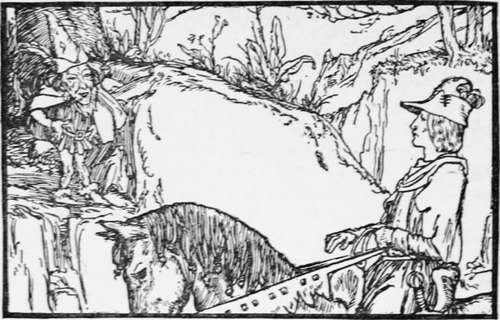
After a time the prince came to a deep valley, overhung with rocks and woods; and looking around, he saw an ugly dwarf who said, ’Prince, whither so fast?’ ’What is that to thee, thou ugly dandyprat?’ said the prince haughtily, and rode on.
 
The dwarf did not take kindly to the prince’s behaviour, and laid a spell upon him. As he rode on, the mountain pass became narrower and narrower until at last the prince could go no further, and neither was there room for him to turn his horse and return whence he came. So there he remained on his high horse, unable to go forward, unable to turn back, and unable to dismount. He remained spellbound. Thus it is with proud and silly people who think themselves above everyone else, and will neither seek nor take advice.

The rest of the story—you can guess I expect—the second son sets out on the quest when his elder brother fails to return. The same happens to him. Then the youngest son, the simpleton, sets off. When he encounters the dwarf, he tells him of his quest and the reason for it, and seeks the dwarf’s advice. He listens, thanks the dwarf and goes on his way. He finds the Water of Life, and on his way home asks that his brothers be freed—which freedom is granted. His brothers repay this generosity by stealing the Water, taking it to the King and claiming the credit. But the dwarf works his magic so that in time the two elder brothers are found out and forced to flee into exile, leaving the youngest prince to rule prudently with all his power.

You may know the story. You may have pondered its wisdom and its Scriptural resonances (and Indiana Jones resonances). I come across this story fresh. It’s on my precious list, along with The Snow Queen (‘melt this heart of ice’), and the Venite (‘Today if ye will hear his voice, harden not your hearts’).
Boxes and coffins

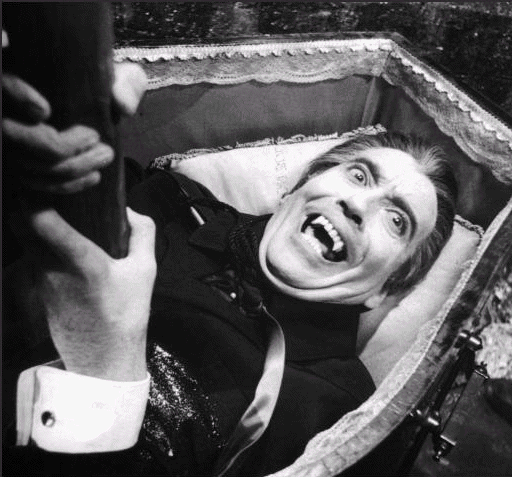
Too many synods have this effect

He’s been at too many synods

I’m in big trouble. One of my wardens sidled up to me just before a recent funeral, whispering into my ear out of the side of his mouth (as they do in County Laois) ‘People complain that you call the coffin “a box”.’

Guilty as charged.

I don’t think I’ve ever done a funeral without saying to the assembled worthies something like: ‘One day we’re all going to end up in a box like that [pointing at same], and we never know when. How do you want to be remembered? What do you want to see when you are forced to look into the mirror and see yourself as you really are? Now’s the time to live the rest of your life so that when that day comes you leave behind as few regrets and as little unfinished business as possible.’ A colleague calls it an altar call.

Anyhoo, back to the plot. Having heard the complaint and lodged it in my frontal cortex, a funny thing happens. Up to the pulpit, burble, burble, burble, and then out comes the word ‘box’. Just as usual. The thing that I don’t want to do is the very thing that I do. Ah well, I’m in good company. Is it a form of Tourette’s do you think?

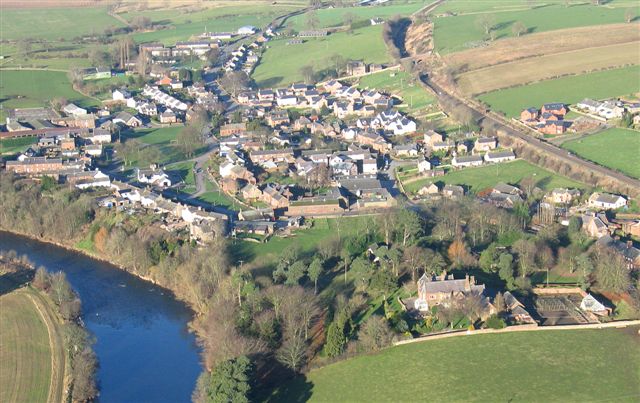
Our house was bottom left somewhere

Our house was centre left somewhere

I like the word box. It’s earthy. Box is what it is. You can take the lad out of the North but you can’t take the North out of the lad. I’m not a Yorkshireman, though many have called me so (they probably think all flat vowels signify Yorkshire whereas the Yorkshire accent is merely lazy, and no vowel is flatter than a Cumbrian vowel). That having been said, I must have been infected by Yorkshire to some extent since down at the bottom of the garden ‘when aa were a lad’ flowed the River Eden. This, one of the few substantial English rivers that flows north, emerges into daylight in Yorkshire, then travels the rest of its 70-odd miles through Westmorland and Cumberland, to the briny Solway.

It must have been this river that brought me one of the rare bits of Yarkshire wisdom. On Ilkley moor baht’at.

Wheear ‘ast tha bin sin’ ah saw thee? On Ilkla Mooar baht ‘at.
Tha’s been a cooartin’ Mary Jane, On Ilkla …
Tha’s bahn’ to catch thy deeath o’ cowd, On Ilkla …
Then us’ll ha’ to bury thee, On Ilkla …
Then t’worms’ll come an’ eyt thee up, On Ilkla …
Then t’ducks’ll come an’ eyt up t’worms, On Ilkla …
Then us’ll go an’ eyt up t’ducks, On Ilkla …
Then us’ll all ha’ etten thee, On Ilkla …
That’s wheear we get us ooan back, On Ilkla …
 

The salient points of this literary epic, be they noted, dear reader, are these: live, sex, die, box (implied), reused. We live, we reproduce, we die, we’re in the box, we’re in the food chain and round and round we go. Our molecules go back to chaos then to kosmos once more. The great cycle of life. The resurrection of the dead.

I’ll stick to box, I think. If people don’t like it, it’s their problem.

Salt, light, snow, ice

monaco-glacier-spitsbergen-norwayA Homily for the fourth Sunday before Lent

Isaiah 58:1-9a. Psalm 112. 1 Corinthians 2:1-12. Matthew 5:13-20

Chips are no good without salt. Salt enhances flavour. We can help others bring out their flavour—to let their light shine. The divine light is in all of us, like a pilot light on a gas stove, and we salty people can help others to turn up the dial so that the stove is aflame with warmth and light.

We add flavour to the world by acts of charity. Care for the needy, poor and oppressed: ‘share your bread with the hungry, shelter the oppressed and the homeless; clothe the naked when you see them’. Your many unrecorded acts of kindness and generosity are grains of salt.

We add flavour to the world by refraining from oppression, revenge and malice. These make us hard-hearted. A friend reported one of our churches to Laois County Council because sometimes only one of the exterior doors is unlocked for services. The fire officer recommended that the others be left unlocked, but fitted with a device so that they may be opened only from the inside. I use this story to ask about the doors to our hearts. Are they open to the message that we purport to profess week in, week out? Or are they shut, excluding the breeze of freshness and renewal as we stay locked into old resentments and fixed false beliefs? In the Venite we are warned against hard-heartedness that corrodes us. It’s a cancer of the spirit. It kills. ‘Hatred devours the wicked. They grind their teeth and their hopes turn to ashes.’

All this takes humility: the realization that ‘I’ am not the only person in the world, and that what ‘I’ want is no more important than what anyone else wants. No showing off. Paul writes: ‘I did not come … in lofty words or wisdom … I came to you in weakness and in fear and in much trembling.’

Humility like this keeps the focus away from self. Indeed, any pretence of the perfect image will stop the light that’s inside from shining out to others. It’s only through our imperfections, our cracks, that the light is able to get out. Put a tea-light into a flower-pot. You won’t see it unless the pot has a crack in it.

Now, another use for salt. We use it to lower the freezing point so that ice melts. There’s salt in tears. We know this, because when we’ve cried and the tears have evaporated, there’s a salty deposit left on our cheeks. So let me tell you a story, and I’m sorry for carving up the work of Hans Andersen, but it’s a long story in its original form.

Once upon a time there lived a wicked goblin who built a magic mirror. Anything that was beautiful or good was reflected in it as ugly and bad. One day, as the goblin was flying through the clouds, he dropped the mirror. It shattered into millions of pieces. A few pieces fell in a small town where two friends named Kay and Gerda lived.

They were neighbours and friends. As they were playing, Kay felt something sharp in his eyes and his chest. Shards of the broken mirror went into Kay’s eyes, and another into his heart. From then on, Kay made fun of everything beautiful and delightful. He no longer saw Gerda as his friend, but sneered at her. His heart turned to ice. Gerda didn’t understand.

As Kay was playing alone in the snow, a large and splendid sledge drew up. Its driver, a most beautiful woman, invited Kay to join her. She was draped in a white flowing gown. On her head was a crown of ice. Her hair was like icicles. ‘Who are you?’ asked Kay. ‘The Snow Queen’ she replied, her face glinting like a diamond in the snow. Kay got int, the Snow Queen tugged at the reins, and off they went up into the clouds, taking Kay to a distant land.

Gerda missed Kay and never stopped loving him. She waited for his return. He did not come. She set off in search. She took her boat and went off on the river. Hearing Gerda’s, a fairy sent her garden flowers to search for Kay, but they returned empty-handed.

Gerda sat under a tree and wept. A crow flew down and told her about a princess who had married a boy. Gerda wondered if that was Kay and urged the crow to lead her to the princess’s palace. She sighed with relief when she saw him, because it wasn’t Kay.

Gerda came to a forest where she met a robber girl and her reindeer. Hearing Gerda’s sad tale, the reindeer said he had seen the Snow Queen flying away with a boy to Spitsbergen near the North Pole. Gerda and the reindeer set off. It was a dangerous journey.

At the Snow Queen’s palace, they found it guarded by snowflakes that prevented their approach. The only thing that overcame them was Gerda’s praying the Lord’s Prayer. Her breath took the shape of angels, who pushed aside the snowflakes and allowed Gerda to enter.

Gerda found Kay alone. He was almost immobile on the frozen lake, which the Snow Queen calls the ‘Mirror of Reason where her throne sits. The Snow Queen had set him a task: if he is able to form the word ‘eternity’ with letters made of ice, the Snow Queen will release him from her power. Try as he might, he is unable.

Gerda runs to Kay and flings her arms around him. He is like a statue. Gerda weeps. Her tears drop on to Kay’s chest. Slowly, slowly the warm tears seep into his heart. Tears of love melt Kay’s heart of ice. Kay bursts into tears, washing out the splinters from his eyes. Gerda embraces Kay, who comes out of his trance. Kay is saved by the power of love. He looks at the lake of ice and sees the letters have arranged themselves to spell ‘eternity’.

Gerda and Kay and the reindeer leave the ice palace for home. They find it just the same as it was when they left. But they have changed!

Gerda’s grandmother reads a passage from the Bible: ‘Assuredly, I say to you, unless you are converted and become as little children, you will by no means enter the Kingdom of Heaven’.

Speed these lagging footsteps,
melt this heart of ice,
as I scan the marvels
of thy sacrifice.   (William Walsham How)

Lighten our darkness

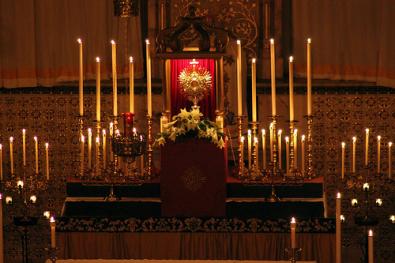
forty_hours_2009I’m a sucker for candles—it must be my inner child. As many as possible all the time. Candles on the Altar, candles on the credence table, candles in the hand. Advent Sunday, Christingle, Christmas, Candlemas, Tenebrae, Easter … whenever. At a confirmation in one of my former churches a strange smell assailed the nostrils, and it wasn’t the incense. An acolyte was taking Matthew 5:16 literally. His cotta caught fire from a neighbouring candle. It livened things up.

This morning we had lots of candles and sprinklings and baptism of twins. A great day for a baptism: the old man carried the child, but the child governed the old man. Simeon’s inner child: he may have gone off to die, but I wonder if he also meant that he now understood the importance of childlikeness, without which the Kingdom is not ours, we are told? He had seen the only thing that matters.

There was a radioactivity leak at Sellafield/Windscale/Calder Hall in the 1950s. I lived 40 miles east, so when the wind whistled from the west, the radioactivity was blown into my cells. Like the child in the Ready Brek advert, I glow in the dark. It’s handy at night and keeps electricity bills down.

There are other people who glow, but for a different reason: they are so filled with goodness that their faces glow and their eyes twinkle. Like Moses and Jesus coming down from the mountains.

Apart from these shining examples, bioluminescence is seen in fireflies and glow-worms, but mostly in aquatic creatures. Moses again: ‘See, with the staff that is in my hand I will strike the water that is in the Nile, and it shall be turned to blood. The fish in the river shall die, the river itself shall stink, and the Egyptians shall be unable to drink water from the Nile.’ The first plague (Exodus 7:14-25) was a bloom caused by dinoflagellates, single-cell algae. It adds up.

There’s squid and jellyfish and sharks and seed shrimps. All sorts of things produce light, sometimes to attract, sometimes to trick, sometimes to warn—reasons concerned with eating, or not being eaten, or reproducing (which three things just about sum up life).

hqdefaultBut by far the most impressive manifestation of bioluminescence is the way that single organisms like sea squirts come together to form a huge great bioluminescent pyrosome (fire body). Look at this: a 30 foot tube made by a colony of millions of minute sea squirts acting together. This is intelligence. Isn’t it truly wonderful?

Just think what we could do if we worked together like this.

Read Frank Schätzing’s The Swarm. Nothing is impossible. Be afraid, be very afraid.

Less religion, more maths

01The Education Minister says schools should teach less religion and more reading.

In my humble opinion, schoolseven primary schoolsshould teach more mathematics too. I don’t mean sums, I mean mathematics. Children will become familiar with logic, conceptual thinking, problem solving and truth. Nothing is truer than mathematics. Mathematics leads to architecture, music and biology, as Donald Duck found out.

Why should schools teach religion at all? You could say it inculcates tribal attitudes and behaviour that can be profoundly unChristianindeed, inhuman. It encourages parents to think that since school does it, they don’t need to, either at home or by church commitment. It encourages a view of God as a cross between a sky pixie and an irascible parent who needs to be placated and evaded. It’s used to tell children that they should be nice, clean, tidy, adhere to notions of respectability and generally do what adults tell them. It can lead to a kind-of spiritual infantilization and emasculation that soon fails them.

What should I be saying at school Assemblies? Should I teach the doctrine of the Holy Undivided and Indivisible Trinity (mathematical concepts of simplicity there), or the difference between substance and essence (chemistry here)? maybe I should be exploring with them the feminine part of the Divine, Sofia, Mary redemptrix (plenty biology there). What about how Greek ideas and fairy tales shaped the Gospels?

What I do try to say is that the Divine light is in ‘here’ in everyone, that ‘we’ is more important than ‘me’ (ants), that we light the way for others when we let the light shine out of ourselves (fireflies), and that we all benefit from a bit of quietness (dormancy and metamorphosis). And also, of course, that whereas human team captains can’t avoid being swayed by personal considerations, there is one captain who shows us the way. I try to explore with them what they think God-ness might be like. I ask them to consider when being ‘nice’ is inappropriate and when they should fight for justice.

I doubt that’s what parents or teachers want. But I plod on trying, for the sake of the staff, not to let the pupils see how much I squirm with embarrassment at some of the words of the silly songs.

After the example of an esteemed colleague, I’ve started reading stories. Oscar Wilde’s The Selfish Giant was a smasher.

Unity?

Ponder the jellyfish

Ponder the jellyfish

Epiphany 3, Year A. Isaiah 9:1-4. Psalm 27. 1 Corinthians 1:10-18. Matthew 4:12-23

As I was leaving a parishioner’s hospital bedside on Friday, the RC priest on duty waved at me and stopped for a chat. He reminded me that it was Christian Unity week.

It’s not top of my priorities, and it falls at a silly time of year, too soon after Christmas. Last year, the Kiltegan Fathers invited me to give their Annual Christian Unity lecture in February – a better time. This year, the PP and I decided that rather than have a badly attended midweek service in gloomy January, we’d do something practical at Christmas. And that’s why I preached at one of the masses on 21 December, and why Fr Eddie came to the Carol Service the next day.

If unity means united in mutual support as we try to live the life of Christ as best we can in the culture and place in which we find ourselves, then I’m all for it. If it means uniformity—that we should all be the same—then I’m against it. Having different ways of thinking and different ways of doing things is wonderful. It means that life is not boring. It means that we can have intelligent discussions about things, whether they be theories of the atonement, or ethical dilemmas, or animal experimentation, or whatever.

What we need is Christian unity-of-purpose. Mutual respect. We don’t quite have it in this state, but it’s immeasurably better than it was. Yes, it’s sad that when I go to RC Mass dressed as a Church of Ireland priest, I’m probably not offered the sacrament, not because I’d refuse it (I wouldn’t) or because left to his own devices the priest wouldn’t offer it (he might), but because conservative people might object as it’s against church rules. And the other way round: I wouldn’t surprise an RC priest by offering him the sacrament in this church—not because the priest wouldn’t accept it (he might), but because of what some of his flock might say if he did. It’s possible, of course, that some C of I parishioners might take offence at what I might do in these circumstances, but I’m not inclined to take any notice of that. I yield to no-one in my regard for church rules.

It’s all rather silly anyway. RC chaplains in prisons and hospitals offer the sacrament to everyone—no questions asked. I urge C of I patients to accept it with joy. In other countries, there are fewer scruples than here where waters are polluted by centuries of resentment bred into respective tribes. In the history of Christianity, murder and violence have too often resulted from a lack of mutual respect because of this sort of tribalism—which brings me to today’s Epistle.

Paul was cross with people arguing about whose baptism was best. Next week I’m baptizing twins in a Candlemas liturgy. I will be doing things that I don’t usually do. I will be doing things that maybe you aren’t used to. But I challenge anyone to say that my baptism is somehow less efficacious than anyone else’s because of that. Something like that seems to be what the Corinthians are arguing about. ‘If this gets any worse’ maybe Paul is thinking, ‘there’ll be arguments, rivalries, sectarianism and even warfare’.

Isn’t that the problem with the world—‘my way is right, yours is wrong’. ‘I know best.’ ‘If you don’t agree with me, you don’t deserve to live.’ ‘You’re not part of my tribe, so you matter less than I do and I can have you rubbed out’. We need tribes and families for support. But when they get ‘notions’ of superiority, those in other tribes come to be regarded as less human, with ethnic cleansing and concentration camps just around the corner.

The problem with tribalism, or denominational posturing in church terms, arises when how we do things becomes emphasized at the expense of the reason why we do them. The point of the game is, as I said before, to live as best we can the life of Christ in the circumstances in which we find ourselves. The focus is the Lord and the Lord’s kingdom. If we forget that focus, we’re likely to think that the focus is what we think and do. The focus becomes ‘our’ mob versus ‘your’ mob.

Life is too short for this nonsense. Of course decisions have to be made, but as I said last week, it’s often not a matter of right and wrong, but rather simply choices and consequences. It really doesn’t matter if others choose to express their love of the Lord differently from us, so long as we, and they, don’t start to claim that only ‘our’ way is best. If we do, we are making an idol of the way we do things. Tribalism in any form depends on the claim that ‘we are best’, ignoring the possibility that other tribes may think that ‘they’ are best. It assumes that there is nothing bigger than us.

If religion has no other use, at least it tells us that there is something bigger than us. We humans can be extraordinarily arrogant. We assume that we rule the planet and that it’s our plaything. Let me tell you, boys and girls, that if any creatures could be said to rule the planet, they could well be jellyfish and their friends in the oceans. They’ve been around 700 million years. They’re the oldest living multicellular organisms. They can kill us. They are increasing in number. They show every sign of continuing well into the future, long after we humans have gone (we’re not, despite what we think, a very successful species).

Faces of the Divine

Faces of the Divine

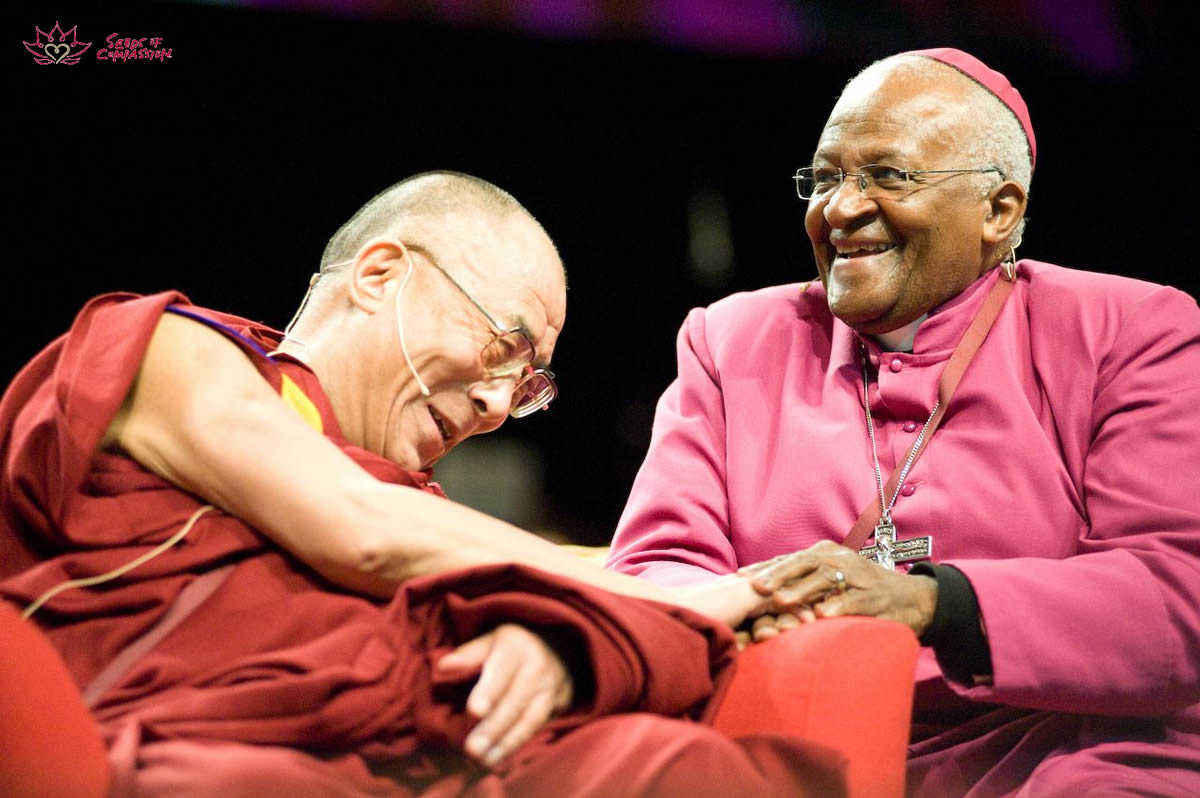
In Christian Unity Week we do well to remember how tribes and tribalism can lead us to do terrible things. We do well to realize that what dictates our identity as creatures of this earth doesn’t come from us, but from the Christ. And that identity could include Jews and Buddhists and others, as well as people who call themselves Christians.

This is what Christian Unity is about: respect leading to justice. Disunity and tribalism that lead to injustice are what Paul was arguing against.

Ultimately, what matters is what the Psalm speaks of: ‘The Lord is my light and my salvation … One thing have I desired of the Lord, which I will require: even that I may dwell in the house of the Lord all the days of my life, to behold the fair beauty of the Lord, and to visit his temple.’

The Beaker Folk of Husborne Crawley

Beaker Header Trees Henge. newA subversive streak is something to be cherished, so if you’ve got one I recommend an occasional visit to The Beaker Folk for refreshment. Flooding Caused by Gay Marriage, is particularly good.

My regular reader will know that a while back in Brave new world I chided the Archbishop of Canterbury for seeming to belittle the work of the parish priest. I put these sentiments into a courteous email to him. After 10 days or so I had a reply from the Archbishop’s Acting Correspondence Secretary, a retired Archdeacon, saying, in essence, push off and get used to the new regime, and stating that the traditional model of parish ministry was failing. The questions I raised about expectations and administrative burdens, however, were ignored.

One thing amused me. The retired Archdeacon, despite being a fully paid-up member of the new iconoclasm, appended ‘The Venerable’ to his signature.

Titles and status remain so very important in the brave new Church.

Of mice and men

1510896_642587485805127_2086111283_n

Animal experimentation is certainly an issue that polarizes. I wonder how many opinions are based on facts and experience rather than sentiment and propaganda. How many of those vehemently opposed are principled enough to refuse antibiotics, or question how they were tested?

For several years I worked on the mammalian adrenal gland. The mouse Mus musculus was the creature of choice. I could not have done the work without killing. The question is: was it worthwhile?

Zhou Enlai, when asked about the importance of the French revolution, is reported to have said that it was too early to tell. I feel rather the same about much research in general, and mine in particular. I certainly don’t claim it to have had any impact, but this is not to say that in the future someone will not build upon it in a way that enlightens us about endocrine processes.

Headline-grabbing results are rare. Scientific research is like chipping fragments from a stone, a sculpture gradually emerging. Researchers build upon the work of others, and slowly, slowly knowledge accumulates. After a great deal of accumulation, conclusions can perhaps be drawn. It is dangerous to draw them too soon.

Yes, there are alternatives to animal experimentation, and they are increasingly used. More will be developed. But, in the words of my friend Andy, ‘at the moment they can’t simulate the real deal because mammals are so delightfully complex and still so poorly understood—despite the hubris of the scientific community.’

Is animal experimentation evil, immoral, bad? It concerns me that too much is done simply as CV boosting, as truthfully in my case, and there are problems with the way that research is politicized by factions and industry, but that’s another story.

I suspect that opposition to animal experimentation is most vociferous among those who are furthest removed from living and working with animals. You won’t find much opposition in the agricultural community. If you hold that all creatures are God’s creatures like us, then the only logical position is Jainism: non-violence towards all living beings. How do you define living? Plants? Fungi? Bacteria? Slime moulds? Clergymen?

Much of what we know of how the inner ear works comes from research that was done on human subjects in 1930s and 1940s Germany, in circumstances that may well appall us. We have benefited from that research not least in the development of hearing aids and cochlear implants. Knowledge of some neurological conditions comes from experiments on monkeys and apes. It’s all very well to object—until, that is, you get the disease.

When we lived in Nottingham, our children attended a school patronized by sandal-wearers, amongst whom there were more than a few objectors. Our children said “my daddy works with mice’s kidneys” (kidney/adrenal confusion understandable at that age) and drew pictures of my office. I did rather fear reprisals.

I was a reluctant researcher—a disappointment to the eminent Professor Rex Coupland, I didn’t enjoy the nitty-gritty of research and much preferred teaching, scholarship and administration. Rex was a big man with a long stride, so there was warning of his approach as he stomped along the echoing corridors. When professorial footsteps were heard in the distance, one could either dodge into the Dissection Room, or dash into the khasi, or else nip downstairs, along the corridor on the floor below, and then up again at the other end. Silly or what?