A Swiftian circular argument

wmNone for ages, then three at once. Like buses. Funerals I’m talking about. And what a trio: the 20-year-old murdered in Jerusalem, then two from the same extended family with strong church and business connexions—big funerals.

They don’t half take it out of you. Or rather me. The 20-year-old’s last week was excruciating for personal reasons, nails hammered in wounds still raw, but the most difficult that I’ve ever had to do, Hugh excepted, was about 10 years ago, very soon after ordination. A thirty-something-year-old mother of four dropped dead as she was preparing supper. No warning, just kerplunk. I was just about doing OK at the funeral until, during my address from the pulpit, my eyes rested upon the four year old weeping into her teddy bear. Ye Gods.

It’s not easy to process all this—at least I don’t find it so. I asked for some advice from an experienced colleague about coping mechanisms and he said that he imagined the emotion passing down his body into his feet and thence into the earth. He’s something of a Buddhist Christian, and I see that that might do the business for him, but it doesn’t work for me. I’m not sure what does. Sleep possibly.

All jobs have their stresses. I don’t pretend clergy stress is worse than that of any other occupation. After all, we have a free house even though the kitchen is dire, a non-contributory pension (for how much longer?), about £24K a year (no, we don’t get to keep wedding and funeral fees), and, as has been so frequently pointed out to me, we only work one day a week. This remark retains its freshness even on the 137th hearing. So amusing.

Notwithstanding, parochial ministry brings stress of an unusual and peculiar intensity of emotion. Funerals illustrate one aspect, but there’s the stress that comes from the disconnect between the expectations of others, for example that the Vicar will always be smiling and willing to agree with whatever loopy and self-serving notions that fall on his ears, and the demands of the organization and—dare I say—demands of the Gospel to confront hypocrisy and injustice. Like a former Vicar of Chesterfield and Archbishop of Cape Town, Geoffrey Clayton, I was determined when I was ordained that nobody should ever say of me “our nice new Vicar.” Nobody ever has. Or will.

Is this the reason why there is so much fallout from parochial ministry? They are leaving it in droves for such as chaplaincies (much better pay, defined hours of work, protection against exploitation) or civil employment. One of the curates ordained the year before me stuck it for about 18 months, then said she wanted her weekends back.

Anyhoo, it’s time for a palate cleanser, a tart lemon sorbet to mop up the funeral emotion and start the salivary juices flowing again.

I see that novelist Ian McEwan is in the soup for suggesting that before long all the old people who voted Brexit will be dead so we can vote again to stay. Let’s take it a step further. Does it not strike you as a waste of NHS resources that so many old people have expensive hip replacements and then die soon after? Maybe the surgery is too much for them. Maybe they’re shoved downstairs by some avaricious trout who wants their money or house or whatever. It may be practice for the surgeons, but would it not be better to spend the money on getting young people back to work? And what about all the mobility scooters? Would it not be better to force the occupants to go to the gym three times a week and tone up, shed flab and strengthen the heart? There is no better medicine than human sweat. It might be cheaper.

But wait a minute—they might live longer. We can’t have that. Such a drain on the national purse. Maybe we should be forcing cream cakes down people’s throats to send them to the starry heights sooner. Or feeding them antibiotics so that they’ll be carried off by superbugs, leaving only the genetically resistant to repopulate the earth. This is a most attractive notion. It grows on me. A government commission should surely be set up. I shall chair it.

Bearing in mind how I began this piece, you might say “but it will mean more funerals for you”. I doubt that. More and more funerals—sorry I mean Celebrations of Life—are in the hands of non-religious celebrants. Well, I say non-religious, though I gather that they have prayers and very often the Our Father. It’s important to retain a bit of folk religion even though Christianity is actually a middle-eastern religion and it might be more English to go for the pure pagan. Have you seen The Wicker Man with Christopher Lee? There’s something to think on: why wait for people to die?

I’ll get my coat.

Hannah Bladon: life abundant cut short

_95649795_mediaitem95649794Hannah Bladon was killed in Jerusalem on Good Friday. Here is my eulogy delivered at her funeral today, 
I met Hannah soon after I came to Burton in 2014. We were waiting for mass to begin in St Paul’s. Although we’d never before set eyes on each other, Hannah, characteristically direct, came over and made some intelligent remark about the liturgy. I was dumbstruck. The thought that a young person in today’s Church of England might be interested in liturgy was intoxicating.

We chatted some more. Within seconds it became clear that this was a most unusual young lady: bright, intellectually supple, intellectually resilient, intellectually fearless and completely open-minded. I had to reach for the sal volatile before I fainted, for this was almost too much for my system. An intellectually supple and open minded Anglican. Can you imagine such a thing? I said so and we dissolved into laughter.

It seems that not only did I instantly take to her, but she also took to me. I think this is the reason I have the heart-rending honour of speaking to you on this desperately sad occasion. I thank everyone who has told me about Hannah, but particularly Stella and Max.

Not only intellectual resilience

Hannah was born with a dislocated hip undiagnosed for 18 months. Treatment involved hip traction, the wearing of heavy boots, and frequent hospital visits. But never a word of complaint. In fact it was those visits, usually accompanied by Granddad Colin that resulted in ‘granddad’ being Hannah’s first spoken word.

Hannah knew what she wanted. Parents wonder is this determination or pig-headedness? She was the first player to sign for Burton Ladies rugby club juniors. Even though she was quiet and slightly built, you learned to underestimate her at your peril, as her opponents discovered. She was a winger—nippy, a different sort of resilience. She was the first girl to come off the pitch with blood on her shirt, but soon bounced back.

In Jerusalem Hannah was up at 5 am to get to the dig site by 6. Her friend said that Hannah would arrive back in the evening filthy and exhausted—often too exhausted to shower—and go straight to bed. One of the people Hannah worked with was Bob Henry, a retired chemist from Alabama. Bob flew home at Easter, but when he heard about Hannah he was devastated, and flew back to Israel to meet Stella and Max when they went to bring her home.

Hannah knew justice, mercy, humility

Prophet Micah advises us to do justly, love mercy and walk humbly with God. Hannah did not need to be told any of that. Her last act of kindness on the day she died—one that according to friend Christina was common for Hannah—was to give up her tram seat to a young mother. She was not political, but believed all people should be equal. She had a profound sense of justice for the underdog. She did not think she was special. She lacked self-confidence. She never expected to get the HSBC scholarship that enabled her to go to Birmingham University in 2015. She never expected her application to the Rothberg International School at the Hebrew University of Jerusalem to be successful. The assessors could see what she did not: what a wonderful ambassador she could be.

An upward trajectory

Hannah was a member of a local archaeology group, and had a great interest in history. During the dig that was completed on Maundy Thursday, she excavated a vase of a type not previously known to have existed at that time. She was interested in the past but did not live in it: she used the past to inform the present for the future. One of her lecturers in Jerusalem described Hannah’s career as being on a ‘steep upward trajectory’, and said that he would have given anything to work with her when she’d completed her doctorate. Others have said that whatever came out of Hannah’s mouth was worth listening to—certainly my experience. Her impact on others was recognized by Mr Netanyahu, the Israeli Prime Minister ,who mentioned Hannah in his Remembrance Day address on 1 May, and by the Archbishop of Canterbury who was with the Bishop of Lichfield and the Chief Rabbi in Jerusalem a couple of days ago. The Bishop told me that he sensed that Hannah was regarded with awe by her colleagues.

Drains and radiators

It is a truth universally acknowledged that people can be divided into two categories—not sheep and goats, but drains and radiators. In pastoral ministry one comes across a lot of drains. They suck the life force from you as they enjoy ill health, or enjoy finding fault. They try to draw you into their jaundiced world view. They are full of ordure. Hannah was no drain. She radiated energy. She loved a discussion. She had, as I’ve said, a sense of justice that made her dogged and protective. All these characteristics say something profound about the family. Quite clearly they recognized the extraordinary young lady that Hannah was. To their credit never once did they try and mould her into something less challenging, as many parents would have done. They marvelled at her.

In conclusion, some personal remarks

Let me offer you all some advice. You will not know what to say to Stella and Max, to Colin, June and Malcolm. There is nothing you can say that makes any sense. The best thing that people said to my wife and me when our son died was ‘there’s nothing I can say’. Don’t say ‘I know how you’re feeling’ because you don’t. Don’t say ‘time heals everything’ because it doesn’t. Don’t say ‘she’s in a better place’ for I suspect that she’d rather be up to her armpits in sand. Much better to do something than to say anything, so give them a cuddle and weep with them. Often. And when you meet them in the street, don’t go out of your way to avoid them, but take them for a coffee. Or a gin.

And finally to Stella, Max, Colin, June and Malcolm. Grief at the loss of an adult child is in my experience fierce, bitter, and overwhelming. It is malignant and insidious. It blots out heaven. Your psyche has suffered the most violent attack imaginable. You will need all your energy to look after yourself, so do not waste it on other people. Be kind to yourselves and to each other, indulgent even. Have no expectations. Don’t do anything you don’t want to do. Don’t let anyone tell you what’s good for you—they’re just trying to make themselves feel better. Learn from dogs. When a dog is injured it retreats to its basket and there it stays until it feels better. After 18 months my basket remains the place of safety where I find solace. And when you’re in your basket, you will weep for the loss of that glorious creature whose life was taken in a random act of violence by a sick man.

Sounds exactly like duck

Lady_WhiteadderI knew Hannah, the young woman who was killed in Jerusalem yesterday (Good Friday). She was blessed with three great qualities of intellect, namely vitality, suppleness and rigour. She was therefore good fun. Think of her parents.

Before that news broke I’d been finding this Holy Week particularly difficult. Maybe last year I was in some kind of bubble separating me from grief over Hugh. This year, however, the constant reminders of someone dying so that others may live have been extraordinarily hard to bear. I am brought back again and again to 2 Samuel 18.33. I begin to type “O my son Absalom, my son, my son Absalom! Would I had died instead of you, O Absalom, my son, my son!” and before I get to the first Absalom tears gently drip down my cheek. Added to this, a friend’s daughter died last year and she, the mother, is in bits, not helped now by Hannah’s murder, for she knew her better than I did.

I wasn’t going to write about this stuff any more. I was informed in no uncertain terms about nine months ago by a woman who attends a neighbouring church that it was time I stopped wallowing. After all, she said, she’d buried two husbands. I’m not surprised. I was told by a former student a few months ago that every family had to deal with stuff like this, the implication clearly being that it was time to move on. So, like I say I kind of decided to keep schtum. So why haven’t I? Therapy for me I suppose, given recent events. And nobody is forced to read this.

I’ve no energy for other people. Violence swims about in my mind, seeking whom it may devour. When I hear moaning minnies complaining about their aches and pains I have the devil of a job in not propelling their dentures down their throats. I’m quite likely to tell them some home truths. This may be a very good thing but isn’t what they’re expecting, and it’s professionally risky for the last thing clergy are expected to do is tell the truth. The good news is that I treasure more than ever my family, and the colours that I see increasingly dimly with my one functioning albeit somewhat glaucomatous eye.

I’d hoped that the muse might have returned by now. Two of my regular readers (half of them, so) have been kind enough to hope so too. Occasionally I think of a topic that might serve, the more ridiculous the better, but then I think “what’s the point?” People seem terribly worried by the possibility of North Korea kicking off. I just don’t care. Bring it on, you mad bastard.

I recommend Inside Grief edited by Stephen Oliver (ISBN: 9780281068432), so far the only book that I’ve found authentic. It doesn’t assume that the dead offspring is an infant.
I must confess to having been shocked and wounded by the remarks I relate above. I’d been chugging along as best I could, then wham, those comments have preyed on me, vampires sucking the blood clean out of me. My only response to them is two words, which I regret not having used in context. The second is “you”. The first—and some of you may recall an episode of Blackadder with Miriam Margolyes—sounds exactly like …

Remembrance Sunday 2016

thiepval-memorial-missing-2One of our joys at St Modwen’s is to be a kind of safe haven for people who wander in and out. Some of them are of no fixed abode. All of them find it difficult to cope with society—and I’m not referring to the members of the regular congregation. Some of the occasional visitors sleep in the churchyard. Some should be getting psychiatric care, but instead have what is laughingly called care in the community. Some of them are ex-servicemen who have been so badly maimed by their experience that they have never recovered. It’s this group I’d like to consider today: members of the Armed Forces who return from their service and find themselves unable to cope in a society that is foreign to them.

I try to imagine what it’s like after service life to adapt to the humdrum, to cope with relationships 24/7, to find a job, to deal with jobsworths and bureaucracy, and all whilst coming to terms, or not coming to terms, with the horrors that they witnessed. I try to imagine what it’s like, after having been trained to be alert, to use one’s instincts, and to exist on high circulating levels of adrenaline and testosterone, to find that none of these things is valued in an almost anaesthetized society in which boys are chided for being boys, and men find it more and more difficult to express their masculinity.

The truth is I can’t imagine what it must be like. It makes me wonder what servicewomen and men see when they return to civil society.

They might see sleaze, corruption and greed being rewarded. They will note the rich getting richer. They might notice a significant proportion of people, who are not getting richer, who are effectively ignored. They might have the perception that resources are allocated on the basis of notions of political correctness dreamt up by people who live behind electric gates in Weybridge or Godalming or the Cotswolds, people who should be made to spend time living and watching and listening in the area where I live. They will, in short, detect a good bit of rage. That will do nothing for their well-being.

In the wake of the Brexit vote, the vicar of Hartlepool articulated this rage. He said “the shipyards have sunk, the coalmines have collapsed, the steel works . . . have rusted and the chemical works have dissolved. The jobs that came were lasses’ jobs. And even they didn’t last.” It’s the kind of rage that contributed, dare I say it, to the results of the US election last week. It’s the kind of rage that speaks of growing injustice. In the face of this, returning servicewomen and men might well wonder what they were fighting for.

I applaud the lengths to which the services go to prepare people for return to civilian society. But it seems to me that we need to do some serious thinking about the nature of that society. In the meantime, we can all play our part in helping those who find it difficult to cope, most especially by working to rid society of injustices that enrage. In truth I’m surprised that we don’t see more casualties wandering in and out of St Modwen’s in their vulnerable confusion. So I thank our church people, and urge us all to be mindful and compassionate. Maybe we could emulate the Japanese who, I understand, say to those who have recently left the forces “thank you for a job well done, thank you for your service. Now we need you to let go of that part of life and to start afresh. We will help you.” That is a public ritual of thanks, of grieving, of letting go, and of starting afresh. But it’s no good without justice.

Let me say how impressed I am with you young people here today. I applaud your willingness to join the cadets and other organizations. You will learn about compassion, sharing, recognition of different gifts, the common good, teamwork. You will learn about service and leadership. In an age when so many groups for young people have closed down because of risk-averse political correctness, it’s good to see you here. We need more like you.

It would be wonderful to think that the need for Remembrance Sunday commemorations would slowly fade. The evidence is otherwise. NATO and Russian forces are gathering on the borders of the Baltic States. Middle East madness escalates. Who knows what North Korea will do? And close to home, don’t imagine that the political situation in Ireland is by any means settled. Thumping people on the head to get them to do what you want has never worked in the past and yet it seems that we imagine it will in the future.

The first reading told us to do justly, love mercy and walk humbly. There is some chance justice might begin to prevail if we do that. But there is no chance that there will ever be peace unless there is justice first.

Homecoming

Eden valley 2

Eden Valley looking to Blencathra. No, I think it’s Wildboar fell.

A homily for Proper 19, Year C

Here is Jesus talking to the religious jobsworths and nitpickers, the people who put duty before compassion. He uses two stories about people losing things, searching for them, and finding them.

Is this a message for me to spend my time in places of ill repute, talking to the lost, rather than propping up this strange manifestation of the Evergreen Club? I have sympathy for this view but it makes me a bit uncomfortable for it seems to imply that I am not lost, and am making judgements that they are.

Yes, we must feed the hungry and tend the sick, but maybe there are other messages here that we need to apply to ourselves as individuals. What is Jesus telling those who put rules before people? Is he hinting that they themselves have lost something? Is he trying to tell them that in their punctiliousness to keep rules and tick boxes, they have lost themselves, their humanity, their sense of joy and fun – all lost amongst regulations; lost amongst their amour propre, their pride.

Luke’s two short stories come immediately before the story of the man with two sons, the gracious father, and the so-called prodigal son. Another story of lost and found. In the father and two sons story, both sons are lost: one lost in recklessness and wilfulness, the other lost in envy and resentment. Both of them have a twisted relationship with their father. Sometimes we are like the son who goes off, deliberately sticking two fingers up at some authority figure. Sometimes we are like the son who stays at home, begrudging others’ successes, others’ good fortune, and angry with our friends for having things we lack. In sermons, my guess is that we hear more about the son who went a-wandering and a-squandering, probably because the church was much into trying to control people rather than help them develop. Jewish commentators, on the other hand, concentrate just as much, if not more, on the stay-at-home, sulky son.

If we’re honest, it’s easy to think of ways in which we are like one or other of those sons. But I think that it is our calling to move beyond that. We will find eternity and peace (a quality of mind, and nothing to do with idleness or sitting having pious thoughts) when we become like the father: compassionate, forgiving, welcoming home.

And that – homecoming – is what this is all about. It is about what Christianity is all about. Homecoming, forgiveness, shalom, reconciliation, salving, HEALING. Coming home to the Divine – or rather recognizing that it is there in the middle of us all the time. We can identify what we have lost, and make our way back home, through what the church calls repentance, re-turning, RETURN.

Getting lost is a good thing. Keeping young people attached to apron strings, or parents’ purses, always ends in tears. We need to be lost in order to realize what it is we need to seek, or re-seek, or re-turn to. And it’s not a matter of going back in time to things we used to love, or to things that take us back to our childhoods, but rather a matter of going home to our real selves, to that inner sanctuary of the soul that we shut out through wilfulness, recklessness, pride, self-importance, resentments. We can’t see that inner self, that bit of the Divine within, unless we have been lost, and have ditched ego, amour propre, and the dignity on which we are so keen to stand.

T S Eliot, Little Gidding

         We shall not cease from exploration

         And the end of all our exploring

         Will be to arrive where we started

         And know the place for the first time.

In my pastoral ministry, I find that nearly all our spiritual sickness comes from a sense of guilt or shame about the past. Such guilt and shame often—not always—come from our not having accepted ourselves for the maimed humans we are. Guilt and shame come from our thinking that we are in charge of our natures. We are not. We are simply bags of hormones and emotions, and constantly at their mercy. I don’t think there is any such thing as free will. We are, every one of us, potentially able to do the most horrid things to other people. If we haven’t ever committed such atrocities, it’s just because we haven’t been in circumstances that have tested us. Deliver us from the evil part of ourselves. When we acknowledge our shame, longings, guilt, we feel a great liberation, a great sense of coming home. RE-TURNING.

The shepherd seeks out the lost sheep, finds it, places it on his shoulders, and brings it home. Look at sheepdogs. They don’t run barking after the sheep. But, as the sheep wander off, they watch, then run like hell, and get in front of the sheep. Then they lie down across the path where the sheep were wandering. So when the sheep come up to them, they are gently turned in the right direction.

That is the challenge for us: to care not for our own cosy club, but for the lost. First, observe and think; second, run like hell; and third, be found lying about. And the lost includes our selves. We are no use to anyone else unless we recognize our own need for homecoming.

John Henry Newman

Lead, kindly Light, amid th’encircling gloom, lead Thou me on!

The night is dark, and I am far from home; lead Thou me on!

Keep Thou my feet; I do not ask to see The distant scene; one step enough for me.


I was not ever thus, nor prayed that Thou shouldst lead me on;

I loved to choose and see my path; but now lead Thou me on!

I loved the garish day, and, spite of fears, Pride ruled my will. Remember not past years!


So long Thy power hath blest me, sure it still will lead me on.

O’er moor and fen, o’er crag and torrent, till the night is gone.

And with the morn those angel faces smile, which I 
have loved long since, and lost awhile. 


Life moves on

wormMouthOpen2_2144128i

Bristleworm mouth. These creatures of the sea bed can be a foot long

Type “coping with the death of son/daughter” into a search engine and you will be rewarded with a host of material. But most of it is directed at mothers, and nearly all concerns the death of an infant or a child. There is next to nothing about a father coping with the loss of his adult son.

In writing what follows, it’s inevitable that I’ll be accused of wallowing in it, or drawing attention to myself. I don’t think either is true, but who am I to judge? Anyway, for what it’s worth, here are some observations on how I felt and feel. It might be helpful for someone else.

Within days of returning from the funeral, I took up weightlifting again. I’m glad I did, and I intend to carry on. But the interesting thing is why? Physical activity is of course an outlet for energy and anger, but I can’t in all honesty say that I felt angry. I felt drained, despondent, scraped out, exhausted, flattened, destroyed, sad—overwhelmingly sad at such a waste. But not angry. What I certainly did feel was the need to test my own physiology, particularly cardiac, since that is what failed Hugh, to see if it would stand up to extreme provocation.

About four months after the funeral I became aware of a nasty creature roaming my subconscious. I didn’t know how to get it to show itself except by waiting. So I waited. And one day, it poked its head out of the sea bed, and then its bristly carcass followed. It was this. (1) A father’s job is to protect his offspring. (2) I had failed to do this. Therefore – and this is the important bit – (3) I deserve to die.

Note the word deserve. I can’t think of a better one. I did not wish to die: I deserved to die for having failed him and his wife and daughter and sister and brother and mother. And, ye gods, for having failed myself.

Understandable, I think, from a biological point of view. I’ve passed on my genes and had a vasectomy, so I’ve had no biological function for over 30 years (I have views on the effects of vasectomy, but they can wait). And since one offspring has gone before me, I might as well do the honourable deed and bugger off myself. There the logic breaks down. Logic breaks down in other ways too, of course. I have two other offspring alive and kicking and lovely; parents do not own their children; parents are not responsible for their children once the latter have reached adulthood; and so on. But logic is not much in evidence in these circumstances, and I still felt that I deserved to die.

Maybe the wish to provoke my cardiovascular system was the first manifestation of this malignant worm that was, as I say, gobbling its way through the floor of my psyche, but it has gradually faded. Not completely, but substantially. And since I rather overdid it at the gym and tore my right gastrocnemius (almost better now), I hope that it and I can settle down to a less frenzied modus vivendi.

Then there is the matter of allowing a new normal to develop, and a new vision for the rest of life. This is a work in progress.

I used to rail about stupid parents who lived through their children, and now see the extent to which that is what I was doing. My plan for retirement involved at least annual trips to the US to explore, I dunno, the north east, the west coast, the Great Lakes, the east coast – whatever – in his and his family’s company. Trips to the US will continue, but on a different basis. Part of the plan was a response to my not looking forward to retirement. What will I do? How will I occupy my brain? This forces me to ask what I want, and frankly, after a lifetime of—so it seems to me at present—pleasing parents, teachers, bosses and ego, and providing for and ministering to others, I’m not sure what ‘I’ is any more, let alone what it wants. So it’s back to the drawing board, and let’s hope that whatever blueprint emerges is built this time upon reality rather than escapism.

I’ve coped with the last ten months by doing very little. At a review meeting with the area bishop recently I said that since two of my urban colleagues were leaving Burton soon, I would consider going if that would help diocesan strategy. He said no, they wanted me to stay as long as possible. So I said OK, but I’ve no intention of looking for work. I’ve watched a lot of films. I find that I still have little to spare for other people, and as far as parishioners are concerned they seem to have sensed that: they have been gently supportive and got on with things without bothering me. Long may this continue. I did rather lose it at a meeting last April at which I, in the throes of major exhaustion, was gravely provoked by people who wouldn’t shut up and I said that I was sick of this and I was going to bed and they could all go forth and multiply. But apart from that, we’ve done quite well. (I offered my resignation, but was told that I should never apologize for being human).

What of Susan? I learnt long ago never to put words in her mouth, or into the mouths of my children, so all I shall say is that different people cope differently. We talk. It affects us differently and at different times, unpredictable and sometimes debilitating. But as she says, you just can’t maintain that level of grief. Eventually it dissipates, until the next time. And while the distress is on me, there is nothing I can do but wait. Getting used to that impotence has to be done, and I venture to say that it is more difficult for men, who are in general used to solving problems, than for women.

And finally what of God? Hollow laughter. That’s something for another blog. If I were wise it would not appear until after I retire, but since I’m not it will appear sooner.

Comfortable words

1We’re not the first and won’t be the last, but I don’t know what I think until I write it down, and writing is therapeutic, so …
We need to lick our wounds. We’re not straying from the nest.

I find solace in liturgy and the offices of the church. A funeral visit yesterday was truly moving, and I heard and saw that the family found it so too. Officiating at Evensong sung by Lichfield Cathedral choristers was like being wrapped in a sucky-rug woven by strands from Carlisle, Southwell, Ripon and Dublin. Mostly Carlisle: great east window, celestial ceiling, mediaeval misericords, organ. Emotional certainly, but good emotional not bad emotional. This kind of professional activity is somehow real. It’s just about all that matters at present other than family and close friends. Come unto me, all ye that travail and are heavy laden, and I will refresh you.  

Anything that requires a response from me is out of the question. I should be at two coffee mornings today. There’s no chance. I can’t face any sort of social interaction except with those who know the value of silence. This is nothing new, but what is new is the pain of being talked at. Pious platitudes provoke an only just resisted thrusting of index and middle fingers into the speaker’s eyes. They may mean well, but that doesn’t make it any better. Wise people say “there’s nothing I can say.” Even some clergy have responded thus. If in doubt, say nowt.

Some people say they will pray for us. A few years back while driving up the M1 I heard a radio play in which Almighty God, overwhelmed by prayer requests flooding in by heavenly fax, asked his secretary to hand him the next in line for action. It was—a bit of a backlog—from someone whose family had been wiped out by the Black Death. I doubt that any fax about us would make it to the top pretty soon. My notion of the impassible Divine isn’t that of a celestial GP doling out analgesic pastilles on demand.

The new dog entertains despite sharp baby teeth. It’s impossible not to be amused at a Boxer pup, though I suspect amusement will soon become tarsomeness and irritation. Irritation: yes, the rawness of grief makes me even more intolerant. I can hardly bear to engage with arguments about trivia, and let’s face it, it’s all pretty trivial. I know that people like the Vicar to make decisions so that they can blame him when stuff goes wrong, but Hugh’s death has made me determined not to engage with this kind of childishness. Is this intolerance of trivia temporary? I sure hope not.

I’ve been taken aback by some people’s responses in two ways. First, some persistently ask prurient questions. Ed pointed out that what they really want to know is: was it suicide? (Hugh “died suddenly”). That had not occurred to me. Now when people do this, I say “it wasn’t”. Second, a few people who’ve made precious little effort for decades to keep in touch with Hugh or us suddenly become very “caring”. Perhaps they are sincerely trying to help, but I can’t help feeling it’s just guilt.

It’s a lovely day: cold, sunny, my favourite. The sort of day for a train journey down the Rhine to a Christmas Market. Mainz perhaps, or Limburg (that was good). The Germans know how to do Advent.

They also serve who only stand and wait

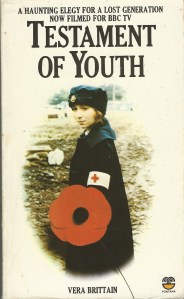
testament-of-youthThe Civic Service on Remembrance Sunday 2015 at S Modwen’s Church, Burton upon Trent

Micah 6: 6-8. Matthew 5: 1-12

Last year I told you how moved I had been by the valour, comradeship and courage of trainee Marine Commandos seen in the 2014 TV series. I lamented that those values are so lacking in the narcissistic society that we have created. This year I’m looking at the valour, comradeship and courage in a different group of people affected by conflict.

It was a woman of Staffordshire and Derbyshire who alerted me to the valour and courage of those who waited, supported and loved from afar. I’m talking about Vera Brittain and Testament of Youth. At the risk of boring you with more of my viewing habits, I refer you to the 1979 BBC TV production, available on YouTube if you’re interested. I remember two of its most powerful scenes: Vera at the telephone hearing of Roland Leighton’s death, and later, so sadly near the end of the war, Mr Brittain reading the telegram informing him of his son’s death.

My wife and I went to Texas in September to see our son and his family. One of the few pleasures of breathing recycled farts for half a day is the possibility that there might be a decent film to watch, and so there was: the 2014 film version of Testament of Youth. I thought as I watched that my theme for this 2015 Remembrance Day sermon would be those who, like Vera Brittain and her parents, “also serve who only stand and wait”.

So as well as those who have died and those who have been maimed, physically and psychologically, we remember the bereaved: the Vera Brittains, the mothers, fathers, lovers, sons, daughters, and friends. Those who wonder “what was it all for?” We remember that behind the ceremonies of this week there are countless stories of real human tragedy.

Now, please allow me a personal note. I decided on this theme about six weeks ago. Then, just two Fridays ago at 9.15 in the evening I had a telephone call from Texas telling me that my son had died in his sleep. He was 38 years and three days old. He leaves a wife and a daughter, a sister, a brother, a mother, countless friends on at least two continents, and a father. Now I am Vera Brittain receiving the phone call, I am Mr Brittain reading the telegram. Now I begin to understand what it was like, and is still like, for those who feel that part of them has died when they receive that shocking news. “Stop the clocks” does not even begin to express it adequately.

But among the desolation, I glimpse shoots of new life. I see that entombing oneself in memories and glorifying the past will not do. I see that the best way of trivializing an event and refusing to learn from it is to arrange an act of commemoration, then forget about it. This must not happen to me, or to us.

Nationally and individually, shoots of new life grow when we look into ourselves. We are all warmongers on a small scale: we think our opinion more important than someone else’s, we seek revenge, we won’t let go, we think we need to get the better of someone at Scrabble, or win petty arguments. I sit impatiently at traffic lights fulminating about why the old trout in front is waiting for a particular shade of green. Magnify that and put it in a different context, and we have war. We should remember how every evil act begins as a thought in someone’s head, and how every one of us must keep guard over our thoughts to nip the problem in the bud.

Today I urge you to think of the word remember in a different way. If dismember is taking apart, remember is putting it back together again. The King’s horses and King’s men couldn’t put Humpty back together again, because Humpty has to do it for himself. We must—I must—acknowledge the grief of loss, but then let go so that unlike Miss Havisham we are not trapped in the past. This is just as important for nations as for individuals. Look at the world and you will see.

We have the key to this in the first reading: Do justly, love mercy, walk humbly. And how do we walk humbly? Hear the second lesson: look into your own heart and see your poverty, your perplexity, your sadness at past hurts. These are your enemies. Love your enemies. They are inside you. Love them and you will move beyond them.

Today is about more than remembrance. It is about resolution to work for justice, and release of past grievance.

This is hard work, but in the words of Dorothy Fields, alluded to by Barack Obama at his inauguration:

Will you remember the famous men / Who had to fall to rise again? / So take a deep breath / Pick yourself up / Dust yourself off / And start all over again.