Ireland and England

I hardly think a caption necessary

I hardly think a caption necessary

Sunday afternoon I announced to SWMBO that since I now had only two services most Sunday mornings I was less tired than in Portlaoise where I had three. Then I fell asleep. I was snoring and muttering so loudly that Og the dog was agitated. Anyhoo, I set to thinking how life as a priest in the Church of Ireland compares with that in the C of E,

Irish clergy are better paid and can go on until they’re 75. Irish clergy have fewer demands on their time. I know of at least one who’s rarely outside the Rectory during the week. But because they are essentially chaplains to a small tribe, most Irish rectors care for their flocks with greater involvement than in the C of E. In return, parishioners respond with random acts of kindness – fuel for the rectory fire, a full tank of heating oil, the occasional hamper and/or bottle of nectar. The downside of this is that parishioners feel that they at least in part ‘own’ you, but there’s a price for everything.

English clergy come across a wider section of the population, even if only on an occasional basis for weddings, baptisms and funerals. Some of us like this, others don’t. There are more meetings in England (you never know what you’re missing if you don’t go, so I miss quite a lot) and we are much more ‘watched’. We are appraised and monitored. We are urged to do this, that and the other. We are told what healthy growing churches should and should not be doing. Frankly, all this makes me feel deeply inadequate and that whatever I’m doing is not enough. There are moves to import all this to the C of I, so I hope it will be resisted.

In Ireland (I speak of the Republic outside Dublin) clergy are thin on the ground. Any sense of isolation is overcome by networks from college (there’s only one in the C of I) and social media. I know of no English clergy who are such keen FaceBookers as Irish clergy. I’ve caught the disease. The many flavours of the C of E create their own support networks. There are accepting liberals, intolerant liberals, traditional catholics, wishy-washy catholics, traditional evangelicals, wishy-washy evangelicals … yes, it’s silly isn’t it … and these groups can be helpful so long as we don’t take ourselves too seriously.

The tribal nature of the C of I, with the Church building as its totem, means that so long as there’s a steady supply of fecund Anglican maidens, with not too much notice taken of Ne temere if an Anglican should dare to marry a Catholic, the small rural church will be supported and maintained, if not often attended. I wouldn’t be surprised if the rural C of I survives longer than the rural C of E, where buildings are more expensive to maintain and where there’s little sense of loyalty other than to the graveyard (‘so that I can be buried with my ancestors’). The quasi-Masonic Lodge function of the church building has a huge downside, however. The loss of Anglo-Irish aristocracy can result in the gap being filled by self-appointed royal families, some of whom come to hold doleful and ignorant hegemony over parish and parishioners.

As to relations with other denominations, these are much healthier in Ireland. The dominance of the Catholic church means that it is secure enough to be gracious to the tiny minority. The Church of Ireland punches far above its weight, I guess, so that Irish society is seen as not being discriminatory.

So pluses and minuses. Maybe my soporific state on Sundays has little to do with any of the above, and more to do with the fact that I’m old and fat. Recent news that eggs and butter are no longer evil might help the first but not the second.


What is truth?

4288759Whistleblowing is in the news. Banks and bankers are at it again. HSBC is caught with its knickers round its knees. UK tax authorities have allegedly been either negligent or complicit in not having acted on a tip off. Church of England Archbishops have been cosying up to the former chairman of HSBC, himself an Anglican priest, so make of that what you will.

Let’s not fool ourselves into thinking that this is unusual. Remember Mr Fred Goodwin and his antics when The Royal Bank of Scotland almost folded? I suspect that if there’s a bank that hasn’t yet made the news for the wrong reasons, it’s only because it hasn’t been found out. And it’s not confined to banks. Any organisation that has power will, in my experience, do everything it can to cling to its precious, at almost any price. Did you see the Belgian series Salamander when it was shown on BBC? The DVD is available, and I look forward to series 2. Is that truth or fiction? The powerless are pilloried by the powerful. Individuals are attacked by the mob. This is the law of the playground bully. If you were in any way unusual at school, you will know what it feels like to suffer at the hands of the unimaginative, and you will know to what ends you had to go to appease them.

For 19 years we lived in Ireland. Hardly a week goes by there without some new revelation of political chicanery, or some report of abuse of the powerless by the Church – an organisation that for reasons of history has been allowed way too much power over society. A dear friend, who worked for years in the Irish psychiatric hospital service, had a mantra that she impressed on me when I was having a spot of bother: “Might is always right and authority always upholds authority, so get used to it and watch your back”. I doubt it’s better here in the UK. It may even be worse: in this more complex layered society, with the networks of the largely public school educated élite who are in charge, it’s easier to hide things out of sight of the great unwashed—that is, you and me.

Whistleblowers always have a tough time. If you tell an unpopular truth, people will criticise you. Far better, it seems, to live in some artificial never-never land of make-believe than to dwell in the courts of straightforwardness and truth. Prophets are never popular. They have always suffered for pointing out the elephant in the room.

Lent is about a spiritual spring clean. The events leading up to Easter include the story of one who suffered for daring to tell it like it is. Pontius Pilate’s question ‘what is truth?’ is the anthem of the pragmatic appeaser. We need more whistleblowers. We need more people who are ready to tell the truth and who are willing to suffer for it. Are you? Am I?

Life is a terminal condition

Dream as if you'll live forever. Live as if you'll die today.

Dream as if you’ll live forever. Live as if you’ll die today.

Please excuse me: I’ve written about this sort of stuff before, but I can’t stop myself doing so again.

TV adverts at the moment tell us: for the first time as many people survive cancer as die from cancer; together we’ll beat cancer; soon nobody will die from cancer.

What nonsense! It’s emotional manipulation to get you to give to cancer research.

If you don’t die from cancer, then what will you die from?

Maybe you think you won’t die at all. Maybe you’ll live for ever like the struldbrugs in Jonathan Swift’s Gulliver’s Travels, increasingly opinionated and cranky (some of us are like that already). At 80 years of age their marriages were dissolved because no two people could stand each other any longer, and they became legally dead, no longer able to own property. This is not unattractive: no taxes, no responsibilities, no leaking roofs to worry about.

Somehow, unlikely though it may seem, I think Swift was taking the piss.

Life is a terminal condition. Deal with it. We invest so much in doctors and drug companies because people can’t come to terms with that fact. We imagine that the next new drug or treatment will allow us to live for ever—or at least, for that bit longer.

Imagine you’re expecting to kick the bucket any day, then a new drug unexpectedly becomes available and you are told you have an extra month. What will you do with the extra days? Will you travel to where you’ve always wanted to go? Will you write your life story? Will you make sure that the people you think are gobshites know your opinion of them? (a very tempting option.)

When my mother was on her last legs with secondary cancer, she was put on morphine and had a couple of months at home. She asked me what to do. I said if I were her, I’d get a train ticket and go places I’d never been, though by then she was too ill to bother. After she died, my father bought a deep fat fryer, so that was soon the end of him. If we don’t die of cancer, I suppose heart disease will be the killer. Or murder—if the struldbrug character changes are an indicator.

What will it be for me? Road traffic accident? Heart disease (I like eggs; I like salt)? Cancer? Quite possibly cancer. I’m a bit of a worrier and there is evidence of cancer-genes in the family. Now just so you get this straight, cancer is not a disease, it’s a side-effect of ageing: the longer you live, the more likely your cells are to go out of control. Also, cancer is not God’s judgement. Cancer is not a punishment. Cancer, like so many other things, is just stuff that happens.

The game's up

The game’s up

Back to the plot. The beginning of the year is a good time to make peace with people you know you’ve offended or hurt. You might tell people who’ve hurt you that you bear them no ill will. You would then have a lighter heart, carry fewer burdens, and live more serenely. You can start this now, by living each day as if ‘twere thy last. Because it jolly well might be.

Wiping out this disease today means you die of something else tomorrow. Life—to repeat—is terminal, and you never know when the game’s up.

To potter, to think, to write, perchance to dream

fawlty2_465x371Fawlty Towers, Communication Problems

The Major: Going to have a flutter, Fawlty?

Basil: No. No, no, no, no, no.

Sybil: No, Basil doesn’t bet anymore. Do you, dear?

Basil: No, I don’t, dear, no. No, that particular avenue of pleasure has been closed off.

I’m with Basil. Are there any avenues of pleasure that are not now closed off? The joy of playing in the snow – gone. The absorption of damming a stream – gone. The pleasure of learning a new piece of music – gone. The thrill of fiddling with my organ – gone. The excitement of visiting a place I’ve never visited before – gone. All gone. All passion spent.

In Nottingham we were neighbours of novelist Stanley Middleton who wrote one book about 23 times. He never moved from his study. He said if he couldn’t imagine all he needed to know he didn’t need to know it. But imagination and memory are malevolent, for I remember things that I might reasonably be proud of only when someone else thanks me for them or reminds me of them, and yet my head is full of past episodes real and imagined that make me squirm with embarrassment or shrink with shame.

Is this because I am tired? Possibly: Christmas is busy and tiptoeing round parishioners’ sensibilities is tiring. And futile. Is it because the last decade has been tumultuous—we have moved six times, twice across the Irish Sea? Is it because of the oppressive weight of diocesan desperation? Is it because circulating testosterone has dropped off, along with a few other things? Undoubtedly.

I often think I’ve been on the planet long enough. And I know I’m not alone, as became clear in a bit of R and R with my friend yesterday. But this solution won’t do, at least not yet. My expectations of myself need to be lowered. Others’ expectations of me need to be lowered: ‘No, the Vicar won’t do that: do it yourself.’

Sessile sea squirts

Sessile sea squirts

Some marine creatures move about only when they are immature. As they mature they become sessile, fixed to the sea bed. Maybe I’m maturing. SWMBO tells me that Churchill did a lot of his work in bed. It’s taken me a long time to discover the value of two short taps on the fn key at bottom left of this Mac keyboard. I like playing with words as I lie in bed.

To potter, to think, to write, perchance to dream.

God bless this mess

tasty_middle_east_treats_off_market_menu_for_now_1715875500But as many as received him, to them gave he power to become the sons of God

Imagine the shed. Imagine the cold, the sense of being alone. Let’s assume there were animals there. Imagine the creatures, the smells, the dung. Imagine the placenta, the umbilical cord – the connexion between old life and new life. Imagine the blood. Since neither parent was, as far as we know, a qualified midwife, imagine the fear of getting things wrong and the baby suffering. What a mess!

Life is a mess. Relationships don’t do what you expect. Things don’t work out. Actions, or inactions, have consequences. Like a row of skittles where one knocks over the next, and the next, and the next …. actions and consequences endless and uncontrollable. This is the glorious mess of being alive.

If the divine was willing to lose control by jumping into this mess of humanity, then we don’t need to worry about it. To begin to know the innermost part of the mess that is yourself is to begin to meet the Lord. Relax into yourself, as you are—after all, you are made in God’s image. Then you will start to see what you can be. Christ is born in you today. That’s the Christmas message. We are sons and daughters of the Lord.

Don’t be ashamed of yourself. You are part of the mess of God. Let go. Pick yourself up, dust yourself down, and start all over again.

Courageous Pope

Pope_Francis_2013Il Papa needs to watch his back. He is ‘courageous’. Francis has listed fifteen ailments from which he thinks the Vatican Curia suffers. Here is my interpretation of them.

  • They treat the church as a private club. They form cliques. They show off. They suck up to people more ‘powerful’ than themselves. They think the more they have the better off they’ll be.
  • Everyone thinks he is in charge, so without coordination, nothing gets done.
  • They confuse looking miserable and/or pompous with seriousness of purpose.
  • They build walls around themselves and their own creations. They are inclosed in their own fat, and their mouth speaketh proud things. ( Psalm 17:10, BCP 1662)
  • They think that driving a computer is more important than dealing with real people.
  • They are hard-hearted. They are delighted when a rival comes a cropper. They ‘kill’ others by gossip and backbiting because they lack courage to speak face to face.
  • They plan too much so become inflexible, they think activity means progress, so they never reflect on what they have done or what the consequences might be of planned action.

Sound familiar? Entitlement. Masonic intrigue. Petty rivalries. PCC meetings. Church processions. Church politics. Mission Action Plans. Fawning to bishops. Church flower rotas. Church choirs—oh Ye Gods, church choirs, may the Lord save us and protect us.

I spent three years of my life dealing with a particular manifestation of such as this. I resolved when I got out of it that I would never again tolerate such self-obsessed behaviour. And I mean it.

Back in the fourth century AD Evagrios the Solitary wrote that the demons that fight us in the front line are those entrusted with the appetites of gluttony, those that suggest avaricious thoughts, and those (worst of all) that incite us to seek the esteem of men.

Nothing has changed. I’m with the Pope.

No room in my head

homer_braincolor1The characters in the Christmas story live in my head. It’s pretty crowded in there. Legion, you might say.

There are characters on the hillside left out in the cold until they are surprised by light and encouraged in. There’s Mary who listens to something bigger than herself and sets aside her own plans. There’s Joseph who worries that maybe he’s taking too big a risk, but he’s started so he’ll finish. There are magi that journey far and wide using abundant gifts to enrich life.

Then there’s Herod strutting and swaggering, clinging to power and possessions, like Gollum to his precious. He is fearful. He stifles initiative, nips new life in the bud before it gets chance to flourish. Or so he thinks.

All these characters move towards the infant.

The child in the manger shows us how to let go, take risks, follow our stars, bring in from the cold. If we search hard enough—and it is maybe the most costly thing we ever do—we might even realise that the Christ child is within, like a neglected pilot light waiting to be turned up. The infant saving us, in fact, from ourselves, selflessness superseding self as the inner light glows ever more brightly. My kingdom is an inner kingdom.

In the early hours of 30 June 2005 I dreamt I was descending stairs into a church basement, completely in the dark. Something was awaiting me, though I knew not what. I was without fear. Along a corridor, into a room, pitch black. I felt to the left for the light switch. I flicked it. In front of me was a young lad. So pleased to see me, so lonely, tears of joy, so relieved. He had been abandoned and given a home in the church, alone all week. So sad, but so full of grace. ‘I am so glad you’ve come for me.’

Would the child you once were be pleased with the adult you have become?

Church parasites

Heartworms

Heartworms

Today’s Church Times announces that the good old C of E is thinking about using human resources managerial strategy to train people for high office. Nothing has quite spoiled my Friday morning as much as this has – not even the prospect of a politically correct Christingle for a non-church and significantly Muslim school later in the day.

I know from selection conferences when I was an Assistant Diocesan Director of Ordinands that people, even at that very early stage, are labelled as potential high fliers. This is woeful enough in an institution that claims to be about service. But to institutionalize it is shameful.

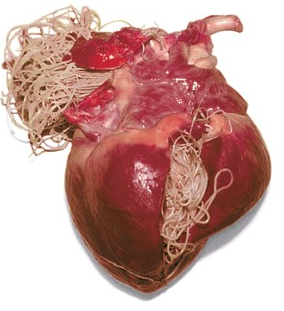
The problem about wearing the clothes of other creatures is that one picks up their parasites, and in this case the parasites that come with the coats of corporate managerialism will at best disable and at worst consume the host. This is the sort of policy that drives me towards the former ‘flying’ bishops for a vision of the church that accords with what has been handed down to us.

I suppose the people that come up with this are so struck with guilt about what they have allowed to happen to the church – or rather, they should be – that they now flail about like headless chickens. ‘Something must be done’ they say. Maybe, but Ye Gods not this.

It’s like medical education. You qualify as a doctor (it’s a conveyor belt – don’t let anyone tell you otherwise – there’s no intellectual content, it’s all memory), then you train in obs & gynae, GP, physician, surgeon etc. Then you get 8-10 years under your belt and find yourself approaching divorce, middle age etc. And you are BORED. You have done 5 gall bladders a day every day. You have looked up the orifices of 7 zillion people and you are NUMB. So then you take to the bottle, or whatever, and start to attend meetings (with expenses of course) at the Royal Colleges where you sit around in panelled rooms on committees that interfere in things that don’t need interfering with. You impose your ‘new’ ideas and force reorganizations and generally foul things up even more. But at least you are not bored any more, and you can wait in line for your gong.

Now put all that in the context of the church. I’m long enough in the tooth to say to Church apparatchiks that I shall go on as I am. By the time they get round to disciplining me for not going along with unimaginative fads I shall be either dead or retired. But I pity the poor souls who are at the beginning of their ministry.