This sanctuary of my soul

Great_Mass_in_C_minor_(Mozart)_p1We were in Hugh’s truck on the way from San Antonio to Fredericksburg in the Texas Hill Country. A day out. Muzak was oozing from the speakers. Quite without warning Mozart’s C minor Mass Kyrie began. I can’t quite find words for the effect it had on me at that time in that place, but it was something like being jolted by an electric shock in an instant into the fullest sort of life imaginable.

‘This is the best thing he ever wrote.’

‘They used it in A Very British Coup, with Ray McAnally.’

‘There’s a bit in the Sanctus that quite bowls me over.’

‘Doesn’t it all?’

University Methodist Church, San Antonio

University Methodist Church, San Antonio

The following Sunday we were at the local church. Plush, wealthy, comfortable, striking modern stained glass, acolytes in albs, candles to gladden my heart (yes, Methodist candles!), a lovely two-manual mechanical action organ by Rosales of Los Angeles—and they let me play it. The church orchestra featured. I must say, though, it was rather like a diet of honey both musically and theologically. Not soporific exactly, but certainly tending to make me wonder if I was in Stepford.

The contrast between the two musical experiences was remarkable. Mozart electrifies, muzak stupefies. Mozart—that Mozart in particular—exposes in an instant that central vacuum in my being that longs to be embraced. It tears apart the layers of ‘show’ that collect like dental plaque. It brings home to me, yet again, that all ‘this’ is vanity. It explains, yet again, why my best sermons are written under the influence of music, for it’s not long before whatever comes through the headphones bypasses conscious hearing and unlatches the sanctuary of my soul. The sad thing is that it is so expensive of emotion and self that I don’t do it often enough. My kingdom is an inner kingdom.

I was 13 when I first heard Patrick Hadley’s I sing of a maiden. ‘However long I live’, I thought then—as now—’I shall never be able to produce anything quite so concentratedly beautiful.’ I wonder what it felt like to be Patrick Hadley—actually, quite fun by all accounts, for there are lots of stories about him. I wonder what it felt like to be Mozart.

Still small voice of calm

galilee-3A homily for Proper 14. 1 Kings 19: 9-18. Matthew 14: 22-33.

At creation, the spirit hovers over the waters. The spirit brings order to chaos. In Holy Scripture, water, waters, the sea always signify risk, danger, turmoil, the tendency to entropy. We talk of being up to our necks, out of our depths, going under.

Elijah was in it up to his neck. His personal circumstances were to say the least a bit sticky. He found the spirit of wisdom not in the noise, the storm, the wind, but in the silence.

Life is a bit sticky. We fall out with people, sometimes their fault, sometimes ours, usually both. We struggle with fractious families, tedious jobs, unyielding rules, unreasonable expectations, addictions, and more. Will we find wisdom in more noise, more words, more busy-ness? Will we find wisdom in a bit of solitude and silence? How can we hear the still small voice if we crowd it out with noise and crackle? The spirit came to the disciples as they were in it up their necks. Calming wisdom bringing order to disorder, cosmos to chaos.

Sit back. Silent. Still. Perhaps the answer to the question the Lord asked of Elijah will become clearer to you.

What are you doing here?

Chucking and clubbing

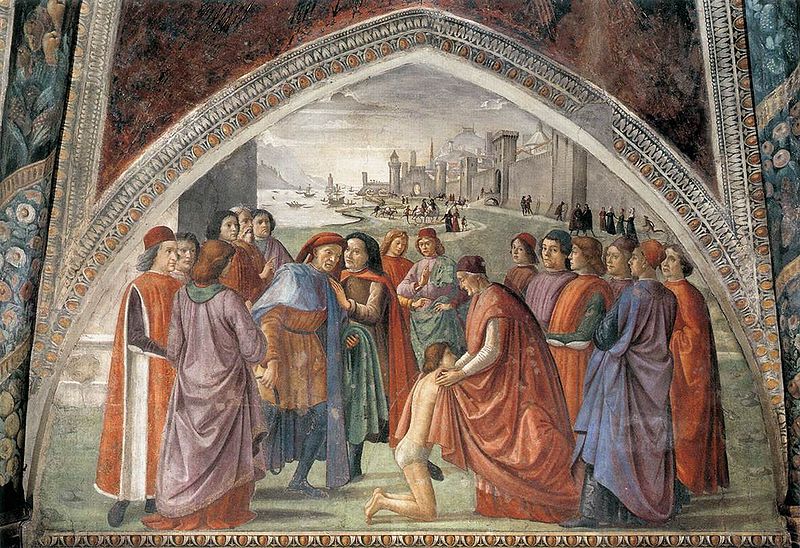
800px-Cappella_Sassetti_Renunciation_of_Worldly_GoodsSWMBO is a hoarder. I’m a chucker out. So we have rows.

In the last 15 years we’ve moved six times, chucking out each time. But then we accumulate more, and it’s not from parents for they were dead 20 years ago. Before we die we’ll likely as not be in a two up, two down, and we’re chucking out now.

I can’t speak for her indoors—wouldn’t dare, though I know she finds it painful (‘books are my friends’), but I think it liberating to see the back of stuff I don’t need any more. There’s nothing like a bonfire.

Take my books. Over the years I’ve collected a vast number. Lots of them signified a club I thought I wanted to belong to: organ building, Greek, Latin, Sanskrit (how stupid is that?), a bit of philosophy, theology, medicine of course, embryology. Organ and piano music too. When I was a teenager and wanted to be a cathedral organist I stocked up on all sorts of music. I look through the library and think ‘I’ve never touched that in the last 20, 30, 40 or even 50 years; I’m not likely to in the next 20 if I live that long (family history not encouraging there), so out it goes.

And it has. I’m very grateful for the ‘ministry’ of Sue Ryder, theological colleges and musical friends. I’ve kept stuff that interested me when I was a child (zoology), music that I could well get round to playing, and  books that speak of beauty and that I might find useful (some theology). But that’s all.

The question is: why did I want to belong to those clubs? Why do we want to join sports clubs or golf clubs (I’m not old enough to play golf) or drinking clubs or backslapping clubs where we stitch up local business to our own advantage? Is it because we feel we have no identity unless we are part of a mob? The story we read on Palm Sunday says a good deal about the mob.

Maybe it’s because we become infected by a demon. Back in the fourth century AD Evagrios the Solitary wrote that the demons that fight us in the front line are those entrusted with the appetites of gluttony, those that suggest avaricious thoughts, and those (worst of all) that incite us to seek the esteem of men. I think it’s the last one that makes us want to join clubs: the craving for recognition by those whose recognition is not worth having. He knew a thing or two did Evagrios the Solitary.

Out goes the rubbish. Maybe I’ll end up sanyassi.

Stuff as dreams are made on

Fear not

There is a tide in the affairs of men that results in dreams of foreboding and inadequacy. I’m back at school. I have the life experience I have now, but I’m full of anxiety about having to repeat A levels. Especially Physics. Or I’m back at medical school aged 63, required to sit final exams again and knowing that I never grasped biochemistry in the first place so there’s no chance now.

The psyche takes a long time to catch up with the rational mind, so dreams like this might be expected as the brain rids itself of stuff that’s past its sell-by date. Bewilderment. Wilderness.

I wondered if this was my psychopathology. And then I discovered Smirnoff. Well, actually, I started to tell a friend, but before I’d got to the end of the first sentence, he interrupted and finished it for me. He was having them too, and had been for ages. And then another and another friend tell me much the same. It’s good to know I’m not psychotic. *

Whatever else these dreams may be, they’re not irrelevant. All our lives are governed by attitudes and ways of thinking that develop when we’re in our prime. Decades later circumstances have changed, and it’s often inappropriate to let those same attitudes govern how we think or respond. With a bit of luck, I can give them up for lent. At first I was disturbed by the dreams, but now I look forward each night to the next instalment of the soap opera.

There’s a scene in Shadowlands, the film of Joy Gresham’s romance with C S Lewis, where Lewis meets one of his former pupils, now a teacher. In the course of a brief conversation, the former pupil quoted his father: ‘we read to know we’re not alone.’ We talk and listen to know we’re not alone, too. It’s reassuring to hear ‘that’s just how I see it too’. Knowing that you’re not alone gives you courage to stick to your guns.

* Neurotics build castles in the air, psychotics live in them, psychiatrists collect the rent.

The Water of Life

The-Water-Of-Life-65Just back from a week in Gran Canaria. Terrific. Never been before. Hired a car. Mega-scary road from La Aldea to Agaete. Lots of twisty corners and places where all I could see to the left was sky. I am not exaggerating, It’s as well that I didn’t know when I set off what I know now. I never used to suffer from what people call vertigo when I was younger, but something happened in early middle age.

I took the trusty Kindle with me. I was looking through Aesop and Grimm and Andersen for some stories for school Assemblies, and came across The Water of Life (Grimm). It might or might not be suitable for Assembly (stories tend to need shortening) but, ye Gods, it’s spot on for life in general and parochial life in particular. It quite bowled me over. It begins thus.

Once upon a time in a land far away there reigned a king who had three sons. The king fell ill. His sons were grieved at their father’s sickness; and as they were walking in the palace garden, an old man met them and asked them of their woes. The princes told their tale. ‘His Majesty must drink of the ‘Water of Life’ said the man. ‘Were he to have but a sip of it he would be well again. But it is hard and dangerous work to collect it.’
 
The eldest son thought to himself ‘If I bring my father this water, he will make me sole heir to his kingdom.’ He went to the sick king and begged that he might go in search of the Water of Life. ‘No,’ said the King. ‘My life is not worth the great danger of the journey.’ But the prince persisted and eventually the King let him go.
 
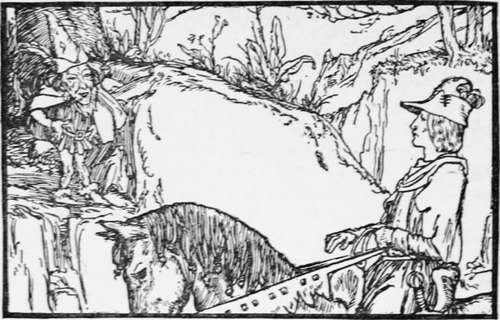
After a time the prince came to a deep valley, overhung with rocks and woods; and looking around, he saw an ugly dwarf who said, ’Prince, whither so fast?’ ’What is that to thee, thou ugly dandyprat?’ said the prince haughtily, and rode on.
 
The dwarf did not take kindly to the prince’s behaviour, and laid a spell upon him. As he rode on, the mountain pass became narrower and narrower until at last the prince could go no further, and neither was there room for him to turn his horse and return whence he came. So there he remained on his high horse, unable to go forward, unable to turn back, and unable to dismount. He remained spellbound. Thus it is with proud and silly people who think themselves above everyone else, and will neither seek nor take advice.

The rest of the story—you can guess I expect—the second son sets out on the quest when his elder brother fails to return. The same happens to him. Then the youngest son, the simpleton, sets off. When he encounters the dwarf, he tells him of his quest and the reason for it, and seeks the dwarf’s advice. He listens, thanks the dwarf and goes on his way. He finds the Water of Life, and on his way home asks that his brothers be freed—which freedom is granted. His brothers repay this generosity by stealing the Water, taking it to the King and claiming the credit. But the dwarf works his magic so that in time the two elder brothers are found out and forced to flee into exile, leaving the youngest prince to rule prudently with all his power.

You may know the story. You may have pondered its wisdom and its Scriptural resonances (and Indiana Jones resonances). I come across this story fresh. It’s on my precious list, along with The Snow Queen (‘melt this heart of ice’), and the Venite (‘Today if ye will hear his voice, harden not your hearts’).

Salt, light, snow, ice

monaco-glacier-spitsbergen-norwayA Homily for the fourth Sunday before Lent

Isaiah 58:1-9a. Psalm 112. 1 Corinthians 2:1-12. Matthew 5:13-20

Chips are no good without salt. Salt enhances flavour. We can help others bring out their flavour—to let their light shine. The divine light is in all of us, like a pilot light on a gas stove, and we salty people can help others to turn up the dial so that the stove is aflame with warmth and light.

We add flavour to the world by acts of charity. Care for the needy, poor and oppressed: ‘share your bread with the hungry, shelter the oppressed and the homeless; clothe the naked when you see them’. Your many unrecorded acts of kindness and generosity are grains of salt.

We add flavour to the world by refraining from oppression, revenge and malice. These make us hard-hearted. A friend reported one of our churches to Laois County Council because sometimes only one of the exterior doors is unlocked for services. The fire officer recommended that the others be left unlocked, but fitted with a device so that they may be opened only from the inside. I use this story to ask about the doors to our hearts. Are they open to the message that we purport to profess week in, week out? Or are they shut, excluding the breeze of freshness and renewal as we stay locked into old resentments and fixed false beliefs? In the Venite we are warned against hard-heartedness that corrodes us. It’s a cancer of the spirit. It kills. ‘Hatred devours the wicked. They grind their teeth and their hopes turn to ashes.’

All this takes humility: the realization that ‘I’ am not the only person in the world, and that what ‘I’ want is no more important than what anyone else wants. No showing off. Paul writes: ‘I did not come … in lofty words or wisdom … I came to you in weakness and in fear and in much trembling.’

Humility like this keeps the focus away from self. Indeed, any pretence of the perfect image will stop the light that’s inside from shining out to others. It’s only through our imperfections, our cracks, that the light is able to get out. Put a tea-light into a flower-pot. You won’t see it unless the pot has a crack in it.

Now, another use for salt. We use it to lower the freezing point so that ice melts. There’s salt in tears. We know this, because when we’ve cried and the tears have evaporated, there’s a salty deposit left on our cheeks. So let me tell you a story, and I’m sorry for carving up the work of Hans Andersen, but it’s a long story in its original form.

Once upon a time there lived a wicked goblin who built a magic mirror. Anything that was beautiful or good was reflected in it as ugly and bad. One day, as the goblin was flying through the clouds, he dropped the mirror. It shattered into millions of pieces. A few pieces fell in a small town where two friends named Kay and Gerda lived.

They were neighbours and friends. As they were playing, Kay felt something sharp in his eyes and his chest. Shards of the broken mirror went into Kay’s eyes, and another into his heart. From then on, Kay made fun of everything beautiful and delightful. He no longer saw Gerda as his friend, but sneered at her. His heart turned to ice. Gerda didn’t understand.

As Kay was playing alone in the snow, a large and splendid sledge drew up. Its driver, a most beautiful woman, invited Kay to join her. She was draped in a white flowing gown. On her head was a crown of ice. Her hair was like icicles. ‘Who are you?’ asked Kay. ‘The Snow Queen’ she replied, her face glinting like a diamond in the snow. Kay got int, the Snow Queen tugged at the reins, and off they went up into the clouds, taking Kay to a distant land.

Gerda missed Kay and never stopped loving him. She waited for his return. He did not come. She set off in search. She took her boat and went off on the river. Hearing Gerda’s, a fairy sent her garden flowers to search for Kay, but they returned empty-handed.

Gerda sat under a tree and wept. A crow flew down and told her about a princess who had married a boy. Gerda wondered if that was Kay and urged the crow to lead her to the princess’s palace. She sighed with relief when she saw him, because it wasn’t Kay.

Gerda came to a forest where she met a robber girl and her reindeer. Hearing Gerda’s sad tale, the reindeer said he had seen the Snow Queen flying away with a boy to Spitsbergen near the North Pole. Gerda and the reindeer set off. It was a dangerous journey.

At the Snow Queen’s palace, they found it guarded by snowflakes that prevented their approach. The only thing that overcame them was Gerda’s praying the Lord’s Prayer. Her breath took the shape of angels, who pushed aside the snowflakes and allowed Gerda to enter.

Gerda found Kay alone. He was almost immobile on the frozen lake, which the Snow Queen calls the ‘Mirror of Reason where her throne sits. The Snow Queen had set him a task: if he is able to form the word ‘eternity’ with letters made of ice, the Snow Queen will release him from her power. Try as he might, he is unable.

Gerda runs to Kay and flings her arms around him. He is like a statue. Gerda weeps. Her tears drop on to Kay’s chest. Slowly, slowly the warm tears seep into his heart. Tears of love melt Kay’s heart of ice. Kay bursts into tears, washing out the splinters from his eyes. Gerda embraces Kay, who comes out of his trance. Kay is saved by the power of love. He looks at the lake of ice and sees the letters have arranged themselves to spell ‘eternity’.

Gerda and Kay and the reindeer leave the ice palace for home. They find it just the same as it was when they left. But they have changed!

Gerda’s grandmother reads a passage from the Bible: ‘Assuredly, I say to you, unless you are converted and become as little children, you will by no means enter the Kingdom of Heaven’.

Speed these lagging footsteps,
melt this heart of ice,
as I scan the marvels
of thy sacrifice.   (William Walsham How)

Anger and apathy

475px-The_ScreamCorrupt police, whistleblowers persecuted, financial crime unpunished, cronyism, laws that are obligatory for us but merely aspirational for the rich and famous. Maybe all this doesn’t affect you personally.

Dealing with jobsworths in utility companies, banks, and councils. Wondering why you have to make an appointment in your busy life to sign a piece of paper that could have been posted to you. Maybe at work you’re harassed to do more, to achieve more, to sell more, to recruit more. Maybe you have to deal with managers who dump on you because they’re concerned only for themselves. Maybe some of this is more your experience.

Maybe you work for an institution that appointed you to do a job that cost you a great deal of distress, which, when the institution changed the rules, you see was for nothing. You’re left drained, disheartened, feeling foolish and hopeless—that is, de-sperate. There’s a memorable episode in the US House of Cards in which Kevin Spacey’s ‘wife’, a self-obsessed businesswoman, asks her underling to sack employees, and after it’s done, then sacks the underling. Maybe you understand what that must have felt like.

Anger is hard-wired in to the amygdala and limbic system of the brain. We need it, or used to, for survival. Suppressing it, however socially acceptable, is bad for the organism. I internalize it. I pretend to myself I can deal with it. Then after a couple of days I get collywobbles and pains and what feel like panic attacks. Slowly, it dawns on me that this is not indigestion or oesophageal reflux, neither is it psychiatric illness. It’s anger.

Some people get rid of their anger by thumping. I wish I were more like them. There’s no point explaining to those responsible why you’re angry, for the likelihood is that they’re so keen on saving face or backside (interchangeable?) that their response is merely to hide behind legalities and protocols.

What can the pastor advise about dealing with anger? I spent a good bit of time with a 12 year old lad who had an abusive father. He knew the fate that awaited him for having lost some trivial item. He was beside himself. I said ‘I know how you’re feeling.’ And he – to his great credit – said ‘no you don’t, how can you? you’re not me’. That taught me a thing or two. Saying ‘Jesus understands’ is likely to result in your admission to A & E. Rightly so. Getting people to talk about it is an absolute must. To scream and shout, to curse until there is no more energy left. To sink into apathy.

Apathy. A useful state, however painful it is to arrive there. A lack of emotion. All passion spent. No longer are you foolish enough to expect others to imagine how their decisions might affect you. From apathy you begin to pick up again, knowing better what you’re dealing with. Maybe you become intent on revenge. They say it’s a dish best served cold. The trouble is that seeking revenge makes you hard-hearted and bitter as it eats away like cancer. It is cancer of the spirit. But it’s easy to understand why films about revenge – Shawshank – are so popular.

Perhaps you’ll learn from the experience and move on. Maybe you’ll distinguish between anger on behalf of others, and anger on behalf of self, that is, injured amour propre. If it’s the latter, maybe you’ll see that you’ve fallen victim to the demon that incites us to seek approval from others, and you’re angry with yourself. Maybe you’ll see that those others’ opinions are not worth having. If so, you’ll come out of it wiser, determined to continue to let your ‘yes’ be ‘yes’ and your ‘no’ be ‘no’, despite the duplicity and thoughtlessness of others.

But it is never easy.

Baptism

800px-Baptistery.Arians06Homily for 12 January 2014. Isaiah 42:1-9. Psalm 29. Acts 10:34-43. Matthew 3:13-17

As a child I was enraged when adults referred to me as Arthur’s lad, or whatever, and it narks me now to hear people say so-and-so’s daughter or son. I have a name, dammit, and I was given it at Baptism.

When we give someone a name, we feel more personally involved with him or her. A different kind of relationship is established: I’m now me, not just Arthur’s son, or his car, or his boots. Using a name, we can address someone directly.

But other things happen too when we give somebody a name. We make them part of our tribe, our group. We domesticate them like a pet. We begin to feel comfortable with them, and able to control them, drink tea with them and suck them into our prejudices.

It’s easy to let this happen with our relationship with the Master.

We begin to feel we know him. We ask him for this or that favour,  ignoring the fact that millions of others ask for favours that negate ours. We ask him to cure this or that illness in someone we know, as if he is at our beck and call. We twist his teaching to suit us and our situation, ignoring the fact that we’re already pampered and privileged. As we domesticate Jesus we try to make him ‘one of us’, like a lap dog that wags its tail and goes for walkies at our whim.

It’s dangerous to claim to know Jesus. It reflects our narcissism. What emerges from Holy Scripture is just how unpredictable he is. I marvel at those people who claim to know the Master. I do not dare presume. He is concentrated, undiluted love—certainly—but that is not limited by my desires and prejudices. Concentrated, undiluted love might mean saying ‘no’ to me, for my own well-being. Many churches have the strap-line ‘to know Jesus and to make him known’. Good luck with that.

Who is doing the naming in today’s Gospel?

The mistake I’m making is to assume that I’m doing the naming. Of course I’m not. ‘This is my beloved Son, in whom I am well pleased’ doesn’t come from my mouth, nor from the mouth of John the Baptist, who’s puzzled by Jesus’ appearance in the queue. ‘What are you doing here? You know what I’m on about better than I do.’

Jesus doesn’t need baptism. But maybe he’s waiting in line for our benefit. Acting as our representative, he shows us what to do. In the words we heard at the carol service: ‘and if you want to know the way, be pleased to hear what he did say’. He identifies with all of us imperfect people who need a fresh start and a new identity—which is one of the things that baptism’s about.

The Gospel tells us whose son Jesus is, and the first readers knew very well what his name meant. Jesus, the Greek version of Joshua (and like Jason, as in the Argonauts), means ‘the one who saves’. From what, by what means, and to what end, are topics for a whole course of sermons.

Whatever else today’s events mean for you and me, they remind us that the Master is not a personal pet, to be called on only when we need a bit of a cuddle and ignored the rest of the time. And just as he, the beloved Son, shows us the way, all of us are beloved sons and daughters of the Divine Lord, with all the rights and responsibilities that brings.

Jesus is immersed in the Jordan. We are immersed in divine love, by no means always easy to bear. Today is a call to think about our personal relationship with the one we claim to worship.