Tuesday in Holy Week: love your enemies

prodigal_son33

The welcome

Isaiah 49:1-6. John 13:21-33, 36-38

I suspect all church people have heard ‘I’m not coming to church: you’re all a bunch of hypocrites.’ The usual response is ‘well, there’s always room for one more, so you’d be in good company.’

We hear a lot about Judas in Holy Week, and Judas is, amongst other things, accused of being a hypocrite. Judas wasn’t a particularly bad man, just weak. His weakness is part of the story, just as are Peter’s denials. Maybe if Judas hadn’t killed himself he’d be a saint like Peter—maybe he should be, since he was the agent of Jesus’ liberation from earthly form. Yesterday we heard him say that money used to buy oil should be given to the poor, whereas in fact he wanted to filch it for himself. And tomorrow there’s an element of ‘it wasn’t me, guv, honest’ in the Judas story.

It all puts me in mind of Homer Simpson’s advice to Bart. Homer says: I want to share something with you: the three little sentences that will get you through life. Number 1: Cover for me. Number 2: Oh, good idea, Boss! Number 3: It was like that when I got here.

As it happens I think Homer’s a great guy. For all his faults, he’s a kind of innocent, and he certainly loves his family. But enough of these insights into my depraved televiewing habits. I want to talk tonight about demons—the kind of demons that assailed Judas, and because there’s Judas in us all, in our human nature. Once again, biology plays its part.

We left Jesus on Sunday standing at the gates of the city, facing death in the city of wrong. Jesus faces his demons. As we go with him, we must face our demons, our fears. These demons are the enemies within, enemies of spiritual growth, enemies of resurrection, enemies of imagination. Jesus tells us to love our enemies, but we can’t love these demons until we see them, and we can’t see them until we look them full in the face.

What are our demons? Let’s look at the demons in the Passion narratives. Three are obvious:

  • Denials. Peter’s denials saved his skin—but only for that moment. Later, he wept, overcome with remorse. It’s hard to hear today’s news without being confronted by denials. How can a head of state deny his part in a situation that sees three quarters of his people starve while he lives in luxury? How can a politician say what is self-evidently not the case? Is anyone guilt-free? Who has not tried to get something for nothing, or used work time for personal business?
  • Mob justice. There are so many stories that illustrate this. Children attacking other children. One from 2007 sticks in my mind. In March of that year, The Times reported, a young man was surrounded by a gang with wooden sticks. Witnesses say that teenage girls egged on the attack with shouts of “Kill him, kill him.”
  • Evasion of responsibility. Judas said ‘it wasn’t me’. Pilate wriggled out of responsibility and washed his hands. Pilate needed to please his superiors. It’s easy to pick on politicians because they set themselves up for it. Look at bankers evading responsibility. Now, we all make mistakes. We all are greedy. We all want the advantages of investment dividends if we are lucky enough to have money invested, and our pensions depend on them. In this regard, we are all complicit in the problems that afflict us, and our children and grandchildren will have to bear the burden of the mistakes our generation has made. I accept all that, and I can’t and don’t condemn anyone for faults that also afflict me. However, the arrogance and lack of remorse that we see in public life is staggering. According to the Gospels, Jesus was censorious about very little, but always, always, always about hypocrisy and complacency.

So three headings, but in truth they can be compressed into one: the sin of Adam—trying to be what we are not. The fig leaf has nothing to do with covering up our genitals, but is about covering up our naked selves by putting on a mask, a persona to hide our true faces. We deny the truth because of our need to save face, but it’s not the face that suffers. It is the inner self that I harm when I deny what is evident to others. This inner self that is, in my theology, the Christ within, the Divine within. When we harm others, we wound the Christ within as surely as any nail on the cross.

I want to give you some biological basis for the Christ within. I begin with a prayer from the Liturgy of S Basil, addressed to Our Lady.

Because of you, O full of grace, all creation rejoices, the ranks of angels and the human race; hallowed temple and spiritual paradise, pride of virgins; From you God was incarnate and he, who is our God before the ages, became a little child. For he made your womb a throne and caused it to become wider than the heavens.

Mary is the means by which logos, word, wisdom becomes human. She is God-bearer, QeotokoV. Now, just listen to this reproductive biology.

  • When an embryo is growing in the uterus, some of its cells invade maternal tissue. Some of these destroy maternal tissue and allow the embryo to exchange things with the mother.
  • Some of these embryonic cells also find their way into mother’s blood vessels and are carried throughout the mother’s body.
  • The invading embryonic cells are very unusual, in that they lose their individual boundaries and become a community without boundaries – individuals give way to a cooperative.
  • Embryonic cells remain within the mother up to and after she gives birth, so the woman is changed by the embryo growing in her uterus. After giving birth, the woman is no longer the same: embryonic cells have been incorporated into her. The mother is changed by this, and it happens within a week of fertilization – before she knows she’s pregnant.

All this is biology. Now put this in theological terms. During pregnancy,

  • Jesus’ cells invade Mary.
  • Mary does not reject Jesus.
  • Jesus and Mary exchange material.
  • Some of Jesus’ cells are left behind in Mary after Jesus has been born, and by this means Mary has been changed, transformed by the 9-month Christ-pregnancy.

But Mary is the representative of humanity, she’s one of us. So by spiritual extension, the Christ-event that began with Mary’s pregnancy and transforms her, also transforms you and me.

Jesus’ divine cells invade Mary. Jesus invades us – the divine spark within, like a divine radioactive core, ready to saturate all our cells, all our being, if only we will let it. As embryonic cells devour maternal tissue to enable exchange, so the divine core within can, if we allow it, devour our less salubrious parts, to enable exchange with God. Bishop Lancelot Andrewes in 1614 wrote: ‘He was not idle all the time He was an embryo — all the nine months He was in the womb; but then and there He even eat out the core of corruption that cleft to our nature and us …. [We] were by this means made beloved in Him … this the good by Christ an embryo.’ This is astonishing for 1614, without knowledge of reproductive biology.

Exchange. The embryonic Christ and Mary exchange things through Jesus’ placenta. So we exchange with God: God sustains us, and we offer the sacrificial gifts of worship and compassion. I call this the doctrine of mystical intermingling, and I have patented it!

Then there is community. Embryonic cells that invade the mother lose self-identity and become a community. This is a wonderful example of the mystical body of Christ where we lose our self-hood in community. In cooperation we can be so much more effective than if we act singly. The light in a glow-worm comes from millions of luminescent bacteria – one alone is invisible, but when they act together it is a different story.

Given that we have this divine core within, why do we do rotten things like Peter, like Judas, like Pilate? Why, as Paul said, do we do what we know we shouldn’t, and don’t do what we know we should? Where do the demons come from? I look at newborn babies and see no evidence of them. But as Satan—however we choose to interpret that—entered into Judas, so Satan enters into us sometime during our exposure to life on this planet. There are spiritual battles going on in us all the time with demons that we need to guard against. There is a whole subject opening up as I speak: our biological urge to reproduce, our biological need of sustenance, the need to survive at the expense of competitors—all this set against community and common good. This is for another day.

Using my image of God implanted within, how do we allow this divine core to transform us?

  • Mary listened. We need to listen to God. We do this by listening to God within, the still small voice. This is the implanted word. Conscience.
  • Mary did not resist. Honest self-examination is a key to this. It’s not so much that we have to do something actively, it’s that we have to stop doing something, and the thing we need to stop doing is resisting.
  • Thus we let the divine core within expand to fill our skins and suffuse all our tissues and thoughts. The pilot light flares within. This is salvation, redemption, deification, theosis.

God became man so that man might become God, said St Irenaeus.

Self-examination melts away the demons, allowing the divine spark within to fill our skins. It is painful when the light shines in our souls and we see ourselves starkly illuminated. But as Isaac the Syrian said, it is a spiritual gift from God for a man to perceive his sins. Only then can we repent. Isaac talks of three stages in the way of union: penitence, purification and perfection – that is to say, conversion of the will, liberation from the passions (detachment), and the acquisition of that perfect love which is the fullness of grace.

Mary is suffused with divine cells, she is divinized. She is a co-redemptrix. But remember, Mary is one of us, so we all share in this redemptive power if we choose to: we can all light the way for others. As the Divine within suffuses all our tissues, so we have the new creation happening in and around our cells. We are transformed from one degree of glory to another.

Charles Wesley was thoroughly grounded in this theology. His most astonishing hymn is Let earth and heaven combine. Here are some lines from it:

He deigns in flesh to appear, Widest extremes to join; To bring our vileness near, And make us all divine: And we the life of God shall know, For God is manifest below. … His love shall then be fully showed, And man shall all be lost in God.

Mary enables this mystical intermingling of human and divine. It is based on sound theology and, amazingly, on sound biology. In the words of Mother Julian of Norwich, the Saviour ‘began his work very humbly and very gently in the Virgin’s womb.’

My point is that the battle for salvation is not about doing stuff and ticking boxes, but rather about relaxing so that the Divine core can expand to fill our skins, pushing out the demons. Imagine these demons as imps when you recognise one, and send it on its way. There’s nothing like the light of day to make these creatures dissolve. But there is a never-ending supply of them, and they keep us in exile from that inner sanctuary. Here is a poem that talks of this inner kingdom, the holy of holies within that I suggest needs to fill us from the inside. It was written by a 20-year old C H Sorley who died weeks later in 1915 at the Battle of Loos.

From morn to midnight, all day through,

I laugh and play as others do,

I sin and chatter, just the same

As others with a different name.


And all year long upon the stage,

I dance and tumble and do rage

So vehemently, I scarcely see

The inner and eternal me.


I have a temple I do not

Visit, a heart I have forgot,

A self that I have never met,

A secret shrine—and yet, and yet


This sanctuary of my soul

Unwitting I keep white and whole,

Unlatched and lit, if Thou should’st care

To enter or to tarry there.


With parted lips and outstretched hands

And listening ears Thy servant stands,

Call Thou early, call Thou late,

To Thy great service dedicate.


We left Jesus standing at the gates of the city and confronting reality. We are standing at the gates of the inner kingdom. Let us love our enemies, our demons. Let us embrace them and expose them to Divine light and watch them dissolve.

Monday in Holy Week: letting go

hot-air-balloons-1422702946OcWIsaiah 42:1-7. John 12:1-11

The events in tonight’s gospel take place before the Palm Sunday procession. I’m going to take the stories in the Biblical order.

Here are some themes that strike me.

  • Preparing for death: Mary’s anointing Jesus with oil normally reserved for anointing the dead.
  • Hypocrisy and dissimulation: Judas pretending to object to the waste of oil because of what it might have bought the poor, whereas maybe he wanted it for himself.
  • Jesus doing the unexpected: riding a donkey (Zechariah 9:9. Rejoice greatly, Daughter Zion! See, your king comes to you, righteous and victorious, lowly and riding on a donkey, on a colt, the foal of a donkey).
  • Jesus facing the future squarely: his cheerfulness, and the crowd’s acclamation. Faces are important in this story.

Preparing for death

We live in a society that refuses to look death full in the face. People pretend it won’t happen. They go to great lengths to try and delay it, even when it’s obviously inevitable. The medical profession doesn’t help. We spend money on seeking a cure for this or that disease as if there’s some hope that we can live for ever. We may be cured of cancer today but as sure as eggs is eggs we’ll die of something else tomorrow.

This always leads to trouble. If you pretend it won’t happen, you can’t set things straight before you go. There’s unfinished business. If you can’t set things straight, you are left with regret and guilt. You can’t say that you wished you’d not said so-and-so, and you can’t say, before it’s too late, what you should have said years ago. And all that is the overwhelming cause of grief and weeping and family tensions at funerals. It’s in contrast to the death of a friend of mine, who knew she was dying, told the world, and wrote her funeral homily, and characteristically witty it was too. Our refusal to be straightforward about death results in grave disappointments.

For six months of my life I worked in a children’s hospital just off the Brixton High Road in south London. I saw there babies with incurable conditions having operation after operation, and I was required to insert drips into their tiny veins whilst seeing their eyes looking at me. The inhumanity and cruelty of it. I plucked up courage to suggest that baby Anthony should be allowed to die with dignity. The reaction was swift: I was reprimanded in no uncertain terms. He died the next week after yet another operation. It is not my intention to start a debate tonight on end-of-life issues—that’s for another time maybe—but I’m using this as an illustration of how many of us refuse to confront one of the realities of animal existence on this planet. Death comes to all≠. By pretending otherwise we cause grief for ourselves and for those that love us.

This sanitisation of death, this refusal to look it full in the face, is a consequence of urbanisation. In Derbyshire and Ireland, my parishes covered large rural areas. Rural folk have a robust attitude to death. They see it day by day. Animals are killed so that we might eat. One of my churchwardens thought nothing of shoving her arm up a cow’s vagina to pull out a dead calf. Now, I acknowledge that my attitude to death may be peculiar: not only was I brought up in a farming village, but for 25 years I was using human cadavers to teach anatomy: cutting them up, examining them and handling them.

I’m convinced that our attitude to death needs realigning. Tonight’s Gospel and the Palm Sunday procession seem to say likewise. Our Lord faces death full in the face. Face: earlier in the gospel Jesus came down from a mountain with a shining face. Then he set his face to go to Jerusalem. And now acknowledging to Judas—I rather like Judas by the way—that he is being anointed for death. The Easter message is that death leads to new life. If you want to build on a new site, it is wise to clear it of rubble so that good foundations can be laid. This is new life following death of the old. And so, of course, is the resurrection story.

Biologically speaking, death is part of life. The cells of our bodies are dying all the time, and new life replaces them. Skin cells are constantly being shed and replaced. Blood cells past their sell-by date are replaced all the time. There are lots of other examples, but here is a startling example of the necessity of cell death. When a fetus is developing in the uterus, the hands and feet start off as spade-like things, a bit like fists. You might think that fingers and toes grow out from the spades, but you’d be wrong. What happens is that rather than digits growing out, four strips of cells are programmed to die, leaving digits remaining between them. If not enough cells die, we get webbed fingers and toes. If more strips die we get more fingers than usual. Here is another example. When a bone is fractured and reset, the two ends are rarely aligned properly. The body copes with this by killing off bone cells in the wrong place, and laying down new ones where needed.

Biology has no hesitation in killing off the old in order that the new can flourish. We can’t move on if we try to preserve the past. That is why, despite my love of architecture and liturgy, I oppose the conservationist lobby. We must face death when necessary. We can’t engage with the present if we refuse to accept the inevitability of death, because we will be tempted to put off things that need attention before it’s too late.

No dissimulation

As the donkey procession (allegedly) arrives from the east, history books tell us another procession arrives from the west. At Passover the Jewish people celebrate deliverance from the Egyptian oppressors. But here they are now under Roman oppressors. A recipe for civil unrest. The Romans were nervous. So the Roman governor rode to Jerusalem from the ‘capital’ Caesarea on the coast, with military reinforcements in case of trouble. The procession from the west was one of Roman imperial power. Pilate rides a war horse, Jesus rides a donkey. Empire versus individual. Mockery of imperial power. Turning the tables of convention as much as turning the tables in the Temple. Wisdom from a donkey. There’s a scene in Attenborough’s film Gandhi which always catches my attention, and that is when the ship docks in Bombay, some British bigwig is disembarking in full dress uniform to the sounds of bands and military display. At the same time, Gandhi dressed as a local is disembarking further up the quayside. The crowds are with Gandhi.

I wonder which procession we will be part of? Will we part of the naked emperor’s procession that lusts for power, that fawns over those who have it? that fiddles expenses claims? Will we like them go for the puffed up image like an overstuffed balloon that will soon burst? Or will we be part of the procession of straightforwardness, of humility, of service? Will we be in the procession that faces stark reality, that embraces death in order that something much more glorious can rise? Death of worldly ambition. Look at the contemporary church and see how the power-lust of bishops leads them to put the needs of the institution before those of the individual.

Renunciation

Facing the future mindfully means killing all that holds us back. It can be very painful. We begin to see ourselves as others see us. We realise that we are not as good as we thought we were. We realise how we deceive ourselves and the truth is not in us. We need to grieve our lost attitudes, our lost expectations, our lost dreams. We need to let go of what we want, or wanted, and accept the grace of God to resurrect us. We must die in order to live. Death of our self-obsession enables us to rise:

As larks, harmoniously / And sing this day Thy victories: / Then shall the fall further the flight in me.

As I grow older, I look back on some of the things I used to be so passionate about and wonder what it was about them that so obsessed me. Obsession is the right word, because these passions blinkered my vision and limited my action. A couple of humdrum examples. I once had a huge collection of books: they were my friends. I came to see that they limited me. Not only did they cost a lot of money, they also dictated the type of house we could move to. And after all, when one has sucked the marrow out of a book, one might as well pass it on! (How many books do we all have for show, unread and likely to remain so?) In my teens, cathedral music introduced me to beauty, lifting me from a drab village existence. I allowed it to rule my choices for too long. Now it sustains me without, I hope, dictating to me.

These are not evil things in themselves (though many clergy harbour evil thoughts about church musicians—or is it the other way round?) but they limited me, they narrowed my vision. They stole some of “me” and prevented me from being fully me, in a similar way to that of any addiction. I am still afflicted by things—we all are—but now I’m slightly more aware of the symptoms of addiction. As we get older we find ourselves attached to fewer and fewer things. Our vision becomes less restricted. We are moving into a wide, unfettered place. The view from the road from Sleaford to King’s Lynn is an image that I have in mind for this wide view. This notion of being in a wide place is one of the Hebrew images of salvation, and it is one that Jesus teaches. If we die to earthly attachments, we are in this place, and we can focus on what matters: love of God, and love of neighbour. I like the Buddhist idea that all disease is caused by attachments—or hatred, which is just negative attachment.

Eternal not everlasting

There is a kind of renewal in all this, and the key to it is to live in the present. Our Lord’s teaching again and again emphasizes that we need to do just this. Learn from the past certainly, but don’t live in it. Look to the future, but don’t waste time laying up treasures. Live now, in the moment. This, actually, is what eternal means. When we hear ‘everlasting life’ in church services, we often get the wrong idea, and it would be better, and more accurate a translation of the Greek, to use eternal. It’s not quantity or length of time that matters, but quality. Eternal, timeless, out of time, in the present, Divine. Thy kingdom come on earth, here and now. Trust the teaching of Jesus: live in the present moment, and do your best in that moment. We can do no more, and we need do no more. In one sense this is easy to do, and in another it’s extraordinarily difficult when we are surrounded by the petty irritations that life throws up day by day, when we see the injustice that surrounds us, and when we are governed, as we are, by prejudices and faulty behaviour patterns bred into us by our upbringings. But see all these for what they are, and trust and hope.

Back to death

If we are to attain eternal life, here and now, we must face death and die to worldly trivia—the vain things that charm us most. Having divested ourselves of these burdens we walk off lighter. ‘My yoke is easy and my burden is light’ – light in both senses, light because of the light of the world, and light because we are less burdened by weighty impedimenta from the past.

Jesus’ last hours complete the incarnation. Our Lord gave up a divine dwelling for human frailty, and now he suffers the stripping away of dependence on self to fall into he arms of the divine. ‘It is finished’. This is a renunciation that we recall every time the priest utters the consecration prayer at Mass. It is a renunciation that we join in this week, and every week. And the task for us, sisters and brothers, is to accompany the Lord on his journey of death in order to fall into the arms of the divine.

Saints and souls

800px-Votive-candlesHomily for All Saints and All Souls

Colossians 1: 15-20. Matthew 5: 1-12

Today’s gospel, the Beatitudes, takes on a startling immediacy in The Message. I shall read it to you.

You’re blessed when you’re at the end of your tether. With less of you there is more of God. You’re blessed when you feel you’ve lost what is most dear to you. Only then can you be embraced by the One most dear to you. You’re blessed when you’re content with just who you are—no more, no less. That’s the moment you find yourselves proud owners of everything that can’t be bought. You’re blessed when you’ve worked up a good appetite for God. He’s food and drink in the best meal you’ll ever eat. You’re blessed when you care. At the moment of being ‘care-full,’ you find yourselves cared for. You’re blessed when you get your inner world—your mind and heart—put right. Then you can see God in the outside world. You’re blessed when you show people how to cooperate instead of compete or fight. That’s when you discover who you really are, and your place in God’s family. You’re blessed when your commitment to God provokes persecution. The persecution drives you even deeper into God’s kingdom. Not only that—count yourselves blessed every time people put you down or spread lies about you to discredit me. It means that the truth is too close for comfort, and they are uncomfortable. Be glad when that happens, for though they don’t like it, I do! And all heaven applauds. And know that you are in good company. My prophets have always been in that kind of trouble.

This is how to be a saint. It’s not about piety and being seen to do the right thing. It’s about persistence, carrying through, determination, self-knowledge. It’s about disturbing the comfortable and not being swayed from the cause of right. It’s about being real and authentic, and giving your self away.

I’m not keen on saints. They’re too perfect. The nearest thing to saints I’ve come across are those who live with the most awful grinding problems day by day, hour by hour, minute by minute, yet still manage to keep their heads above water, if only just, smiling and glad to be alive.

Prophet Micah says do justly, be merciful, walk with humility. Humility is the key. Prophet Stanley says Micah is right, because one day you’ll be dead – and it could be very soon. Live life to the full. Those who do that, who use their gifts and lives to make the world a better place are saints in his book.

If you want to be remembered as a saint, you’ve no chance. If you don’t care how you’re remembered other than as someone who did their best, then you might be—if that matters which it shouldn’t. It’s trite to say that every saint has a past and every sinner a future, but its true. Prophet Stanley goes further and says that you’ve no chance of living life to the full unless you’ve cocked up in the past. Often. And learnt from it. The words of the hymn we shall sing in a few minutes—we feebly struggle, they in glory shine—are wrong. They shine, and we shall shine, because they and we have feebly struggled, and are feebly struggling.

As I say, humility is the key. Humus, earth. Feet planted firmly on the earth, living in the here and now, not in some la-la-land of your imagination, or someone else’s imagination, or of how things used to be when you were young and vicars knew how to be vicars. Earthed. We are creatures of this earth. From the earth we come and to the earth we return.

In Colossians we hear of the cosmic Christ, present at the moment of creation with the creative force. Begotten of his Father before all worlds. The Christ that comes to show us the way, who in the Greek comes to save not just you, not just me, not just humanity, but the cosmos. The Christ, that is the anointed one, the Messiah, who is always and everywhere present.

We are creatures of the cosmos. The Christ is of the cosmos, always and everywhere. We come into being as biology gathers up particles and atoms and molecules into what you see when you stand with no clothes on in front of the mirror. A frightful sight, I know. And when you pop your clogs you disintegrate as molecules and atoms and particles return to the cosmos for reuse. It’s the same for everybody and everything. Always was, always will be.

Think about that. Some might say it’s a kind of reincarnation. Whatever. Certainly, nothing is wasted. But however you look at it, people come, people go, but particles, atoms, molecules remain. Importantly for today, we are never not in the presence of the particles, atoms, and molecules of those we mourn. The particles, atoms and molecules that constituted them are all around us. We are never not in the presence of those whom we remember today.

We are never not in their presence, and they are never not in ours.

Their names will be read out. Candles will be lit. What do we think we’re doing? Praying for their safe crossing across the sea of purgatory? Well, if you like. That doesn’t float my boat though. There might be some kind of reckoning in which we see ourselves for what we really are, naked, rather than as what we in our delusional pride think we are, but I doubt that a few scrappy mutterings on days like today will make much difference.

No. What today’s about is us, not them. Reading out names and lighting candles is about our coming to terms with loss. Today’s ceremonies are intense. And so they jolly well should be. Our love for the dead was—and is—intense. Our grief is—should be—intense and painful.

The grief will of course have different hues. Loss of a spouse, loss of a parent, loss of a son or daughter, loss of a friend: different shades of intensity. Recent loss, distant loss: different shades of intensity. Different people have different feelings today, and cope differently. You can’t judge another person’s grief by the standards of your own. Susan and I know that full well.

As well as all this, there’s something else, and this comment comes from deep within me. When somebody dies we lose not just them, but also part of ourselves. That is particularly so with the loss of someone younger than us. We have had ripped from us the emotions we projected onto that person. In my case, I wish I had been more like Hugh in his fearlessness, so I saw him as making up for my own inadequacy. We have had ripped from us the plans we tentatively made. No chance now of driving with him from Denver to Las Vegas. Loss of potential, waste of life, destruction of dreams. All this we must grieve—for them and for us.

Finally, I ask you particularly today to remember a group of people often forgotten. Remember women who have lost embryos through miscarriage or induced abortion. Pregnancy, however brief, changes a woman. It is not widely known that fetal cells invade the mother in the first week of pregnancy—before she knows—and change her ever so subtly. The notion that her body is the hers to do with as she likes is biologically questionable. The loss of an embryo should never be trivialized, and we should treat women who have suffered such loss with utmost compassion and tenderness. There are countless numbers of them, many of our nearest and dearest.

When you light candles, remember that you’re lighting them for yourself as much as for the dead. And remember that they are never not in our presence.

Homecoming

Eden valley 2

Eden Valley looking to Blencathra. No, I think it’s Wildboar fell.

A homily for Proper 19, Year C

Here is Jesus talking to the religious jobsworths and nitpickers, the people who put duty before compassion. He uses two stories about people losing things, searching for them, and finding them.

Is this a message for me to spend my time in places of ill repute, talking to the lost, rather than propping up this strange manifestation of the Evergreen Club? I have sympathy for this view but it makes me a bit uncomfortable for it seems to imply that I am not lost, and am making judgements that they are.

Yes, we must feed the hungry and tend the sick, but maybe there are other messages here that we need to apply to ourselves as individuals. What is Jesus telling those who put rules before people? Is he hinting that they themselves have lost something? Is he trying to tell them that in their punctiliousness to keep rules and tick boxes, they have lost themselves, their humanity, their sense of joy and fun – all lost amongst regulations; lost amongst their amour propre, their pride.

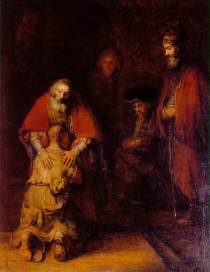
Luke’s two short stories come immediately before the story of the man with two sons, the gracious father, and the so-called prodigal son. Another story of lost and found. In the father and two sons story, both sons are lost: one lost in recklessness and wilfulness, the other lost in envy and resentment. Both of them have a twisted relationship with their father. Sometimes we are like the son who goes off, deliberately sticking two fingers up at some authority figure. Sometimes we are like the son who stays at home, begrudging others’ successes, others’ good fortune, and angry with our friends for having things we lack. In sermons, my guess is that we hear more about the son who went a-wandering and a-squandering, probably because the church was much into trying to control people rather than help them develop. Jewish commentators, on the other hand, concentrate just as much, if not more, on the stay-at-home, sulky son.

If we’re honest, it’s easy to think of ways in which we are like one or other of those sons. But I think that it is our calling to move beyond that. We will find eternity and peace (a quality of mind, and nothing to do with idleness or sitting having pious thoughts) when we become like the father: compassionate, forgiving, welcoming home.

And that – homecoming – is what this is all about. It is about what Christianity is all about. Homecoming, forgiveness, shalom, reconciliation, salving, HEALING. Coming home to the Divine – or rather recognizing that it is there in the middle of us all the time. We can identify what we have lost, and make our way back home, through what the church calls repentance, re-turning, RETURN.

Getting lost is a good thing. Keeping young people attached to apron strings, or parents’ purses, always ends in tears. We need to be lost in order to realize what it is we need to seek, or re-seek, or re-turn to. And it’s not a matter of going back in time to things we used to love, or to things that take us back to our childhoods, but rather a matter of going home to our real selves, to that inner sanctuary of the soul that we shut out through wilfulness, recklessness, pride, self-importance, resentments. We can’t see that inner self, that bit of the Divine within, unless we have been lost, and have ditched ego, amour propre, and the dignity on which we are so keen to stand.

T S Eliot, Little Gidding

         We shall not cease from exploration

         And the end of all our exploring

         Will be to arrive where we started

         And know the place for the first time.

In my pastoral ministry, I find that nearly all our spiritual sickness comes from a sense of guilt or shame about the past. Such guilt and shame often—not always—come from our not having accepted ourselves for the maimed humans we are. Guilt and shame come from our thinking that we are in charge of our natures. We are not. We are simply bags of hormones and emotions, and constantly at their mercy. I don’t think there is any such thing as free will. We are, every one of us, potentially able to do the most horrid things to other people. If we haven’t ever committed such atrocities, it’s just because we haven’t been in circumstances that have tested us. Deliver us from the evil part of ourselves. When we acknowledge our shame, longings, guilt, we feel a great liberation, a great sense of coming home. RE-TURNING.

The shepherd seeks out the lost sheep, finds it, places it on his shoulders, and brings it home. Look at sheepdogs. They don’t run barking after the sheep. But, as the sheep wander off, they watch, then run like hell, and get in front of the sheep. Then they lie down across the path where the sheep were wandering. So when the sheep come up to them, they are gently turned in the right direction.

That is the challenge for us: to care not for our own cosy club, but for the lost. First, observe and think; second, run like hell; and third, be found lying about. And the lost includes our selves. We are no use to anyone else unless we recognize our own need for homecoming.

John Henry Newman

Lead, kindly Light, amid th’encircling gloom, lead Thou me on!

The night is dark, and I am far from home; lead Thou me on!

Keep Thou my feet; I do not ask to see The distant scene; one step enough for me.


I was not ever thus, nor prayed that Thou shouldst lead me on;

I loved to choose and see my path; but now lead Thou me on!

I loved the garish day, and, spite of fears, Pride ruled my will. Remember not past years!


So long Thy power hath blest me, sure it still will lead me on.

O’er moor and fen, o’er crag and torrent, till the night is gone.

And with the morn those angel faces smile, which I 
have loved long since, and lost awhile. 


Life moves on

wormMouthOpen2_2144128i

Bristleworm mouth. These creatures of the sea bed can be a foot long

Type “coping with the death of son/daughter” into a search engine and you will be rewarded with a host of material. But most of it is directed at mothers, and nearly all concerns the death of an infant or a child. There is next to nothing about a father coping with the loss of his adult son.

In writing what follows, it’s inevitable that I’ll be accused of wallowing in it, or drawing attention to myself. I don’t think either is true, but who am I to judge? Anyway, for what it’s worth, here are some observations on how I felt and feel. It might be helpful for someone else.

Within days of returning from the funeral, I took up weightlifting again. I’m glad I did, and I intend to carry on. But the interesting thing is why? Physical activity is of course an outlet for energy and anger, but I can’t in all honesty say that I felt angry. I felt drained, despondent, scraped out, exhausted, flattened, destroyed, sad—overwhelmingly sad at such a waste. But not angry. What I certainly did feel was the need to test my own physiology, particularly cardiac, since that is what failed Hugh, to see if it would stand up to extreme provocation.

About four months after the funeral I became aware of a nasty creature roaming my subconscious. I didn’t know how to get it to show itself except by waiting. So I waited. And one day, it poked its head out of the sea bed, and then its bristly carcass followed. It was this. (1) A father’s job is to protect his offspring. (2) I had failed to do this. Therefore – and this is the important bit – (3) I deserve to die.

Note the word deserve. I can’t think of a better one. I did not wish to die: I deserved to die for having failed him and his wife and daughter and sister and brother and mother. And, ye gods, for having failed myself.

Understandable, I think, from a biological point of view. I’ve passed on my genes and had a vasectomy, so I’ve had no biological function for over 30 years (I have views on the effects of vasectomy, but they can wait). And since one offspring has gone before me, I might as well do the honourable deed and bugger off myself. There the logic breaks down. Logic breaks down in other ways too, of course. I have two other offspring alive and kicking and lovely; parents do not own their children; parents are not responsible for their children once the latter have reached adulthood; and so on. But logic is not much in evidence in these circumstances, and I still felt that I deserved to die.

Maybe the wish to provoke my cardiovascular system was the first manifestation of this malignant worm that was, as I say, gobbling its way through the floor of my psyche, but it has gradually faded. Not completely, but substantially. And since I rather overdid it at the gym and tore my right gastrocnemius (almost better now), I hope that it and I can settle down to a less frenzied modus vivendi.

Then there is the matter of allowing a new normal to develop, and a new vision for the rest of life. This is a work in progress.

I used to rail about stupid parents who lived through their children, and now see the extent to which that is what I was doing. My plan for retirement involved at least annual trips to the US to explore, I dunno, the north east, the west coast, the Great Lakes, the east coast – whatever – in his and his family’s company. Trips to the US will continue, but on a different basis. Part of the plan was a response to my not looking forward to retirement. What will I do? How will I occupy my brain? This forces me to ask what I want, and frankly, after a lifetime of—so it seems to me at present—pleasing parents, teachers, bosses and ego, and providing for and ministering to others, I’m not sure what ‘I’ is any more, let alone what it wants. So it’s back to the drawing board, and let’s hope that whatever blueprint emerges is built this time upon reality rather than escapism.

I’ve coped with the last ten months by doing very little. At a review meeting with the area bishop recently I said that since two of my urban colleagues were leaving Burton soon, I would consider going if that would help diocesan strategy. He said no, they wanted me to stay as long as possible. So I said OK, but I’ve no intention of looking for work. I’ve watched a lot of films. I find that I still have little to spare for other people, and as far as parishioners are concerned they seem to have sensed that: they have been gently supportive and got on with things without bothering me. Long may this continue. I did rather lose it at a meeting last April at which I, in the throes of major exhaustion, was gravely provoked by people who wouldn’t shut up and I said that I was sick of this and I was going to bed and they could all go forth and multiply. But apart from that, we’ve done quite well. (I offered my resignation, but was told that I should never apologize for being human).

What of Susan? I learnt long ago never to put words in her mouth, or into the mouths of my children, so all I shall say is that different people cope differently. We talk. It affects us differently and at different times, unpredictable and sometimes debilitating. But as she says, you just can’t maintain that level of grief. Eventually it dissipates, until the next time. And while the distress is on me, there is nothing I can do but wait. Getting used to that impotence has to be done, and I venture to say that it is more difficult for men, who are in general used to solving problems, than for women.

And finally what of God? Hollow laughter. That’s something for another blog. If I were wise it would not appear until after I retire, but since I’m not it will appear sooner.

The old man carried the child, but the child governs the old man

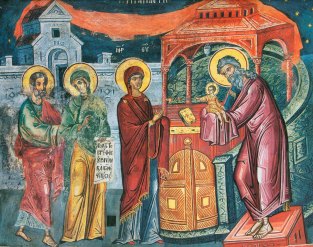
dionysiusmonastery_athosEaster is early so Lent is upon us almost before the last of the Christmas chocolate cherry liqueurs disappear ‘down the little red lane’. We turn from crib to cross at the last great feast of the Incarnation: Candlemas, or Presentation, or Purification.
Simeon holds the child and says ‘this is enough, I need no more’. Ich habe genug—if you have not heard Bach’s Cantata of the same name, it’s not too late. Find the first movement on YouTube here sung by the glorious Dietrich Fischer-Dieskau.

euston 030-1The old man carried the child, but the child governs the old man: you might reflect on how spot-on that is psychologically. The child is the father of the man. We are governed by thought patterns laid down in childhood. Childhood innocence, willingness to explore and ability to have fun are, as we grow up, so easily perverted by the slings and arrows of outrageous fortune that life throws at us. The supermarket trolley of the psyche becomes more and more wayward, and less and less inclined to head for the target we once thought we were aiming for.

We need the 3Rs: repent, recall and recover the childlikeness we’ve lost. Is the child you once were proud of the adult you have become? Examining that question is worth the Lenten discipline of spiritual spring-cleaning. If the answer is no (and I doubt that anyone can truthfully answer otherwise), what are you going to do about it?

The Orthodox call this great festival The Meeting – Simeon meets the infant that changes everything. We meet again the child we once were in order to change what we are. We are changed by encounters.

Seeing clearly now the rain has gone


quote-i-can-see-clearly-now-that-the-rain-is-gone-i-can-see-all-obstacles-in-my-way-gone-are-johnny-nash-106-43-93-1For Paul’s and Aidan’s magazines, January 2016
Christmas is Emmanuel: God with us. Or rather, God within us.

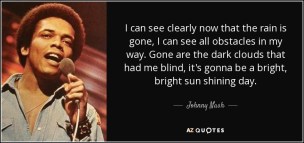
We cannot attain the presence of God because God is already in us. We just don’t realize it. We have nothing new to learn, but an awful lot of things to unlearn, and we need to learn again to see clearly (clair-voyant).

Think about Christmas in our culture. All about more, bigger, better, faster, further, longer, more expensive. We’re hypnotized, sleep-walking, our greed and avarice fed by the narcotics of the evil advertising industry. Have a look at the film They Live! (YouTube again).

“If your eye offend you, pluck it out”, and replace it with one that sees clearly. “If your eye is healthy, your whole body is full of light”. Re-learn to see clearly, as a child. Re-connect with reality. Re-connect in Latin: re ligere. That is what religion is about. Not keeping rules, or gathering brownie points for club class in an afterlife, or asking God to cure your arthritis, or make events suit you, or some other entirely self-obsessed request. But reconnecting with reality. Be awake. Stay watchful. The advent call.

All spiritual disciplines have one purpose: to get rid of illusions so that we can see clearly what is, who we are, and what’s happening. What’s happening is that God is in us. Prayer is not about saying words or thinking thoughts. It is about becoming aware of this: God within and around. The contemplative is not just aware of God’s Loving Presence, but trusts, allows, and delights in it. Let go of trying to control.

When the disciples start jostling for power, Jesus plonks a child in front of them. The only people who can recognize and be ready for what he’s talking about are those who come with the mind and heart of a child—a “beginner’s mind”. The older we grow, the more we’ve been betrayed and hurt and disappointed, the more layers we wrap around ourselves to cover the vulnerable clarity of the childlike mind. Think Russian dolls with all the layers. Or onion skins. We must always be ready to recognize the layers, peel them away and begin to see afresh. To let new life grow in us.

This is the only new year resolution that is worth keeping. Be born in us today and every day and every minute of every day.

Incarnation is the beginning of real-ization.

(Much of this is stolen from that great source of wisdom, Richard Rohr)

I came to bear witness to the truth

15tue_hhdl-adt_12x8

Faces of the Divine

Homily for the Feast of Christ the King 2015

The Archbishop of Canterbury’s recent statement that the Paris attacks caused him to doubt the presence (or was it existence?) of God gave me cause in yesterday’s sermon to lay into the intellectual poverty of our leadership. The implication that God is a European; the blindness to the fact that Islamic fundamentalists were originally recruited and equipped by the US for fighting Russians in Afghanistan; the lack of acknowledgement that the UK and US fawn over the ISIS-connected House of Saud. Is the former oil executive blind?

Look at the West’s involvement in the middle East over the last century: the partitioning of the Arabian peninsula, the partition of Palestine, the formation of Jordan and Iraq, the military campaigns that are seen as Christian wars, modern Crusades. And people wonder ‘why Paris?’

I wonder what His Grace’s musings say about his notion of God. That God is ready to jump in and solve problems for ‘people like us’ in a city that is such a nice place to live? He said something like that too.

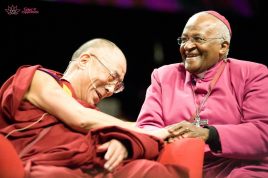
The Gospels tell us that the Pharisees were afraid to go after Jesus because people hung on his every word. Where is there a Christian leader of whom that might be said? Pope Francis perhaps? Certainly no Anglican now that Desmond Tutu has left the main stage. Nobody in the Church of Ireland says anything at all for fear of the brain dead eejits in the North, and in the Church of England all we get is ignorant bluster.

At least Dalai Lama has balls: “We cannot solve [the attacks in Paris] problem only through prayers. I am a Buddhist and I believe in praying. But humans have created this problem, and now we are asking God to solve it. It is illogical. God would say, solve it yourself because you created it in the first place.”

I ‘came out’ in the pulpit yesterday. I said that Jesus was a Buddhist in everything he said and did; that all he asks is that we follow his example; that arguments about atonement are piffling; that what matters are compassion and the death of self.

I said that we were now witnessing the oozing into place of the third world war and that the future is bleak. Of course, none of this absolves the evil perpetrators of evil deeds, but we might at least recognize our complicity in the sin of the world through our own ego and pride.

I said that there is no hope until people realize that the Kingdom of God is not about life after death or about an ideal political system to be gained by bashing people over the head until they agree with us. My kingdom is not of this world.

It is an inner kingdom, here and now. It is certainly not a kingdom of control, It is a kingdom of beauty. I came to witness to the truth – that is, beauty and imagination in all their manifestations. Beauty and imagination do not conquer by forcing, but by freeing.

Conquering kings their titles take, from the lands they captive make; Jesus, by a nobler deed, from the thousands he hath freed.

It was St Cecilia’s day yesterday, so we sang:

When in our music God is glorified, and adoration leaves no room for pride, it is as though the whole creation cried Alleluia!

How often, making music, we have found a new dimension in the world of sound, as worship moved us to a more profound Alleluia!

Beauty and truth seem pretty interchangeable to me. I came to bear witness to the truth. I said I’d probably be sacked after a sermon like this.