Immaturing

remington-keywound-triple-chime-mantel-clock-by-hermle-2-1.gifPortlaoise GFS had its end-of-season bash last night. Terrific! The star event was the dance routine. On the stage behind us, the dance teacher was strutting her stuff for the girls in front of us to follow. After a few minutes I became aware of a small commotion behind me. The girls’ infant sisters and brothers were themselves ‘copying’ the teacher—that is to say, jiggling about with giggles and fallings-over and great glee. It was all quite wonderful.

A three-tiered performance of leader at the back, performers in front, and uninhibited joyful randomness between says something profound about life, the universe and everything. Maybe an improvement on Plato’s cave allegory that I need to tease out a bit.

As a leaving present the GFS gave me a mantelpiece clock with Roman numerals (including IIII instead of IV, very proper) duly inscribed for SWMBO and me on the back. Lovely. In turn, I thanked them not only for the present, but also for simply being. As with students at Maryborough School, I feel as if I’m at their level and they at mine. Heart speaks to heart when we get together. I treat them as colleagues, they respond as colleagues. This isn’t always the case with congregations. A clerical neighbour has twice berated me for looking on them as colleagues: he says I should look on them as children. Try as I might, I just can’t bring myself to do it.

Is it that there’s something deeply infantilizing about attending church? Actually, this is now widely accepted, so there’s no question about it. There’s a container in the church porch for people to put their brains in as they arrive.

Is it that there’s something deeply infantilizing about adulthood? It’s certainly the case that the education system results in people knowing more and more about less and less. Vision becomes more and more restricted. You see this medical education: I regarded it as my job to help remove blinkers. Still do. ‘Education is what’s left after you’ve forgotten what you learned at school.’

Maybe it’s quite simply that I’ve never grown up. Yes, that’s it! My aim is to immature with age. This is why I’m not old enough to play golf.

Out of the mouths …

Picture-1011-300x226A local National School visited St Peter’s yesterday. They asked intelligent questions about the church and items in it. An observant young man wondered why there was a decorative Star of David on some of the chairs. ‘Because Jesus was a Jew’ was my immediate answer, followed by consideration of all the symbolism in church and liturgy that comes from the Jerusalem Temple.

Before long, a black boy asked: ‘are you English?’

‘Yes,’ said I, ‘why do you ask?’

‘Your accent,’ he replied.

What would have happened had I asked him if he were African because of his pigmentation?

The straightforwardness of young people has much to commend it. For myself, increasing the size of the oral aperture in readiness for the articulation of phonation is often merely an opportunity to change feet, and then to wonder to whom the letter of complaint will be sent.

Be ye not like to horse and mule, which have no understanding: whose mouths must be held with bit and bridle, lest they fall upon thee.

Homeward bound

Ulysses_Arriving_In_DublinThe Church Times this morning announces to the Anglican world that I’m leaving these parishes. People here have known for a couple of weeks. What have they said?

Most are sad to see us go. ‘You’re the best rector we’ve ever had.’ Beware Irish charm. The most common comments have been ‘a breath of fresh air’, ‘don’t know how you stuck it so long’, ‘good sermons’ and ‘we’ll really miss you both’ (I’ve long held that SWMBO is a better rector’s wife than I’m a rector). There have been tears. Such responses, the majority, have been affirming. Of course there have been a few negative comments. There’s a sense of satisfaction in some quarters, for ‘you can be controversial, but we’ve tolerated you.’

Some comments relate to the nasty mess that I inherited, that escalated between my appointment and arrival, and that goes on and on. Remarks on how I handled it range from my having been too bullish to my not having been firm enough. I must have got it right, so. Anyway, my shoes contain my feet, and nobody else ever stood in them.

It’s easy to let negative comments weigh more than the positives, but I want to tease out some of them. They’ve included: ‘you’re not one of us’, ‘you don’t understand’ and ‘this is not your culture, so you don’t realize what happens.’

  • First, it’s quite likely that someone looking from outside sees exactly what happens better than people in the midst of it all.
  • Second, these comments implicitly assert that clergy should be emasculated lapdogs who never challenge those in the circled wagons. Just like Jesus I don’t think (though perhaps he’s been emasculated too).
  • Third, they imply that the clergy of the future will be ‘one of us’. The trouble is that ‘one of us’ is not in the clergy-training pipeline. AFAIK there are no ordinands from this group of dioceses, and certainly none from these parishes. My successor is unlikely, therefore, to be ‘one of us’. Yes, more could be done to encourage ordained local ministry by ‘one of us’, though you’d have to beat sense into the Bishops’ ideas for training to be a real possibility for real people with real jobs. Good luck with that.

Members of the Church of Ireland will have to get used to clergy not being ‘one of us’. They may even have to tolerate yet another immigrant from—God forbid—England. Or Africa or America. If incoming clergy need sensitivity and flexibility, then so do the flocks they tend. Any expectation that ‘our ways’ rule the roost has to go—particularly if ‘our ways’ are no longer acceptable. People will have to grow beyond the culture of entitlement, profound in these parts. And there needs to be a rethink of the concept of ‘confidentiality’ that means passing things on by behind-the-hand and corner-of-the-mouth mutterings. Or telling only one person at a time.

I have learnt a huge amount in the last 32 months. Cross fertilization is essential for a healthy organism.

Stuff as dreams are made on

Fear not

There is a tide in the affairs of men that results in dreams of foreboding and inadequacy. I’m back at school. I have the life experience I have now, but I’m full of anxiety about having to repeat A levels. Especially Physics. Or I’m back at medical school aged 63, required to sit final exams again and knowing that I never grasped biochemistry in the first place so there’s no chance now.

The psyche takes a long time to catch up with the rational mind, so dreams like this might be expected as the brain rids itself of stuff that’s past its sell-by date. Bewilderment. Wilderness.

I wondered if this was my psychopathology. And then I discovered Smirnoff. Well, actually, I started to tell a friend, but before I’d got to the end of the first sentence, he interrupted and finished it for me. He was having them too, and had been for ages. And then another and another friend tell me much the same. It’s good to know I’m not psychotic. *

Whatever else these dreams may be, they’re not irrelevant. All our lives are governed by attitudes and ways of thinking that develop when we’re in our prime. Decades later circumstances have changed, and it’s often inappropriate to let those same attitudes govern how we think or respond. With a bit of luck, I can give them up for lent. At first I was disturbed by the dreams, but now I look forward each night to the next instalment of the soap opera.

There’s a scene in Shadowlands, the film of Joy Gresham’s romance with C S Lewis, where Lewis meets one of his former pupils, now a teacher. In the course of a brief conversation, the former pupil quoted his father: ‘we read to know we’re not alone.’ We talk and listen to know we’re not alone, too. It’s reassuring to hear ‘that’s just how I see it too’. Knowing that you’re not alone gives you courage to stick to your guns.

* Neurotics build castles in the air, psychotics live in them, psychiatrists collect the rent.

An Garda Síochána

imagesAs the An Garda Síochána controversy hots up in the glorious republic, I have a tale to tell.

Once upon a time a humble and hard-working professor lived in Rathgar, south Dublin. He worked at the College of Knowledge on Stephen’s Green in town. He was cycling home. Pedestrian crossing lights on Camden Street turned red as he approached. There was nobody waiting to cross, so he did what any self-respecting cyclist would do: he powered on.

Just then, a car pulled out of a side street and turned in front of him. The passenger admonished him with a digital gesture. Again, he did what any what any self-respecting cyclist would do: when he judged the car to be far enough in front to give its occupants a good view of him in the rear-view mirror—all of him, the teeth, the whole personality—he gave them the finger. Swivel. The car screeched to a halt and two trolls leapt out and yanked the professor and his velocipede* to a stop.

We’re Gardai and you’ve gone through red lights. This was said in what might be described as a rural accent.

Now, the car was a bit of a jalopy. No sign of its being provided by the State to law enforcement officers. The two men were tall, lean, mean, early 30s, Ireland’s finest, but nothing to indicate that they’d been brainwashed by a Templemore formation. So when they said they were Gardai the professor thought, ‘huh, a likely story’ and said …

Please show me your warrant card.

All hell broke loose. You’re on a charge, said they.

For what?

For not stopping at red lights. The professor had dissed ‘Gardai’ too, but let’s pass on that.

Please show me your warrant cards, the professor repeated.

What’s your name? they retorted.

My name is ‘Daidí na Nollag’ (the professor gave his proper name, of course, but for reasons of anonymity this can’t be revealed).

Where are you from?

Now, the professor was getting cross. He thought it none of anyone’s business where he was from, and it was obvious from his accent that he was not a native of the ‘pluralist’ republic whose constitution begins ‘In the Name of the Most Holy Trinity’. He’d had enough over the years of snide remarks about English people taking jobs that an Irish person could have had, so he answered a question that had not been asked: I live in Rathgar, said he.

They repeated their question. He repeated his response. They were livid, jumping up and down like trolls that live under bridges. They took the professor’s name and address and did the equivalent of stomping off in high dudgeon in their car in the direction of Harcourt Street Garda station. No warrant card was ever produced, so whether or not they were what they said they were the professor will never know.

The professor heard no more, and they all lived happily ever after.


* As Rambling Rector was writing this piece, he asked SWMBO to clarify the meaning of this word, and she replied: ‘a dinosaur I think’.

A nose that runs in the family

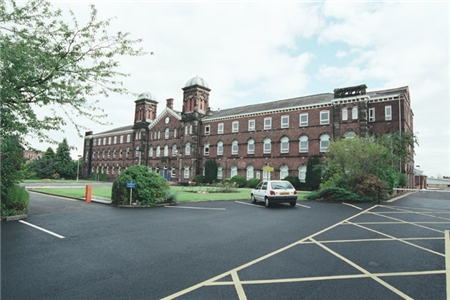
Workhouse, then City General, then University (so full circle)

Workhouse, then City General, now University (so full circle)

Carlisle hospitals saw quite a bit of me when I was young. Chatsworth Square Nursing Home took my tonsils when I was about 5. All I can remember is dark green walls and glass partitions. The Ear, Nose and Throat fraternity made me one of theirs after that, with a sinus job, two nasal polypectomies and an operation on the nasal septum when I was about 17. Somewhere in all this came appendix, two teeth operations (they’re wonky at the front), and an arm job. Mostly, I was at the City General, but the appendix and arm were done at the (old) Cumberland Infirmary where for the appendix in 1960 I was in Ward 18 opposite grandfather W P Monkhouse, then in his 80s.

For one of the nose jobs I was in a side room with a boy from Workington whose sister was called—and this is what it sounded like to me—Hughery. I’d never heard of that name and asked him to say it again, just to be sure. Yes, it sounded like Hughery. So that’s what I said. It wasn’t until years later that it dawned on me that it was Hilary, and he was probably in for a palate operation, so pronouncing ‘l’ was a problem. He thought he was saying Hilary and I heard Hughery. No wonder he was cross with me: I suppose he thought I was making fun of him.

One thing illness does for you, popular wisdom has it, is make you patient. It makes you take each moment as it comes. It teaches you not to have too many expectations. You learn that when doctors say you might be home at the weekend, you equally well might not. You learn to laugh off these little disappointments. When you expect to be going for an operation on Tuesday, and it’s cancelled because you have a chest infection, you learn to take it in your stride. That’s what popular wisdom says illness does for you.

Let me tell you that popular wisdom is piffle. Complete twaddle. Especially if you’re a child. As is well known, I am the most patient and even tempered of God’s creatures, but not even I was able to bear with equanimity the unpredictability of illness. I was in despair when some sign of progress did not materialize as I thought it should.

Dangerous rubbish

Dangerous rubbish

My nose would have been less inclined to run in the family had I not had cow’s milk shoved down my throat ‘when I were a lad’. It should come in bottles marked ‘poison’. Cow’s milk for cows, human’s milk for humans. It’s a snot generator. In the 1990s an Ear, Nose and Throat colleague told me my nose would be better if I stopped milk. I have, except in tea, and it is. The other thing that affected me was grain and meal that, since my father ran an agricultural feed manufacturing plant, put money in our pockets.

Milk and wheat are not good for Rambling Rector. I wonder how different my life would have been if I’d known sooner. As for cats, which always know that I’m allergic to them, the best place for them is under the wheel of a heavy truck.

One of Grimm’s Fairy Tales has a man whose nose grows so long that people trip over it.

Of mice and men

1510896_642587485805127_2086111283_n

Animal experimentation is certainly an issue that polarizes. I wonder how many opinions are based on facts and experience rather than sentiment and propaganda. How many of those vehemently opposed are principled enough to refuse antibiotics, or question how they were tested?

For several years I worked on the mammalian adrenal gland. The mouse Mus musculus was the creature of choice. I could not have done the work without killing. The question is: was it worthwhile?

Zhou Enlai, when asked about the importance of the French revolution, is reported to have said that it was too early to tell. I feel rather the same about much research in general, and mine in particular. I certainly don’t claim it to have had any impact, but this is not to say that in the future someone will not build upon it in a way that enlightens us about endocrine processes.

Headline-grabbing results are rare. Scientific research is like chipping fragments from a stone, a sculpture gradually emerging. Researchers build upon the work of others, and slowly, slowly knowledge accumulates. After a great deal of accumulation, conclusions can perhaps be drawn. It is dangerous to draw them too soon.

Yes, there are alternatives to animal experimentation, and they are increasingly used. More will be developed. But, in the words of my friend Andy, ‘at the moment they can’t simulate the real deal because mammals are so delightfully complex and still so poorly understood—despite the hubris of the scientific community.’

Is animal experimentation evil, immoral, bad? It concerns me that too much is done simply as CV boosting, as truthfully in my case, and there are problems with the way that research is politicized by factions and industry, but that’s another story.

I suspect that opposition to animal experimentation is most vociferous among those who are furthest removed from living and working with animals. You won’t find much opposition in the agricultural community. If you hold that all creatures are God’s creatures like us, then the only logical position is Jainism: non-violence towards all living beings. How do you define living? Plants? Fungi? Bacteria? Slime moulds? Clergymen?

Much of what we know of how the inner ear works comes from research that was done on human subjects in 1930s and 1940s Germany, in circumstances that may well appall us. We have benefited from that research not least in the development of hearing aids and cochlear implants. Knowledge of some neurological conditions comes from experiments on monkeys and apes. It’s all very well to object—until, that is, you get the disease.

When we lived in Nottingham, our children attended a school patronized by sandal-wearers, amongst whom there were more than a few objectors. Our children said “my daddy works with mice’s kidneys” (kidney/adrenal confusion understandable at that age) and drew pictures of my office. I did rather fear reprisals.

I was a reluctant researcher—a disappointment to the eminent Professor Rex Coupland, I didn’t enjoy the nitty-gritty of research and much preferred teaching, scholarship and administration. Rex was a big man with a long stride, so there was warning of his approach as he stomped along the echoing corridors. When professorial footsteps were heard in the distance, one could either dodge into the Dissection Room, or dash into the khasi, or else nip downstairs, along the corridor on the floor below, and then up again at the other end. Silly or what?

Medical school rowing again

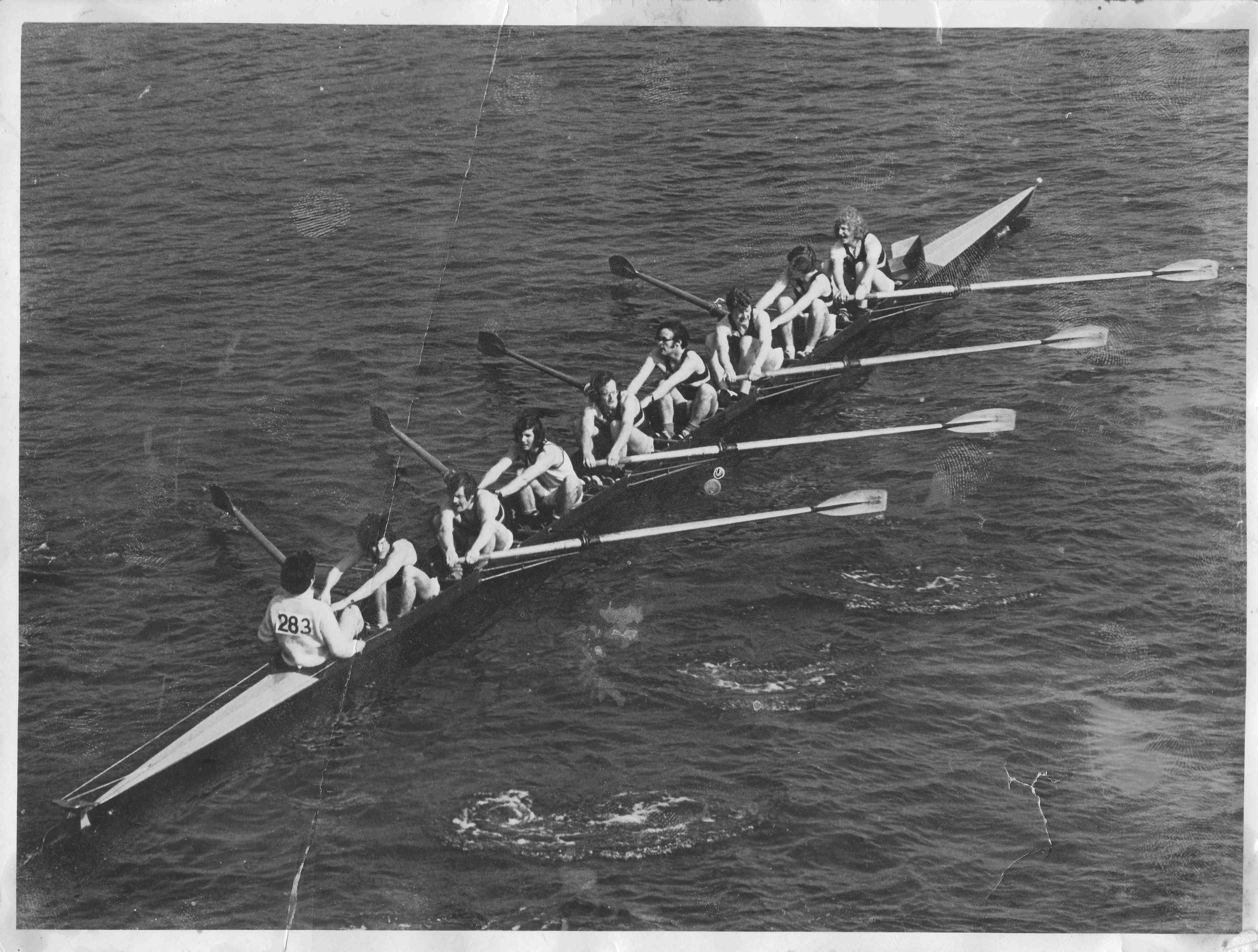
ROWINGPeter Selley, a man with a scanner, has kindly sent me this picture. It shows the King’s College Hospital Medical School eight on the Thames in the Tideway Head. I blogged about this here.

From left to right we are:

  •      Stephen Martin (cox, latterly a psychiatrist in Durham)
  •      Sandy Anderson (stroke, don’t know where he is)
  •      Clive Coddington (GP in Hampshire I think)
  •      Chris Morris (don’t know)
  •      Bob Morris (don’t know)
  •      me
  •      Terry Riordan (pathologist in Devon)
  •      Peter Selley (GP in Devon)
  •      James Anderson (bow, don’t know)

The boat wasn’t ours. We rented it from Thames Rowing Club, whose boathouse in Putney we used. The team was ‘sponsored’ by Mr A M MacArthur (1921-2012), then Consultant Cardiothoracic surgeon at King’s, who had been a noted athlete and rower in his youth. You can read his obituary here.

I don’t remember that we trained much. There were occasional sessions on the rowing tub doodah in the boathouse in an attempt to tidy up technical skills such as feathering, but the training I recall was simply rowing on the river. In all weathers too.

Some of us were serious rowers, in particular the captain, Clive Coddington, whose contacts got us to the Kingston Regatta, Terry Riordan whose voice stunned us all, and (I think) Bob Morris. I hope that Peter and Steve won’t mind if I class them with me as rowing for fun. Not that Steve, mind you, rowed. All he did was sit on his orse (as Ross O’Carroll Kelly would say), steer and shout at us—which he did very well, I might add. Peter had (has still I rather think) a searing wit and is great good fun. Susan and I know him best of all, and were able to visit his  mansion in Devon in later years. Stephen had an explosive laugh, and unlimited enthusiasm for things Scottish and military, and Waugh’s Sword of Honour. I remember Clive for his vigour and intelligence, but I suspect he found it frustrating that some of us lacked his commitment. Of Terry the voice I have already written.

I’m pretty sure Susan and I were wed by the time this photo was taken. I was enjoying myself as a medical student, but Susan was teaching at an inner city school just off the Old Kent Road in north Peckham. This was by no means easy, and I hope she might commit memories of it to print before too long.

Most of us in this photo qualified as doctors in 1975. I organized a reunion for our cohort in 1985 at the Savoy in London. That’s the last time any number of us met, though individuals have kept in sporadic contact.

Gentlemen, thank you!