Flogging a dead horse – a solemn promise

Homer_and_Bart_in_Krusty_Burger

I hope I’m not breaking copyright law

I swear by the authority vested in me by the Church and ‘by the State Gaming Commission’ (to quote the Las Vegas officiant at Homer and Marge’s wedding) that this is the last time I shall refer to flogging dead horses in this context. That said, let me proceed.

I take as my text – again – the gospel story in which Jesus tells the disciples not to linger in houses that do not welcome them. In other words, don’t flog a dead horse. Not even for burgers. Could someone explain to me what’s wrong with eating horsemeat, or dog, or rabbit, or whatever? I’d have thought it preferable to the reconstituted toenail clippings and bits of cheek and intestines and brain and other morsels that find their way into some meat products.

Yes, yes, I know, it’s deception that’s the problem: we’re told something that turns out to be untrue. And we’re shocked. We’ve never been lied to before. This is the first time we’ve been duped by a large organization. This is the first time we’ve come across a conspiracy. Banks would never do it. Politicians never say one thing and mean something else. And of course we ourselves would never be economical with the actualité. So we get hot under the choler when the food industry does it, because we are always so careful about what we swallow, aren’t we? The trouble with being well fed is that one becomes fussy. If we were scrabbling round in the desert desperate for sustenance it might be another story.

Cock up or conspiracy? I wonder. It’s just possible that this imbroglio stems from error, or maybe one deliberate act, that was never picked up. Whether we like it or not, we are complicit. Before any one gets bilious about the evils of the food industry, or the supermarkets, let’s remember that our pension funds are invested in such concerns. It’s all part of the sin of the world. Ash Wednesday readings asked: do you say one thing and do another? do you show off so that others feel worse about themselves? do you let other people’s opinions stop you from doing what you know in your heart is right?

Mrs Rector and I don’t go in for burgers, Shergar-free or otherwise. We are therefore more virtuous than those who do, ensuring us a more select place in heaven, maybe like the premier seats on the Jonathan Swift to Holyhead. However, I like salt. I am therefore a bad person and I am told off by salt police. I also like eggs so am, some say, destined for Sheol. St Paul was quite eloquent about how undesirable it is for people to inflict their food fads on others. Why do they do it? The best thing to do with those who think they know best is to bless them. Love those who persecute you. I shall try my best. Bless them.

Life, the universe and everything

RussianMeteor_GregorGrimm_021413_marquee_420The meteoroid streaking across the Russian sky is a wonderful sight. Pity about the damage and injury, but what a spectacle. Easy to understand why people might have thought such a thing a sign from the gods, or even from God. Easy to imagine too that some people might think it an attack from another country. I wonder what North Koreans would have made of it if they’d witnessed it. We really do need proper education in science: it has implications for politics and peace. I haven’t yet heard a so-called religious figure say that the meteor is a punishment from God, the explanation given by some nutters for the 2004 tsunami, though the lightning strike over the Vatican has been linked with Papa Ratzinger’s resignation. We need proper education in religion. This has political implications too.

I’m not one of those who sees a conflict between religion and science—well, I wouldn’t, would I? I see them as mutually enriching. We are creatures of this earth. We live as biological organisms. We think as biological organisms. Our concepts of the cosmos and of the Divine are shaped by the limitations of our biology, of the way we think, of the way our brain cells interact with each other. Biology shapes our every perception. Mathematicians claim that their discipline is God. the trouble is that that too is shaped by how our, or rather their, brain cells work. Maybe science and biology are two aspects of the same thing. I rather think so. The conversation between science and spirituality is exciting. If only we could find some way of doing it that was jargon-free.

Proverbs 8 tells is that sofia, lady wisdom, is present alongside the creator during creation, at the big bang. Wisdom, an emanation of the creator. The stardust out of which you, me, meteoroids, planets are made. Wisdom, the ordering principle that converts the unformed to the ordered, chaos to cosmos.  The ordering principle, that is the laws of the universe or logos. This kind of stuff is a great way to begin confirmation classes.

Dust thou art and to dust thou shalt return

800px-CrossofashesJoel 2: 1-2, 12-17. Psalm 51: 1-18. 2 Corinthians 5: 20b – 6:10. Matthew 6: 1-6, 16-21

Blow the trumpet. Listen before it’s too late. Do you say one thing and do another? Do you show off so that others feel worse about themselves? Do you let other people’s opinions stop you from doing what you know in your heart is right? Who doesn’t?

Ash Wednesday is one of the best days of the year. It’s a great festival of being human. One day—who knows when?—you’re going to die. Maybe tomorrow. It’s time to get your life in order. How do you want to be remembered? What do you want to be going through your mind as you shuffle off this mortal doodah? Shame? Regrets? Now is the time to give up the things you do that eat away at your conscience. Give them up for all time, not just for Lent. Get your priorities right.

Dust thou art and to dust thou shalt return. Now is the time to turn away from trivia towards what really matters: faith, hope, charity. And the greatest of these is charity. Love in all its forms. Love as nurturing, love as sharing, love as humility, love as warning. Love as justice without which there will never be peace. Getting our priorities right is the way to have life in abundance. It’s a great message on a great day.

I wish you all a very happy feast of Lent.

Metamorphosis

Or if he pleaseth, through it pass

Or if he pleaseth, through it pass

Sermon for Sunday next before Lent, 2013

Exodus 34: 29-35. Ps 99. 2 Cor 3:12 to 4:2. Luke 9: 28-36

I like an early Easter. It gives a sense of progress and movement to the year. Today’s readings have a sense of movement. Over the last few weeks we’ve had a series of manifestations of the Divine: to shepherds, to magi, to Jews, to non Jews. First, Jesus was a baby, then at the Baptism an adults, then last week a baby again, and today he’s an adult again? What’s occurring? We have the same gospel reading on the feast of the Transfiguration in August. Why today as well, on the Sunday when we go round the corner from Christmas and Epiphany to face Lent and Easter?

Well, that’s why – we go round the corner from Christmas and Epiphany to face Lent and Easter. It’s about movement and sense of purpose. It’s the point that moves us from what Jesus has been and is, to what he will become. The becoming. The metamorphosis. The time, if you like, when he enters the chrysalis in order to burst out at resurrection/ascension.

  • Jesus looking backwards, to Moses and Elijah. ‘Do you want to stay there in houses that I build for the three of you?’ asks Peter. ‘No, we’ve work to get on with. No living in the past for me.’
  • Jesus in the present with the voice of God booming out his approval of Jesus. He is declared the anointed one who has come in fulfilment of all that the Israelites longed for, to take the past on to greater glories.
  • Jesus in the future as he sets his face to go to Jerusalem – to the crucifixion.

‘Sets his face to go’ – the crucial phrase turning us from past to future, safety to danger. Face, image, the principal organ of communication. In a few pages time we have the face of agony, Jesus on a different hill, with different companions. A different kind of glory. From glory to glory. Moses’ face shining, after being in the presence of God, shining like a storage heater that continues to glow after being removed from the source of energy. But Moses’ face was veiled from the Israelites. Writing this sermon in the last couple of days I had a revelation. A veil was lifted from my eyes. I was blind and came to see this in a new way. The veil is between Moses and Israelites. but it’s not put there by Moses, or by the Lord. It’s put there, unknowingly by the Israelites, who because of their pride, hardheartedness and moaning refuse to see the plain truth.

Is this why our view of the Divine is so difficult to glimpse? Is it because of the veils or barriers we erect? Barriers of pride? Barriers of pretending we’re better than we are, or stronger than we are, or less vulnerable than we are? Barriers that make us seem we have no problems, no worries? Barriers that makes us hard-hearted as the Israelites were hard hearted (Venite: harden not your hearts …)? The barriers that dull the glow of the shining divine face?

The gospel says ‘Peter and his companions were weighed down with sleep; but since they had stayed awake, they saw his glory’. I think that it’s when I’m tired and at the end of my tether and my defences are down that I am at my most open. Blessed are the poor in spirit – those who lack spiritedness. When you’ve lost all you have, you’ve nothing else to lose, and you can stop pretending. When we remove the veil of self, of me me me, we glimpse the divine.

Which takes me to the epistle. ‘And all of us, with unveiled faces, seeing the glory of the Lord as though reflected in a mirror, are being transformed into the same image from one degree of glory to another’. We look into a mirror, and what do we see? Let me quote the great preacher Charles Spurgeon:

Our own judgment of our own character usually errs on the side of partiality to ourselves. Nor is the evil so readily cured as some suppose, for the gift of seeing ourselves, ‘as others see us,’ is not so corrective as might be supposed. Some persist in seeing us through the coloured spectacles of prejudice and ill- will. And this injustice is apt to create in us a further partiality to ourselves. If other men make mistakes about us who can see us, they probably do not make such great blunders about us as we do about ourselves, since we cannot see our own faces! The truth is that we are very fond of ourselves and have our own characters in high esteem—therefore we are unfair judges on points of difficulty about ourselves.


We think the world revolves around us. Me me me. We do damage in small and subtle ways until perhaps we realize that the cumulative effect has been catastrophic and that we have destroyed a life—our own—and maybe someone else’s as well, and that we are left with nothing of value to hand back to the Lord when we pass through the glass, when we look into the mirror and glimpse ourselves—not as others see us, and certainly not as we see ourselves, but as the Lord sees us. Paul calls for transformation, and the word he uses for this is metamorphoumetha. Metamorphosis. Pupation, maturation, caterpillar to butterfly, ‘ugly duckling’ to swan. A becoming as William Blake says.

Rabbi Zusya said, ‘When I come to die, God will not ask me why I was not Moses, he will ask me why I was not Zusya.’ Becoming the very best, as individuals, that the Lord made us to be. This is what we are to seek as Christian disciples. And we need to help others to be the best that they can be.For this we need humility, we need perseverance and we need a sense of constant reliance upon the other—that is, to accept that we are not in control. We need to let go of the pretences that veil our faces so we cannot see clearly. Maybe this is what Lent can be about: not giving up things like chocolates, but giving up those things that veil our view of the world. Giving up, perhaps, the idea that nobody else’s opinion matters as much as our own.

‘A man that looks on glass, on it may stay his eye, or if he pleaseth, through it pass, and then the heavens espy.’ If he pleaseth – the road is open to all. Maybe all we have to do is to stop resisting.

The way it used to be

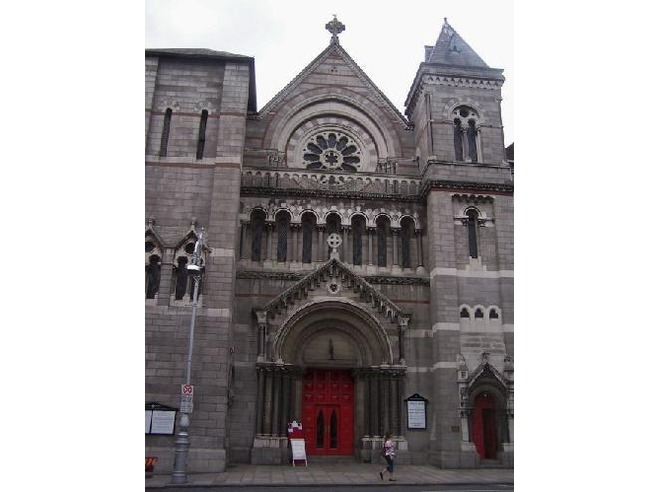
3276135-St_Anns_Church_DublinAs choirmaster at St Ann’s Dublin, now many years ago, I inherited a set up that was still very much in thrall to the choirmaster who died about a decade before. Many Irish church musicians have reason to be grateful to what he taught them. He’d been in post so long that I suspect the men of the choir, who had grown up with him, were still mourning his passing. I arrived on the scene and it was soon made apparent to me that I would never measure up to his memory. My feet were in my shoes and not his, so I just about withstood the onslaught. Since his death there had been a succession of choir directors, none of whom had stayed more than a couple of years, and pretty quickly I understood why—there comes a time when you realize that bashing your head against a brick wall is unproductive. A particularly fond memory was hearing that as the men were queuing up to enter the church, they were kept waiting by someone or something, and were muttering about how long they’d been there. My 16 year-old son, irreverent and fearless, who had been drafted in to lend some accuracy and quality to an otherwise rather wet-dishcloth-like tenor line, could take this no longer and said, very loud, ‘and I’ve been here since 1654’. I suppose you had to be there.

Anyway, the point I’m getting round to is that here I’m much more aware of ‘the way it used to be’ than ever I was in England. This is surprising in a way, for the culture in which I grew up was almost Wahabbi – rural, isolated, conservative, women largely confined to kitchens and bedrooms. In church terms, while women make up the bulk of the congregation, and do most of the work, in some parishes and church institutions it’s all but impossible to get people to vote for them. I refer you to the blog of a neighbouring Rector who is much more trenchant about this than I am.

It’s a human characteristic to hark back to glory days that never existed, but some people seem very good at it. Perhaps it’s because in the old days the tribes were more clearly defined, and comfort was to be had within the fences they provided. The trouble is that the fences are pretty scrappy now: the trumpet blast of increasing transparency and mobility has brought down the walls of Jericho. And a good thing too, for such conservatism, whatever its benefits, stifles creativity and imagination. It can even be dangerous when its adherents refuse to accept that what was appropriate years ago may, because of legislation and changing standards of good practice, be inappropriate now.

To finish the story about St Ann’s, I quickly came to see that the choir of men and boys had had its day. Recruitment of boys was a mug’s game, what with changing family expectations and the move of schools and people from the city centre. Girls were introduced. Mutter mutter grumble grumble. Even that was not sustainable, so a semi-professional group was employed and the Vicar retired the men. I think, on the whole, they were relieved. There comes a time when enough is enough and we grudgingly have to accept that a decent burial is the right thing. In Jesus’s words loosely paraphrased, there’s no point flogging a dead horse*: move on, there’s work to be done.

* though quite a lot have been flogged – as beef.

Magdalene martyrs

Martyrs

Martyrs

From the epistle for today:

My child, do not regard lightly the discipline of the Lord, or lose heart when you are punished by him; for the Lord disciplines those whom he loves, and chastises every child whom he accepts.’ Endure trials for the sake of discipline. God is treating you as children; for what child is there whom a parent does not discipline?

In the week when the report into the Magdalene laundries is published (here), it’s chilling to imagine this kind of text being used to subdue the poor young ladies in those institutions. This is not just an Irish Catholic problem. The first such laundry was set up for Protestant girls. I had a teenage great aunt who, in a close knit Methodist community in northern England, became pregnant outside wedlock. She was thrown out. Her three sisters were all but locked up by their parents, and their mother lived ever thereafter in self-imposed purdah, not even attending Chapel. In those days, and even in my childhood, that was quite something. It’s not just Irish Catholicism that needs to repent.

How long will people continue to twist Holy Scripture in order to oppress? How long will we continue to dissemble? How long will we continue to refuse to acknowledge our shame? Try this for a good read.

In one sense it’s all very sad. In another it’s hopeful. Bringing things into the open is never a bad thing, no matter how painful it might be at the time.

Church of Ireland and termination of pregnancy

Panagia of Yaroslavl

Panagia of Yaroslavl

The Church of Ireland is to make a submission to the Government of the Republic about ‘abortion’. I can hardly wait. (I wish people wouldn’t call it ‘abortion’, by the way, which is a spontaneous event, far commoner than many realize. I wish we would call it termination of pregnancy.) The life history of a human being from fertilization to death is a continuous and infinitesimally gradual process. There is no single moment before and after which the organism is recognizably different. Attempts therefore to say that this moment or that moment is the time after which abortion is not permitted do not stand up to scrutiny.

Some say that ‘abortion’ might be permitted at any stage before the fetus can perceive pain. The trouble is, how do you pin down definitions of ‘pain’ and ‘perceive’, and how does someone who is not the fetus judge? Even if you can pin down such concepts, we would still only be talking of likelihoods and averages, since variations exist in the way that neuronal conductivity develops, and in the development of parts of the brain involved in pain recognition. Others talk of using the ability of the fetus to survive independently as a criterion. But this too is fraught, since it depends on the definition of ‘independent’. Medical intervention now allows premature infants to survive ex utero much earlier than heretofore.

As I see it, then, logic takes me to the position that if it’s permissible to kill a fetus, it’s permissible to kill any human of any age. I can see that under certain very exceptional circumstances, killing the fetus may be necessary. The argument concerns what those circumstances might be, and who makes the judgement.

In forthcoming weeks and months, I picture church bigwigs travelling at church (that is, our) expense to meetings where they ponder issues of ensoulment and anthropology and ontological intentionality and potentia obedientialis. I earnestly hope that biology will not pass them by.

Calving time

Aside

Calves but not as known in Laois

Calves, but not as known in Laois

Some of my parishioners are, as it were, calving at the moment. I’ve just missed the opportunity to be at a bovine obstetric event because I didn’t pick up the phone message soon enough. I asked to be called so that I could have the opportunity to stick my upper limb somewhere the sun don’t shine (normally finger tip and nasal aperture is as far as it gets).

When you see other mammals tumble out into the world, you realize just how immature the human newborn is in comparison. Why? I think it has to do with brain development. If we left if any longer to come out—that is until we were able to stagger like calves, or something similar—the brain would be bigger, the head would be bigger and it would get stuck as it tried to get through mum’s pelvis. So the nine month timing is a kind of compromise between the needs of the mother and the needs of the fetus. That’s my view anyway, and I doubt you’ll find any evidence to the contrary it so it must be right.

What of the placenta? It’s a miraculous organ, another compromise between fetus and mother. It invades the mother so that fetal blood can get near enough to maternal blood for exchange to occur. Too much invasion and mother suffers. Too little, and fetus suffers. Other mammals are very wise to eat the placenta. Why don’t we? (Some do, apparently, but it’s not common.) It’s nutritious, hormone rich, and, unless squeezed, full of blood. Fried I suppose it would be just like black pudding. Add two or three eggs for breakfast. Ahhhhh. I wonder, shall I start a trend here? There’s lots of theology in this.