Worms, worlds and Wesley

The worm that passes understanding

The worm that passes understanding

This week’s New Scientist has three articles that tickle my fancy.

The first is about nematode worms that have been found 3.6 Km down in the earth, where the sun don’t shine. No energy from the sun, no oxygen. And hot. Microbes have been found even deeper. They don’t waste energy reproducing—they simply exist. They move so slowly they seem to be dead. (Do you have friends like that?) But they’re not. It seems they get their energy from uranium and sulphur, methane and hydrogen sulphide. So life on other planets with an atmosphere of such gases may well be a real possibility, just not life as we know it. We use oxygen to get rid of waste electrons, but there are other ways to do that. Maybe as we humans spend more and more time indoors, out of sunlight, and move less and less, we will become like these ‘things creeping innumerable’. We will get fatter and fatter, peering at screens, living in an atmosphere of methane and hydrogen sulphide (farts), and eventually exchange atoms with our environment (like Flann O’Brien’s bicycle seat and the backside on it). We will reproduce by budding. That would save a whole lot of shoving and grunting anyway. And it would mean that the church could stop obsessing about sex.

The second article is entitled The early turd. I suppose you could say it’s also about things where the sun don’t shine. It explains how the study of human excrement from long, long ago (the mind certainly boggles) can tell us about farming in days gone by. Here are some nuggets. Whipworm and roundworm infection exploded about 10,000 BC in Europe as we changed from being hunter-gatherers to farmers. The domestication of wild boar about 8,000 BC made us prone to infection by the liver fluke. In the 13th century AD Christian crusaders from northern Europe, who ate raw fish, took the fish tapeworm to the middle east. And so on. Fascinating stuff. Now wash your hands.

Milky way

Milky way

The other article is not about where suns don’t shine, but where they do—in the middle of the Milky Way. It seems that the giant black hole in the centre of our galaxy (and that is only a tiny part of the cosmos) is about to suck in a large gas cloud. What happens then is exciting cosmologists. I’m not entirely clear why we aren’t all being inexorably sucked into a giant black hole. Maybe we are.

Anyhoo, these articles point to a contrast between deep within and far outside, between very small and very big. Unlike the cows (or was it sheep?) in Father Ted, the stuff far away is very big. We humans are privileged to be able to see both ways. We are part of the smallness and the infinity. Is there any theology in this? There most certainly is: we are part of a system. The Greeks had a word for the system underlying all things, and it is logos. The system underlying all things is divine. Or, as John Addison put it, the hand that made us is divine. That takes us to the Incarnation gospel where heaven meets earth.

Let earth and heaven combine,
Angels and men agree,
To praise in songs divine
The incarnate Deity,
Our God contracted to a span,
Incomprehensibly made Man
 

Charles Wesley had a terrific mind.
Modern railways

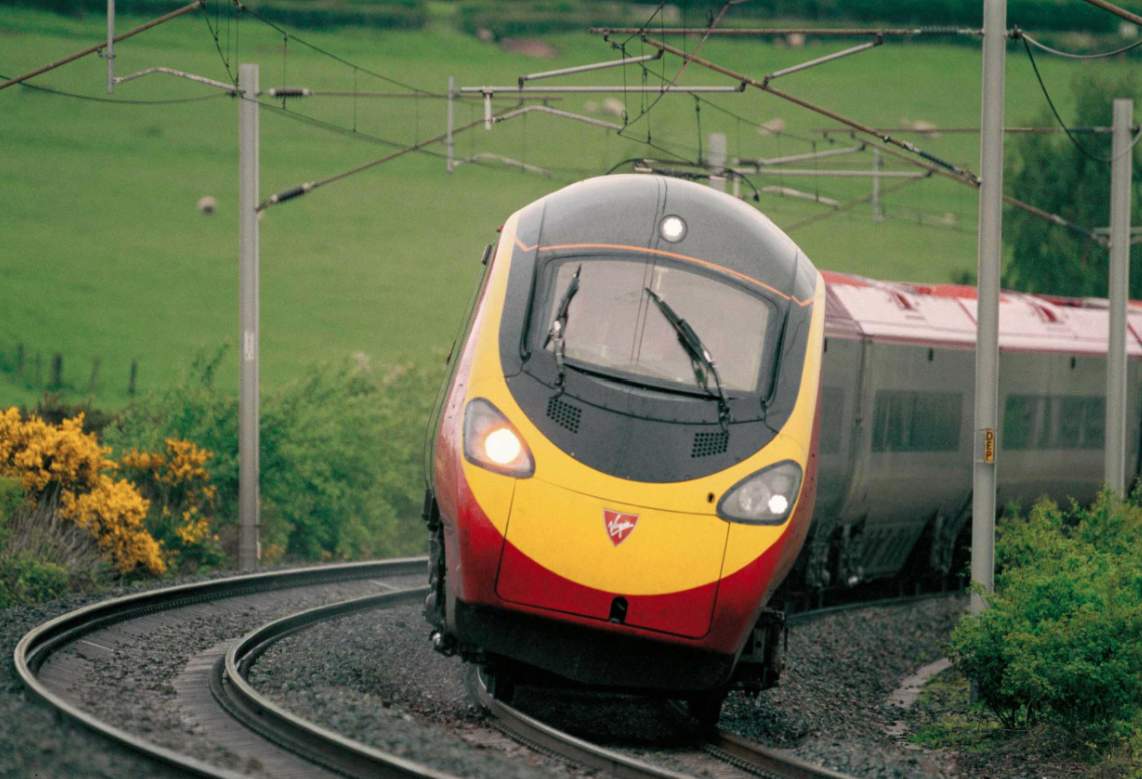
Tilting train near Penrith

Tilting train near Penrith

I’m not a steam fanatic, neither do I bother too much about trains. It’s the permanent way I like: the engineering, the way the railway interacts with the land: bridges, viaducts, embankments, tunnels. Of course trains matter to some extent, but what engages me is what they run on. I like to know about the design of junctions, track plans, the engineering that allows trains to travel round corners at speed. I’m curious about why and how some junctions are limited to 20 mph, or 50 or whatever. Some (a very few) are engineered for 125 mph. In my ignorance I used to think the reason why trains slowed down for bends was to stop them coming off the tracks. This is not so: they would need to be going extraordinarily fast to fly away like that. Speed is limited round bends simply for passenger comfort, the avoidance of the sort of g-forces that we (well I) like on big dippers.

When the railways were built in the 19th century, engine power was limited by men getting the coal into the burners. The surveyors minimized gradients by letting the tracks follow the lie of the land as much as possible. This means that in hilly areas there are lots of bends. This didn’t matter much then because trains could hardly get going fast enough for passengers to be discommoded. Think of the railway between Lancaster and Carlisle where it runs a sinuous course through the Lune gorge and over Shap. The uphill gradients limited the speed (imagine the firemen shovelling coal fast-forward like an old film). As for downhill, I suppose the trains were so slow at the summit that by the time they got up speed by, say, Penrith (northbound) or Oxenholme (southbound), they were past the most bendy bits.

Things are the other way round now. There is so much power available from the overhead wires, or the diesels, that going uphill provides little challenge. What limits now are corners, not gradients. And since the lines were built with lots of corners to ‘flatten out’ the gradients, we have a problem. In the new lines (London to Brussels and Paris, French high speed lines) the lines are pretty straight but the gradients are fierce. On the old lines, where it would be prohibitively expensive to straighten them out, the solution is the tilting train—like a motorbike going round a corner at speed. It’s quite exciting going through Penrith station at 90 mph (normal trains limited to 75) and seeing the station buildings leaning alarmingly. Isn’t the human mind wonderfully inventive?

I’ve taken out a subscription to Modern Railways. The only drawback is the political stuff and management jargon in it, but I still think it’s the railway magazine that suits me best.

One final thing: why do people these days talk about train stations. They are not train stations. They are railway stations. Aaaaaargh.

Sex talk

UnknownThe Church of Ireland Gazette is full of sex talk. It is very boring. People have asked me why I don’t blog about the church’s  to sexuality. After all, I make no secret of the fact that I hold that churchy stuff must accord with biology, not the other way round. The truth is that I think there’s no discussion to be had. I’ve posted here and here on aspects of sexuality. It’s possible for people to have genitalia that are neither one thing nor the other. It’s possible for chromosomal constitution to be, in a sense, neither one thing nor the other. It’s probable that, psychologically, everyone has elements of maleness and femaleness. So the argument comes down to what people do with their genitals. So long as there is no exploitation of one by the other, I cannot see that this is anyone’s business but that of those concerned.

The Archbishop of Canterbury said recently ‘Throughout the Bible it is clear that the right place for sex is only within a committed, heterosexual marriage.’ The Old Testament has polygamy, incest and rape, but is there anything about ‘committed heterosexual marriage’? The New Testament opines that bishops (overseers) must only have one wife, which implies that the norm was more. It’s faithfulness and commitment that the Bible is full of. Parishioners don’t seem bothered. The only time I was ever assailed about the issue was the Sunday after the mealy-mouthed Church of Ireland synod resolution, when an elderly lady poured forth scorn and opprobrium on it. It was not what I was expecting her to say. Joy and delight are difficult enough to find in this world. Any committed relationship of mutual love is worth celebrating.

Pensions and powerlessness

BOHICA

BOHICA

Yesterday I was at a meeting where we heard about the parlous state of the Church of Ireland pension scheme. It is, in a few words, sick, screwed, diseased, creaking, shot at. Its future will be voted on by members of  General Synod, many of whom do not pay into it or will receive from it. I’m not complaining, though I should be. The truth is that I am powerless to do anything about it. I am powerless to call to account the wunch of bankers who got us into this mess. With a wry smile I cry, BOHICA: Bend Over, Here It Comes Again. If you attended a fee-paying school in the old days (I didn’t, but I’ve heard), you will know what that might be about.

Church of Ireland clergy can hobble on until they are 75. But for how much longer will parishes be able to afford to pay for them? In the English Church Times, more and more jobs are advertised as house-for-duty, that is, no money other than expenses, but house provided. The assumption is, I suppose, that applicants are already receiving a pension that will support them, or that their spouses are in receipt of salary or pension. Are the days of stipendiary clergy drawing to a close? This would be terrible: who will the Church of Ireland faithful have to complain about if there are no stipendiary clergy? The thought is intolerable.

As yet, I receive no pension. If I live long enough, I may be the recipient of four partial pensions: one from UK university service (14 years), one from the Royal College of Surgeons in Ireland (16 years; this fund is not in terrific shape, I gather), one from the Church of England (miniscule this one, only 5 years) and one from the Church of Ireland. If it still exists. There are many people worse off than me. What really makes me cross, and I’ve ranted before about this, is all those fees paid to financial advisors who cock up spectacularly, and then, one assumes, charge more fees for advising what to do next. All that money – my money – paid in salaries and bonuses to sharp-suited barrow boys who sit in boardrooms. Some of them may even be members of General Synod. I’ve said it before, and I say it again: what about a national day of prayer and fasting?

Doctors or magicians?

Casting spells

Casting spells

Anne Marie Hourihane (Irish Times 22 April 2013) laid into the Irish healthcare system: ‘It is truly dreadful’ she wrote, ‘to get into your car outside a celebrated Dublin teaching hospital, convinced that you might as well be leaving your loved one on the platform of Heuston Station.’ Not surprisingly Dr Shane Considine (24 April) took exception. I’ve been a hospital doctor, and was a medical educator for 30 years. Now I’m in the parochial ministry of the Church of Ireland. I can glimpse both points of view.

Some patients claim they are not told things that matter to them. Perhaps they don’t remember what is said to them: there is plenty evidence of how what we ‘hear’ is not always what is said. Perhaps the professionals can’t imagine how forlorn it feels to be a patient. The film ‘Wit’ has Emma Thompson as a dying patient whose feelings are trampled upon and whose suffering is observed rather than treated. Perhaps the prospect of litigation means that professionals won’t say anything until technology has provided evidence. Compensation culture catches up with us. Perhaps some doctors have been educated in medical schools where patient-centred concerns are not valued as they are here. This is ironical: Irish medical education is tailored to the needs of the home culture, yet a good proportion of doctors trained here emigrate permanently. I wonder why? And perhaps there is something that encourages doctors to think of themselves as set-apart, different from ordinary mortals. Speeches made at welcome ceremonies, oaths taken at graduations, and the very rituals themselves all point to a mystical ordination rite in which doctors are ‘consecrated’ as an elite.

This is not altogether their fault. It is ours too. We want medical professionals to heal us, to take away our misery. We want them to be gods, omnipotent and omniscient. Yet, when things go wrong and they retreat behind the veil of assumed divinity, we raise hell.

This is a partnership. Whatever the members of the medical profession might need to do, we need to take responsibility for ourselves. The body is a machine and needs to be properly looked after. We need to stop expecting abracadabra miracles, and accept that tubes get blocked, wiring goes wrong, and cells start to reproduce for reasons as yet unfathomed. And even when they are fathomed, and we don’t die of cancer, we can be sure we will die of something else. We need to remember that we are mortal—life is terminal.

I had a parishioner who was delighted—yes, delighted—when doctors told her there was nothing more that could be done. ‘At last’ she said, ‘someone has been honest with me.’

Good shepherds and attentive sheep. Or dogs.

How is your hearing?

Sermon for 21 April 2013.

Jesus said: My sheep hear my voice. I know them, and they follow me. I give them eternal life. You may know about sheep. I know more about dogs. I expect their behaviour has much in common. Our dog is called Og. Og is an Old Testament bad guy, the King of Bashan, the sort of chap that you wouldn’t want to meet in a dark alley late on a Saturday night as the pubs are closing. Or so the Israelites thought. I thought Og was a wonderful name for a dog. Og the dog. Not that Og the dog is in any way like Og the king. You wouldn’t mind meeting Og the dog in a dark alley. He is a rescue dog, and was apparently abused. He is a timid creature, fearful of anyone in a hoodie, of anyone holding a pole or stick, and of traffic. ‘Now, this is all very interesting’, I  hear you say, ‘but what has Og the dog to do with sheep and shepherds?’ Well, boys and girls, it concerns animal behaviour. Og the dog, like Dolly the sheep, will not be hurried. If you try to hurry him he lies down and will not move. If you carry him to where you want him to be, as soon as you put him down, he runs back to where he was before. After all, dog is god in reverse. If you keep quietly walking, cajoling, leading and showing, he will eventually follow. Cajoling, leading, showing, encouraging: these are tips on how to be a good shepherd. Jesus as the good shepherd is modelling one type of leadership.

This calls for persistence, a sort-of pretended nonchalance in the shepherd. The shepherd needs to have faith in the sheep—faith that they will indeed follow eventually. The shepherd must have patience. I am profoundly gifted in this regard—with impatience. When I hear of the need for a shepherd to have patience and compassionate persistence, I am brought up sharp against yet another of my inadequacies.

But the story is not only about the shepherd’s voice and manner. It’s not just for  clergy in their role as shepherd. It’s also about sheep—you and me—and the need for us to listen to the shepherd’s voice. Listening is not just about hearing words. It means attending—giving your attention—to the speaker. Watching the face, the emotions. Observing the body language. Being alert to nuances in the tone of voice. Picking up, you might say the vibrations in the environment. This is hard work.

Sixfinger_threadfin_schoolHearing is about picking up vibrations from the environment. That’s what our eardrums and ossicles and cochleas are for, and the hearing parts of the brain. Eardrums and ossicles evolve from the things that in fish do exactly the same thing: they pick up vibrations from the environment. If you watch a shoal of fish, you will see that they all change direction together. How do they do this? They are picking up vibrations from the watery environment so they know when to turn. How do we pick up what you might call ‘spiritual vibrations’ from the environment so that we know when to change direction? Turning, re-turning, re-pentance, transformation, pupation, metamorphosis. It’s not about changing the environment, about moving to a new place or a new job. It’s about us ‘hearing’ what that still small voice that whispers in our ear is telling us. The trouble is, there is so much noise that assails us: noise from outside, nose from advertising that tempts us to greed and envy, noise from inside that tempts us to pride. Noise of the ego.

In Acts 9, some of which we hear today, we learn of people transformed. Paul eventually hears the divine voice, after having spent so much of his life persecuting it. He is brought, as it were, from death to life. We learn that Aeneas, sick of the palsy, hears the divine voice, and is healed. He is brought, as it were, from death to life. Tabitha/Dorcas is brought from death to life. Last week we heard that Peter, who denied Jesus three times, was nevertheless affirmed by Jesus who asked him to ‘feed my sheep’. He is brought, as it were, from the death of denials to new life.

This is about liberation. Never mind whether the man was actually paralyzed like someone who’s had a stroke. Instead, think of how we can be paralyzed by guilt, how we can be kept captive by regret or resentment, looking backwards, never daring to move on. Never mind whether Tabitha was biologically dead or not. After all, people in coma can appear to be dead. People who breathe unaided can be brain dead (it’s too tempting – I can’t resist it – to point out how many people appear to fall into that category). We talk of a living death: think of team building exercises, or synods.

The message is renewal, transformation from spiritual death to fullness of life. Moving from being constrained to the wide space of salvation. It results from being attentive to the divine voice, the still small voice within. As I say, it’s hard work. C S Lewis wrote: God whispers to us in our pleasures, speaks in our consciences, but shouts in our pains. It was when Tabitha and Aeneas and Peter and Paul were in pain that they heard the voice. It is so often when we are in pain or distress or perplexity—and not until we are—that we begin to see the need for us to change, to turn.

How can we become more attentive to that still small voice? The goal is transformation from spiritual death to fullness of life,  from imprisonment in ego to the wide space of salvation.

All things bright and beautiful

Spider pig

Pigs are very like humans, or is it the other way round?

In a moment of utter madness some months ago, I agreed to have a Pet Service. The dratted date comes up soon. Why did I do it? What will I say? I should make the point that we humans are mammals, just like cows, elephants, dogs, cats and most of our pets (though I feel that cats, to which I’m allergic, are best housed under the wheels of very heavy trucks).  I should make the point that humans are apes—and that apes tend to behave rather better than the worst specimens of humanity. I should point out that by lavishing love and affection on our pets we are in fact making idols of them, worshipping them even. I might say how we eat animals, wear animals, and get glue from animals. I have been a medical scientist, and I could point out that the drugs that heal us are tested on animals, and how some surgical procedures were practised on animals. Pigs are very like humans in their internal anatomy, or is it the other way round?

Instead, I expect I’ll talk about companionship and care and how pets bring out the best in some of us. How they repay our love by guarding and sometimes leading us. How they can sniff out cancers. How the unconditional love of a dog can teach us a thing or two. How they don’t worry, so we needn’t. (How do we know they don’t worry?) And so on. But I feel strangely conflicted.

I asked some school pupils recently if they thought we were animals. They said not. Apes? ‘Certainly not’. Why is it that people can’t see that when we get down on all fours, we are just like other animals? that we are not better than other creatures, just slightly different from many of them? We are ‘creatures of this earth’ just like all the others, from viruses to Einsteins. We are to be custodians of creation, not rulers (the Hebrew of Genesis 1:26 is often mistranslated, with unfortunate implications). The privilege of our intelligence brings responsibilities. We need to remember that crocodiles have been around for aeons, that they and bacteria and insects will still be around long after we apes are extinct.

Ah well, we’ll enjoy ourselves, we’ll parade round church and I will bless the animules and their custodians. I will do my best to have All creatures of our God and King (some of the verses anyway) but not to have All things bright and beautiful which I dislike—no, I hate (the purple headed mountain in verse 2—I ask you!), and others.

Oh Lord, it’s just occurred to me: I hope this is not a slippery slope leading to holding stones, imagining my worries passing into them, and then washing them in water and feeling my cares disappear down the plughole. As if.