Monday in Holy Week: letting go

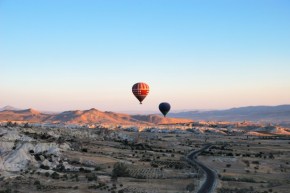
hot-air-balloons-1422702946OcWIsaiah 42:1-7. John 12:1-11

The events in tonight’s gospel take place before the Palm Sunday procession. I’m going to take the stories in the Biblical order.

Here are some themes that strike me.

  • Preparing for death: Mary’s anointing Jesus with oil normally reserved for anointing the dead.
  • Hypocrisy and dissimulation: Judas pretending to object to the waste of oil because of what it might have bought the poor, whereas maybe he wanted it for himself.
  • Jesus doing the unexpected: riding a donkey (Zechariah 9:9. Rejoice greatly, Daughter Zion! See, your king comes to you, righteous and victorious, lowly and riding on a donkey, on a colt, the foal of a donkey).
  • Jesus facing the future squarely: his cheerfulness, and the crowd’s acclamation. Faces are important in this story.

Preparing for death

We live in a society that refuses to look death full in the face. People pretend it won’t happen. They go to great lengths to try and delay it, even when it’s obviously inevitable. The medical profession doesn’t help. We spend money on seeking a cure for this or that disease as if there’s some hope that we can live for ever. We may be cured of cancer today but as sure as eggs is eggs we’ll die of something else tomorrow.

This always leads to trouble. If you pretend it won’t happen, you can’t set things straight before you go. There’s unfinished business. If you can’t set things straight, you are left with regret and guilt. You can’t say that you wished you’d not said so-and-so, and you can’t say, before it’s too late, what you should have said years ago. And all that is the overwhelming cause of grief and weeping and family tensions at funerals. It’s in contrast to the death of a friend of mine, who knew she was dying, told the world, and wrote her funeral homily, and characteristically witty it was too. Our refusal to be straightforward about death results in grave disappointments.

For six months of my life I worked in a children’s hospital just off the Brixton High Road in south London. I saw there babies with incurable conditions having operation after operation, and I was required to insert drips into their tiny veins whilst seeing their eyes looking at me. The inhumanity and cruelty of it. I plucked up courage to suggest that baby Anthony should be allowed to die with dignity. The reaction was swift: I was reprimanded in no uncertain terms. He died the next week after yet another operation. It is not my intention to start a debate tonight on end-of-life issues—that’s for another time maybe—but I’m using this as an illustration of how many of us refuse to confront one of the realities of animal existence on this planet. Death comes to all≠. By pretending otherwise we cause grief for ourselves and for those that love us.

This sanitisation of death, this refusal to look it full in the face, is a consequence of urbanisation. In Derbyshire and Ireland, my parishes covered large rural areas. Rural folk have a robust attitude to death. They see it day by day. Animals are killed so that we might eat. One of my churchwardens thought nothing of shoving her arm up a cow’s vagina to pull out a dead calf. Now, I acknowledge that my attitude to death may be peculiar: not only was I brought up in a farming village, but for 25 years I was using human cadavers to teach anatomy: cutting them up, examining them and handling them.

I’m convinced that our attitude to death needs realigning. Tonight’s Gospel and the Palm Sunday procession seem to say likewise. Our Lord faces death full in the face. Face: earlier in the gospel Jesus came down from a mountain with a shining face. Then he set his face to go to Jerusalem. And now acknowledging to Judas—I rather like Judas by the way—that he is being anointed for death. The Easter message is that death leads to new life. If you want to build on a new site, it is wise to clear it of rubble so that good foundations can be laid. This is new life following death of the old. And so, of course, is the resurrection story.

Biologically speaking, death is part of life. The cells of our bodies are dying all the time, and new life replaces them. Skin cells are constantly being shed and replaced. Blood cells past their sell-by date are replaced all the time. There are lots of other examples, but here is a startling example of the necessity of cell death. When a fetus is developing in the uterus, the hands and feet start off as spade-like things, a bit like fists. You might think that fingers and toes grow out from the spades, but you’d be wrong. What happens is that rather than digits growing out, four strips of cells are programmed to die, leaving digits remaining between them. If not enough cells die, we get webbed fingers and toes. If more strips die we get more fingers than usual. Here is another example. When a bone is fractured and reset, the two ends are rarely aligned properly. The body copes with this by killing off bone cells in the wrong place, and laying down new ones where needed.

Biology has no hesitation in killing off the old in order that the new can flourish. We can’t move on if we try to preserve the past. That is why, despite my love of architecture and liturgy, I oppose the conservationist lobby. We must face death when necessary. We can’t engage with the present if we refuse to accept the inevitability of death, because we will be tempted to put off things that need attention before it’s too late.

No dissimulation

As the donkey procession (allegedly) arrives from the east, history books tell us another procession arrives from the west. At Passover the Jewish people celebrate deliverance from the Egyptian oppressors. But here they are now under Roman oppressors. A recipe for civil unrest. The Romans were nervous. So the Roman governor rode to Jerusalem from the ‘capital’ Caesarea on the coast, with military reinforcements in case of trouble. The procession from the west was one of Roman imperial power. Pilate rides a war horse, Jesus rides a donkey. Empire versus individual. Mockery of imperial power. Turning the tables of convention as much as turning the tables in the Temple. Wisdom from a donkey. There’s a scene in Attenborough’s film Gandhi which always catches my attention, and that is when the ship docks in Bombay, some British bigwig is disembarking in full dress uniform to the sounds of bands and military display. At the same time, Gandhi dressed as a local is disembarking further up the quayside. The crowds are with Gandhi.

I wonder which procession we will be part of? Will we part of the naked emperor’s procession that lusts for power, that fawns over those who have it? that fiddles expenses claims? Will we like them go for the puffed up image like an overstuffed balloon that will soon burst? Or will we be part of the procession of straightforwardness, of humility, of service? Will we be in the procession that faces stark reality, that embraces death in order that something much more glorious can rise? Death of worldly ambition. Look at the contemporary church and see how the power-lust of bishops leads them to put the needs of the institution before those of the individual.

Renunciation

Facing the future mindfully means killing all that holds us back. It can be very painful. We begin to see ourselves as others see us. We realise that we are not as good as we thought we were. We realise how we deceive ourselves and the truth is not in us. We need to grieve our lost attitudes, our lost expectations, our lost dreams. We need to let go of what we want, or wanted, and accept the grace of God to resurrect us. We must die in order to live. Death of our self-obsession enables us to rise:

As larks, harmoniously / And sing this day Thy victories: / Then shall the fall further the flight in me.

As I grow older, I look back on some of the things I used to be so passionate about and wonder what it was about them that so obsessed me. Obsession is the right word, because these passions blinkered my vision and limited my action. A couple of humdrum examples. I once had a huge collection of books: they were my friends. I came to see that they limited me. Not only did they cost a lot of money, they also dictated the type of house we could move to. And after all, when one has sucked the marrow out of a book, one might as well pass it on! (How many books do we all have for show, unread and likely to remain so?) In my teens, cathedral music introduced me to beauty, lifting me from a drab village existence. I allowed it to rule my choices for too long. Now it sustains me without, I hope, dictating to me.

These are not evil things in themselves (though many clergy harbour evil thoughts about church musicians—or is it the other way round?) but they limited me, they narrowed my vision. They stole some of “me” and prevented me from being fully me, in a similar way to that of any addiction. I am still afflicted by things—we all are—but now I’m slightly more aware of the symptoms of addiction. As we get older we find ourselves attached to fewer and fewer things. Our vision becomes less restricted. We are moving into a wide, unfettered place. The view from the road from Sleaford to King’s Lynn is an image that I have in mind for this wide view. This notion of being in a wide place is one of the Hebrew images of salvation, and it is one that Jesus teaches. If we die to earthly attachments, we are in this place, and we can focus on what matters: love of God, and love of neighbour. I like the Buddhist idea that all disease is caused by attachments—or hatred, which is just negative attachment.

Eternal not everlasting

There is a kind of renewal in all this, and the key to it is to live in the present. Our Lord’s teaching again and again emphasizes that we need to do just this. Learn from the past certainly, but don’t live in it. Look to the future, but don’t waste time laying up treasures. Live now, in the moment. This, actually, is what eternal means. When we hear ‘everlasting life’ in church services, we often get the wrong idea, and it would be better, and more accurate a translation of the Greek, to use eternal. It’s not quantity or length of time that matters, but quality. Eternal, timeless, out of time, in the present, Divine. Thy kingdom come on earth, here and now. Trust the teaching of Jesus: live in the present moment, and do your best in that moment. We can do no more, and we need do no more. In one sense this is easy to do, and in another it’s extraordinarily difficult when we are surrounded by the petty irritations that life throws up day by day, when we see the injustice that surrounds us, and when we are governed, as we are, by prejudices and faulty behaviour patterns bred into us by our upbringings. But see all these for what they are, and trust and hope.

Back to death

If we are to attain eternal life, here and now, we must face death and die to worldly trivia—the vain things that charm us most. Having divested ourselves of these burdens we walk off lighter. ‘My yoke is easy and my burden is light’ – light in both senses, light because of the light of the world, and light because we are less burdened by weighty impedimenta from the past.

Jesus’ last hours complete the incarnation. Our Lord gave up a divine dwelling for human frailty, and now he suffers the stripping away of dependence on self to fall into he arms of the divine. ‘It is finished’. This is a renunciation that we recall every time the priest utters the consecration prayer at Mass. It is a renunciation that we join in this week, and every week. And the task for us, sisters and brothers, is to accompany the Lord on his journey of death in order to fall into the arms of the divine.

From beyond the grave

xnpnTxoYetBBBelhzLLAUyuSRcS

From Beyond the Grave – a great film

Two funerals the week after Easter. I’m not available for either.

The first is for a woman who back in the mists of time was christened in St Semperviridis, married there, and so must be buried from there. She has not attended said church for decades, and I know none of the family—indeed they live in a different county and different diocese.

The second is for a woman who has been a member of St Semperviridis for many years past, but whose family have opted to avoid the church for this final ritual and go instead for a crematorium. This causes some distress to members of the congregation who would like to be present in church for the obsequies, but since none of the family is a churchgoer, I guess that won’t weigh heavily on them. Despite not wanting the church building—here’s the interesting thing—the family wants the Vicar of St Semperviridis to do the honours at the crematorium. Since I’m on leave, I arrange for a retired colleague to take the service, but before giving the go-ahead, the family wishes to approve (or not) my choice.

Let me be clear about this: the first family wants the church building but isn’t bothered about the priest; the second wants a priest known to the dead woman but isn’t bothered about the location, or about acknowledging her church allegiance.

Underlying all this is the attitude of the undertakers (two different firms). Would it be unreasonable, if a family wants a particular church or a particular priest, to expect undertakers to establish availability before going ahead with diary bookings? Apparently it would.

What’s going on?

In one case the church building is a tribal temple, like a Masonic Hall. It doesn’t matter who does the incantations so long as they are done in the right place—or in this case the place that was “right” for the woman’s early life. This is the sociological church, the pagan church, the geographical parish church, the established church, the Church of England as it used to be before clergy bothered too much about being friends with Jesus. My three years in the Church of Ireland taught me more than I ever wanted to know about the church as tribal temple, in that case the temple of protestant landowners on whose lives Christian teaching impinges hardly at all.

In the other case it’s not the temple that matters, but the person of the witch doctor: the place where the shaman utters the magic words is of no import.

Of course one doesn’t know what’s going on under the surface. One doesn’t know about the difficulties of fitting a funeral into busy diaries, even though ministers may be expected to change theirs. One doesn’t know how much “getting things right for the funeral” signifies guilt at ante mortem neglect. This is something to which I allude at every funeral when I say that one day everyone will go in a box “like that”, and you never know when, so get your lives in order now so that when that day comes there are as few regrets as possible.

Just for the record, here’s what I’d like to happen to me.

  • cut into bits and fed into a septic tank—environmentally useful; or:
  • burnt, with ashes chucked onto the West Coast Main Line from a bridge just off the road between Orton and Tebay;
  • I’m not bothered about any religious rituals at all;
  • most important of all—a good party.

But really, I don’t care two hoots. They, whoever they are when the time comes, will do just what they want and that’s exactly right. No shoulds, no oughts, no expectations from beyond the grave. I don’t want any physical memorial whatsoever: I don’t want there to be any sign of my having existed.

Blessed George

George_HerbertAdapted from the Church Magazine for this month
Lent is so early this year I haven’t had time to do anything much for a Lent course. I’m not impressed by the mediocre churnings of what passes for the minds of contemporary bishops and theologians, so given that the Church of England kalendar celebrates him on 27 February. I’m introducing my little darlings to George Herbert, a man at the top of my list for canonisation.

He was born in 1593 to a wealthy family in Montgomery. After Westminster School where he was tutored briefly by Lancelot Andrewes, another truly great mind, he went to Trinity Cambridge, became University Orator, and attracted the favours of King James I/VI. Then in his 30s he gave up this glittering life and was ordained priest, serving near Salisbury. He was feted for his care for parishioners and for providing food and clothing for the needy. (Oh to be a priest serving only one church and a miniscule population.) He survived three years of this, dying of tuberculosis in 1633. Do you suppose TB resulted from over-zealous ministry to the sick?

He left us his reflections on pastoral ministry A Priest to the Temple or The Country Parson, still regarded by some as a kind of works manual, though hardly relevant to today’s multiparish clergy, and a collection of poems The Temple. It is thanks to John and Charles Wesley that some have made it into our hymn books: Let all the world in ev’ry corner sing; Teach me, my God and King; King of glory, King of peace; The God of love my shepherd is.

Richard Baxter (theologian, Puritan, hymn writer) said, “Herbert speaks to God like one that really believeth a God, and whose business in the world is most with God. Heart-work and heaven-work make up his books”. Through his fellow poet Henry Vaughan, Herbert influenced William Wordsworth. His poetry has been set to music most famously by Vaughan Williams, and by others including Berkeley, Britten, Weir, and Walton.

There is something about Herbert that intrigues, fascinates, enthrals, and speaks to me heart-to-heart. His poetry is full of humanity, rantings, depression, perplexity, joy, ecstasy, Biblical allusions, theological concepts, and references to science and culture of the day. I’m not really much into poetry, so it’s presumptuous of me to make any comment, but nevertheless, I can’t resist a few.

In Teach me, my God and King he writes of the famous stone that turneth all to gold. The idea of being able to turn base metal into gold has long been a part of intellectual inquiry. In mystical terms it’s about something that can turn base humanity into the divine: an elixir that cures all ills—indeed this poem is called The Elixir. And Lewis Carroll must have taken his inspiration for passing through the looking glass from this poem.

In Aaron Herbert compares unfavourably his unworthy thoughts as he vests for Divine Worship with the vestments worn by the high priests in the Jerusalem Temple: rich, colourful fabrics with bells attached at the hem.

The God of Love my shepherd is: this is quite the best metrical version of Psalm 23. Why did H W Baker think he could improve on it? Maybe he didn’t know it, though I find that difficult to believe.

The Pulley: am I alone in hearing resonances of Pandora’s box?

Redemption: why does this put me in mind of Ursula Le Guin’s shocking The ones who walk away from Omelas?

Love bade me welcome. Look at the third line from the end: My dear, then I will serve. Who is speaking? Is it Love who speaks, ready to serve the meal? Or is it, as I increasingly think, “me” speaking, acknowledging that unworthy though I may be, I’m not so stubbornly proud as to refuse the meal set before me by the prodigally generous father? If so, ‘serve’ is used as we might say ‘OK, I’m not very good but I’m good enough: I’ll do”.

Perhaps his most striking poem is The Collar. This can’t be a reference to the clerical collar, for that wasn’t worn by clergy until the nineteenth century. It’s about a collar used to restrain an animal. The very human Herbert, like all clergy, chafes time and again at the restrictions that come with being a clerk in holy orders: things you can’t do, things you’d like to say but just can’t, things you don’t want to do but must, ways you have to bite your tongue, ways you must put the needs of others before your own, ways you have to bottle up your emotions for the sake of doing the job well (I still find it dreadful to do funerals of people with parents living). In this 36-line poem Herbert rants and raves at God until four lines from the end, when he’s brought up sharp:

But as I rav’d, and grew more fierce and wild / At every word, / Me thought I heard one calling, Child: / And I reply’d, My Lord

A lump to my throat every time.

A Vicar’s Life

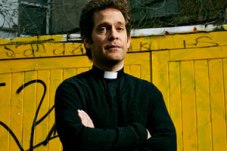
revYou may have seen Rev (BBC1) some years ago, with Tom Hollander as Adam Smallbone. Fiction, but said to be based on reality of being an urban Church of England priest doing his tortured best in the face of an apathetic culture, self-obsessed clientele, and a hostile church establishment interested only in careerism and managerialism.
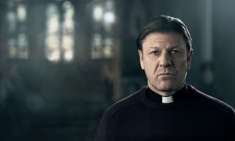
You may more recently have seen Broken (BBC1) with Sean Bean as Michael Kerrigan. Again fiction, but more obviously (to me) based on the reality of being a Catholic priest in a deprived inner city of the north of England. Priest and people in this come across as somehow more genuine than the stereotypical cartoons of Rev. It’s heart-rending stuff, entirely authentic I assure you. It put me in mind of Jimmy McGovern’s Priest (1994), a truly prophetic work.

You may be watching A Vicar’s Life (BBC2) about four real Herefordshire Church of England clergy. Two episodes down at the moment. There’s no comparison with Sean Bean’s Broken, or even Tom Hollander’s Rev. At least the fictional priests lived the agonies and ecstasies of real humanity on the edge. The Herefordshire programme is all about buildings and the institution. I see nothing in it so far other than middle class complacency, and gimmickry to try and get people to support the organization. There is nothing about the inner life. There is nothing about transcendence.

This is odd in somewhere like Herefordshire where you would think that beauty would be a way in. I remember my Methodist minister uncle, who had served in Carlisle, Sedbergh, Leeds and Stockton before retiring to his native Langwathby, telling me toward the end of his life—rather courageously I thought—how his view of God was not what it used to be, and how increasingly he was attracted to a Wordsworthian panentheism, possibly even pantheism. Who could not be so attracted in the gently luscious Eden Valley, more so even than in the Lakes next door in my opinion?

4123Of course, my views say something about me. Others are sure to disagree with me. Good—I like disagreement, for only through being challenged do we grow and develop. But IMHO there is far too much emphasis in the Church of England these days on Jesus and not enough on “The Divine” – which, as a Greek scholar pointed out to me years ago, is a better translation of theos than “god”. No wonder the Hebrews would not speak the word. The sentimentality, emotional indulgence and self-obsession of Jesus as my lover is something in the contemporary church that I find utterly repellent. I need to look out and beyond, not in and around. Thus I prefer facing east at mass, all of us fixed on “the other” beyond, rather than the inward-looking, closed and self-congratulatory circle of “me and my mates” as I stand as at the shop counter facing the congregation.
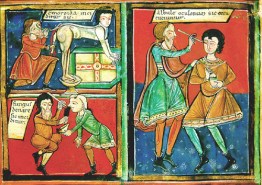
Pub and church used to be the principal facilitators of social cohesion in a community, the price for the ordinary punter being to have to endure a talk of variable quality week in, week out. I bet the publican’s was way more interesting than the Vicar’s. Those functions have slipped away from church to other structures and organizations such as social services and hobby groups. I don’t think that is anyone’s fault, it’s just what’s happened. It’s not recent—it began with the invention of the printing press that enabled people to read for themselves (if they could).

But I’m certain that, as with Old Testament figures time and again, the answer lies not in frenetic activity in the hope of getting people to come back to church, but in inactivity: retreating to the cave to pause, to reassess, to allow or even hasten death in order that rebuilding might begin. Not for nothing is Siva the Hindu God that regenerates after destroying—Phoenix from ashes, the work of the spirit, the blazing bush.

The Master advises against flogging dead horses (Matthew 10.14, Mark 6.11, Luke 9.5). We ignore this by switching on life support when we should be letting events take their course. Close churches. Demolish them. Sell them.

Perhaps future episodes of A Vicar’s Life will reveal more to my taste, but given the state of the Church of England these days, I shan’t hold my breath.

Venerating flesh

Rembrandt_Harmensz._van_Rijn_007

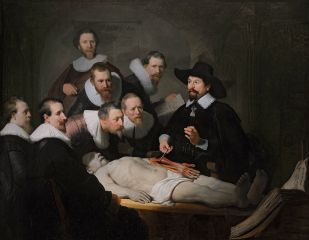
Rembrandt got it wrong

The Vatican has forbidden the sale of would-be saints’ body parts as relics. That momentous news set off a train of thought.

As attitudes to dead bodies go, I guess mine is—let’s be neutral here—unusual. Since 1976 I’ve been handling embalmed bodies, cutting them up, chopping off bits and pieces, sawing heads in half, removing brains, and so on and so forth.

Embalmed bodies don’t really look like human flesh, and they certainly don’t feel like it. Anatomy departments need embalming fluid that preserves for years—three is the normal legal limit—while funeral directors use a different chemical mix that preserves for only a few weeks, but gives a better cosmetic result.

When I was in anatomy we went to considerable trouble to show our appreciation to the families of those who left us their remains. We kept them informed, organised the funeral, and held memorial services to which relatives were invited. In Dublin most students were non-Christian, always keen to be involved. They and I were immensely grateful to the relatives.

In the 1990s there was controversy about body parts removed for future study and retained in hospital labs. After this came to light, funerals were held for the specimens—a liver, a heart, a lung or whatever—despite obsequies having already taken place for the people from whom the specimens had been removed. I pondered how big a body part had to be in order to necessitate a ceremony months or years later. If a separate funeral was required for a liver, say, then what about a sebaceous cyst that had been removed? Should a malignant tumour have a separate funeral? Is it necessary to have a funeral for my nail clippings? What about all the flakes of skin that fall off every day? Pus from an abscess?

Is it possible that compensation culture was rearing its head? Surely not. Why did clergy condone this nonsense? It’s not as if they get the fees—at least not in the C of E they don’t.

In any case these events led to a revision of regulations. Up to that time anatomical donations were governed by the 1832 Anatomy Act, brought in to deal with the Edinburgh body snatchers, so it was overdue.

Coincidentally, as the controversy was kicking off in Ireland and the UK, retained body parts of Thérèse of Lisieux were on a world tour, soon to land briefly in Dublin. I wondered how many of those who flocked to pay them homage were at the same time agitating for separate funerals and/or compensation for a relative’s retained organs. I wondered if they had ever given thought to what Thérèse’s parents would have wanted.

Let me be clear: I’m not knocking the veneration of body parts of saints. If such devotions help you in your passage through life, good for you. It occurs to me that I do it in a different way: I venerate dead people’s intellects and personalities by reading what they wrote.

When I last saw my father in the flesh in his coffin in 1986, the undertaker said to me that it was just a body, it wasn’t really him any more. A cadaver is just dead meat. When I last saw my elder son in the flesh in 2015, a certain finality hit me when I noted the circumferential skull incision through which his brain had been removed for post mortem examination. I don’t know if it was retained. They would have been welcome to take what they liked.

I write this on Christmas Eve. The incarnation is all about flesh. Look after it. Life is short.

British Association of Clinical Anatomists: origin and future

srgry02A paper for the meeting of the British Association of Clinical Anatomists at the Burton on Trent meeting, 14 December 2017
In the beginning was the Word, and the Word was with God, and the Word was the Anatomical Society and the Journal of Anatomy. They were in the beginning with God, and without them was not anything done in anatomy that was done. And the Professors of Anatomy saw themselves as the Lord Almighty. They terrorise and pulverise. They march through the breadth of the earth to possess the dwelling places that are not theirs. They are terrible and dreadful, their judgment and their dignity proceed from themselves. And lo, it came to pass that the people rebelled inwardly in their hearts. They cried to the Lord “wilt not thou deliver us from these bitter and hasty foes?” And the Lord raised up prophets, Coupland of Nottingham and Scothorne of Glasgow. And through them the Lord came to the aid of the oppressed. And lo! BACA was born.

It’s fun to see the formation of BACA in these Biblical terms, and it is not inaccurate. But there’s a bigger story to tell, and since this year marks BACA’s fortieth birthday, I shall do so. Of course, I’m not an historian, but I’m one of the few people alive who witnessed BACA’s birth in 1977 just along the corridor from my office in Nottingham. My recollections are thus first-hand and are as reliable as memory ever is.

First, a brief autobiographical sketch. I was at Cambridge for preclinical studies and then King’s College Hospital in London for clinical training and preregistration house jobs, as they were then known. I went to Nottingham as anatomy demonstrator in 1976 then Lecturer in 1977. In 1988 I began as Professor of Anatomy at the Royal College of Surgeons in Ireland, in Dublin—a medical school as well as a postgraduate college—and then in 2003 was appointed to Nottingham’s Graduate Entry Medical School at Derby. In 2006 I was ordained into the Church of England, becoming Vicar of Burton in 2014.

The origins of BACA are intertwined with two main medicopolitical trends: first, the decline of anatomy as a discipline in the medical curriculum, and second, the loss of medical graduates from departments where they had been predominant. I know that I am talking today to a mixture of scientists, physios and medics, and I apologize if what follows seems irrelevant to many of you, but it is important in the embryonic development of the society, so bear with me.

The decline of Anatomy

I enjoyed undergraduate anatomy. I was riveted by the first lecture in October 1969 concerning lemurs and lorises and thumbs, part of a series on the evolution of Man. Subsequent anatomy memories centre on Max Bull, the doyen of Cambridge anatomy teachers, who gave us a definition of anatomy that has stayed with me: “the study of the structure and function of the growing and changing living organism, not necessarily human”. It’s not elegant but, like a thong, it covers the essentials, especially, as Max was at pains to emphasize, the growing and changing bit.

I was fortunate in the Cambridge anatomists of that time, who with one exception were affable, approachable and interested in students. So when during clinical years I realised that practising medicine was not for me, I thought that if being an anatomist involved what Max Bull did—welfare and nurturing of students using the vehicle of a subject that interested me—then an anatomist is what I would be.

In the third clinical year I approached several professors of anatomy about a job, and ended up in Nottingham because it was a lovely day when I visited and Rex Coupland, the professor, was charismatic. It was a good decision. I immediately saw the value of the brand new systems-based course that resulted in anatomy being significantly trimmed down, with much less time spent on dissection.

Listening to colleagues who had done time at other places, I realized how fortunate I’d been in Cambridge. I heard that more than a few Professors of Anatomy elsewhere were belligerent and irrational, and bullied their juniors and students. I witnessed it in external examiners

This is relevant to the decline of anatomy. In the 1970s and 80s, all the influential people in medical schools had had to endure hours wasted on dissection, all had been made to learn anatomy in excessive detail, and a fair few had suffered from the bad behaviour of some anatomists. Not surprisingly, they resented anatomy and they resented some anatomists. They were determined to cut anatomy down to size. They were abetted by the new discipline of Medical Education, then on the march, many of whose enthusiasts stated openly that doctors no longer needed to have facts at their fingertips. There was growing opposition to what they, wrongly, called didactic teaching

Things did not get better. The systems-based curriculum developed in many places in a way that may have suited metabolic processes but all but wiped out regional anatomy. The understanding of human biology as a product of evolution and adaptation, as imprinted upon me by Max Bull, sank without trace. I must be one of the last medical students to have enjoyed a term studying serial sections of pig embryos as part of an undergraduate course.

What was to be done?

With their clinical training and their clinical eyes—Coupland had begun to train in neurosurgery—BACA’s founding fathers were certain that only medically qualified staff were capable of teaching clinical anatomy. But there were hardly any left. So the question for them, given the image problem and the brain drain, was: how can we in anatomy recruit and retain medics?

The answer, they thought, was twofold: money and status. Rex told me that he saw BACA as a trade union that would lobby for preclinical medics to be paid more. Furthermore, the founders saw it a means of having medical anatomy recognized as akin to a clinical specialty. The trouble was that Rex and Ray didn’t know how to achieve these aims—indeed, given that they were both adept medical politicians in university life, they displayed surprising naivety.

First, money. Formerly, medics in preclinical departments had been paid more than non-medics doing the same job, but this differential had been abolished some years back. No salary committee in its right mind would reverse that decision for the sake of a miniscule number of peculiar medics. Perhaps the founders were thinking in terms of a salary enhancement, for Rex was the recipient of a hefty NHS merit award for which he attended at most one ward round a week. If he thought that that arrangement would catch on with NHS administrators, he must have seen pigs with wings. As for payment for clinical duties undertaken by anatomy staff, of which I was for over a decade a beneficiary, the resentment created by my not being available for university duties for one session a week was considerable. That wouldn’t have survived in the increasingly regulated NHS.

Second, status. I’m afraid Rex and Ray were living in cloud cuckoo land in imagining that clinicians would support any proposal to give senior anatomists clinical privileges. Unless the definition of clinical was twisted to mean what it patently does not, anatomists could never be clinical. At that time I became a member of the BMA Medical Academic Staff Committee, and believe me I know just how little support there was for such an idea. The clinicians simply laughed. In any case, Rex and Ray were wrong. Neither money nor status would have dealt with the image problem. Medics in anatomy were in many cases rightly considered maimed, unable to cope clinically, or, like me, deranged in turning their backs on clinical practice and salary.

It was all too late. King Canute couldn’t stop the waves, and neither could BACA.

Consequences

In the eyes of junior staff, BACA was compromised from the beginning. It was snobbishly hierarchical. For full membership you had to be a medic, and a senior anatomist to boot. Anything else meant a lesser category. And right at the bottom—sorry about this, all you scientists—were the ‘mere’ PhDs. The Association looked like an exclusive club for Rex’s and Ray’s friends and relations. My non-medic colleagues were outraged. The powers that be eventually relented, and this discrimination was abolished, though not soon enough. It left a bitter taste, and non-medic anatomists shunned BACA in favour of other scientific societies, leaving BACA meetings in the early days with little of great worth other than a good meal.

How did clinicians view BACA? I can only go by what I deduced from meetings. I should say that I was never a great meetings enthusiast. As a teacher I felt an impostor as scientist. As someone who did one ENT clinic a week, I felt an impostor as clinician. I was at home with students, provoking them to explore, to think, to imagine, to learn, and to ask questions, but to be on the receiving end of a comment from an eminent scientist which began “Dr Monkhouse, I listened to your paper and I have a question” was to render me incoherent in the sure and certain knowledge that evisceration was imminent. But to proceed. Many of the presentations at early BACA meetings came from only a handful of research groups—we’re back to the private club. Most surgeons looked elsewhere to flex their academic muscles, and few were enthusiasts for BACA or indeed anatomy. I was astonished to hear a Professor of Surgery tell me, the Professor of Anatomy, that he didn’t care what a structure was, or what it was called, or how it developed: all he cared about was whether or not he could cut it.

For these and other reasons, BACA was viewed by non-medical staff as elitist, and by clinicians as not really kosher. BACA meetings and the journal Clinical Anatomy came to be regarded by some in both camps as second or third best. It was fighting for its life as soon as it was born.

The future

I’ve been off the game for over a decade, so what value my comments have is for you to judge. However, as Max Bull remarked over 45 years ago, I have an analytical brain, added to which the view of the forest is better from the edge than from the middle.

The organization I work for at the moment is run by yesterday’s people making decisions for tomorrow without heeding the concerns of those that will have to bear the consequences. Is this true of BACA? Judging from your website, I think not, indeed I have the impression that you have worked hard to move on from those incestuous and hierarchical early days.

The future of an organization depends upon its capacity to be of service to others. So I suggest that you continue in that direction in the knowledge that you are on the right course. The future of BACA depends not on juniors tugging the forelock to grand old men, but on the extent to which those with experience can be useful to those trying to acquire it.

You rightly offer yourselves as a forum for gaining experience to anyone who wishes to explore clinical anatomy, no matter how tangentially. Find out what trainees need and work with them to provide it. Help them build their portfolios, and gain skills in presentation, writing and editing. Think back to when you were young and ask yourself what made you anxious. Help trainees to master these things.

Your committees will need to include more than a token trainee, so sling off the superannuated. If trainees are hard pressed to find time to serve, then organize things to suit them. I don’t want to get overly theological about this, but didn’t someone once say that the first would be last and the last first?

Many of the scientists among you will know more embryology than the medics. Teach them! It is hugely important in several clinical and scientific areas. How can anyone understand the function and layout of the cranial nerves except in terms of evolution and embryology? How can anyone understand how a weak voice might signal a mediastinal tumour except in terms of evolution and embryology? The medics among you can help nonclinical staff get to grips with some of the more obscure consequences of regional anatomy in terms of diagnosis and treatment. Work with the Anatomical Society—after all they are wealthy while you, I understand, are merely comfortable.

Is there anything to be gained by working with the Royal Colleges in training programmes? I know it’s difficult to work with surgeons, especially those who are big in the Royal Colleges, for as with Yorkshiremen, you can’t tell them anything: they are multitalented and omniscient. But there are other disciplines …

Another flight of fancy. Alternative medicine is on the up. See if you can cooperate with some of its more anatomical branches. I was in terrible trouble early in my Dublin days for having conversations with osteopaths and physical therapists about how we could help with their training. My knuckles were well and truly rapped by protectionist surgeons. I still see nothing wrong with those conversations and remain unrepentant, especially since they had money to pay us. One of the things I learnt from osteopaths was the way in which neglected ideas from the past surface years later. For example, the gut brain, once sneered at, has a new lease of life. It was an osteopath that directed me to a book entitled “The Autonomic Nervous System” by Albert Kuntz, published in 1929. There are some prescient nuggets in there that might repay imaginative thought.

Now there’s a word: imaginative. Imagine how you could serve. Imagine how things might develop and plan for them. Maybe that’s the best advice anyone could give the Association as it looks towards the next forty years. You’ve done well to come from a precarious postnatal period to the state you’re in now, so keep your eyes open and your antennae alert and let your imaginations flower. You can be proud of yourselves.

Finally

When I saw that BACA was coming to Burton, my first thought was “perhaps they’ll give an honorary member, or whatever I am, a free dinner”. And so you did, last night. It pays to be cheeky: “ask and you shall receive” is a phrase I read somewhere. It’s lovely to meet you, to renew friendships, and a real pleasure to begin to get to know Neil Ashwood. When we first met he asked me if I knew any connexions between Burton and Anatomy to which he could refer in his speech. I said modestly “not really, only me.”

Friends, thank you for your invitation, for feeding me, and for listening to me.

Advent light

247f11754cd5847ddbc149fb2acdc2beCarol Service homily for Burton and Bretby Rotary Clubs
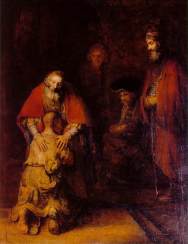
Most people don’t expect a sermon at a carol service. But since a good many of you here today find yourselves in church only once or twice a year, I shan’t resist the urge to poke you.

I hear it said that English society is losing the plot, that it’s obsessed with individualism. People think their rights as individuals trump—pardon the verb—their duties as members of society. I hear it said that the church has contributed by having failed to proclaim its message clearly, that it has given in to the zeitgeist in colluding with the forces of secularism.

If you think this and deplore the way in which the Church has retreated from society to become an inward-looking sect, then I say this to you: stop moaning and start going to church. Put your money where your mouth is and change the church from the inside.

“Ah but”, I hear you say (there’s always an ah but). You say “church is only for old women and children”. “Church these days is sentimental claptrap of flowers and pet services and vicars obsessed with chocolate and coffee”. “Church is about middle class complacency” you say. “Church patronizes me with doggerel songs, playschool prayers and infantile sermons”. “Church doesn’t connect with the joys and sorrows of ordinary people” (I suppose members of Rotary Clubs can be regarded as ordinary people for the purposes of this homily.)

Certainly, when I look at celebrity vicars today, I can understand why people think like that.

So let me correct you about Christianity.

It’s not about chocolate. It’s not about vomit-inducing Jesus-is-my-best-friend talks. It’s not about worshipping texts written by people who thought the earth was flat. It’s not about believing fairy stories. It’s not about asking a sky pixie to sort out your problems because you’re too lazy to take responsibility for yourself.

I think Christianity is really quite simple:

  • Every one of us has the divine light within, a bit of the Divine, like a pilot light on a gas stove. The inner Christ.
  • All we need to do is let that inner pilot light grow to fill us from the inside. That’s what Christmas is about. As Mary let the infant grow in her belly, so can we let him grow in ours, for we are all Mary. We don’t need to do anything—the Christ-child within is already there; we just need to let it happen—or rather, we just stop resisting. As we have already sung: O holy child of Bethlehem, be born in us today.
  • As the Christ-flame grows within us it brings to light our egotistical desires and all the vain things that charm us most, then consumes them, often very painfully. That’s the crucifixion.
  • With all the inner rubbish now burnt up, we are resurrected; we ascend to the heights like a hot air balloon now unburdened by ballast. Our inner flame lights the way for others and consumes their burdens. Light as illumination, light as wisdom, light as less heavy.
  • And this with Jesus as the model, the example, divine humanity, the Word.

Christianity is about putting other people on the same pedestal that you’re on yourself. Christianity is about recognizing that we’re all in this together—every living creature, not just humans. Christianity is about giving away your self, because only then will you find yourself. And at this time of year it’s about remembering the importance of being child-like. Not child-ish: selfish, egotistical, me-me-me, but child-like: trusting, exploring, fun-loving, risk-taking.

I leave you with this question: would the child you once were be proud of the adult you have become? If not, use this Christmas, this festival of childlikeness, to do something about it.

A very happy Advent and Christmas to you all.

Christus Rex

prodigal_son33

The welcome

Homily for the Feast of Christ the King 2017 

Ezekiel 34:11-16, 20-24; Ephesians 1:15-23; Matthew 25:31-46

Stir up, we beseech thee, O Lord, the wills of thy faithful people; that they, plenteously bringing forth the fruit of good works, may of thee be plenteously rewarded; through Jesus Christ our Lord.

In Latin it begins, Excita, quaesumus, Domine … This, sad to say, is not about Christmas puddings, but is about asking to be excited.

The Christian life is not easy. It’s not about blindly following a pre-established rulebook or imposing rules on others. Jesus did not write an arid rulebook for his followers. Jesus did not think that belief in him could be attained through imposition. He did not come to establish a new religion. In fact more and more I think he came to abolish religion—to set us free from rules for their own sake, by showing us how to renounce all the vain things that charm us most. He came to show us wisdom that has no need of the rules of jobsworths, no need of prosperity and security for ourselves, no need of always having to be right. Then we are free to live selflessly, ego-free, for others.

A Vicar comes in contact with all sorts and conditions. People who are recovering from illness, people who have been in and out of hospital, people who are out of work, homeless, hungry, at their wits’ end, people who’ve endured more hardship in life that I would wish to endure. I witnessed dignified behaviour from people at their most exposed, most vulnerable, weakest. Regal, king-like.

Is this the kingship of Christ the King? If so, it involves accepting stuff that happens. Being passive: the passion. It involves rising above desolation in the hope of a fresh start. Resurrection and ascension. It’s not comfortable: we have to cope with the darkness of the deeps before we can rise to the sunlight. But the gospel readings of the last few weeks have not been comfortable. All of them have spoken of judgment, of exclusion, of condemnation for those who are late, or lazy, or easily satisfied, or who—as today—are hard-hearted.

********

Conquering kings their titles take from the foes they captive make: Jesus, by a nobler deed, from the thousands he hath freed.

Who do you remember from your past? Do you remember with gratitude those who punished you, who tried to impress you, who imposed on you? Do you remember with gratitude those who showed you, taught you, encouraged you, goaded you to action perhaps by words that rankled at the time, and then left you to get on with things?

Christ the King never uses power to his own advantage. He shows, teaches, encourages and then lets us get on with it. He is a team captain who works with the team rather than imposes on them; a captain who uses power for the benefit of others rather than for his own self-interest. He is the sort of king who leads us, pushes us, to places we fear to go. He stirs us, excites us, to action. He provokes us to realize that we don’t need to be fearful and ashamed of the past, but that we can move on with the past behind us to great new things. He doesn’t burden us with expectations and rules and shoulds and oughts. He takes them away from us and carries them himself. He is the sort of King who makes our loads lighter, not heavier. Christ the King lifts us from the rut and excites us to look to the future.

Conquering kings their titles take from the foes they captive make: Jesus, by a nobler deed, from the thousands he hath freed.

********

Kings have kingdoms.

When Christ the King was on trial for his life, he said his kingdom was not of this world. This is NOT about the afterlife. He was telling Pilate that his kingdom was an inner kingdom—a kingdom of outlook, of attitude, of motive—that powers Godly action here and now. It’s a recognition that the trappings of the material world are part of the layers we surround ourselves with in order to make ourselves look big. Vanity. Illusion. Look at Robert Mugabe and his millions, his palaces, his jets, all the people he has conquered and maimed and killed and humiliated.

We make the ideal kingdom—the Kingdom of heaven—here NOW. Life before death, not life after death. It’s about you and me making a world where we show, we teach, we encourage. A world where we don’t impose. A world where we don’t sit back criticizing others and looking down our noses at them. It’s not a kingdom where we stifle and suffocate and kill, but a kingdom where we excite and inspire others to action.

The Kingdom includes children, who were nobodies in that world—children who take risks, who listen, who experiment, who play, who are uncynical. The Kingdom excludes the pompous jobsworths. The Kingdom stands in judgment of the elites who create and shape things so that they can grow richer and fatter at the expense of the rest of us. Mugabe again.

It’s a kingdom where we seek the lost, bring back the strayed, bind up the injured, strengthen the weak. Where those who had trampled the weak are brought down. A kingdom where people are brought in, and community is restored. Where the tendency to entropy is reversed, where chaos is transformed into cosmos as in Genesis 1. Continuing creation.

********

We live messy lives. The mess of holiness. God bless this mess. We honour the King

  • when we forgive others and let go of resentments.
  • when we feed the hungry, give drink to the thirsty, welcome the outcast, clothe the naked, visit the prisoner—thus helping to free them from their pasts.
  • when we realise that the hungry, the thirsty, the naked, the imprisoned, are all parts of us that we have lost contact with—parts of ourselves that are strangers to us. And as we forgive others, we begin to forgive ourselves. This is truly the key to liberation from the past. Harden not your hearts ….
  • when we grow up, and take responsibility for ourselves.

We do all this to refresh and re-empower ourselves in order to do what we say we will do at the end of Mass—that we go in peace to love and serve the Lord, to bring about his kingdom here on earth as it is in heaven.