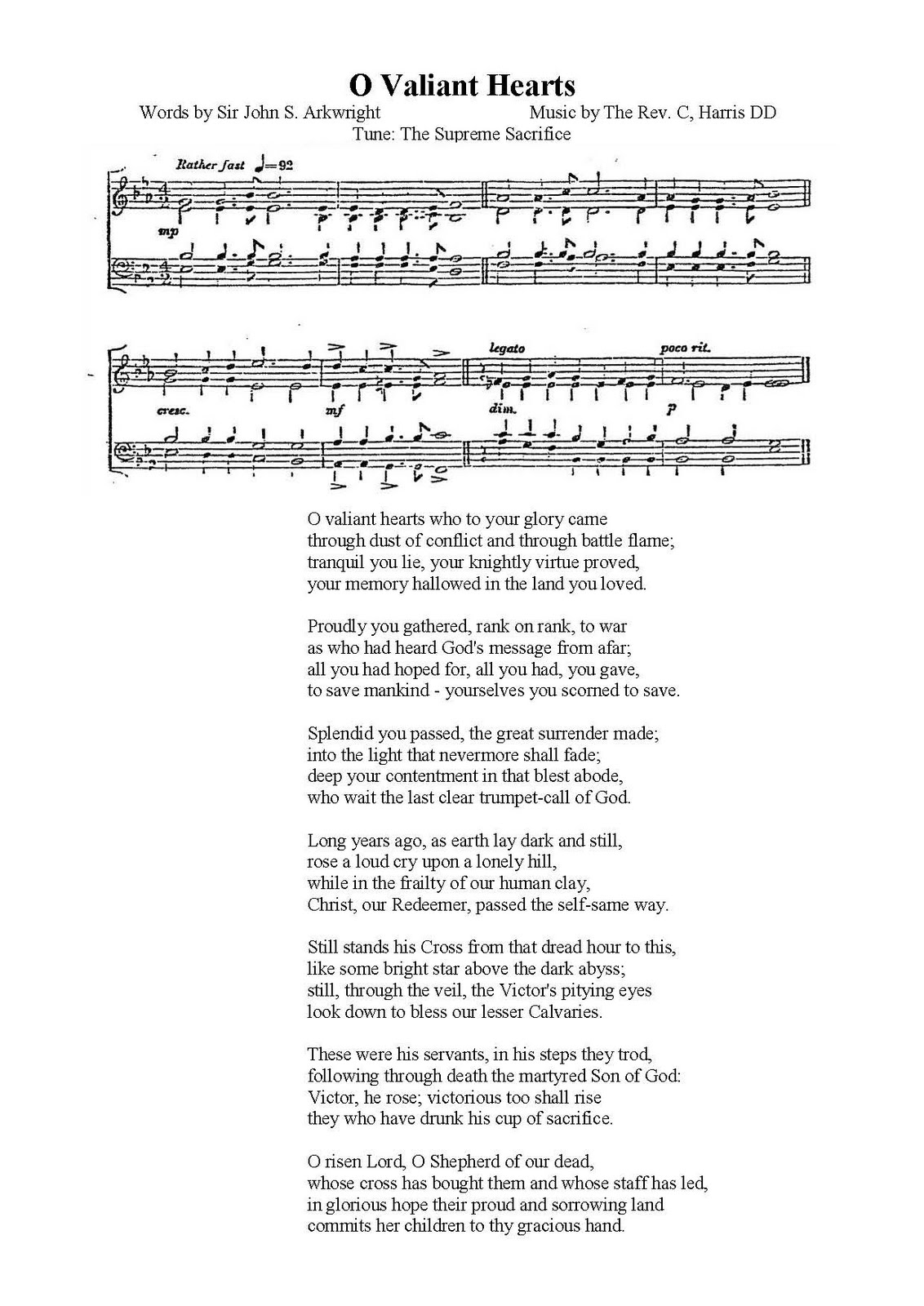
O valiant hearts

OValiantHeartsWithMusicRTFThe Civic Service on Remembrance Sunday 2014 at S Modwen’s Church, Burton upon Trent

 Micah 6: 6-8. Matthew 5: 1-12

Monday evenings this summer saw me glued to the box, watching the training of Marine Commandos. We glimpsed them, we glimpsed their trainers, many fresh from Afghanistan, and we saw how duty and tough love are agents of transformation. It made me wonder what our future is likely to be, shaped increasingly nowadays by ‘rights’ and indulgence.

It was remarkable to witness as training went on how these men come together in the service of something bigger than themselves. They learn that individuality is subservient to the common good. They learn that their own preferences and desires count for nothing when it comes to the well being of the unit. They learn comradeship. When one of them fails in an exercise there is none of the derision that I suffered in PE classes at school (I was and remain physically inept) but instead a remarkable level of encouragement and support.

It’s people and attitudes like this that we honour today.

Think about the men in the trenches a century ago. Maybe they signed up seeking excitement, maybe they were bored, maybe they had a sense of service, or maybe they were escaping desperate circumstances. Just like today’s commando trainees. Think how dreadful life was in the trenches. And death. And yet, despite this—or perhaps because of it, for there’s nothing quite like adversity to bring people together—we witness the comradeship and intimacy that develop, and we see it in ex-servicemen and -women.

Now think of the women and men who served in the Second World War, in the Gulf War, Ireland. Think of those serving at this moment: Afghanistan, the Middle East, and more. Think of servicemen and women who suffer in peacetime as a result of idiots who think they know better than everyone else. Think of those that are injured physically and mentally. And think of their families.

It is people like this that we honour today.

We’re not here to honour politicians who appear to indulge in playground games like ‘mine’s bigger than yours’ or ‘you can have my soldiers if I can be your friend’. We are not here to condemn service chiefs who make the best decisions they can given the information they have at the time—or who have decisions imposed on them. We’re here to remember those who learn to their cost about justice, and mercy, and humility. That is what the first reading is about. And in the second reading we hear that only when we have emptied ourselves of selfishness can we begin to glimpse the kingdom of God—which is not about life after death, but about what life could be here on earth, as it is in heaven.

However much historians might proclaim the stupidity of the First World War, one cannot deny the evil that was confronted in the Second. Fighting evil is necessary, so long as we remember that every evil act begins as a thought in the mind—and that such evil thoughts are in your mind and mine as well as in the mind of the Dictator. It’s worth remembering too that nowadays a UK military presence often serves, in the words of the second reading, ‘to show people how to cooperate instead of compete or fight.’ Selflessness replaces selfishness. That, brothers and sisters, is what Resurrection is about: we can all rise to the selflessness of eternal life if we put aside selfishness and ego.

My son and his family live in the United States. I’m always struck at US airports how military personnel are invited to board first, and how at shows and public events the military are applauded. Americans respect their military all year round. This week we show our respect for those who learnt the hard way that selflessness, not selfishness, is the way. It would be good if we could remember this message in the other 51 weeks of the year, every year, and in every moment of our lives. Before it’s too late.

Ugly bug prayers

1409307203767_wps_14_BN2XBP_Colorized_transmisThere are calls for prayers to end the Ebola curse. Cathedrals do it, churches do it, even educated fleas do it. So what’s it all about? What are they asking for?

That the Lord will strengthen sufferers to bear what must be borne? Fair enough I suppose. We need to relax into allowing the processes of nature to take their course.

That the Lord will zap the viruses because they are less important than people? Are not viruses ‘creatures of this earth’ just like us? Why should viruses suffer more so that we suffer less? Do viruses suffer?

That the Lord inspires medical scientists to come up with a cure or a vaccine? If they don’t or can’t, does that mean they haven’t tried hard enough, or that they were not properly tuned in to the Lord’s radio frequency?

That the Lord intervenes to solve the problem somehow? Good luck with that.

On the way to Texas, a lightning strike over Bristol (damn the place) caused us to return to LHR where we were welcomed by fire engines and ambulances. They kept us on the plane, fed us, did the necessaries, and then we took off again to arrive 6 hours late having breathed recycled farts and each other’s germs for 16 hours. What was the Lord telling us, do you think? Possibly as a result, SWMBO and I now have viruses attacking our respiratory tracts. There’s a wire brush going back and forth in my trachea.

Will someone pray for me? I can’t do that—it would be very un-C-of-E. Will someone pray for the viruses concerned? As others have said, hunger kills more people than Ebola, but dealing with Ebola is more important because rich people can die from it.

Pass the sherry, darling.

Preparing for harvest

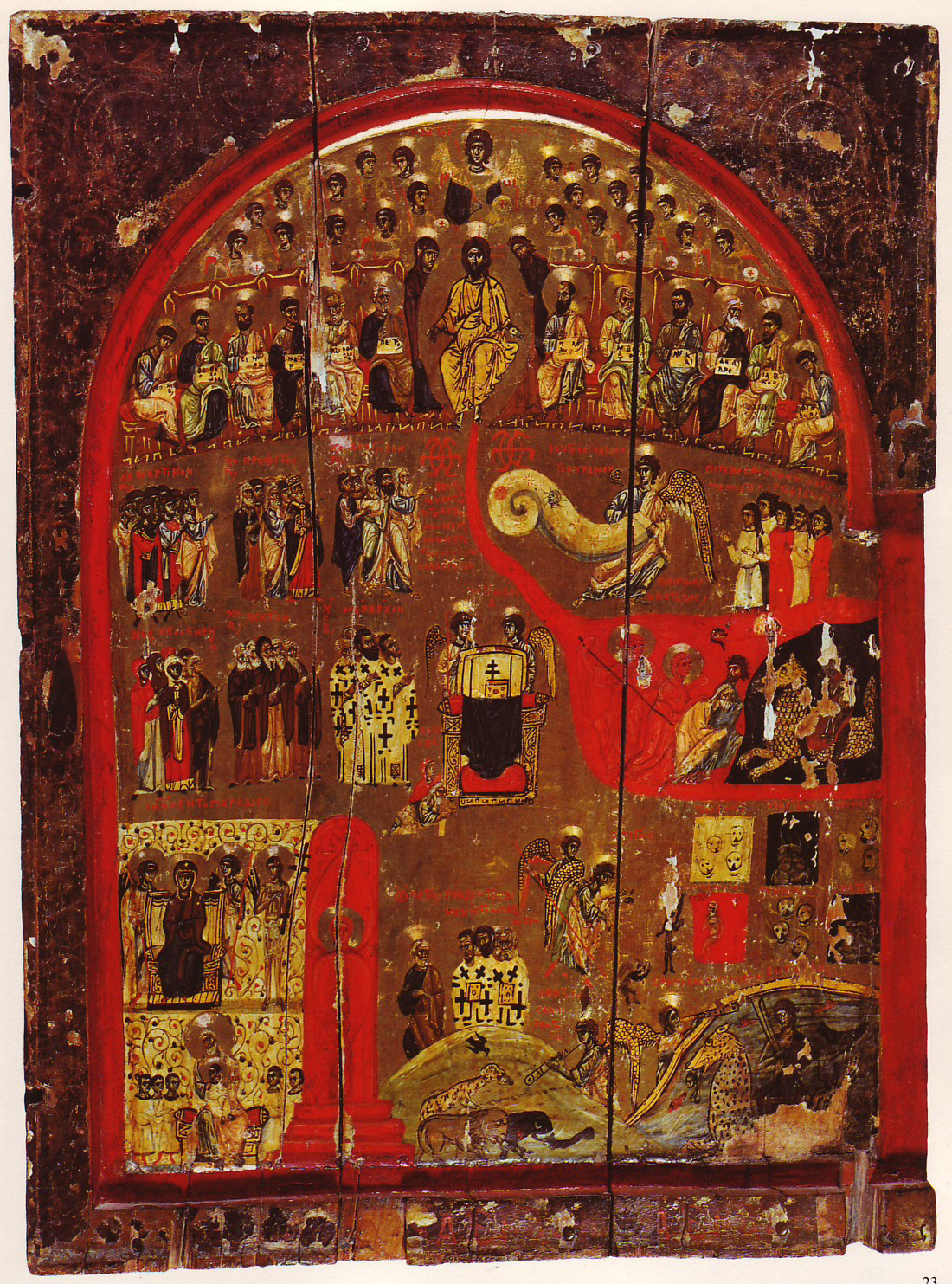
Last_Judgement_Sinai_12th_centuryA homily for Proper 22, Trinity 16, Year A Isaiah 5:1-7. Psalm 80:7-15. Philippians 3:4b-14. Matthew 21:33-46

Here is the prophet doing what prophets should do: speaking unpalatable truths. Here is Jesus doing what Jesus so often does: speaking unpalatable truths.

The kingdom of God will be taken away from you and given to a people that produces the fruits of the kingdom.

The Lord provides the means for the vineyard to grow good grapes. But it’s a bad harvest of wild grapes and so the vineyard is destroyed. The Lord provides the ingredients for the Kingdom of God. How do you respond? The Lord gives life. How do you respond? It’s up to you.

A gift is only a gift if you accept it as a gift. You have to stretch out your hands to take what is on offer. You have to respond. You have to act. Refusing to accept, refusing to act, amounts to rejecting what’s on offer. We throw the gift back in the donor’s face. We exclude ourselves from the generosity. Jesus talks about people being excluded from the Kingdom. The Lord does not exclude us, but by our standoffishness and refusal to dance to his invitation, we exclude ourselves.

I’ve been here three months now. A quarter of a year. I’m wondering how best we can thrive in the next decade or two. How best can we serve the town? Let us imagine that Our Lord comes here. What does he find?

  • He finds that a church built in his honour is locked most of the time.
  • If he comes at a time when the building happens to be open might see people who in world terms are reasonably well off. He might wonder how they serve the people of the town who are less well off.
  • He might notice that people seem to communicate with smiles that often hide inner sadnesses that they feel unable to speak of.
  • He might wonder how we tell each other of our deepest darkest fears, to allow the transformation of ‘the body of our humiliation that it may be conformed to the body of his glory’.
  • He might notice that the building is a temple to the past.
  • If he comes to a PCC meeting, he would hear that much of the energy and interest is with money, and with keeping the building looking as it did in the past.
  • He might wonder why all decisions are made by older people for a future that few of them will see.

Let us imagine that Our Lord now looks around Burton.

  • He might see a lot of people sitting alone watching a flickering box in the corner of the room.
  • He might see people at night around the church injecting fluid into their veins.
  • He might see men and women hitting each other.
  • He might see children being hit, and still going to school the next day.
  • He might see young people’s bodies being exploited for the sexual gratification of those who should know better.
  • He might see people knocking on Vicarage doors for food and drink, and sleeping outside in boxes.

Our Lord might look at all this, and look at us here in this building, and think, ‘ah, they come for spiritual refreshment so that they can go out into the world and be my ears, my eyes, my hands, my feet, and my mouth, to heal the sick, to free the captives, to tend the poor, to bind the lame, and to restore creation.’

Or would he? Would he hear moaning and criticism and Chinese whispers? Would he think that we come here simply to keep us happy in the prisons that we have made for ourselves, ‘inclosed in our own fat’? Would he perhaps think that our coming to this church for an hour or so once a week was a hobby like going to the gym, the golf club or the sewing circle?

We have some serious thinking to do about the future. At this time of year we know well enough that the harvest is plentiful only if the ground has been disturbed and seeds have been planted. Leaving things as they are means that soil becomes more and more stale, with the inevitability of death.

I would like to set up a Survive and Thrive group to get going with planning. Not a group that talks, drinks tea, and complains about the Vicar, but a group that gives serious consideration to what this church and church community must do, and how to do it. If you wish to serve on this group, write your name on the sheet at the back of church. I hope that someone might offer to convene this group—it needs to be run by someone other than me.

Vicars come and go, and initiatives and planning for the future have to come from you rather than be imposed by me. I’m embarking on trips to other town churches nearby to see how they do things. Stoke, Wolverhampton and Birmingham are fixed, and Tamworth and Derby are possibilities. If any of you would like to come along, please see me afterwards.

We have been given all these ‘talents’. What shall we do with them? The kingdom of God will be taken away from you and given to a people that produces the fruits of the kingdom

Living on borrowed food

importship_406Harvest Sermon 2014 by Mr Rod Prince

Can you remember where you were on 22 November 1963? Or 11 September 2001?

Where were you on 7 August 2014? It was not a notable day in most people’s diaries. It probably went unremarked. Nevertheless, it was an important date for the UK. If the UK relied solely on the food it grew, then supplies ran out on that day. The National Farmers Union have stated that despite our farmers being better placed to produce more food than at any time in the past our ability to feed ourselves has dropped 2% every year since 1991 to just 60%.

National problems and their solutions begin with individuals. Not only can we consume more locally grown food but we can also cut back on the food we waste in staggering quantities. Here are some figures: About 50% of the total amount of food thrown away in the UK comes from our homes. We throw away about 7 million tonnes of food and drink and more than half of that we could have consumed. Wasting food costs the average household £470 a year rising to £700 for a family with children.

If we stopped wasting food the benefit for the planet would be equal to taking one car in four off the road. The foods we waste the most are fresh veg (not if you grow it!) salad, drink, fresh fruit and bakery products. We throw away more food than packaging in the UK every year.

Before you become too depressed, the good news is that between 2007 and 2012 avoidable food waste reduced by 21%. Is there a link with the economic downturn?

To keep us going from 7 August until the end of the year we bring our food, out of season, from across the globe. Two years ago I played a game with some children at a harvest festival service. I told them that I had planned a valentine’s dinner for my wife. Being a child of the 70s it was prawn cocktail, roast lamb and an exotic tropical fruit salad washed down with a bottle of Australian wine. The prawns came from Bangladesh, the lamb from New Zealand and the exotic fruit salad from all over the globe. We went through the menu and they guessed where it came from and the distance from the country of origin to the UK. To reach my dinner table the food in the meal had travelled a total of 50,000 miles or twice round the circumference of the earth.

In “A picture of Dorian Gray” can be found the following quote “Nowadays people know the price of everything and the value of nothing.” Supermarkets bombard us with adverts and bogofs. Turn on the TV and it won’t take you long before you know the price of the bargains in store for the week. We know the price of everything from bread to strawberries but do we know the value of food?

This year our village Parish Council opened an allotment for the village. It is easy to see them as just another amenity, a place where people can indulge in a hobby, but the allotment movement throughout the country plays an important role in raising awareness of the value of locally grown food. As with so many activities in life it is not until you have undertaken it for yourself that you appreciate its value. If I offered the people on the new allotments twice the amount of produce in return for their home-grown produce I’m not sure that many would accept. When you invest something of yourself, your time, your care, your backache into growing some of your own food you begin to look at the food you buy in a different way. You begin to value not only the produce itself but the labour of those who produced it.

Harvest reminds us of the value of creation, its beauty, its fragility, its bounty and of our total dependence on it for our wellbeing. Harvest reminds us of the value of food; its importance in providing, not only essential nutrition but for promoting healthy relationships within families and communities. Harvest reminds us of the value of those who produce food for us no matter where they are in the world; of our dependence on them for our basic needs and their dependence on us for a just reward for their labour. Fair Trade is not about food it is about ensuring a right relationship with our brothers and sisters around the world. Harvest reminds us of our dependence on the grace of a loving, bounteous God who has provided enough resources for all; a God who creates, sustains and cares; who brings us into life and is there for us in the life beyond life.

Christians are called to live a life that rejects that assertion from Oscar Wilde. We are called, not to know the price of anything but rather to acknowledge the value of everything and everyone.

Let earth and heaven combine

MichaelA Homily for St Michael and All Angels 2014 by Fr Phillip Jefferies

Surely the Lord is in this place – and I did not know it! Genesis 28: 10-17. Revelation 12: 7-12. John 1: 47-51.

The Old Testament is often not a nice place to be. And Jacob, the younger twin son of patriarch Isaac, and Rebekah his scheming mother, are hardly nice people. Isaac, father of Esau and Jacob, could have been in the original Specsavers advert … the myopic shepherd who can’t distinguish between the sheep and his sheepdog and shears the lot. Isaac should have gone to Specsavers: with the connivance of Jacob’s mother he blesses Jacob instead of the older twin Esau, so Jacob gets Esau’s inheritance.

Jacob is not in a good place. Physically, he’s alone in a barren wilderness with only a stone for a pillow. Morally his position is woeful. However, Jacob has this glorious dream: a ladder reaching up from the cold and isolated place, where he is, up to glory of heaven. And on that ladder is a two-way traffic: angels going up, and angels coming down—and that is important to note. The ladder isn’t a way of escape, but provides, rather, an enrichment of the place where Jacob finds himself—enrichment with the angels of God, no less.

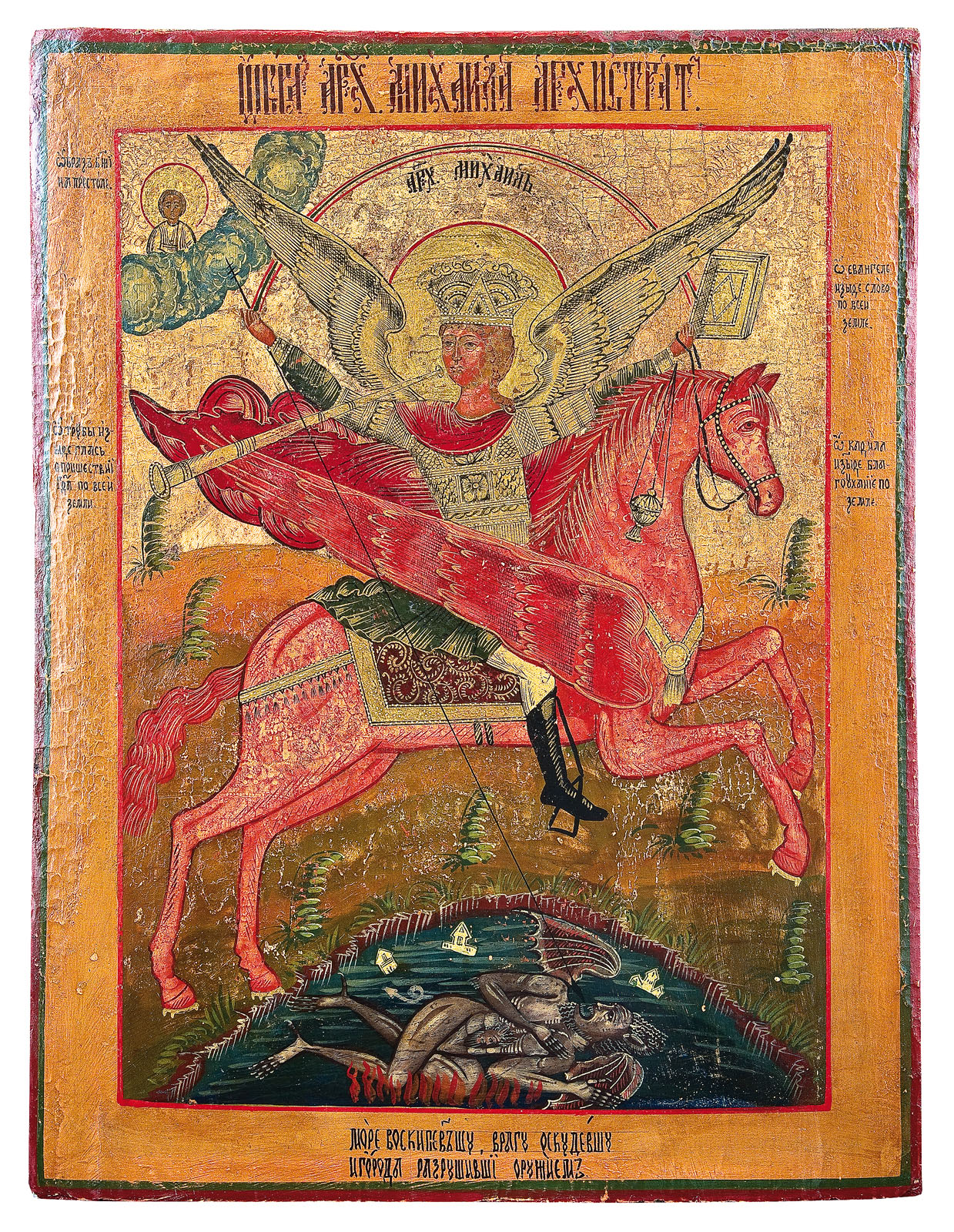
What angels do is announce the presence of God. Greek angelos = a messenger. You might think that they would get a pretty good press; there is, after all, that beautifully poetic description of Gabriel in the carol (The angel Gabriel from heaven came, his wings of drifted snow, his eyes of flame). Simon Barnes, in his The Bad Bird Watchers’ Guide begins with the robin, and describes its natural habitat: Christmas cards. We might give the same natural habitat for angels … or look in the north nave of S Paul’s, over there, at the glorious Archangel Michael, his wings spread wide, his lance striking home. He shall defend thee under his wings and thou shalt be safe under his feathers: his faithfulness and truth shall be thy shield and buckler! What could be more welcome, what could be more attractive?

But not so fast. What angels consistently generate in those to whom they go, however, is not safety—far from it: it is fear.

Mary, above all, is greatly perturbed by Gabriel’s annunciation. The archangel had to encourage her not to be afraid, as did the leader of the angelic choir that appeared to the shepherds watching their flocks by night. At the other end of the gospels, the various visitors to the empty tomb are thrown into turmoil and fear by the presence of these emissaries of God, these ambassadors of heaven; just as Jacob was in the Genesis story.

Why?

Jacob is between a rock and a hard place. Not just physicallycold, alone, with rocks for his head and his feetbut personally, for he has yet to face his elder brother whom he cheated, and suffer the consequences of his actions. Jacob has to face the truth. The ladder between heaven and earth is not an escape route from his situation, but it provides a sign that heaven will come down to him, and the truth will somehow set him free.

This hard-headed and down-to-earth understanding of the meaning of angelic presence belongs to a non-tacky celebration of our faith. God knows, there’s enough of the other: the sickly sweet escapist religion within easy reach, encouraging us to climb up, up and away from the rock and the hard place into the fluffy clouds of never-never land. But, this is not the land of Enid Blyton’s Faraway Tree; and, as the reading from the Book of the Revelation reminded us, there is war in heaven anyway, just as there is in all of us.

What we have to do is grow up in our faith and into confrontation with the truth, just like Jacob, and see that his ladder has its feet set firmly on the earth, not for escape, but so that angels can descend. We find our salvation where we are: the glory of heaven comes to earth – as it always has and as it always will.

Let earth and heaven combine, Angels and men agree, To praise in songs divine The incarnate Deity, Our God contracted to a span, Incomprehensibly made Man. (Charles Wesley)

Immanent and transcendent

1774716Some Burton church ‘leaders’ met yesterday. Of about 20 people there, over a half were from churches under the broad Pentecostal banner, with seven of us from the C of E.

Despite a rather self-congratulatory tone, it was impressive to hear of churches with big budgets and lots of people laying on programmes of social action, support groups, food banks and the like, that fill gaps gaping ever wider as the government obsesses about the Daily Mail vote (I wonder how many volunteers vote for the policies that result in the conditions they are volunteering to address). I hope, though, that there’s something more to church than being busy. If not, I’m doomed.

Five or six years ago I would have come away from such a meeting feeling inadequate. I’m blessed with faithful and lovely people but we certainly don’t have a critical mass of volunteers, though I know my parishioners give in their own sweet and quiet way to voluntary programmes throughout the region. And as for funds, the buildings more than eat up our money.

I was pondering this all afternoon. Then in the evening two couples contacted me about baptisms and a wedding at S Paul’s. They had been inside (we must keep churches open) and they had been ‘blown away’ by it. ‘A church should bring you to your knees’, said Sir Ninian Comper. And it does. Even if we humans are not active in the community, our buildings certainly are. Thank the Lord for those that built them, those that beautified them, those that handed them on to us. They may be long dead, but they’re still at work. I count it a privilege to have them in my care.

I can’t compete with the busy-ness of some churches. But I can have buildings open and available; I can be seen around town myself, open and available. It’s terrific that churches are able to lay on extensive programmes of social action, but if that’s all they do there’s something missing. The Immanent is all very well, but without the Transcendent, churches are simply an arm of social services.

We are privileged to be able to offer something else: the Transcendent. We offer space, silence, beauty, the numinous. In our worship we can offer a glimpse of otherness, a glimpse of heaven. And it is that that recharges the batteries so that we can go out and serve each other.

Like I say, once I would have come away from yesterday’s meeting feeling inadequate. But I’ve grown up a bit since then.

Do justly, love mercy, walk humbly

See the mascot?

See the Mascot?

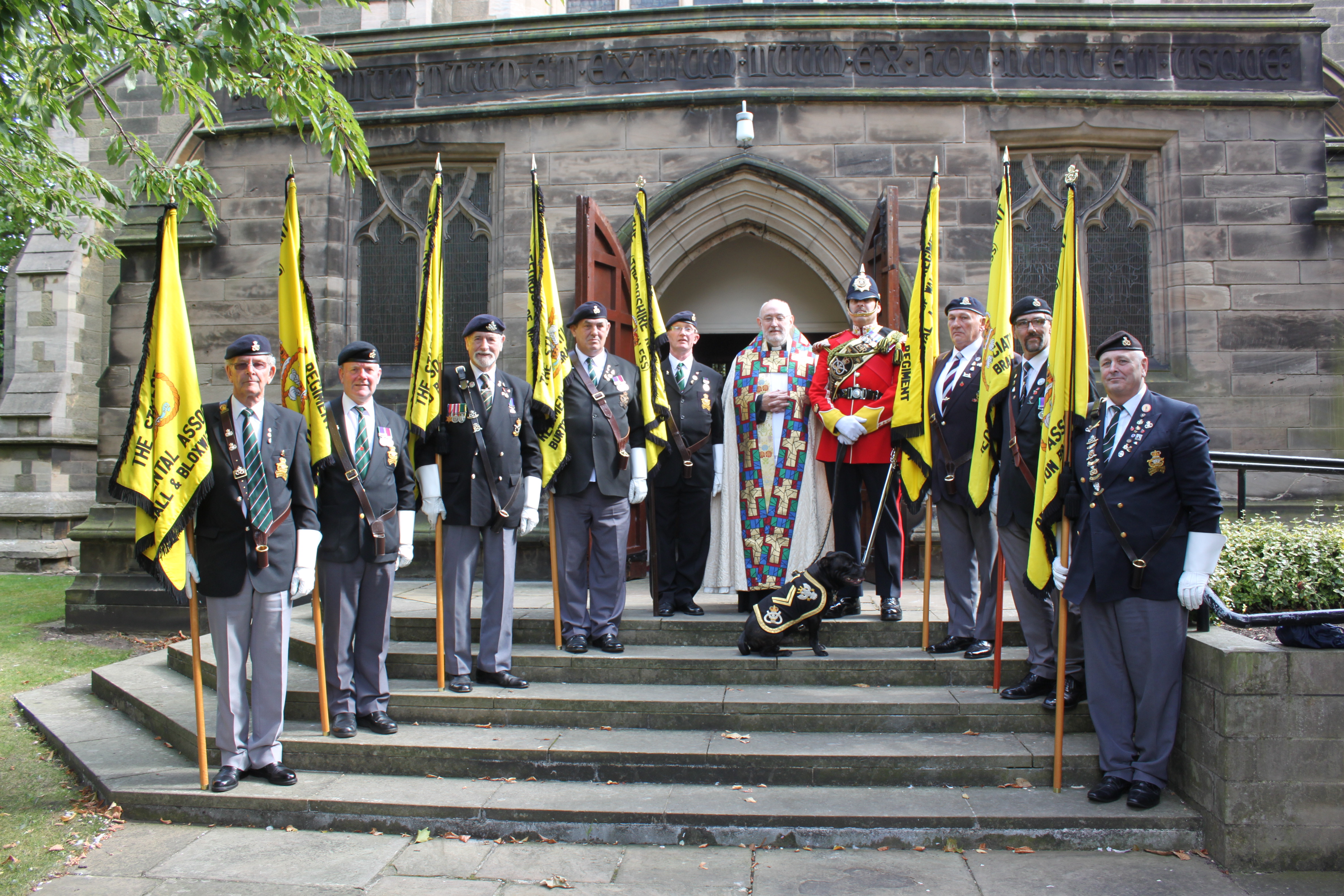
Homily at the Annual Commemoration Service for the Staffordshire Regiment at S Paul’s Church, Burton upon Trent, 13 September 2014

I have no military connexions other than a father-in-law who served in the Royal Navy, an uncle who served in the Royal Air Force and a father who served as a batman to a General in the British Army. Born in 1950, I am one of the pampered post-war generation who have never had to fight for anything and for whom everything has been free, including education to third level. What can I say to you who have served, to you who have suffered, and to you who have lost comrades, or confidence, or loved ones? What can I say to you who through your training learnt the hard way that personal preferences were irrelevant when you trained and worked together in the service of something bigger than you? What can I say to you who through all this were forced to think about justice and mercy, and who had a certain sort of humility drilled into you?

Although others have called me morally and intellectually courageous, nobody has ever called me physically courageous. I am a coward. I am always willing to stand right behind someone else, physically. So I need people like you who I can stand behind. I thank you!

Regimental Mascot

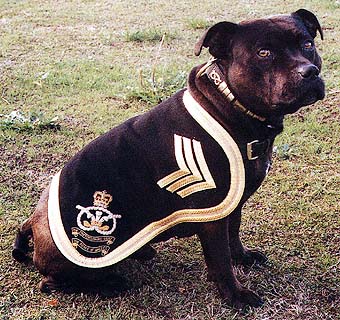
Regimental Mascot: he sings when we sing

I have been transfixed these last few Monday evenings watching the training of Marine Commandos. It is wonderful to see how in the service of something bigger than themselves these young men learn about justice and their attitudes to it, men who see by example when mercy is called for, and men who learn that their own preferences and desires count for nothing when it comes to the wellbeing of the troop. When one of the company failed in an exercise there was none of the derision that I suffered in PE classes in school, but rather a remarkable level of sympathy and support. You might even call it prayer.

All this has obvious biological parallels in the cooperative communities of creatures like ants, termites and marine invertebrates, where each individual knows its place in the big scheme of things—a scheme of things that to each individual must surely be incomprehensible, but which must, one supposes, be hard-wired into what passes for a brain.

You men know what it is to have to put your ‘self’ aside for the sake of something bigger. In the church calendar, tomorrow we celebrate the Holy Cross. There is a tendency to think that the death on the cross is only about what happened 2000 years ago. This is nonsense. It is of course about that, but it is also about what happens every moment of every day as we gradually realize that the energy we spend in trying to be individuals yields altogether more wonderful fruit when we divert it into trying not to be individuals—when we give up ‘self’ for the sake of something bigger. That is what happens in your military training. At some point in the pursuit of individualism we will ‘hit the wall’, and, as in training, we can, if we set our face to it, break through into resurrection life.

Commemorations such as today’s are ambivalent occasions. You know people who were injured, you know people who are still suffering, you know relatives who suffer, you have comrades who were killed. But you know the excitement, the comradeship, and the singleness of purpose as many hands are put to the plough.

I know some of you, having been at home in community, find it difficult upon leaving to cope with the individualistic society that you find yourself thrown into, but I hope most if not all of you can look back with satisfaction on what you learnt in training together. Young men these days lack opportunities like this. There is nothing, or very little, set apart for them. We have organizations for women only, and women are certainly encouraged to be women, but men aren’t allowed to be men, from early childhood onwards. Schools and society tend to emasculate. Society needs more opportunities for men to be men—I’m not talking about boorishness or the dreadful hail-fellow-well-met insincerity of golf-clubs where ‘you scratch my back and I’ll scratch your BMW’—but opportunities for the naturally occurring testosterone to be expressed in male bonding, adventure and service.

You, gentlemen, have a wonderful opportunity to help today’s young men to learn how to be men, and to learn the benefits of working for a cause that is bigger than any individual. That perhaps is your job now: to show others how to do justly, love mercy, and walk humbly.

Once again, I thank you and I commend you in your service, past, present and future.

Doctrine of the fall

The fall

The fall

Ladies ‘fall pregnant’. Why? It’s a curious conjunction of verb and expectant adjective. Today’s Church Times describes Sinéad O’Connor as falling pregnant. Is it like Breaking Bad? What or where do they fall from? Do they fall onto something, or into something? Is it like tripping on the pavement and falling onto something they’d not noticed? And are they pushed?

Fr Richard Rohr uses the expression falling upwards to signify that only through falling, a kind of crucifixion in which one sheds one’s ego-driven obsessions, can one ascend to the heavens. Is this what happens to ladies who fall pregnant? I know that motherhood, like apple pie, is a state of grace, but am not clear why ladies fall into it. Is it like leaves falling after a glorious display?

Yet another of life’s perplexities.

Post script. SWMBO tells me that I should change ladies to women.