Acceptance

Homily given in SS Peter and Paul (RC), Portlaoise, at the Vigil Mass for the Fourth Sunday in Advent

It’s a pleasure and delight to be here tonight to bring to you warmest Christmas greetings and blessings from the people of St Peter’s. And personally from Susan and me, and especially to Fr John and his colleagues here. Whether they know it or not, they are a great source of advice and support for me, and I treasure that more than I can say.

In the Church of Ireland, of course, we use the same lectionary as you, so like you this weekend we celebrate Mary the Mother of God. My very short message to you is kind-of biological. By the simple act of saying ‘yes’ to the Lord’s invitation, Mary allowed the infant Christ to grow in her belly for nine months. Just think how we can be transformed by that same simple act – saying ‘yes’ to the Lord’s will.

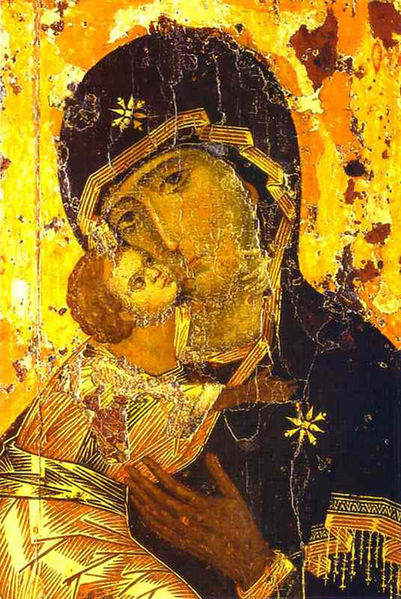
VladimirIf we can be transformed, then think how much the world will be transformed.

Christmas, when you strip away the gooey stuff, is a festival of childlikeness. Not childishness, but childlikeness. Think of the newborn Lord: open, trusting, dependent, straightforward, without guile. Just think how the world could be transformed if we were all like that. ‘Transformation to the kingdom’ is for me is the real Christmas message. This is the festival where heaven meets earth, and prepares us for being taken there ourselves.

Discerning the Lord’s will is not an easy exercise when we have to cope with all the ‘noise’ and distractions that the world throws at us, but as the Nativity shows us, the Lord is with us in our mess, just as he is in the mess of the stable. God bless this mess.

As we sing in one of the Christmas Carols: O holy child of Bethlehem, be born in us today. Let the Divine light within grow to en-lighten us from the inside out.

Prophets

skinnerpointingWhat do you expect of a man who lives in the wilderness? Someone dressed in posh frocks and smells of roses? Get real.

Walking to the Rectory from church the other night: ‘Father, can you help me?’ Can you guess what’s coming? A child in hospital, a mother dying in Dublin, needs money for bus fare, food, accommodation. Yup, spot on. All of ’em.

This is common enough. He might be telling the truth. Shall I look at his teeth for signs of crystal meth use? Shall I ask to see his forearms for signs of needles? Will anyone visit me in ITU if I do? I think: ha, I’ll see if a few questions will catch him out. Where does he live? Which hospital in Dublin? Has he been to social services? (What social services? you may well ask.) But I know there’s no point asking questions. I am naïve, he is smart. Anyway, who am I to judge?

Of course, I part with money. He goes off: a small victory for him. I’m tired, and there’s something on the box in two minutes, and for a moment I’m relieved. Then the nagging guilt: I should be doing more. I can’t blame him: what do I expect from someone who hasn’t been dealt the same cards as me?

—————

A phone call from prison asking if a man could put my number on his phone card. Again, common enough. Yes, of course. Next day I had a call from the gentleman who asks me questions about the C of I – are we Presbyterian? (No, but congregations behave as if we were!) What do we believe? (Ye Gods! What do we believe?) Can I change religion? (Why?) Will you come and see me? Of course I will.

I’m uneasy, not least because the exchange doesn’t conform to my expectations of a conversation with someone I’ve never met. And I’m left from childhood with a wariness of people not like me. Then I think, what do I expect from someone with a different view of society who has not been dealt the same cards as me?

—————

Like the people who gather on Coote Street waiting for their drugs from the clinic, and like the people who chuck used needles and syringes over the Rectory wall, just down the street, these men are prophets.

Prophets make us uncomfortable. Prophets say what others dare not. Prophets reveal our values. Journalists like Veronica Guerin, killed for her trouble. Journalists who report the Dublin ‘poor’ given an extra €135K from donated money to top up a salary of €116K (and we vote for people who turn a blind eye).

It’s not just about what happens ‘out there’. It’s about ‘in here’ too—the John the Baptist that lives inside my head and nags insistently when I go for the easy option, like handing over money and thinking that the problem is dealt with. It’s not dealt with at all—it’s compounded.

Prophets force me to judge myself: have I ordered my life to attend to what is most true, most important, most essential?

And if not, what will I do about it?

Advent reflection

UntitledLook at some details of the Christmas story: virgin birth, in Bethlehem, from Nazareth, descended from David, shepherds, stars in the sky, born in a manger, animals.

Now some postnatal events: men from the Orient led by a star, flight to Egypt, massacre of the innocents, presentation in the Temple.

That’s enough to be going on with. Every single one of these details has resonances with Old Testament writings. You could say:

  • ‘how clever of prophets, centuries before, to be right about what would happen.’
  • ‘how clever of God to listen to prophets, and arrange things so.’
  • ‘how clever of Gospel writers to manipulate the story so that prophetic comments can be interpreted as having come true.’

It’s striking how people obsess about detail but miss the big picture. Not one of those details listed above matters. They’re colourful and fun, but that’s all. The Christmas story is, big picture, about renewal, and the power of powerlessness. End of. That’s what the resurrection/ascension is about too. In fact, that’s what Christianity is about.

One of the reasons I like Advent is because of the sense of yearning for renewal. Homecoming. ‘O come, O come.’ To quote a friend: ‘I yearn to be a person who is better able to bring the qualities I see in Jesus into the world. I yearn for a better world and for the ability to make a contribution to it.’

Renewal comes when we put the past behind us, mistakes and all, and start again, in hope. As Queen Elizabeth II said in Dublin in 2011, ‘With the benefit of historical hindsight we can all see things which we would wish had been done differently … or not at all.’ We’re all in that place.

Renewal is about forgiving and being forgiven. The Christmas story is about renewal for you and me that comes when we give up the search for certainty, we accept that we, like infants, are powerless, and fall back on what Christians might call the Divine will. ‘Be born in us today.’

Never mind that the Nativity story is probably entirely fictional—it’s fiction with meaning. Our lives are messy like a stable, at least mine is, with all sorts of smelly impedimenta cluttering the place up. We have to start from where we are, and that means letting go of where we were, or used to be—and of where we would like to be.

We forgive. We are forgiven. We move on, naked and powerless.

Lost and found

prodigal_son3Exodus 32:7-14; 1 Timothy 1:12-17; Luke 15:1-10.

I suspect many preachers will use these texts to exhort us to seek out and tend the hungry, the homeless, the poor, the destitute. And so we should. But I think there is something else too.

These are stories of restoration. They come before that most moving tale of restoration – the man with two sons, the gracious father, the so-called prodigal son. Another story of lost and found. One son is lost in recklessness and wilfulness, the other in envy and resentment. The gracious father welcomes the wanderer home, and is ready to ‘welcome’ the sulker back to grace.

Homecoming is the theme. Homecoming is what Christianity is all about: forgiveness, shalom, reconciliation, restoration.

Getting lost, however distressing, is necessary. We can’t seek something until we realize that we’ve lost it. We need to miss something in order to welcome it home. Although we’re often like the a-wandering and a-squandering son, and often like the begrudging son, we need to move beyond them, and  become the father: compassionate, welcoming, forgiving. This is how we find eternity and peace – when we are ready to welcome back home.

And what is it that we need to welcome home? What is it that, like the shepherd and the woman, we need to seek?

I wonder if inside each of us there is something that we think we’ve lost. Maybe we begin to realize that there is part of us that we’ve covered up with fig-leaves of pride, arrogance, and the certainty that we are right. It was never lost, of course, just hidden from view. The sanctuary of the soul. If only we knew it, what we seek is what we already have: the Divine within. We can’t reach this inner self unless we have been lost. We re-turn, and return as we strip away the leaves of amour propre, the dignity on which we are so ready to stand.

I suspect that nearly all our spiritual sickness comes from trying to bolster up a false self-image, together with a sense of guilt or shame about it. We’re reluctant to accept ourselves as the maimed creatures we are. When we acknowledge that we are imperfect, and see the full extent of our imperfections, we come home. We find ourselves. We relax into ourselves. When we confess our sins, we feel great liberation, a great sense of being at home.

I turn with groaning from my evil ways, and I re-turn into my heart, and with all my heart I turn to thee. God of those who turn, and saviour of sinners, evening after evening I will re-turn in the innermost marrow of my soul. (Lancelot Andrewes 1555-1626)

In today’s stories about lost and found, and in Exodus, we are assured that the Lord is never indifferent. The shepherd seeks out the lost sheep and brings it home. The lost sheep is part of self. We are no use to anyone, least of all ourselves, unless we recognize our own need for homecoming.

Coming home to the Divine. Through re-turning we return to the divine by surrendering.

Trust and be silly

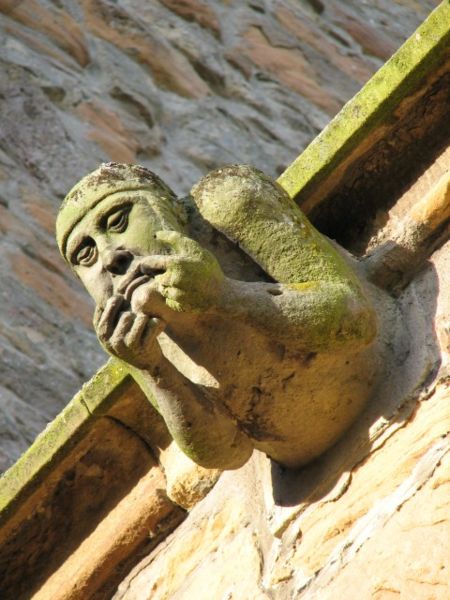
450px-Gargoyle_Dornoch_CathedralThe weekly sermon. It’s relentless, What can I say that I haven’t said before? I vowed I wouldn’t say anything that wasn’t true for me. Aaaargh!  Then, as I was pondering, an idea came into my head. The pondering took place, as it so often does, in what people call the smallest room of the house. There are sound biological reasons for this, by the way, and they involve the Vagus (tenth cranial) nerve, which is part of the parasympathetic nervous system that has to do with, among other things, relaxation and the opening of sphincters. I suppose I’d better stop there, but there’s a piece in a recent New Scientist that explains a bit more. (Or you could read my textbook on Cranial Nerves.)

The thing that came into my head was an image of David and Goliath. I’m not quite sure where it came from, but anyway came it did. David the lad versus Goliath the hero. And David killed him. They weren’t expecting that. What sticks in my mind is an easily missed detail in the build-up. Saul gives the young David all his armour because, presumably, he thinks the boy David has no chance without it. David tries it on and says ‘no thanks, too heavy, I can’t move in all this clobber, I’ll be better without it’. That’s the part of the David and Goliath story that I find arresting.

No armour. Armour is heavy and limits movement. The armour that we cover ourselves with consists of things like preconceptions, assumptions, prejudgments, notions. We spend a lot of time trying to make sure that our lives will be predictable so that we don’t have to move within our inflexible ‘armour’. We try to manipulate people so that they do things that we can cope with. We want to feel that we’re in charge. The trouble is that if we’re in charge like that, we’re not open to inspiration, we’re not flexible, we’re not responsive to changing needs. Think how many businesses go under because they are not responsive and so can’t cope with change. It’s just the same.

If we are to live, as opposed merely to exist, we need flexibility. We need to resist the temptation to dress ourselves in restrictive armour: David ditched ‘all this clobber’ and marched off to meet Goliath full of confidence that since he could deal with lions and bears that attacked his sheep, he wouldn’t have any difficulty in decking the big man. And he was right. We need to take the risk, like David did, of stepping out without conditions, restrictions, safety nets, assumptions, efforts to manipulate. In Christian-speak you’d say that the Lord wants us to trust him enough to live with him unafraid, totally defenceless in his presence. The ancient Greek word for this is pistis, and in Greek mythology Pistis was the personification of good faith, trust and reliability. Pistis is the intellectual and emotional acceptance of a proposition. It’s a decision. Faith is a decision. We decide to trust.

Trust in the uncertainty of life. Trust not to be fearful of possibilities. Work with the cosmos, don’t fight it. Part of me would love to fight with the silliness of the institutional church and institutionalized people in it, but there’s no point. Let them at it. For us all, it means working with what we’ve got and enjoying it while it lasts. And if it goes before we do, we work with something else rather than moan how good things used to be—an empty-headed activity according to Ecclesiastes (in the Bible so it must be true). Let go of trying to control. Let go of what ‘I’ want. Let go of ‘ego’. ‘Do not be afraid’. Step out, be ready, be alert to possibilities, be responsive. This means having faith in, trusting in, our own personal ability to make decisions as circumstances arise. In my theology, this means making contact with, and having faith in, the inner divine core, the boy David within each of us. This brings us on the road to holiness. At Christmas we sing ‘O holy Child of Bethlehem, be born in us today.’ We can sing it every day.

Life is messy and unpredictable. Despite what anyone may tell us, or what we in the privileged West may think, we are not in control. We simply don’t know what’s around the corner. Acceptance of uncertainty is the key to living in the moment, and living in the moment is the key to eternal life—eternal being a quality of life outside time, not everlasting. When we acknowledge our powerlessness, and discard attachments, there is nothing left for us to stand on our dignity about, so pride (hubris) goes too. Think how much better the world would be without that sort of pride, based as it is on the notion that ‘I’m better than you’.

I know—this is hard. I say these things not because I’m good at them, but because I’d like to be. But we’ve got to start sometime, and the right time is always now, before it’s too late. Bronnie Ware, a nurse working in palliative care, recently wrote The Top Five Regrets of the Dying, based on her experience. Here they are (my summaries, not hers):

  • I wish I’d had the courage to live my life rather than the life others expected of me. Most people die knowing that their lives have been limited by their choices.
  • I wish I hadn’t worked so hard. This came from every man the author nursed. It is true for me. I missed a good deal of my children’s youth and Susan’s companionship.
  • I wish I’d had the courage to say what I felt. Many people don’t say what they think in an attempt to keep peace. They settle for a mediocrity. The frustration, bitterness and resentment that build up inside can cause heart disease and cancer.
  • I wish I’d stayed in touch with friends.
  • I wish I’d let myself be happier. Happiness is a choice. Misery is a choice. People stay stuck in old habits. Fear of change makes us pretend to others and to ourselves that we are content, when deep within, we long to laugh and be silly. There is not enough innocent silliness in this world.

So there you are! Ditch the notions. Trust in uncertainty. Be silly.

Proper 14, Year C

Simple

Layers

Layers

Homily for 4 August 2013 (Proper 13, Year C)

Ecclesiastes 1:2, 12-14; 2:18-23. Psalm 49:1-12. Colossians 3:1-11.Luke 12:13-21

Simple.

Not simple as in lacking, stupid, inadequate, unsophisticated, not quite all there. Not that sort of simple, the sense in which the word is often used. A somewhat derogatory meaning.

But simple in the way that it is properly used. In Latin, simplex: single, whole, having one ingredient, plain. Simple in the way that mathematicians and philosophers use the word: indivisible, incapable of being splintered—the opposite of diabolical. Innocent, modest, free from ostentation, unmixed.

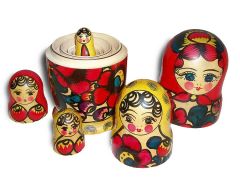
Here is an image of our psychological development. We begin simple and whole in the Garden of Eden. We see the world around us and begin to make judgments. We begin to clothe ourselves with finery (fig leaves) to make ourselves look more and more impressive. We surround ourselves with layer after layer, like a Matryoshka doll. Each hurt brings more and more scar tissue. We become heavier and more complex, weighed down, more and more rigid, less and less adaptable. There’s more to break down. Like electric gadgets in the car, they’re more difficult and more expensive to fix. The opposite of simple.

Simple is a beautiful word. A restful word even.

It’s easy to read today’s Gospel story as if it were about redistribution of resources. I am nervous about preaching such a message because it soon sounds sanctimonious: look how good I am because I ‘graciously’ give my stuff away. When I attack the mega-rich, it sounds suspiciously like envy. The Archbishop of Canterbury recently said that if he’d been working in the financial services he couldn’t say that he would have behaved any better than the sharp suited barrow boys who’ve got us into this mess. And neither could I. As has been said: ‘it is possible for the rich to sin by coveting the privileges of the poor.’

We live in a society where governments and the advertising industry encourage us to indulge ourselves with what we don’t need. The Lotto! How would you deal with winning millions? Go round the world? Buy this and that? Buy posh clothes? Eat and drink fine food and wine? So what? After all this, you are the same you, but now with new sensations behind you. Your quest for new experiences—for that’s what it is—means that it’s now harder for you to experience the same degree of novelty. You need more and more of whatever it is to get the same degree of stimulation. There’s plenty of biological evidence for this: the biology of addiction. The more we have, the more we want. This is greed. It becomes dangerous for the community when we wilfully accumulate so that others are deprived. We possess – a terrible word. We think we are self-sufficient. If we have enough in the barn, we won’t need anyone else. We become lonely and paranoid. Greed shows a lack of love and trust.

Psalm 17:10: They are inclosed in their own fat and their mouth speaketh proud things.
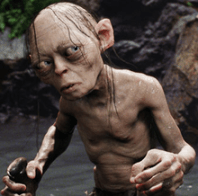
My precioussssss

My precioussssss

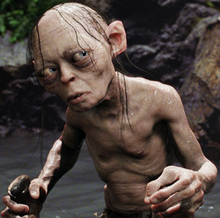
It seems to me that today’s gospel story is not about renunciation, though there is plenty in Jesus’ message about exactly that. Today’s story seems more about how to cope with good fortune. It’s not about giving it away: it’s about sharing it. By sharing we demonstrate our connectedness, our not being separate. The Good Samaritan shared his wealth. When we keep things to ourselves we become wizened and twisted and consumed, like Gollum. We become being inclosed in our own fat, behind electric gates and security fences.

The alternative is to stop trying to accumulate goods and feelings and emotions. Simply exist and enjoy. Simply. Living with trust, directed towards the Divine, reminds us that there’s no point thinking that possessing more and more will  make us immortal and invincible. Let’s share what we have—time, talents, money—before it’s too late. That’s what the men in today’s story need to be doing.

St Paul recommends that we kill everything that belongs to the earthly life, especially greed, which is like worshipping a false god. To attempt to keep possessions and memories locked ‘in a barn’ is like chasing after wind. Vanity of vanities. We can not recover the feelings we once had, we can not find the same stimulation we once found. All passion spent. This is a great blessing: I can relax. It doesn’t matter what I have or what I’ve done. What matters is who I am and how I share what I am.

A rich woman dies. Where there’s a will, there are relatives! How much did she leave? She left everything.

In our lives we move from simple to complex and hopefully to simple again. The wisdom of age.

‘Tis the gift to be simple, ‘tis the gift to be free
‘Tis the gift to come down where we ought to be,
And when we find ourselves in the place just right,
‘Twill be in the valley of love and delight.
When true simplicity is gain’d,
To bow and to bend we shan’t be asham’d,
To turn, turn will be our delight,
Till by turning, turning we come ‘round right.
I want to be alone

apple-and-snake_1280x1024_2988So you’re in the Garden of Eden, right, and you’re watching the drama of Adam and Eve unfold, with the talking snake and the scrumping of apples. There’s something very strange. The snake talks to the woman who seems to be alone. The big question is: where is the man? We’re told that Eve was created from Adam’s rib, surgery having been performed while yer man was asleep. Biologists have recently managed to grow rudimentary teeth from cells in human urine, so I suppose the woman-from-rib story has something going for it even if cell biology labs in the Garden of Eden weren’t like the ones we have now. A different version of the story from Hebrew literature goes like this: when the Holy One created Adam, the creature had a female aspect facing one way and a male aspect facing the other. The Holy One then sawed the creature in half giving the (now two) creatures a back for one part and a back for the other. So both man and woman were created from a hermaphrodite first creation. Now, that’s more likely, isn’t it? It explains why men and women see things differently—they look in opposite directions, the push-me-pull-you. Anyhow, back to the question: where was Adam? Well, it’s universally acknowledged that men make more fuss of being ill than women, so he was probably taking longer to recover from major surgery than Eve, thus unable to engage in intercourse with the snake. On the other hand—and I think this much the more likely explanation—he was where any self-respecting man would be: hiding from the missus in his garden shed.

Up to now, gentle reader, you might think I’m taking the micturition (though the Hebrew commentary story is authentic). But I have a serious point to make, and it’s this. We all need time alone, and men in particular do. As we get older, we need our solitude more and more. It’s an unfortunate fact that in today’s world success is judged by ‘outgoingness’ and extraversion. The go-getters and self-publicists are rewarded, and the more retiring folk are not. We are required by economic demands to join in the culture of back-slapping hail-fellow-well-met seminars and team exercises and confrontational ‘discussions’ at meetings where testosterone wins. For many of us, this is a real effort. For those of us whose energy comes not from company but from solitude, it’s exhausting to play at being an extravert for any length of time. After a while we long to back home with a book or listening to music or whatever. In my case, my groove on the sofa sings a siren song.

I never said, 'I want to be alone.' I only said, 'I want to be left alone.'

I never said, ‘I want to be alone.’ I only said, ‘I want to be left alone.’

The terms extravert and introvert are used for, respectively, those whose energy comes from interaction with others, and those whose energy comes from rich inner resources. Many of us who seem to be extraverts are actually introverts who have learnt to put on an act as required. And I’m pretty sure that there are more introvert men than is commonly thought.

In my former career, I was disturbed to find important decisions being forced at the meetings at which the issue had first been raised, thus without considered reflection. The idea that we might defer decision until we’d had time to think about the issue was derided as indicating a lack of purpose and courage and commitment. People in power tend to be extraverts—after all, they do better at interview, are better at selling themselves, and are more likely to charm interviewers. And so the cycle perpetuates itself.

A new book Quiet by Susan Cain explores this issue. The author points out that the world needs introverts. We need people who say ‘just hold on a minute, we must think about this’. We need people who don’t just rush into decisions without considering implications.

Our culture makes it easier, I think, for women to recharge than for men. Boys and men who like to be alone, who have solitary pursuits, are looked upon strangely. They are urged to ‘come out of their shell’, to ‘pull up their socks’, to ‘stop shilly-shallying’, to be more like your cousin ‘who climbed Everest when he was six’. This displays more than a little intolerance. It’s not easy for anyone, let alone a child, to say ‘this is me, you will have to accept that I’m not the person you’d like me to be—I am as I am.’

As Susan Cain says, it’s time that we acknowledged the value of introverts. Without them we would have no theories of gravity and relativity, a good deal less technological innovation, and next to no music, art and literature. With more of them I suspect we’d have had far fewer disasters caused by impulsive risk-taking.

Science and self

451px-New_Scientist_6_Feb_2010New Scientist has jiggled my little grey cells recently.

You are not alone

We have creatures living in us and on us. We’d die without them, especially the ones in the gut that help us digest food. Some of them are not good for us, though, and these are parasites. They take, take, take—there’s no give with a parasite. Did you know that parasitism is the most popular lifestyle on Earth? Up to now you may have thought it confined to adolescents who lie moping on the couch all day. Some of you may have, or have had, personal experience of this curious parasitic life form that lives at the expense of its host(s). Perhaps you harbour the wish to turn the tables and one day, in your dotage perhaps, become parasitic on those who treated you as their host. We can all dream. You may have seen parasites in or on your pets. You may even have them yourself: worms and malaria for example (if so, hopefully now recovered). Anyway, the point is that you and I are never alone.

Depression

Sometimes it feels as if we have parasites living in our minds. They suck well-being from us. They used to be called demons, but now we call them other things. One of the commonest is depression. At least 1 person in 6 has to deal with this some stage. It seems that the most popular antidepressants are not as effective as was once thought. Or perhaps it’s better to say that drug-resistant depression is on the rise. New treatments involving magnetism and electricity (not the old-style ECT) are being investigated. If brain waves can affect the external environment—and they can, otherwise EEG/EKGs wouldn’t work—then magnetic and electrical forces might affect the brain. Perhaps someone some day will explain to me exactly what magnetism and electricity are. The anaesthetic ketamine might also have its uses. Indirectly it helps nerve cells in the brain to grow new bits and pieces—which is a good thing for depressives. So maybe depression is not only a chemical thing, but also a structural thing—the shape of nerve cells is affected in depression. Then again, there’s the moon. It’s reported that the full moon makes people edgier. Well, if the gravitational pull of the moon can affect the oceans, might it not also affect the liquid in and around the brain, and the brain itself which is really quite jelly-like? Perhaps someone some day will explain to me exactly what gravity is.

Methane

Huge amounts of methane lie just below the Arctic sea. Melting of seabed ice means that there could be a gigantic smelly belch any time soon. That would bring global warming forward by over 30 years and change the face of the planet: sea levels, climate zones, malaria risk areas … a long list. Human activity might have nothing to do with it: the leakage of methane from this area is nothing new and could have been going on since the end of the last ice age.

So what?

Yellowstone

Yellowstone

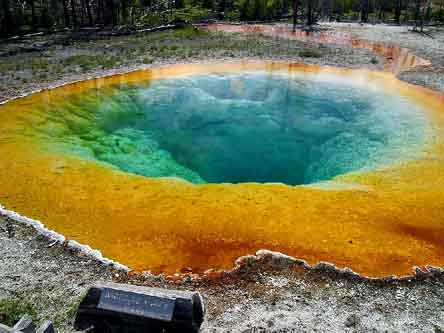
The earth does not revolve around you or me. In time-terms, the ice age is but yesterday. It will come again. The earth will do what the earth has to do, and we can not stop it, even if that means a gigantic arctic fart next month, or a catastrophic eruption of the Yellowstone caldera. Microbes will do what microbes have to do, and we can not stop them, even if that means MRSA and/or bird flu epidemics decimate the human population next year. We are not in control. Not one of us. The sooner each one of us comes to terms with this, the better. Actually, it’s liberating, for it means that there’s no point fretting about the future so we might just as well work with the here-and-now–which is what eternal means anyway: out of time, in the moment.

Each one of us is no more than a collection of memories, feelings, and illusions—or more likely delusions—about ourselves. If we keep inflating our balloons, at some point they will burst. If we recognize our own powerlessness and frailty, we are not subject to illusions about them, or about the pride that causes us to think ourselves better than others. Ego-self is illusion. St Paul calls it flesh. Letting go of it is what the crucifixion is about. To love my life is to lose it—the self-centred ego, the me, me, me. Losing this means stepping into the freedom of resurrection. Liberation comes phoenix-like after destruction. This is the truth of all religions worthy of the name. We can rise only if we have fallen.

It’s been said that the principal job of the priest is to prepare people for death. So here you are, boys and girls: sooner or later you’re gonna be dead. All your self, your hurts, your trophies, your notions, your targets, your money in the bank … none of it matters. Vanity of vanities, saith the preacher; all is vanity. Meaningless. It doesn’t matter how big your grave is, how well-tended it is, how often it’s visited, or how large is the plaque erected in your memory.

Reading about science reminds me that, as I pointed out here, we are creatures of this earth. No more, no less. We’re in partnership with the cosmos, not opposition to it. So work with what you’ve got and enjoy it while it lasts. And when it goes, work with something else.