I love all beauteous things

CarlBoss

Eyes that see shall never grow old

At last, Herbert Howells speaks to the sanctuary of my soul. Or, more truthfully, at last his music has penetrated the fat inclosing it.

Over the years, I’ve thought and said some dismissive things about Howells. That when you’d heard one of his Evensong settings, you’d heard them all (like Haydn String Quartets, and Palestrina Masses). That his organ compositions were little more than quiet-loud-quiet or loud-quiet-loud. That—ye Gods, how I am ashamed of this—he never let go of the death of his son. Mea culpa, mea culpa, mea maxima culpa.

It’s tempting to say that his loss released energy in his work that speaks to my loss. But the Requiem that I now find so poignant was written in 1932, three years before his bereavement. Howells certainly channelled his grief into creativity, but early compositions speak to me just as powerfully, so there is something more than the outworking of his grief that penetrates to my Holy of Holies.

I wonder what it is. Is it perhaps no more and no less than the pursuit of beauty?

I found beauty in the early 1960s in Carlisle.

The biology teacher shouts “don’t you know which side your bread’s buttered?” when I bare my soul about music or medicine. The organ teacher borrows money from my parents, so can hardly encourage me to go against their wishes. I finally let hold of my grip in 1972 when I went to medical school. I don’t think I’ve ever recovered from that loss. I’ve been chasing and mourning it ever since. Is my addiction to the church merely a vain attempt to cling to that first love?

Today I’ve discovered Howells’ I Love all Beauteous Things written in 1977. Like the anatomist’s knife it slices open my insides in one stroke. It exposes my soul to the world. An unprotected soul is mortally vulnerable, but better wounded than icy, for the wounds do the work. Gerda and Kay in The Snow Queen, different parts of me, tears of love melting heart of ice.

We see events in the world that demonstrate, yet again, the three groups of demons (addictions in modern parlance) that Evagrios in the fourth century AD identified as responsible for the ills of the world: “those entrusted with the appetites of gluttony, those that suggest avaricious thoughts, and those that incite us to seek the esteem of others. All the other demons follow behind and in their turn attack those already wounded by the first three groups.”

“We cannot solve [the attacks in Paris] problem only through prayers. I am a Buddhist and I believe in praying. But humans have created this problem, and now we are asking God to solve it. It is illogical. God would say, solve it yourself because you created it in the first place.” These words of Dalai Lama shout at me.

Take responsibility for your actions: your overeating, your overuse of antibiotics, your exploitation of other people, your consumption of natural resources … Face your grief for your sins, and for the hurts done by others. Then your tears will flow. Tears that come from the heart: herzwasser. The woman’s herzwasser that washes Jesus’ feet. Herzwasser that flows when we are forgiven, and when we forgive. Herzwasser that flows in the presence of beauty in all its manifestations: sounds, sights, smells, handiwork, openheartedness, and above all else sacrificial love: “O my son, my son, my son! would God I had died instead of thee, O my son, my son!”

The Kingdom of God is not about life after death. It is not about an ideal political system. My kingdom is not of this world: it is an inner kingdom, here and now.

It is certainly not a kingdom of control. It is a kingdom of liberating beauty in its protean manifestations. Beauty does not conquer by forcing, but by freeing.

I love all beauteous things,

      I seek and adore them;

God hath no better praise,

And man in his hasty days

      Is honoured for them.

I too will something make

      And joy in the making;

Altho’ to-morrow it seem

Like the empty words of a dream

      Remembered on waking.

Robert Bridges, 1844–1930

Keeping up appearances

article-1029700-001533AB00000258-694_468x383Homily for 30 August 2915. Proper 17, Year B. Deuteronomy 4: 1,2,6-9. James 1:17-27. Mark 7: 1-8,14,15,21-23

Last week Martin told us that when Paul said that we should fasten the belt of truth around our waists, the word he used which is translated as ‘truth’, alètheia, means openness, reality, authenticity, the opposite of lie or appearance. Martin said: “many people hide behind a façade, never really allowing others to get to know them. Like Adam and Eve covering themselves with fig leaves, many believers dress themselves in man-made realities that are easily penetrated, their weakness quickly exposed in times of intense spiritual onslaught. Paul exhorts us to be honest, to live with integrity and be real with God. Dishonesty is an open door that will wreak havoc in our lives, especially during any kind of enemy siege.” I suppose that’s saying, in short, the trouble with telling lies is remembering which lies you’ve told to whom: it gets so complicated that before long you’ll be found out.

Look at today’s Gospel: Pharisees concerned only about appearances, about doing the right thing, or rather being seen to do the right thing. Do you know people who are always finding fault? Do you know people who are always and only concerned with what the neighbours think? Do you know church people like this?

Look at the Epistle. Paul says: do it, don’t just listen to it, or think about it. JFDI. “If any are hearers of the word and not doers, they are like those who look at themselves in a mirror; for they look at themselves and, on going away, immediately forget what they were like.” I’ve preached so often about looking in the mirror and asking yourself what you see? Do you see yourself as you would like to be seen? Or as the Lord sees you?

It’s hard work to sift through our facades, our appearances, our pretensions, our notions. Look at Hyacinth Bucket keeping up appearances. It takes so much energy to pretend, just as it takes so much effort to remember to whom we’ve told which lies. The result is that we don’t have the energy to live life to the full.

There’s a word in today’s Old Testament reading that’s important in this respect: discernment. It comes from two Latin words, dis and cernere. Dis– means apart, and cernere means to separate. In his book God of Surprises Fr Gerry Hughes writes “The words ‘shit’ and ‘discernment’ have the same root – the word ‘shit’ being related to the Old English sceadan meaning ‘to separate out’! The billions of cells in our body continuously practising ‘discernment’ on the food and drink we consume and on the air we breathe. Each cell accepts what it needs for the good of the whole body and rejects or passes on the remainder. Cancer cells could be described as a failure of discernment on the part of individual cells. They ‘forget’ the good of the whole body and concentrate only on their own individual good. As a result, the whole body suffers … In human society, individuals, groups, nations and religious bodies are all liable to act within the narrow parameters of their own immediate interests. Such behaviour brings oppression, misery, starvation and death to other human beings … Discernment is as necessary for survival as air, food and water.”

Sifting through our attitudes and actions to get rid of the masks, the notions, the pretences. It’s such hard work.

Let me tell you a story. Are you sitting comfortably? Then I’ll begin.

I was a regular visitor to the biggest men’s prison in the Republic of Ireland. One of the gentlemen there said something that impressed me very much: “it’s such a relief be found out.” Now he was caught, he didn’t need to pretend any more. Such liberation, lightening of the load. I became aware of the energy we waste trying to put on a show, to pretend to be what we are not. The energy we use and the trouble we go to hide from ourselves and from each other. We become enslaved to pretence.

We – all of us –  need to find that same sense of relief in the liberation of being found out. It’s almost completely absent from ordinary lives because we try so hard not to be found out. The result is that we never find true freedom because we can’t bring ourselves to give up our addictions to pretending, even though it costs so much. It’s like being trapped in OCD (did you see the TV programme the other night – a young man weeping because OCD was ruining his life?)

If only we could expose our burdens to the light, as it were, instead of hiding them away. If only we could accept ourselves, warts and all. St Paul, the patron of this church, continually talks about the past he was ashamed of. He does this to show God’s mercy and he uses it to power his own work. It would be self-indulgent of me to do likewise, though I have no objection to doing so, and not now. But I know that until we’ve seen the dark places of our own hearts, the evil that comes from avarice, envy, pride … and so on, we will never be free and never be fully ourselves. Just think what could happen if instead of using energy to keep up appearances, we use it to bring healing and delight to the world, the last mask shed as we emerge from the chrysalis of old habits into the fully adult form, the imago. Imago Dei in whose image we are made.

If only we could pass our burdens to someone else. This is what talking with a trusted friend is about. I like Cardinal Hume’s image of God: someone into whose ear you can whisper all the things you’re afraid and ashamed to tell anyone else, and know that you will not be rejected. If you know of anyone who needs to talk in confidence to someone, tell them that I shall be in the Lady Chapel every Friday between 5 and 6. Nobody will be rejected.

***************

Much of this meditation has been inspired by the writing of Metropolitan Anthony Bloom of the Russian Orthodox Church in London. I finish by quoting someone whom he greatly admired, the Latvian Elizaveta Yurievna Pilenko (1891-1945), later Skobtsova, murdered in Ravensbrück Concentration Camp, who became known as Mother (Saint) Mary of Paris.

It would be a great lie to tell searching souls “go to church because there you will find peace.” The opposite is true. Go to church because there you will feel real alarm about your sins, about your perdition, about the world’s sins and perdition. There you will feel an unappeasable hunger for Christ’s truth. There, instead of lukewarm, you will become ardent, instead of pacified you will become alarmed. Instead of learning the wisdom of this world you will become foolish in Christ.

We preach best what we need to learn most

Sr Consilio

Sr Consilio

Watch this for wisdom, from about 37 minutes on. What I write below is a pale reflection.

Two quotes from St Francis have come my way recently:

  • You can show your love to others by not wishing that they should be better Christians.
  • We must bear patiently not being good . . . and not being thought good.

Yes, they are correct. Those three nots are there.

Read the quotes again, and this time leave out the nots. ‘That’s more like it,’ you say. Those piously corrected versions give us an illusion of superiority that appeals to the ego. ‘After all’, you say, ‘I am not like other people. I am a Christian’.

Now, delve into you heart and mind. Ask yourself why do I think what I think? Why do I do what I do? Why do I react as I react?

When you lift up the stone, you see all sorts of grubs wriggling about that you never knew were there. You see such things as having always to be one-up, having to be ‘right’, always criticizing and finding fault, and so on.

These are addictions. They are just as harmful as booze or fags or drugs—worse, in fact, for they are demons that melt into the surroundings like chameleons. They are vain things that charm me most; they rob us of our personalities.

All of us have them: we can be addicted to power, controlling, wanting to change other people, protecting, pleasing, TV, internet, Facebook, criticizing, moaning. They developed when we were little in response to our circumstances and our experiences. We kid ourselves that we are well-adjusted, and if we are careful never to step outside our comfort zones, never to stray beyond the circled wagons that we have become used to, our illusions are not challenged. But the truth is we are all wounded—because of the things we experienced as we grew up.

And now we are all in recovery. Every single one of us. It’s hard to accept it. It’s as hard for you and me to quit finding fault, or whatever, as it is for others to put down the drink and quit the drugs.

Now, read those quotes of St Francis again. Do you see why the nots are essential?

Each one of us has to face those things in us that we’d prefer to pretend are not there. When we do, we begin to come to terms with who and what we are. This is hard work, but I would go so far as to say that we don’t begin to grow up until we begin it.

If you persevere with honest self-observation, you begin to accept your own addictions when you look them in the face. You begin to understand humility. Your heart softens towards yourself and other people. Do not harden your hearts. You begin to see your weaknesses in others, and others’ in yourself.

This is what people call the “integration of the negative.” It is Jesus’ teaching (Jesus was a mystic). It is Paul’s teaching (Paul was a mystic: see Romans 8), and that of all great spiritual writers. They honour the things that society dismisses, like not winning, not acquiring, not collecting, not imposing.

We can only do our best in the circumstances we find ourselves. We will make mistakes and we will get things wrong. But we will get many more things right and light up the world as only we can. It’s so much easier to love people who acknowledge their inadequacies than people who stand on their dignity and pretend to be perfect. Read The Water of Life by The Brothers Grimm, and you will see why people get stuck on their high horses.

There’s no need for us to be perfect. We do a better job when the soft and vulnerable centre is exposed, rather than the smooth exterior. Like chocolate éclairs: that lovely moment when the goo inside is reached. A lamp inside a vase is no use unless the vase is cracked. Only through your cracks, defects, and wounds, will your true humanity shine out.

Love your faults and frustrations, for they are the making of you. Indeed, there’s a sense in which you need to welcome them and embrace them. Only that way can you love the hell out of yourself.

Life abundant

A little brown bird

A little brown bird

A homily for the Sunday after Ascension

Did you enjoy the reburial of Richard III down the road at Leicester? What a load of claptrap. Is that what the church is for now: heritage industry, pageantry, posh dresses, and anodyne addresses? That’s what people seem to want. Is this worship of the past all that we’re about. I hope not.

Evidently not for Jesus. In St John’s account of Easter morning, he says to Mary Magdalene ‘Don’t cling to me, Mary, for I have not yet ascended to the Father.’ I would be ashamed to confess how recently it dawned on me why this matters. I used to think that it was in Mary Magdalene’s interest not to cling to Jesus, and couldn’t work out why. Then I realized. It’s not for her sake, but for his (which in the long run is hers, but bear with me). ‘If you cling to me, you’ll stop me doing what I have to do’. Not for Jesus any idea of sticking with the past or even the present, but for him—and it could have been said brusquely—‘let go of me, I have work to do.’

We’ve waited 40 days since Easter to celebrate the Ascension and now, thank God, we’ve done so with great joy. Life that has been on hold, as it were, for 5+ weeks now resumes. I’d like to look at the Ascension in three ways.

First, the cosmic event. At the incarnation, God takes human form and enters into all human experience. These events take place at one time and in one place. At the Ascension the Christ-event becomes available to the entire cosmos, unlimited by space and time. Outside time—ex stasis. The cosmos is redeemed.

Second, the personal event. God returns into the Godhead. God returns to Godself, goes deep inside himself. This is a model for the way we can journey into ourselves, a call to searing self-examination, the better to gain wisdom and insights in the service of others. Paradoxically the more one goes into oneself, the more one is free from oneself. It is painful, as the crucifixion was. The blackening of the forge (Jung’s nigredo) before the transformation to new creation. Personal blackening, personal crucifixion, personal resurrection, personal ascension as we learn to fly—yes, fly. We become unlimitedly available for service to others, as Christ was unlimited by the Ascension. We do not impose ourselves on others, as Christ never did. It is a leaving behind of self, just as Christ left behind human flesh. An ascension beyond self.

Third, the salvation event. We are human beings. There is nothing shameful about this. If there were, why would the Ineffable God have taken the trouble to become one? At the Ascension all human experience was lifted up into the Godhead. The ascended Christ is the wounded Christ, the wounded healer, insulted, spat at, nailed, kicked, beaten, thirsty. By his wounds, we are healed. Through our woundedness we can act as channels of healing for others. We do not need to pretend to be what we’re not—that’s the sin of Adam and Eve in the garden where they tried to cover up who they were. Humanity with all its imperfections is divinized: ‘God became man so that man might become divine’—the interpenetration of divine and human. Rising above is always a metaphor for release, for a yearning (eros) for better things. Such yearnings are part of the human condition. The abused people I have dealt with ache for better things, and look forward to a better life. Ascension as something to aim for.

So what?

God became man in order to raise man to God. Christ takes human-ness to the Divine Godhead. The Ascension unites earth to heaven, humanness to divinity: sanctification, divinization, redemption, theosis, call it what you will.

We are too obsessed with the puritan mentality of the BCP, miserable sinners and so on. We wallow too much in self-flagellation. This is self-obsession, a kind of inverted pride. We are obsessed with what we are saved from. We need to lift our eyes to what we are saved to: glory and splendour of Ascension. This is why we need the Ascension: to rekindle, restore, our sense of hope in a world where we hear and see too much of the nastiness of humanity, where we hear of people who ignore that longing for the divine, who shut it out. We need this when we hear the bad news that the media seem to like to concentrate on and when we are, as I have been this week, dealing with people for whom life is not worth living.

God the Logos became what we are, in order that we may become what he himself is. The glory of God is a living person and the life of man is the vision of God.

Harry Williams, author of

Harry Williams, author of “Life abundant or life resisting?”

The mission Jesus gave the apostles was simple. It was to teach others what he had taught them. So what are you going to do about it?

Let’s put heaven on earth. Let’s ascend to new possibilities. Let’s do what we can to enable others ascend to the heights of humanity. This is sharing in divinity.

You write a new page of the gospel each day, through the things that you do and the words that you say. People will read what you write, whether faithful or true. What is the gospel according to you?

What is the gospel according to you? Mine is life abundant, not life resisting.

Where the wild things are

WTWSome years ago we went to the Holy Land. We stayed in Jerusalem and Tiberias. We visited Roman remains and Biblical sites. One of the most lasting images for me is the Judean wilderness – the desert. From Jerusalem to Jericho in the bottom of the Great Rift Valley, the desert road goes down, down, down, down. Sand, sand, sand, sand, dunes, caves. Maybe the occasional lizard. Not much else. Unrelenting sun or penetrating cold.

Christianity is a religion of the desert. Moses led his people through the desert from slavery to the Promised Land. John Baptist came from the desert to make way for the Messiah. Jesus began his work in the desert.

The silence is profound. Nothing comes between man and The Divine. No life thrives here except the inner life. Confront it or go mad.

Listen to the wild beasts that live inside us that incite us to put ourselves at the centre of our lives: to take more than we need, to pile up possessions, to seek approval from others. Confront these beasts.

Listen to the angels that live inside us encouraging us to put the common good – God – at the centre of our lives. Take heed.

I am caught between wild beasts and angels inside me. I do what I wish I didn’t and don’t do what I wish I did. I an caught between wild beasts and angels outside me. I find myself quite alone in a moral and spiritual wilderness, pulled this way and that by external forces that beguile and suborn me.

I suppose I have to face the desert, the barren place, the wilderness, the untamed place, the purgatory through which I must pass to reach that quality of life which is eternal.

A man that looks on glasse, On it may stay his eye; Or if he pleaseth, through it passe, And then the heav’n espie.  (Blessed George Herbert).

Lent as relaxation

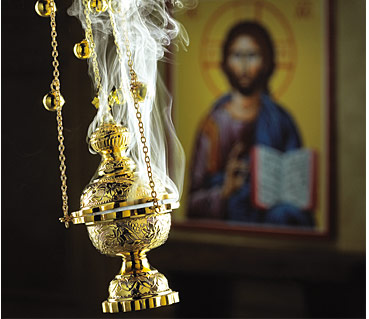
censer-incense-burner-01Welcome deare feast of Lent.

We had beautiful Ash Wednesday ceremonies yesterday evening. Unaccompanied plainsong, psalm and Merbecke, and three gentle hymns. Whoever observed that in the catholic tradition music aids devotion and calms the spirit, whereas in the reformed tradition it excites the emotions, knew a thing or two.

Ash Wednesday is a wonderful feast of being human. Since dust we are and to dust we shall return, we might as well stop trying to be what we’re not. Ditch the personae, shed the skins. Relax into ourselves.

Lent as relaxation. Yes, relaxation. Letting go, loosening up. Freeing from constraints.

Relaxation from the constraints that we tie ourselves up with, and the new clothes we wrap around ourselves to appear bigger, brighter and better than we are, to impress others. (Evagrios the Solitary, 4th century: Of the demons … there are three groups who fight in the front line: those entrusted with the appetites of gluttony, those who suggest avaricious thoughts, and those who incite us to seek the esteem of men.)

Relaxation from the constraints that constitute addictions. I’m not suggesting we indulge them but, as it were, put them on the table in front of us and look at them full in the face. Addictions to food, booze, complaining, finding fault, having to win … and so many more. Hold them up to yourself and the Lord. You can’t let go of something unless you look at it and know what it is you have to let go of.

Relaxation – moving to a wide place. If we are not constrained, if our view is not limited, we have freedom of action, we are farseeing.

Relaxation – not laziness—far from it—but freeing up so each one of us can give to the world what only each one of us can give.

Relaxation – abstinence from things that hold us back. Don’t give up what you enjoy: that’s just another constraint. Rather give up what you don’t need any more. Let go of ways of thinking that you once needed but that now constrain you. Let go of hurts, resentments, oughts and shoulds. Let go of prejudices and attitudes that restrict your view of the world. Start saying ‘no’ to the expectations of others, and begin to get to know someone you’ve hardly ever met—no, not your maker, but yourself (thanks to W R Inge, sometime Dean of London, for this nugget of gold).

This Lenten abstinence has nothing to do with hair shirts, but everything to do with freeing up yourself for delight you had forgotten was in you. It’s about losing your ego, and rediscovering the Divine within.

Welcome deare feast of Lent.

Spirituality

Floral_matryoshka_set_2_smallest_doll_nestedSWMBO asked me “what exactly is spirituality?”

It’s a very good question, for the word is bandied about quite indiscriminately, but nobody ever says what they mean by it..

I’m not aware of any generally accepted definition, not even one that’s widely accepted.

What is a ‘spiritual person’?

  • Some people mean someone who’s into joss sticks, open toed sandals, cheesecloth shirts, tie dies, that sort of stuff, gaia, energies. Others call them away with the fairies.
  • Some people mean someone who is serious, moves and talks slowly and rarely smiles and says they think a lot. Others call them lazy shirkers.
  • Some people mean someone who goes to church every day and pontificates about keeping the rules. Others call them sanctimonious hypocrites. 
  • Some people mean someone who puts on a permanent ‘I’ve found Jesus’ smile and who patronizes and condescends to those who don’t. Cambridge University CU members come to mind. I find it difficult to resist the urge to poke their eyes out.

I think spirituality is a looking out: a recognition of the fact that we’re not in control, that we’re at the mercy of something infinitely bigger. That we are, in a word, contingent.

I think spirituality is a looking in: an acknowledgement that the faces we present to the world are merely masks that could be otherwise, and that an inner journey calls us to search among this detritus for the Divine core—the ground of our being.

I think a spiritual person is one who acknowledges all this; someone who lives life to the full as best s/he can and helps others to do likewise; someone who is fully aware of his or her own strengths and weaknesses; someone who is in no doubt that s/he is no more and no less than a creäture of this earth among many other creatures, and someone who knows that s/he is here today and gone tomorrow.

Two pretty awful, and therefore quite funny, medical student aphorisms:

  • If you talk to God you’re a Christian. If God talks to you you’re a schizophrenic.
  • Neurotics build castles in the air; psychotics live in them; psychiatrists collect the rent.

I’ll get my coat.

No room in my head

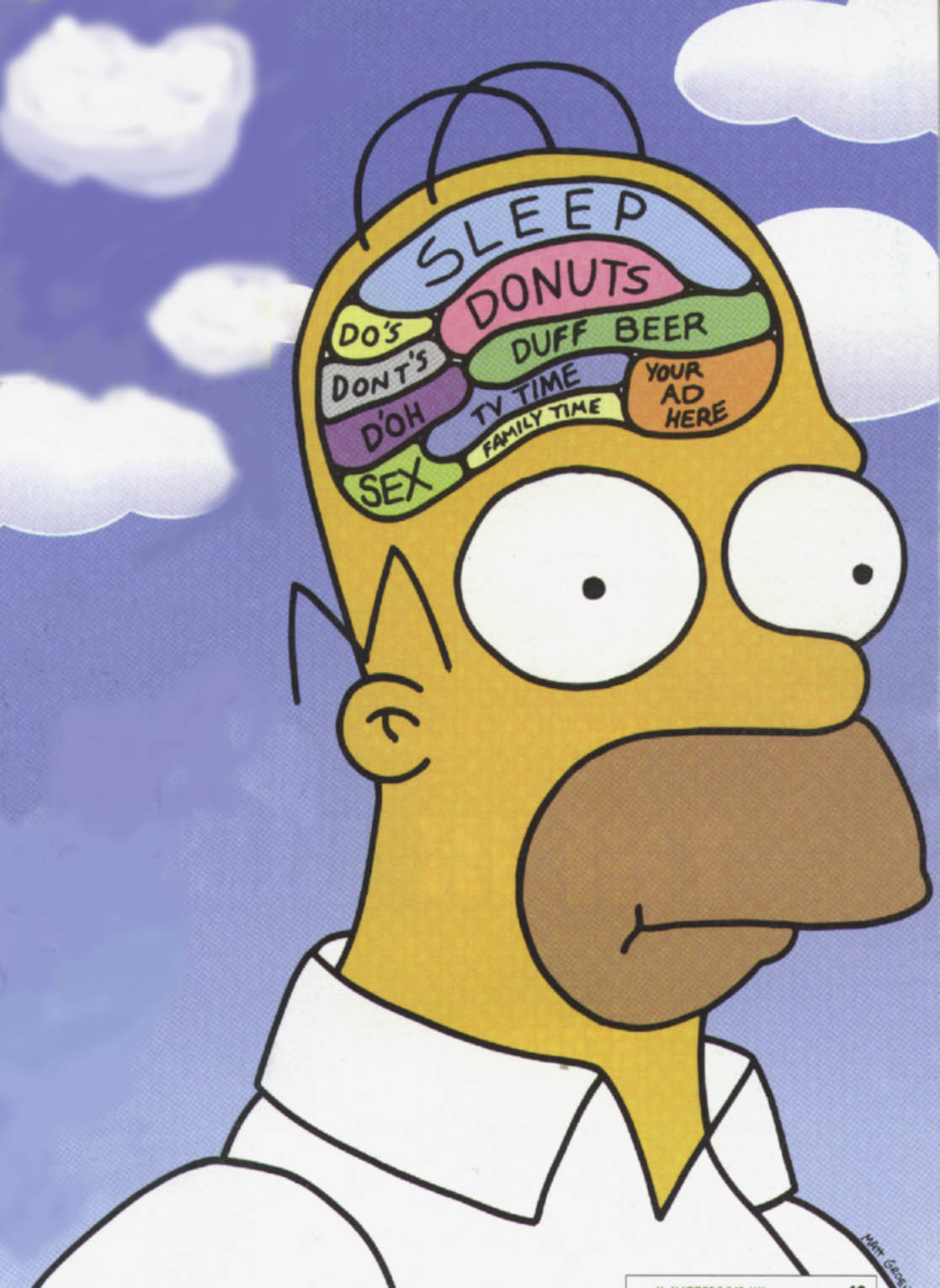
homer_braincolor1The characters in the Christmas story live in my head. It’s pretty crowded in there. Legion, you might say.

There are characters on the hillside left out in the cold until they are surprised by light and encouraged in. There’s Mary who listens to something bigger than herself and sets aside her own plans. There’s Joseph who worries that maybe he’s taking too big a risk, but he’s started so he’ll finish. There are magi that journey far and wide using abundant gifts to enrich life.

Then there’s Herod strutting and swaggering, clinging to power and possessions, like Gollum to his precious. He is fearful. He stifles initiative, nips new life in the bud before it gets chance to flourish. Or so he thinks.

All these characters move towards the infant.

The child in the manger shows us how to let go, take risks, follow our stars, bring in from the cold. If we search hard enough—and it is maybe the most costly thing we ever do—we might even realise that the Christ child is within, like a neglected pilot light waiting to be turned up. The infant saving us, in fact, from ourselves, selflessness superseding self as the inner light glows ever more brightly. My kingdom is an inner kingdom.

In the early hours of 30 June 2005 I dreamt I was descending stairs into a church basement, completely in the dark. Something was awaiting me, though I knew not what. I was without fear. Along a corridor, into a room, pitch black. I felt to the left for the light switch. I flicked it. In front of me was a young lad. So pleased to see me, so lonely, tears of joy, so relieved. He had been abandoned and given a home in the church, alone all week. So sad, but so full of grace. ‘I am so glad you’ve come for me.’

Would the child you once were be pleased with the adult you have become?