Laois, Langwathby and lips

Langwathby and the railway

Langwathby and the railway

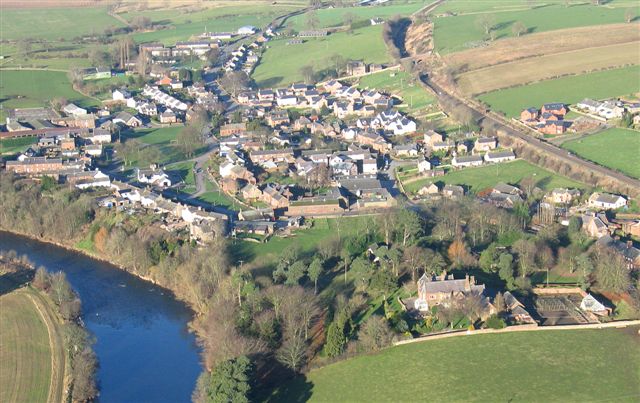
When people ask where I come from, I usually answer ‘north-west England, almost Scotland’. If there’s a flicker of  recognition in the listener’s eyes, I narrow it down a bit more to ‘Carlisle’ (I was born in the City General Hospital) on the basis that they may have heard of that. The next level of detail is ‘a village in the Eden Valley near Penrith’, and if they have heard of Penrith, I say ‘Langwathby’—the settlement (by, as in Danish) at the long (lang) ford (wath, Irish ath). My mother was brought up nearby in Kirkoswald and married my father from Langwathby. Both were children of butchers, Cranstons butchers (her dad’s firm) still going strong.

072713_dbf41d3c

Settle-Carlisle and Helm tunnel

The  Eden is one of the few north-flowing rivers in the British Isles. It makes its way from the source in Yorkshire (you can understand the hurry to get out of Yorkshire) to the Solway Firth between England and Scotland, passing on its way Kirkby Stephen, Appleby, Langwathby, Lazonby, Armathwaite and Carlisle, and joined by the rivers Lowther and Eamont bringing water from Haweswater and Ullswater. Its 70 mile journey provides a home to the Settle-Carlisle railway from Ais Gill summit to almost sea-level at Carlisle. It is surprisingly untouristed compared to the miniature Switzerland of the Lake District less than 10 miles to the west, and the Pennine moorlands to the east. It is gentle, rolling, pastoral, farming and growing land. It’s a surprisingly red area, not politically (Willie Whitelaw country, remember him?) but geologically. Red sandstone buildings, walls and outcrops. A ‘warm’ stone, not the cold blue-grey of Keswick or Kendal.

Eden Valley - or is it Laois?

Eden Valley – or is it Laois?

It’s a bit like the area round Portlaoise. Hills not too far away, drumlins dotted about, good views, farming, damp windy weather much of the time. When I was in my teens I couldn’t wait to get away from the Eden Valley, and here I now am in an area quite like it. Karma I suppose. Both places are windy. The local wind in the Eden valley is the Helm, the only named wind in the British Isles (according to Wikipedia, so it must be right). It’s a fearsome force, capable of inflicting great damage.  I think that the windiness there and here leads to a rather surprising similarity in the way the locals speak, for in both places they seem unwilling to open their mouths much. Sometimes, in fact, you can hardly see the lips move. This makes it quite difficult for me, for I rely on lip-reading to an increasingly large extent. It’s not the volume, but the articulation, the diction (or lack of it), that catches me out. This morning the GP told me to get a new hearing aid.  I have one, but it tickles, and magnifies everything. I had two but the dog ate the other.

Why should there be this lack of dictional lip activity? I conclude that were people to open their mouths any wider when they spoke, the fierce winds would blow into their oral cavities, inflating the cheeks like balloons, and the poor dears would be borne aloft, never to be seen again. Somewhere over the rainbow ….
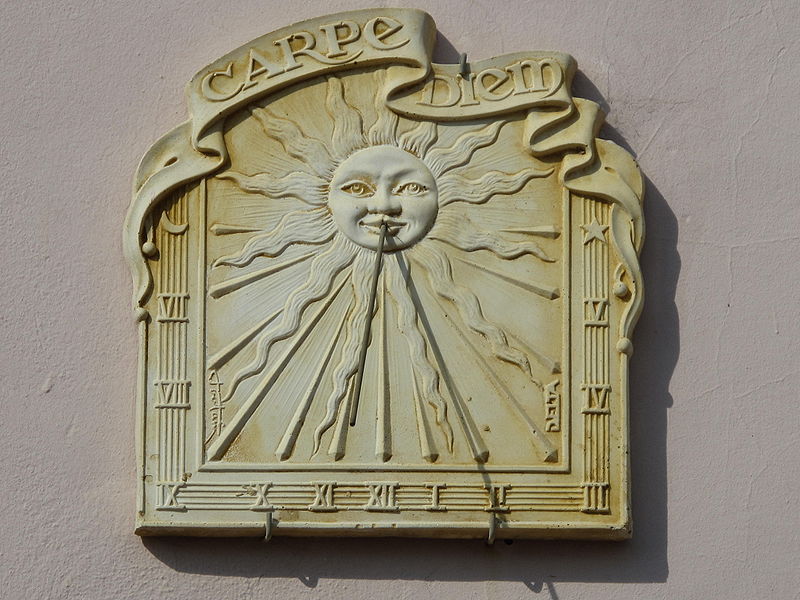
Carpe diem, humanity and Holy Week

800px-Carpe_DiemTwo people have told me in as many days that they wish they had made more of their youth. They wish they had not squandered opportunities that came their way to finish this course, or take up that hobby. Telling them that squandering opportunities is what young people do didn’t seem to help. I wish that I’d taken up rowing more seriously when I was at Cambridge. I very nearly did, but it was fear that stopped me. Fear of jumping into the unknown, fear of stepping into a milieu populated by those who’d rowed at school and who all spoke with posher accents than my flat-vowelled Cumbrian voice. Cowardice, ambivalence, fear of being ridiculed.

We are too hard on ourselves. We have reasons for doing, or not doing, what we do, or don’t do. Our choices may reflect disordered thoughts, faulty logic, or fear, but they are nevertheless entirely understandable given our circumstances and the forces that have shaped us.

Not long ago I was the invited speaker at a medical school reunion: people I’d taught when I was in my late 20s and early 30s, barely ten years older than them. At the time of the reunion, they were in their mid-40s and well-established in their careers, on astronomical salaries, living in gaffs with tennis courts and swimming pools. It’s always the ‘successful’ ones that go to reunions. Can’t think why. I started my speech by commiserating with them that they were just about to find that they were at a difficult time of life: all has gone well so far, in the main, but trouble will soon start as kids hit adolescence, as relationships start to creak and as confidence begins to wane. Oh, how confidence wanes.

And how would you describe yourself?

And how would you describe yourself?

I was at a job interview recently at which someone asked me how I would describe myself. That rather took the wind out of my sails. (Interviews, by the way, get much harder as one ages. You would think the opposite would be the case, but not for me.) It’s difficult to answer because I need so many qualifying clauses and verbal explanatory brackets, and a few seconds were all I had. A fatuous question, of course, but interviewers are full of fatuous questions. Anyway, the question set me thinking.

The first thing I remember wanting to be, and howling at the top of the stairs because I wasn’t, was a boy singing on the TV. Then I ‘wanted’ to be a doctor—but that was to please my parents, especially my mother. Then I wanted to be a cathedral organist. That lasted a long time—indeed, it’s still there inside me: in my darker moments I’m still a failed cathedral organist. Next, I wanted to go to Cambridge (managed that one, God only knows how, since my A level results were spectacularly mediocre: an E in biology, I ask you). I’m conscious that I never lived up to parental expectations: they saw me as a wealthy GP living in a big house on Beacon Edge in Penrith, or as a medical consultant with rooms in, say, Portland Square, Carlisle. All I managed was a second rate academic with a poky office in Nottingham medical school. I certainly was a teacher, and a good one too in the sense that I provoked people to think. Since I taught them, I moved on to a good job in Dublin by charming the selection panel, and then managed to write two textbooks, neither of which sells terribly well, for they are too gloriously idiosyncratic to appeal to those responsible for recommending them to students. And now I am a clerk in holy orders in the Irish midlands.

Some people look at this story and say: ‘he likes getting qualifications, he must have an inferiority complex’. Others say: ‘he likes dressing up and lording it over others’, and hint at some dark secret. Some think ‘he’s restless and can’t settle at anything.’ Yet others say ‘he’s a dilettante’ (not a compliment). Well, all I can say is: guilty as charged on all counts (except for the dark secret, of course, depending on what you call dark). My life has been rich, and it ain’t over yet.

At the interview, I mumbled something about other people seeing me as gifted, but that I didn’t see it that way, for I am just me. I have all these fears and insecurities, and lots more. I am just me, like all humans, wonderfully and deeply flawed. At the risk of sounding complacent, I’ve stopped worrying about lost opportunities, and now wish only to make the best of what comes my way. Perhaps that’s the product of being 62 rather than 42. I’ve stopped worrying about my ‘kids’ as much as I used to: when I was their age, I managed without parents worrying about me, because they were both dead.

It’s Holy Week. One of the risks of being churchy in Holy Week (and there are many) is that we will feel, or be made to feel, guilty about the fact that we betray like Judas, we deny like Peter, we squirm like Pilate, we are cruel like Herod, we are economical with the actualité like Pharisees, we sometimes follow the mob. In other words, we are human. I have a Judas, a Peter, a Pilate, a Herod, a Pharisee, a mob, living inside me. They are part of me. I hear the passion stories no longer as guilt-inducing because I’m not perfect, but as comforting (that is strength giving) because I will never be perfect and I can stop trying. No matter how hard I try, I will never be able to stop being human. If I say hello to all the different parts of me—the Judas, the Peter, the Pilate, the Herod, the Pharisee, the mob—and give them a hug and look them in the face, then divine light can love the hell out of them, out of me, and out of you if you do likewise. There is nothing to fear, and everything to gain.

Whatever happens, there is something bigger than me, and you, and we are not in control. Despite this the world keeps on turning and the sun keeps on shining. A happy Holy Week to you all.

Splutter snotter headache

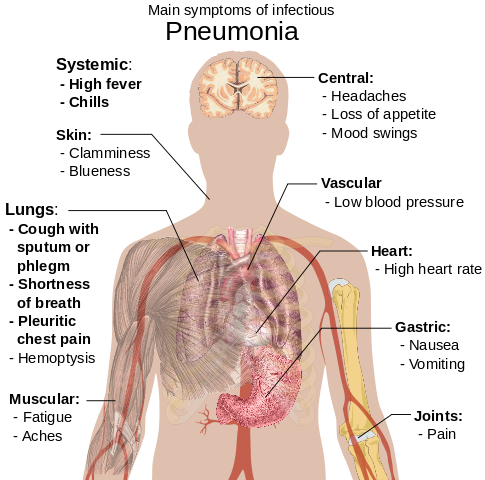
485px-Symptoms_of_pneumonia.svgChest infection again. I’m prone to them, nearly always developing just as some stressful period has ended. The immune system senses that danger is over and relaxes, only to let the cunning little microbes get a toehold. It’s like the story about cleaning out the demons from your mind, then just when you’re relaxing into smugness, they come back bringing their friends with them. My chest infections always begin with a whooshing pulse in my ears. This is different from the normal ear noise that I have all the time (so don’t notice any more). ‘High BP’ thought I, so out comes the trusty sphygmomanometer. BP 128/82, not unusual for me. ‘How can he have a blood pressure like that when he’s so fat and takes so little exercise and likes eggs?’ It’s because—and I’m reluctant to tell you this—I’m so fat and take so little exercise and like eggs. Good God, surely, you don’t expect life to be fair, do you? Maybe it’s because I once was fit, and thin, and lifted weights, and the body is stuck thinking that. Anyway the sphygmomanometer might be bust. So then, going on the basis of the usual course of events, I suspect that a chest infection might be on the way, and, lo and behold, it is. Joy, joy.

Always the same. Tickly throat, swarm of bees in my larynx. Unsteadiness when I stand. Timpani in my head. Then blocked nose. Next, a hammering on my upper teeth from inside the maxillary sinuses. The cough starts. The chest hurts. The cough gets worse, and worse. Now it really hurts to cough. Then it gets better and I feel absolutely knackered for two weeks. Then all is hunky-dory again. That’s the way it is. That’s the way it was when I was a child. As it was in the beginning, is now, and ever shall be.

People are very kind. ‘Go and see the doctor’ they say. And they tell SWMBO that I must be made to visit the GP. What do they think the GP can do? What I want to say to them is: ‘Why? This is viral. You can tell that because of the symptoms, because it usually is, and most of all because the sputum I’m splattering over the carpet and the bedclothes, and perhaps the handkerchief if it gets there in time, is frothy and clear. If it were green, or yellow, or had blood in it, I might think otherwise. Nothing the doctor can do will be worth €50.’ But I don’t say that. It’s not worth the not inconsiderable effort. I’ve tried saying all that, and people don’t want to hear it. They think that GPs, having replaced clergy as people to be looked up to, are omnipotent, and if they’re not, they can be sued (so can clergy in certain circumstances, but let’s not go there just now). Anyhoo, I say, ‘Yes, good idea. If I’m not better by Monday, I will go and see the doctor.‘ Knowing that usually I will be somewhat better, and so won’t go. Some people treat me as if I were an imbecile and talk to me as if I were a decerebrate puppy (if I were, I wouldn’t be able to hear, but that escapes them). They mean well.

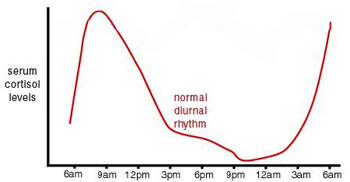
diurnalws1There are times when one must listen to one’s body, and one just knows that nature must take its course. I wonder: ‘if I didn’t allow myself to get worked up, would the infections not happen?’ Maybe there is something that demands illness like this twice  a year. If I didn’t allow myself to get worked up, then I wouldn’t be me (whatever that is, see here). So, grin and bear it. I remember the words of Homer Simpson to his children: ‘Kids, kids, I’m not going to die. That only happens to bad people.’ I’m still at the coughing stage, though it’s better than it was yesterday. The reason that the cough is worse in the afternoon than the morning is because of what SWMBO wittily refers to as the arcadian rhythm in the levels of endogenous steroids. That’s the way it is. And if you don’t know what some words mean, look ’em up.

The way it used to be

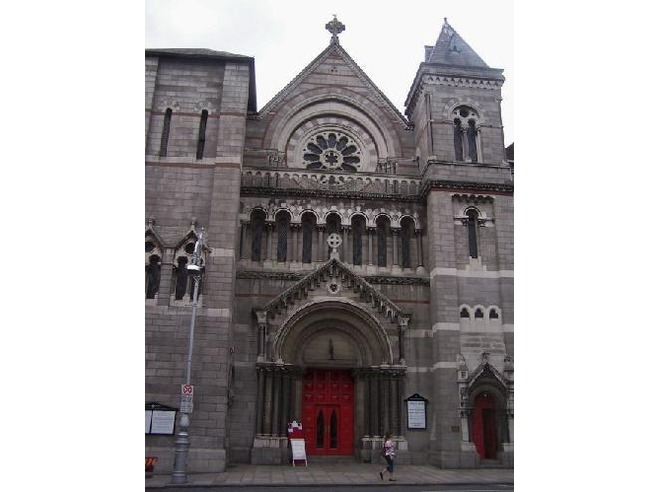
3276135-St_Anns_Church_DublinAs choirmaster at St Ann’s Dublin, now many years ago, I inherited a set up that was still very much in thrall to the choirmaster who died about a decade before. Many Irish church musicians have reason to be grateful to what he taught them. He’d been in post so long that I suspect the men of the choir, who had grown up with him, were still mourning his passing. I arrived on the scene and it was soon made apparent to me that I would never measure up to his memory. My feet were in my shoes and not his, so I just about withstood the onslaught. Since his death there had been a succession of choir directors, none of whom had stayed more than a couple of years, and pretty quickly I understood why—there comes a time when you realize that bashing your head against a brick wall is unproductive. A particularly fond memory was hearing that as the men were queuing up to enter the church, they were kept waiting by someone or something, and were muttering about how long they’d been there. My 16 year-old son, irreverent and fearless, who had been drafted in to lend some accuracy and quality to an otherwise rather wet-dishcloth-like tenor line, could take this no longer and said, very loud, ‘and I’ve been here since 1654’. I suppose you had to be there.

Anyway, the point I’m getting round to is that here I’m much more aware of ‘the way it used to be’ than ever I was in England. This is surprising in a way, for the culture in which I grew up was almost Wahabbi – rural, isolated, conservative, women largely confined to kitchens and bedrooms. In church terms, while women make up the bulk of the congregation, and do most of the work, in some parishes and church institutions it’s all but impossible to get people to vote for them. I refer you to the blog of a neighbouring Rector who is much more trenchant about this than I am.

It’s a human characteristic to hark back to glory days that never existed, but some people seem very good at it. Perhaps it’s because in the old days the tribes were more clearly defined, and comfort was to be had within the fences they provided. The trouble is that the fences are pretty scrappy now: the trumpet blast of increasing transparency and mobility has brought down the walls of Jericho. And a good thing too, for such conservatism, whatever its benefits, stifles creativity and imagination. It can even be dangerous when its adherents refuse to accept that what was appropriate years ago may, because of legislation and changing standards of good practice, be inappropriate now.

To finish the story about St Ann’s, I quickly came to see that the choir of men and boys had had its day. Recruitment of boys was a mug’s game, what with changing family expectations and the move of schools and people from the city centre. Girls were introduced. Mutter mutter grumble grumble. Even that was not sustainable, so a semi-professional group was employed and the Vicar retired the men. I think, on the whole, they were relieved. There comes a time when enough is enough and we grudgingly have to accept that a decent burial is the right thing. In Jesus’s words loosely paraphrased, there’s no point flogging a dead horse*: move on, there’s work to be done.

* though quite a lot have been flogged – as beef.

The Laois sleeper

Ballybrophy

Ballybrophy station

I took the train to Dublin today to talk to a dear friend about things that were bothering me. We had lunch, I bored the pants off him, he spoke the truth to me and helped to dispel some illusions, we had tea in the august establishment where I used to work, I conversed with former colleagues, then I took a taxi (I’d cut it a bit fine) to Heuston for the 1525 to Limerick, third stop Port Laoise. So far so good.

At Kildare I fell asleep. I must point out that no alcohol had been taken at lunch, and neither had hypnotics been consumed. I was vaguely aware of Portarlington. I woke just as we were pulling out of Port Laoise. Next stop Ballybrophy, where at about 1630 I alighted. The next train back was not until after 7 pm. Ballybrophy—and I mean no disrespect to the worthy inhabitants—is not what you might call a thriving metropolis. A few cars, a few potholes in the road, and a few cow pats. Taxi ranks are conspicuous by their absence. The Irish Rail gentleman was most courteous, and mildly amused at my predicament. He might have charged me for the extra journey, but did not. He assured me obligingly, and helpfully, that I would have been better staying on the train, alighting instead at the stop beyond Ballybrophy, namely Thurles, since more trains stop there for the journey back to Port Laoise. I smiled sweetly. Having consulted the timetable, I see the sense of that, and have noted it for the future.

As luck would have it, Ballybrophy is in the parish of a neighbouring Rector, so I rang him and told him of my situation. After he’d stopped wetting himself, he was able to contact some good Samaritans, who metaphorically fed and clothed me and transported me home.

What do I learn from this? Sleeping on trains is dangerous. Mobile phones are wonderful. Good Samaritans are alive and well in Co Laois, and I thank the Lord for them. Does the parable of the wise and foolish virgins say anything to me? Not really, for had I been a wise virgin, I would not have had the chance to meet these lovely people.

All in all, an interesting afternoon. Could it happen again? It could. It might.

‘An Englishman abroad’

West Kensington

West Kensington

Back in 1988, when I’d recently arrived from Nottingham to work in Dublin, an intellectual asked me why I’d come to Ireland to take a job that could have been filled by an Irishman. This raised questions of Irishness, charity, welcome, and his cerebral stenosis. And my sanity. Back then things were not so good economically as they became a decade later, so maybe the inquisitor was mindful of inherited notions of poverty that, if you believe what you hear, only Ireland has suffered. Self-pity is a wondrous thing. At that time we lived in a money-pit in Co Wicklow, and I worked in Dublin with, amongst others, inhabitants of West-Kensington-by-the-Liffey, whose knowledge of poverty, I can only assume, must have been truly profound. Once these people established that I was related to nobody that mattered and nobody they knew, I became invisible. This allowed me space to observe. And observe I did. Fortunately, I found good friends who had a surer grasp of Dublin’s latitude and longitude.

I come from part of England that has been trampled afoot by conquistadores from Scandinavia, Rome, Scotland, Normandy, Scotland (again and again) and Westminster. And now Brussels. The BBC thinks it’s part of the same region as Liverpool and Manchester. Other institutions regard it as part of Newcastle-upon-Tyne. People assume that my accent comes from Yorkshire. They are all wrong. The churches of the region are dedicated to people like Oswald, Ninian, Kentigern (Mungo), Hilda, Columba and—wait for it—Patrick (how that must sting!). Yet my worthy assailant felt that I was an unwelcome interloper.

I’ve been confronted by a similar question recently from someone who resents eastern Europeans taking Irish jobs. His family depended years ago on one of them finding work in London. Geneticists tell us that there is no such thing as pure Irishness, or pure Celticness, or pure anything. The Celts came from way over east. Aran islanders, I’m told, have genes from Cromwellian soldiers. This must be truly shocking. At a recent Remembrance Sunday political speech, I heard about the sufferings in the two world wars of the French, Germans, Belgians, and Irish, but only of oppression by ‘our near neighbour’. I heard nothing about the sufferings of the Russians who suffered more than the rest put together, but that’s for another day maybe. The faux-Irishness that has infected this culture seems to have grown up really as an anything-but-Englishness.

It’s undoubtedly difficult for outsiders to settle in these parts. Everyone is related to everyone else. Nobody will tell it as it is for fear of offending neighbours and relations. Valley of the squinting windows. This is all the more reason why outsiders are needed—to point out what needs to be pointed out, because locals won’t. Yesterday we heard that Jesus was hounded out for daring to tell his folks that they were getting no special favours from him just because they were his kinsmen. Scriptural readings emphasized that we are all in this together. Plus ça change …

Clonmacnoise, Capernaum and rubble

Stones in Jerusalem

Having some weeks back found the Rock of Cashel wanting in the welcome department, now it’s the turn of Clonmacnoise. A pile of rubble in a field—is it more than this? Apparently so, for huge coaches clog up narrow local roads, bringing hordes of pilgrims to tread in the footsteps of Ciaran and JPII. Even on a day blighted by low skies, soft rain and a general air of gloom, the car park was full. Last time we were there, about 20 years ago, entry was free and views unimpeded. Today we found that not only did entry come at a price, but also any possibility of using the loo—at the same price. It seemed that trees had been planted deliberately to obscure any chance of a view without paying. Rampant commercialism meant that even a cup of tea was not to be had without paying the entrance fee. Maybe this is what happens after JPII has visited a place.

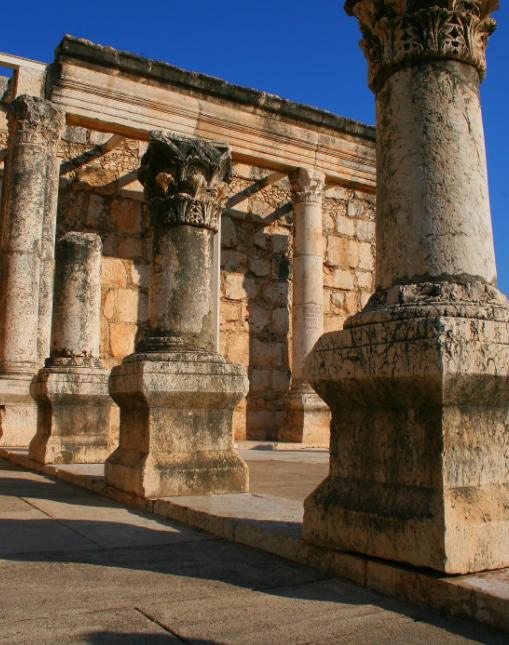
Capernaum

Rampant commercialism reminds me that last week we called in at Knock on the way back from Donegal. The shop merchandise was all in the best possible taste. She who must be obeyed said that the loos there were ‘appalling’. She is not alone: so say several online reviews. The weather was awful too, but I don’t suppose we can do much about that. A few years ago we visited the Holy Land. We saw lots of piles of rubble in fields near Jerusalem that possibly may possibly have possibly been associated with Jesus and the disciples. Galilee is beautiful and very moving. It feels real. And the Rock of Dunamase still rocks.

More intourism

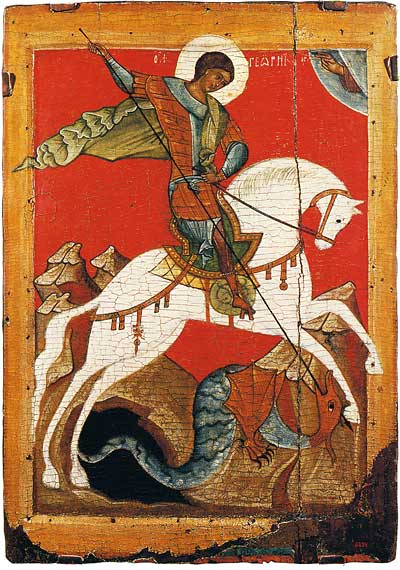
Russian icon

My enthusiasm for things Russian persists. I love the icons, the incense, the architecture, the matryushka dolls, The language: wonderful sounds – ‘l’ sounds like you hear in east Lancashire in places like Burnley and Chorley (listen to Jane Horrocks). And music to die for – literally, the Contakion with Russian basses whose vocal cords (no h, please) must be at least a foot long, and whose chests must contain several barrels of vodka, for them to get that low. The chants, the Rachmaninov Vespers: I drool like Homer Simpson with a donut. In Leningrad I sought out a poster shop a few metro stops from Hotel Moskva, and brought back some treasures, now gone the way of much else in various house moves. But one was particularly juicy, I recall, with square-jawed Soviet heroes and the hammer and sickle, and a slogan exhorting the workers to something or other in Russian.

Soviet icon

A few months after that holiday, we moved from Nottingham to Kilmacanogue when I started professoring at the College of Surgeons in Dublin. What better place to display the said communist poster, thought I, than in the Anatomy Room of that august body, well known for its revolutionary history and sympathies. At that time, we had some young surgeons in training at least one of whom, from a wealthy Dublin family (a rarity, of course, at the College of Surgeons) found it unsettling. He disapproved, and said so. What a tease!

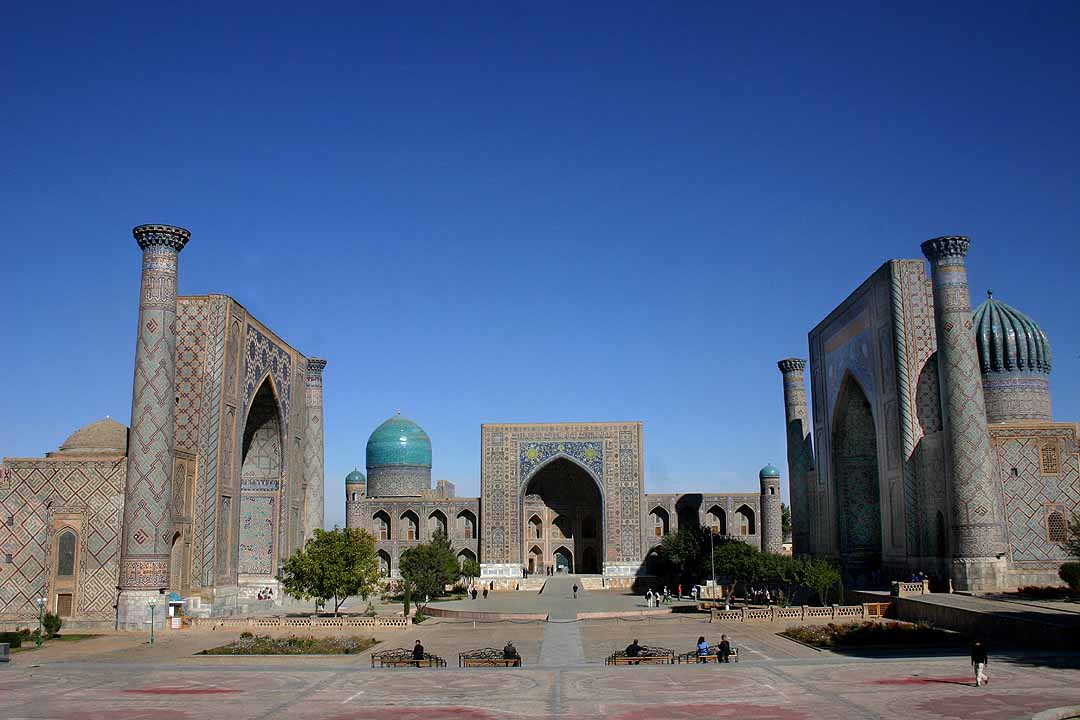
Registan, Samarkand

The year before all five of us went to the USSR, Susan and I went to Leningrad, Tashkent, Samarkand and Moscow. It was a rather rushed trip, and memories are hazy: tea drinking and beautiful Islamic architecture in Samarkand stand out. Someone wanting to talk to westerners the following day approached us in Samarkand, but nothing materialized. Gorbachev was in power then, and Moscow was boss. I wonder what has become of the would-be conversationalist in the now independent Uzbekistan. I wonder what has become of Comrade Boris and Borisovna of the erstwhile Soviet Union. Were they better off under Krushchev, Brezhnev and Gorbachev, before the ex-KGB man came to power and their oil tycoons became filthy rich and bought up football clubs?

One thing I brought back from the USSR was the realization that despite what we are told year-by-year, the Russians suffered war casualties on a far greater scale than anyone in the so-called west. You can understand why Uncle Joe was so keen to have a fence of buffer states between him and the western aggressors that had invaded Russia time and again over the centuries.

Communism and Christianity have much in common. A pity nobody’s tried either of ’em. Happy days.