Healing and research

“They don’t like it up ’em!” said Corporal Jones

I wrote recently about healing, in theological terms, being about acceptance of reality, preparation for the future, liberation, rather than about medical cure. Heal = salve = save. Here are some more phrases: healing as coming to terms with, at-one-ment. I’ve been provoked to think more about this as a result of discovering that the Burzynski Clinic in the US is attempting to silence a 17 yr old young man for having the temerity to point out to the world on his blog that the clinic’s claims of offering a cure for cancer are not founded on robust scientific evidence. The young man has gone so far as to call Stanislaw Burzynski ‘a quack and a fraud’.

Why do we invest so much in doctors and drug companies? Why are they paid so much? At least part of the reason is that people can’t come to terms with the fact that life is a terminal condition. We imagine that the next new drug, or treatment, or whatever, will allow us to live for ever—or at least, for that bit longer. Now, let’s imagine you’re expecting to kick the bucket any day, then a new drug unexpectedly becomes available and you are told you have an extra month. What will you do in that extra month? Will you travel to where you’d always wanted to go? Will you write your life story? Will you watch more TV? Will you make sure that the people you think are eejits know your opinion of them? (That’s a very tempting option.) Perhaps you will try to make peace with people you know you’ve offended or hurt. You might even try to let people who’ve hurt you know that you bear them no ill will. You would then, in your last days, have a lighter heart, carry fewer burdens, and die more serenely. You—we—can start this now, by living each day as ‘twere our last. Because it might be. Life—to repeat—is terminal, and we never know when the game’s up. Wiping out this disease today means we die of something else tomorrow.

This takes me back decades to when I was a medical student and junior hospital doctor in south London. I ministered to dying babies, children and adults, and to their to parents and families. I began to wonder about the distinction between medicine as easing suffering, medicine as restoration, and medicine as prolonging a life of suffering or even unconsciousness. I witnessed the switching off of life-support systems for people who had effectively ‘died’ months earlier. I witnessed ‘treatments’ that were little short of medical experiments dressed up as false hope.

Research in medicine has enabled us to move on from surgery as practised in mediaeval times—see the illustration at the top. Most medical research is of the highest ethical standards, but some is driven by the need for researchers to climb the greasy pole of career advancement. Peer-reviewed assessment can result in the stifling of innovative thought because it challenges accepted wisdom, threatening to diminish the reputations of reviewers. Research funded by drug companies should always be most closely scrutinized in case commercial concerns have distorted methods and/or findings (see or read Le Carré’s The Constant Gardener). And of course, medical research is always at the mercy of charlatans. When people are at their lowest, they are at their most vulnerable. That is why quacks and frauds must be exposed for what they are.

You are perhaps beginning to see that I was never cut out to be a researcher.

Nappies, nurture, nets

Casting a net on the Sea of Galilee

Permission? – don’t wait

I’ve heard it said that the best mark of a group leader is how well the group has been prepared to prosper without one. In church terms, a good indicator of a successful incumbency is how well the churches can manage in an interregnum. If the departing priest was someone who insisted on making all the decisions, allowing nobody else to do or say anything that threatened the priest’s power, then the church community is unlikely to be well prepared to manage in a vacancy. It will be fractured and fractious, like naughty children when the teacher leaves the room. If, on the other hand, the priest encourages others to have a hand in the administration, the liturgy, and the generation of ideas and plans for the future, and is prepared to let people have responsibility, then things may well run pretty smoothly in a vacancy. I don’t wish to be a priest of the first category—I would like to be one of the second. So I’m delighted to see people volunteering—or being volunteered—to enrich the life of our churches and communities. I remember our children finding out that helping themselves to sweets and then telling us (or not), was ‘better’ than asking first and being told ‘no’. Better, surely, to ask forgiveness than seek permission.

Growing up

Did you see on TV recently the programme about English teenagers living with the Amish? One was pampered (smothered?) by parents; one was sponging off benefits. They grew up pretty quickly. Ministers who keep their congregations in nappies stunt their growth, and congregations who expect the minister to do everything for them will never grow up. Taking responsibility for oneself is one of the Gospel messages, and it is a real healing act. If we expect healing to mean medical cure, as if biological processes can and should be reversed by the odd prayer here or there, then we live in a fool’s paradise. Jesus the healer helping people come to terms with the situations they are in. Healing as acceptance of reality. Healing as preparation for future development. Healing as salvation, liberation.

Stress for fun

Muscles and bones grow by being stressed and challenged. Healthy immune systems work when challenged (we’re too clean). Some people imagine that life should be stress-free. This is self-indulgent piffle. Without stress, we don’t grow and learn. We remain in a rut, ignorant of the big wide world with all its opportunities. We let our unchallenged prejudices corrupt us. We become like those who (Psalm 17) ‘are inclosed in their own fat, and their mouth speaketh proud things.’ Gospel messages again: let’s take responsibility for ourselves, let’s take stock of where we are, let’s take risks, let’s push at boundaries, let’s put out into the deep, let’s cast our nets on the other side—the side we’ve never tried before.

Memory and delight

Eyes that see do not grow old

Looking back

November is a very looking-back sort of month with All Souls at the beginning, then Remembrance Sunday. We will say prayers in churches and at memorials. We will remember names of those killed trying to maintain peace. But what use are these prayers unless they result in changing our human behaviour? It is easy to see how others need to change their behaviour, but the truth is that we all need to look into a mirror and start with our own behaviour before even beginning to think about telling other people what to do. Playground fights become wars. Interpersonal slights grow through resentments into bitternesses and feuds. The trouble is that when you harbour a grudge, and plot revenge, you are harming yourself more than anyone else. And then you die. So let us use the November season to resolve that when that day comes when we shuffle off this mortal coil, we leave behind as few resentments and as little unfinished business as possible. Let’s start now by being honest with one another, by getting things out in the open. An abscess needs to be lanced with a knife, not covered by an elastoplast.

Looking forward

Learn from the past to live in the present to lay foundations for the future. This brings me to Advent on the four Sundays of which we remember patriarchs, prophets, John Baptist and Mary—the past being renewed in preparation for a transformed future. Advent for me the best time of year: cool, sunny (one hopes), fresh, crisp, invigorating. Images of waiting, preparing, cleansing. And yet, with Christmas carols already as shop muzak, we seem to have lost the art of waiting. I’m one of the world’s most impatient people, but a bit of waiting, however painful, increases the joy. And it’s waiting that the four weeks before Christmas are all about: Latin ad venire meaning ‘coming towards’. We wait for a guest, an eagerly expected visitor. As at home, preparation for such events usually means a bit of tidying up, getting stuff ready, and relaxing before the arrival. Unfortunately, this sense of waiting with mounting excitement has been all but lost to us in what the media call the ‘run up to Christmas’ – planning presents, trees, food, booze, frenetic activity, much of it fuelled by the children’s media and the evil advertising industry that incites us to greed and avarice. Even the church in so many places is caught up in this as Carol Services are held well before Christmas. Advent is obliterated. And I am complicit: although I complain, I do not like Carol Services after Christmas, so must have them before! I encourage you, if possible, to take some time out in December, maybe just a minute or two here and there, for stocktaking and refreshment. For waiting, in fact. For relaxing. At Christmas we celebrate having been shown the way to live as the Divine comes to us: ‘God became what we are, in order that we may become what God is.’ The glory of God is a human life lived to the full, when our deep joy meets the world’s deep need. If, like me, you long for a bit of peace and quiet before Christmas, don’t feel bad about taking time out. And if you want to be stimulated, come to our Advent discussions on Wednesdays at the Rectory at 8 pm. These might be just the things to revive your drooping spirit before the onslaught of family arguments and frayed nerves. Relax into being yourself. Get rid of the ‘shoulds’ and ‘oughts’ (too much butter leads to hardening of the arteries, and too many ‘oughts’ leads to hardening of the ‘oughteries’), and be yourself, bringing as much delight as you can into the world.

Money

I have a simplistic view of money, and doubtless old fashioned. I do not see how people can spend what they do not have. I have always been better at spending than at earning, and I look back with horror at the ways in which I have been a poor husband of my resources. The retrospectoscope is a wonderful thing. But: the churches need your money. This is not a good time to ask for it, but needs must. First among our financial obligations come the diocesan assessment (clergy stipends, pensions, advisers, administration etc), upkeep of the buildings, and the maintenance of our liturgical and pastoral activities. There are those who bemoan the fact that historic buildings can be a millstone around our necks, but they are a fact of life, and it would be irresponsible for us wilfully to neglect them. Anyway, buildings are mission tools—they can bring people to church, and there they might just find something worth staying for. Some churches have large reserves. Maybe we should ask ourselves: what are these for? It’s difficult to persuade people to give to an organisation that is wealthy. In the Jewish Scriptures, much is made of tithing—giving a tenth of your income to support the work of the Jewish priesthood. Christian Scriptures make no mention of tithing (though since the early Christians were Jews they may have assumed it), but they do (see Acts especially) talk openly about the maintenance of ministry and the obligations of those that have more than they need to support those that have not. This does not mean that sponging off others is permissible or even allowed—we are all responsible for ourselves ultimately. But I encourage you to dig deep into your pockets to support the work of the church and its ministry in order to safeguard the future. 

Thankfulness

Despite my profligacy, I am alive. I wake up each morning and think, good—I’m not dead yet. I’m of an age when some of the people I was at school and university with are no longer breathing. If you are reading this, be glad.

Back to Ireland

A Rector knows his place - between a rock and a hard place

Greetings and thanks

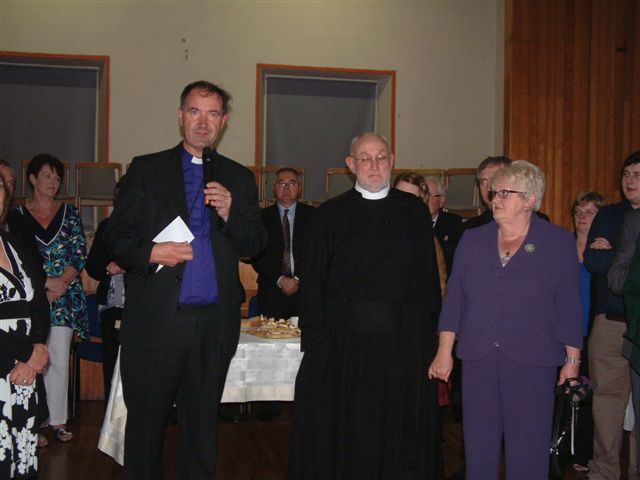
You have worked hard on the Rectory and the garden. One of you only narrowly escaped amputation of a foot—an act that takes selflessness to new levels. The garden, greenhouse, new path, patio and fence look very good. The Rectory—and please call in when you are passing—looks lovely. Painting all interior walls magnolia has worked a treat to give the place a sense of light and cheer. Our visitors from England were impressed by Portlaoise, Ballyfin and the Rock, and by your friendliness to them. The institution service was a real delight and great fun, and the refreshments afterwards were magnificent. It is dangerous to mention names, so I won’t—but thank you to wardens, musicians, flower arrangers, cleaners, bakers and caterers, bringers-up, readers, gardeners, craftsmen and craftswomen—we thank you all for your industry and welcome. You could not have been more welcoming.

Moving is exhausting

Moving to Ireland the second time is easier than the first in 1988: not only familiarity, but also this time no house-hunting or worries about schools for children etc. However, we are 23 years older. On Irish TV when we arrived is Rose of Tralee, which was on when we first came house hunting in 1987. Some things never change.

Knowing me, knowing you. It will take time for me to get to know you, and you me. It will take a while for me to be able to put faces to names and names to faces. Please bear with me, and don’t be offended if you have to correct or remind me: no insult is intended. The poet T S Eliot wrote:
What we call the beginning is often the end
And to make and end is to make a beginning.
The end is where we start from.
and:
We shall not cease from exploration
And the end of all our exploring
Will be to arrive where we started
And know the place for the first time.

One of the messages of these two snippets is that through exploration we begin to know ourselves. We make decisions about ourselves partly on the basis of what we sense around us—the environment—and in order to do this we need to explore. We grow through exploration. The Church in Europe needs to interact more with the environment in which it finds itself. It needs to become involved with (engage with, though I dislike that management jargon) contemporary culture, with physics, with biology—with what it means to be human. If it does not, it will surely die. You might think it’s already dying. Maybe that’s a good thing since death precedes resurrection. Archbishop Michael Ramsey said ‘it may be the will of God that our Church should have its heart broken, and if that were to happen it wouldn’t mean that we were heading for the world’s misery but quite likely pointing the way to the deepest joy.’

It’s inevitable that there will be frustrations and friction as we step onwards, trying to adapt to the world as it is, rather than as it used to be or as we wish it could be. Our Lord’s ministry was always concerned with getting people to come to terms with the situation they were in, rather than the situation they wished they were in. That is what healing means—it is not about cure, but about acceptance. And that is a big part of salvation. Think about the word: save, salve, heal – all part of shalom, peace—and peace does not mean suppressing anger, but rather is a process in which the causes of anger are exposed so that they can be addressed. If you have a festering abscess, sticking an elastoplast on it is useless. You need to open it and clean out the pus. Christianity is not about being nice. I hope no one will ever call me nice. (No one yet has. I’ll know you’re trying to insult me if you do.) Irritations and robust discussion are the grit around which real pearls may form. The pearl we seek is eternal life—nothing to do with life after death, but everything to do with life here and now. Quality of life, not quantity. Eternal, out of time, in the present. Instant by instant. ‘Thy kingdom come on earth as it is in heaven’ is about state of mind. It’s about how we see ourselves. I’m certain that Christians on the whole do not spend enough time looking into themselves: get yourself straightened out first, like on the aeroplane where you are exhorted in an emergency to put your own mask on before bothering about anyone else’s. A man that looks on glass [mirror], on it may stay his eye, or, if he pleaseth, through it pass, and then the heavens espy. For too long church people have been concerned about telling others what to do, rather than looking into their own innards.

So what is the point of being a Christian? For me, it is this: I came that all may have life and have it in abundance. And: that all may have power to become sons and daughters of God. We do this by letting go of attachments. If you want to know more, come to church.

Things you need to know

My right ear hears better than my left. I do not find hearing aids much use because they magnify all the background. It is often an advantage to be hard of hearing, especially at meetings. Susan wears her hearing aid more often than I wear mine. Vision in my left eye is restricted (retinal detachment in 2006). I like tea strong, with milk in second. Please sing loud: enthusiasm is more important than accuracy. Please say the spoken parts of the service with enthusiasm. If you don’t we will repeat them until I think they are loud enough (seen the film Groundhog Day?). Whatever we do in church says something about our humanity so let it be with verve. Let go of inhibitions. To be fully human is to approach the divine. Let delight be our watchword: desire and delight, prayer and parties. Remember this: without joy and delight, we are in hell. That indeed was St Isaac’s definition of hell.

Engaging gear

More tea, Vicar?

A silly time to start a job

As I write in early October, it’s six weeks since I started this job. I’ve come to the conclusion that Autumn is a daft time to begin. Almost immediately, I was plunged into preparations for the most important liturgical solemnity of the year (no, no, no, not Christmas, let alone Easter, but Harvest, of course). Since I did not know the Irish tradition of inviting suckers from other parishes to come and preach, I’ve ended up being a sucker several times over, preaching not only in my own churches but in two of more savvy neighbours as well. One lives and learns. Or not. After the Harvests, the clergy conference. In the diocese of Derby, clergy conference was optional, and with over 150 stipendiary clergy, nobody bothered whether one went or not. Here it is different, so let me say without further ado how much I enjoy conferences. Nothing gives me greater pleasure. In academic life, conferences are marked by spite and invective thinly veiled as insincere politeness. Beware the question that begins ‘a most interesting presentation—I have one tiny question’. You are about to be disembowelled. My joy at Derby diocesan conferences was to open a book on which member of the clergy would speak (a) first, and (b) most often. After the conference comes the synod. I remember my days on the Diocesan Synod of Dublin and Glendalough, so have some idea of what joy is in store. After Synod comes Advent, by far the best time of the liturgical year though sadly now merely the ‘run up to Christmas’, and then Christmas itself. Jesus’ sweet head, the heresy of ‘veiled in flesh’, and … I’d better stop now. In amongst all this come prisons, hospitals, civic things, visiting the firm and infirm, being berated for not remembering someone’s name, and—the thing that theological colleges spend most time preparing one for—the drawing up of rotas.

Are you settling in?

This is the question that has tickled my acoustic apparatus (such as it is) several times daily for the last six weeks. You have all been most solicitous, and Susan and I thank you for your generosity and warmth. Monsignor John Byrne and his colleagues at SS Peter and Paul have been wonderfully hospitable, and when I represented the Church of Ireland Portlaoise Group at the memorial mass for UN veterans I was acclaimed most warmly. For the purposes of this discussion, though, please note that we are now settled. It is questionable whether one should ever feel too settled. There is no evidence that Our Lord was settled, or that he felt any terrestrial ties. He was certainly ambivalent about family. Family ties can indeed be invigorating and life-enhancing, but so too they can be stifling and repressive. Not doing things because so-and-so might disapprove. Being inhibited by some self-appointed and often rather stupid guardian of family morality. Jesus’ message was one of freedom from all this. He is on record as having urged people to distance themselves from (‘hate’ is the translation one most often hears) family. This is yet another call to detachment. We are all parts of the one body, but we are all detached. The liver and right kidney are parts of the same body, but are separate from each other. (Sorry—too much information for some of you, but you ain’t heart nuthin yet: wait till Mary’s uterus comes along). If over-attachment (obsessions, addictions, hatreds, etc), is the cause of most of life’s ills, and I am certain that it is, then detachment is at least part of the answer. Let it go. Be wary of being settled, because then you won’t cope with change. It’s worth remembering that mankind was originally nomadic, a lifestyle that became more difficult when we stopped being hunter-gatherers and became farmers.

A spot of bother

Those of you who follow church politics in the press, or on t’interweb (and, boys and girls, who doesn’t?), will have seen that our Bishop has been in what P G Wodehouse might have called a spot of bother. At the root of this bother is the matter of how we interpret Holy Scripture. How do we interpret Greek words of dubious meaning? How do we in the 21st century interpret Scripture written for a particular mindset and culture 2000 years ago and more? We accept that the Biblical flat earth and watery heavens are mistaken. We accept that the slavery, polygamy and incest that occur in the Bible are unacceptable. We do things that Holy Scripture tells us are forbidden: we eat pork, we wear polycotton, we ignore Levitical rules about farming. For people to get hot under the ‘choler’ about some rules and not others displays an arrogance and irrationality that is breathtaking. We must be honest about our own animal nature. The Church of Ireland bishops have announced that there will be a conference in 2012 to explore sexuality. This is good: we need to have this discussion, and we need to be seen to be having it, no matter what the result might be. The Bishops write that ‘biblical, theological and legal issues’ will be explored. This is not enough. They have omitted human issues, animal issues. How can they consider human actions and behaviour without considering the fact that we are animals, governed by instincts and hormones that are God-given. Come on Bishops, wake up!

Maybe we need to remember that alongside the two great commandments to love God, and neighbour as self, Our Lord gave us what is perhaps the third great commandment, to love our enemies. That is the work we have to get on with.

Farewell to Derbyshire

I’ve been planning this address for some time. Then this last week, things happened that overturned my plans. The UK riots. I simply cannot ignore them. I do not see in them anything that has not been seen before in recent history. To give a few examples: In the 18th century civil chaos was such that people ventured out of doors at night at their peril; look at Paris in revolutionary times; student riots and Brixton riots in my living memory. In January 1848 Abraham Lincoln said: “Any people anywhere, being inclined and having the power, have the right to rise up and shake off the existing government, and form a new one that suits them better.” I’ve no doubt that the riots were fuelled by evil, by boredom, by a lack of respect for other people, by young people brought up with a lack of tough love, by the psychology of the mob, by an education system that promotes rights over responsibilities and is increasingly feminized. But also a sense of powerlessness. And while it’s right that the perpetrators are made to face the consequences of their actions. I just wish the same applied to bankers.

But we would do well not to point the finger at others. We—all of us in the west—take more than we need. We all do risky things expecting someone else to mend us when the risks don’t pay off. We live in a welfare state that seems to encourage people not to take responsibility for their actions. We envy what other people have, and the evil advertising industry incites us to grab it. We do things to seek approval from other people, and this leads to lying – diplomacy we call it – to obfuscation – pastoral sensitivity we call it, and to the adulation of the masses for so-called celebrities who, in truth, are ordinary human beings quivering in terror behind the masks that are made for them by menacing media moguls. And we are all complicit. We listen to the music. We pay to go to football matches. We buy the publications if only to disapprove of them.

It is not possible to live on this planet without the divine image within being maimed by what we do or don’t do. We are surrounded by things that purport to be quickfix solutions, following the latest fashions, the latest brands, the latest chic destination to visit. But the truth is, these things are not satisfying: the effects don’t last. They are like candyfloss, insubstantial, sticky and full of air. Because we set them up as idols, and we become obsessed by them, they steal our liberty: we become slaves to them. This is what St Paul called the flesh. There are lots of these wolves in sheep’s clothing that sing their siren song. They all lead us up a cul-de-sac. They don’t lead to green pastures.

These human failings – wanting more than we need, wanting what others have, and the mob psychology in which we seek the approval of others – are the failings that were identified 1700 years ago by Evagrios the Solitary as the deadliest of the seven sins. And before that, they were the temptations of Christ. I see the results of these sins daily in myself as I want this or that CD, or this or that new book, or eat something that I’m told will clog my arteries but I like the taste. I see the results of these failings every time I drive between churches and Rectory. I pass homes behind electric gates and electronic security systems. Every time I am put in mind of Psalm 17 verse 10: they are inclosed in their own fat and their mouth speaketh proud things. Like Gollum in Lord of the Rings, we want to hang on to what we think is ours and we become spiritually wizened and deformed in our obsession to do so.

We all hide behind masks, behind personalities, cosmetics of the spirit. We all mask the divine light within. We put on a pretence. We say that this is necessary for the smooth running of society, for manners, for charm. How I am suspicious of charm. I am determined that nobody should ever call me charming. No-one has! There is a notion that a façade of smoothness and perfection impresses others, that we must do all we can to hide our wounds. We put up barriers between ourselves and other people: barriers of attitudes, possessions, mental attitudes that form security systems between others and ourselves.

This pretence never works! It’s too good to be true. You know how infuriating it is to deal with bureaucrats who refuse to acknowledge that they’ve made a mistake. You know how healing it is when someone acknowledges that they got it wrong. Perhaps you’ve witnessed the effect of letting someone else see by your tears, your wounds, that you too are vulnerable. Perhaps you’ve seen how effective this can be in bringing reconciliation, forcing reassessment, resurrection that comes after death of what we thought we held dear. I’m certain that I often get things wrong, and unintentionally as a result people can be hurt. That’s the way life is.

I look around and see the church complicit in pretence. It erects barriers. I see Church of England bishops hiding behind status, behind secretaries and personal assistants and chaplains. I see the institutional church hiding behind rules and regulations. I see church councils hiding behind ‘we’ve always done it this way’ and – as was said to me three years ago with breathtaking arrogance ‘we’ll soon have you whipped into our way of thinking.’ All this is humanly understandable. It is truly pathetic. In the exchange between Jesus and the woman, today’s Gospel tells us that erecting barriers to exclude people who are different from us is never acceptable. Depending on how you read it, it shows Jesus as truly human acknowledging that his first comments had been inappropriate. Or else that he was tongue in cheek provoking the woman to justify her opinion, which he then affirmed.

We see exclusions in churches about all sorts of things: who can sit where, who can do the flowers, who can bake the scones (wars are fought over this), who can be a server, what people should wear, commenting on whether people stand or sit or kneel to pray. We see it in the way some so-called Christians reject people who disagree with them. We see it in the way that some people accept as valid only certain ways of expressing their faith. In Christ. Are you saved? Have you accepted Jesus into your life? Let the love of God into your heart. Jesus loves you (it sometimes doesn’t feel like that). That awful prayer for serenity ‘go placidly …’ or whatever. This is all gobbledegook to me – these statements are not how I express my perception of the Divine, or of the meaning of Jesus and his work.

From the Church of Ireland Gazette last week:

A great challenge is posed by moving on from a parish or a position or a place of work; that requires great strength of will and purpose. Anyone who has had experience of this will agree that suddenly the place from which one is moving has never seemed so attractive! All its advantages are glaringly obvious, in a way they had never been before. Perhaps that is also because people’s attitudes change when they know you are about to disappear from their lives. Suddenly, there is a loosening of emotions, a reaching out and willingness to articulate friendship which may not previously have been on offer. Sad, however, that it takes a move to allow this to happen – perhaps it is symptomatic of the perversity of human nature that we all do not appreciate people until it is too late.

That is absolutely my experience! I look back over three and half years and review what has happened in my churches. The churches are now more realistic about the state they are in. They are more ready to look through clear, as opposed to rose-tinted, spectacles at themselves and the challenges that lie ahead. Church councils are more business-like. There is a wider spectrum of people involved in the running of the churches—not wide enough, but better than it was three years ago when too many activities were dependent on an inner clique. Some people may not like the fact that power is slipping through their fingers. They may not like that fact that their opinion which once counted for so much now counts for no more and no less than that of everyone else. I see fewer barriers than there were. I’m proud of that. In my previous job I was described as an agent of change. I’m pleased with that, not least because that is exactly how I see Our Lord’s ministry.

I’ve provoked a handful of parishioners to begin to explore their vocation to a deeper ministry. I’ve provoked people to study Holy Scripture and see how to apply it to life today. I have, I hope, encouraged people to take the liturgy more seriously: more worship and less trivializing entertainment, and in that worship not to lose a sense of fun. I hope I’ve encouraged people to live with delight and commitment, and to enjoy their humanity. As the barriers come down, as we leave the inclosure of fat, we become more open to the delights of being fully human, fully ourselves—and that is the way to becoming divine.

Over the last month I’ve had a fair number of well-wishing cards, emails and messages, mostly from nonchurch people whose baptisms, weddings, or funerals I’ve done, and from people who read my writings. I seem to have the gift of engaging the unchurched as much as I discomfit some of the churched. Which is more important for the future of the church? Our Lord comforted the disturbed, and disturbed the comfortable. I have my priorities right.

Jesus’ own story has so many elements that strike me as true because they speak of the way people are, as I am. And it’s that honesty, that authenticity, that is attractive. It’s the sight of wounds that tell us a person is speaking from experience, with freshness and straightforwardness. It’s that lack of guile that attracts people to Jesus, makes them feel secure around him, and it’s all of that in us that gives each of us the ability to serve those in distress, to provide the safety of the sheepfold.

I can only do my work effectively if I’m honest about myself. ‘Here in honesty of preaching’: in sermons, I hope I’ve never been holier than thou. I’ve never said anything that isn’t true for me. It’s expensive because I have to go deep down inside myself, look honestly at personal issues that confront me. When we face up to and recognize our faults, then the opportunity comes for the spirit to change us. Confronting ourselves is essential, and necessary before confronting others—motes and beams. Those who are aware of their own imperfection are inevitably the most tender, compassionate, and understanding of others who are bruised or weak. It is the self-righteous who, the Gospel tells us, are not suited to God’s purpose.

T S Eliot:

  • What we call the beginning is often the end And to make and end is to make a beginning. The end is where we start from.
  • We shall not cease from exploration And the end of all our exploring will be to arrive where we started And know the place for the first time.

Since May 2008 you’ve entertained and provoked me as I have, I hope, entertained and provoked you. I thank you for the fun we have had together, the joy and delight. And remember this, without joy and delight, we are in hell. That indeed was St Isaac’s definition of hell. Joy and Charity, JC, Jesus Christ. Listen to George Herbert:

As on a window late I cast mine eye,
I saw a vine drop grapes with J and C
Anneal’d on every bunch. One standing by Ask’d what it meant. I (who am never loth
To spend my judgement) said, It seem’d to me To be the bodie and the letters both
Of Joy and Charitie; Sir, you have not miss’d, The man reply’d; It figures JESUS CHRIST

Sisters and brothers: Go raibh maith agaibh. Slán agus beannacht leat Bail ó Dhia ort.

Life is not fair

I’ve just returned from the surgery. Blood was taken two weeks ago. I was told today that I would need to make another appointment (the third, therefore) to have blood taken for a test that should have been done but wasn’t. I said ‘why don’t you take the blood now?’ Not allowed. I said ‘give me the needle and I’ll do it myself, here and now.’ I’ve done that often enough before, and I have veins that are easy to find – indeed they positively invite the needle to jump in. The nurse was horrified. So the system requires me to make an extra trip. If I had to take time off work, I would be in difficulty. If I had a physical struggle to get to the surgery, think of what an extra trip might mean. The lady in the surgery said, ‘I’m only doing my job.’ I left feeling that I had not been heard.

‘I’m only doing my job’ is increasingly how we relate to each other. We are not people any more, only cogs in a machine. It is not good. It is the trap that catches all of us who must tick boxes in order to put bread on the table. The unhealthiness of the work culture in which we live. Listen to Psalm 115: ‘They have mouths, and speak not: eyes have they, and see not. They have ears, and hear not: noses have they, and smell not.’ That was written about statues and images, and it seems to me that we are now treated as inanimate statues, unthinking lumps. Whatever happened to the idea that we might relate to one another as people who have opinions and feelings? Rules and regulations kill relationships. The institutional church has too many rules and regulations, but I try and sit as light to them as I possibly can. Jesus talked to people as individuals, and went out of his way to pour scorn on institutions and regulations and jobsworths.

It’s easy to gloat at the downfall of News of the World. It’s interesting to wonder how far the tentacles will extend. To wonder about the connexions between that organisation and political parties, the reasons why daily papers might shift their allegiance from one party to another, the reasons why people like us buy those papers. At least page 3 is clean. So I’m told. A note from Susan: At school, when asked which daily papers my parents took, I replied ‘Guardian and Sunday Times’. Why was I embarrassed to confess the truth: Daily Mirror and NotW? Perhaps because I was a perceptive child who recognised the scandal sheet for what it was. Perhaps.

Some of my parishioners have lost their jobs. 1500 jobs lost recently at one firm in Derby. Many see the bit of their pensions that has not disappeared into the bowels of bankers and their cronies now wafting gently over the rainbow. Some people earn more in a day than others in month, even a lifetime. Life is not fair. There is nothing in Holy Scripture that says it is. There is nothing in Holy Scripture that says we can expect equality, which is maybe a good job since if there were, we should all have to come to terms with the fact that most people in the world are worse off than even us poor souls whose pensions are threatened. Holy Scripture enjoins us to do justly, love mercy, and walk humbly, mindfully, with our eyes and hearts open.

Let go

The sight of Her Majesty at a state banquet in Dublin Castle was astonishing. To hear her speak of the mistakes of history in a way that acknowledged the wrongs done to the island of Ireland by English colonialism was truly moving. And she hit on something that Jesus says time and again: clinging to the past is the very thing that burdens us. It stops us living in the present and looking forward to the future. An inability to forgive ourselves for what we have done is an example of dwelling on the past. It is also a form of self-obsessedness, a perverted pride. ‘Let the dead bury their own dead’ said Jesus, ‘we have work to do’. This is one reason why I will never support conservationism. I admire the buildings and achievements of the Victorian age, and I once joined the Victorian Society, but now I am irritated by its reluctance to acknowledge that things might need adaptation to suit the here- and-now. Many church people are obsessed by pews, imagining that they have been there since the church was built. Others are obsessed about the internal appearance, ignoring the likelihood that in the middle ages the church was plastered and colourfully painted. We need to acknowledge the past (not apologise), understand it, but don’t live in it. Initiative is so often stifled by those who are stuck in the past. Church councils need to heed that lesson: the needs of the present and future are not well served by attitudes of the past.

Which brings me to the difficulties of getting older. Our brains are wired so that we tend to lose short-term memory before long term memory. As we age, we remember 30 years ago better than yesterday. There are species-preservation reasons why this is a good thing—if only we did not live so long. We tend to dwell on the days when we were fit and active, and when we grabbed life by the short and curlies, and we become sad about what we can’t do any more. We need to grieve this loss: the loss of youth and energy and get-up-and-go. And the realisation that things we once thought dear turned out to be no more than seductive bubbles that have burst, leaving only a soapy mess. Rather than moping, try mopping. Think how you might share your wisdom and experience with others. Enjoy the young members of your family, talk to them as friends. One of the sadnesses about my relationship with my father was that before he died (I was 36) we never reached the stage of talking to each other as friends. I dare say it was as much my fault as his, but at the time his words seemed only to be given as peremptory instructions.

There comes a time to acknowledge that it’s someone else’s turn to carry the flag. And yes, I know it’s difficult. We see people doing things that our experience tells us will come to grief, and we want to tell them why. If only we could plug a memory stick into a USB port on the side of our heads, transfer our wisdom onto it for transmission to someone else’s cephalic USB port. If you don’t know what a memory stick is, that illustrates my point. If you don’t know what cephalic means, look it up. It does have something to do with Cephas. Maybe the development of bodily USB ports will be the next stage of evolution. Have you seen the wonderful Vincent Price in the marvellous The Abominable Dr Phibes? It’s not irrelevant to this idea. (Far be it from me to encourage you to break copyright law, but it’s available in chunks on YouTube.) Hindu sanyassi give up all their possessions and wander off to fend for themselves. I find this peculiarly attractive. I’ve lived my life backwards in a sense, each change of job in the last 10 years some sort of a renunciation, with less and less income (poor Susan). But I lack guts to go the whole hog (relieved Susan). Move on. Enjoy getting older. Acknowledge the right of others to cock up just like you did. It takes courage, but it’s worth it. Let go of the will to control and influence, and relax into life. Clutter, rank, things, attitudes, stuff, possessions—none of this matters. The only things that matter are relationships. Happy days: live in the present because before you know it, it’ll be too late.