Aim high

618px-Cosmic_Heavyweights_in_Free-For-All-_One_of_the_most_complex_galaxy_clusters,_located_about_5.4_billion_light_years_from_Earth.I was thinking of starting a campaign to get people to stop chatting in church for five minutes before the service starts. I was foolish enough to labour under the apprehension that people come to worship and learn, and for spiritual refreshment, whereas in fact the service is but a short rest from the exhausting rigours of socializing. I don’t even mind people being late: I would hate to think that church attendance was interfering with gossip.

In the Exodus from Egypt the Israelites were freed from slavery not to build an ideal society, not to campaign for FairTrade, not to care about the environment, but to worship freely in accordance with the divine command. We recall this every time we say or sing the Benedictus Dominus in Morning Prayer.

For me, worship should speak of mystery, majesty and glory. It’s not just about how much I love Jesus, or Jesus loves me. There must be a sense of ‘otherness’. However unfashionable it may be to say so, Christianity is a supernatural religion that commands us to look deep into ourselves, and way beyond ourselves, to the invisible and intangible. It is about spiritual things, forgiveness primarily, and self-forgiveness particularly, but such forgiveness is to my mind pretty useless unless we each begin to glimpse our own need for it.

We are right to build up church community—that is, the body of Christ—and pursue justice without which there will never be peace. But our first priority is worship, and worship exists to give us glimpse of the Divine. Liturgy matters. The biggest enemy is mediocrity. If worship is mediocre, then faith is mediocre. If worship is half-hearted, then God becomes a half-hearted creation of our own, not the cosmic Lord. Many modern hymns and choruses are about me (Here I am Lord); golden oldies are principally about God (Immortal invisible). We need both, but we don’t need self-indulgence. We need to lift our eyes out of self and above the humdrum. That is why I’m suspicious of calls for worship to be ‘relevant’. Worship is not about leaving us feeling cosy and comfortable. Energized, yes; smug, no. And maybe slightly unsettled.

Church militant? Church irrelevant

At least this is a natural hypnotic

At least this is a natural hypnotic

Look at the pictures of the 2013 General Synod in Armagh. Same old, same old. Where are the new faces? Where are the young people? Read the accounts of business. Where’s the reality? Where’s the vitality? Where’s the strategy? Where’s the vision? Where’s the engagement with science, with society? Why are Bishops apparently obsessed with sex, but say next to nothing about injustice and usury? Listen to the way at Diocesan Synods that rabbit’s friends and relations are voted into vacancies, or retiring members are immediately re-elected. See how fear of reprisal influences voting by show of hands.

Is this a portrait of a thriving organisation? It is not. It’s a portrait of an irrelevant and self-congratulatory club in which old people plan a future they will not be around to see. What’s the point of spending money on prizes for blogs, websites, media? Who, outside the membership of the select little club, cares a damn about this piffle? I’m reminded again of Aer Lingus being awarded the prize for the best Irish airline by Cara, the in-house magazine of Aer Lingus.

Well over half the clergy in this diocese are over 60. Will we be replaced? Even if replacements can be afforded, where will they come from? I suspect the trickle from Rome has peaked. Some of us come from England, and there are some from the kingdom of Far Far Away, but the church can’t rely on them. The Church of Ireland community can hardly be said to be enthusiastic about fostering vocations. Look at the pictures of synod again: how many of those people can even manage to get their children and grandchildren to come to church?

In Co Laois there are eight paid Church of Ireland clergy. Costs are rising, property taxes are passed on to churches. People are increasingly hard-up. Crisis looms (crisis does not mean opportunity—that’s management-speak invention). How long before eight are down to three: north, central, and south? And as for churches: there are too many. So close some. Simples.

What’s the chance of a rational and clear-headed discussion of these issues? None. It’s all about tribal identity, posturing and self-gratification. If the Church of Ireland population were even a fraction as loyal and committed as is the Muslim population, churches would thrive and lives would be changed.

Pentecost delight

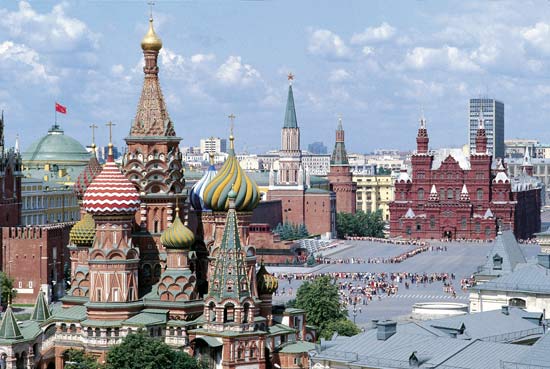
84883-004-ACA9F3E9Red for beauty. Red Square, beautiful square. Red for delight, life, joy. Red for blood, blood of martyrdom, destruction,  blood of Christ. Red for blood that fights disease, removes waste, brings oxygen. Red for paradox. Red for inflammation, heat killing bacteria. Red for fire, burning dross that tethers us. Red for consuming flames; flames of the spirit that sets us free; flames that destroy so that phoenix may rise. Tongues of fire and fire in tongues, apostles’ tongues for good news to the world.

Dove or flames?

Dove or flames?

Red for Kingdom of God in our blood, in our veins. Kingdom, not comfortable God, not vengeful God, but unknowable Divine that turns chaos to cosmos. Divine unconstrained by human thinking, unknowable, immortal, invisible, inaccessible. Divine wisdom, stardust from which cosmos is made, in air we breathe. Divine wisdom in Christ, challenging, unpredictable.

Red for church militant, not church hesitant, not church petulant. Red for salvation. Red for glory. Red for flames cleansing falsehood and bringing truth’s delight.

A ‘simples’ problem for Justin

Aleksandr Orlov

Aleksandr Orlov

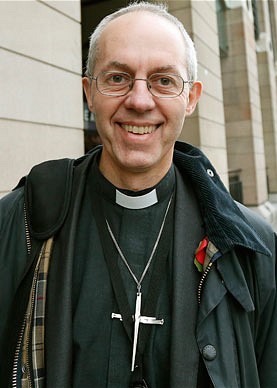
Justin Welby, Archbishop of Canterbury, was recently interviewed by a Financial Times journalist. You can read it here. It’s all pretty anodyne, except that when pressed a teeny bit about the thing that Jesus spent most of his time talking about, namely what homosexual clergy may or may not do in the privacy of their own bedrooms, Justin got shirty, and reportedly said ‘I’m not going to go into all the sort of intricacies of what [celibacy] might or might not mean specifically, not least because we’ve just had lunch and it’s a bad post-lunchtime conversation. I’m not going there.’

I think he may have to go there, and I have a solution to his problem, if problem it be.

In the English Book of Common Prayer there is a Table of Kindred and Affinity that sets out who you may not be married to (I know the grammar’s wrong, but that’s what I say). It begins ‘A Man may not marry his mother, daughter, adopted daughter ….’ and similarly for a woman. It’s quite detailed and includes such prohibitions as a woman not marrying her daughter’s daughter’s husband. In light of such a document going into this level of detail, I suggest that what Justin now needs is a similar document giving precise details of those anatomical structures which may be apposed in the pursuit of delight and pleasure without incurring archiepiscopal censure. Such a document would be an adornment to Common Worship—indeed, definitions, footnotes and references may be sufficiently copious as to necessitate yet another volume.

Justin Welby

Justin Welby

Of course, this will have to be enforced, so I have two further proposals: (1) that CCTV monitoring equipment be installed in all (so as not to be discriminatory) clergy bedrooms; and (2) that diocesan pleasure police be appointed to monitor them.

‘Simples’ as Aleksandr Orlov might say. We need a coherent theology of delight, and one that takes account of evolutionary biology. I’m working on it.

I promise that this is positively my last blog about the matter.

Degrees, hoops & osmosis

Too many degrees

Too many degrees

One could be forgiven for thinking that the Church of Ireland Bishops have decided that clergy are no longer needed. They in their wisdom have decreed that ministers should have a master’s degree. Now, I yield to no-one in my admiration for the wisdom of Bishops, but I can tell you that I have (1) a medical qualification—that is, a couple of bachelor’s degrees; (2) a couple of master’s degrees, one in theology; and (3) a science PhD, and not one of these helps me master essential tasks of ministry such as photocopying and tea-drinking. What does most certainly help is experience of life, mortgages, deaths, births, agonies and ecstasies. And such common sense as I can muster.

Having acquired degrees does help with the reading of documents—or rather, spotting which need not be read. The trick is to read the first and last sentences and see if you want to go deeper. One rarely does. That works for books as well. Indeed, if you hold the book in your hand long enough, the information therein contained seeps into your brain by osmosis and you needn’t read them at all. That’s why students spend so long in libraries just handling the books. They don’t actually read them. On reflection, this can’t be true because if it were the average congregation member would know all the words in the Prayer Book off by heart. And they seem not to, despite repeating them week in, week out. It’s great fun when I say a liturgical good morning to see how flustered people get because the response is not written in bold on page 201 or whatever.

Does the insistence on a master’s degree (it’s the same in the C of E by the way, but there are more people there so the problem is less acute) dissuade people from coming forward? I suspect it does. I suspect it’s intimidating to some capable people who have no record of formal education beyond secondary school, but who have more than enough wisdom and ability to do what is required of the clergy after a brief (18 months perhaps) training that consists of seminars and on-the-job stuff. This is training by osmosis that certainly works.

Rambling Rector wins a prize!

prize-medalRambling Rector has been judged runner-up in the blog category of the Church of Ireland Communications Competition 2013. The judges said: ‘An engaging and compelling blog voice on theology and everyday life. Cultivates readership. Good use of photos. Consistency in form and style. User–friendly archiving. Great job!’

This is astonishing, for I make no effort to toe any party line. I’d been thinking of starting the blog before I did, but was stimulated to act when the editor of the Cashel and Ossory Diocesan Magazine intimated that some of my pieces were too controversial for that august publication. So, thought I, time to publish them myself. Thank you, editor! Plenty people tell me that I make them think, which is one of my jobs as Rector. It is possible, I suppose, that the readers of the Diocesan Magazine don’t like having to think, but the first great commandment, ‘thou shalt love the Lord thy God with all thy heart, and with all thy soul, and with all thy mind‘ is a command to do just that.

Coo! Thank you for reading, encouraging and commenting. Keep ’em coming, and urge others to log-on.

The prize is an Eason’s ‘credit card’ to the value of 30 somethings, probably pounds Sterling since it came from Armagh.

Happy ballooning

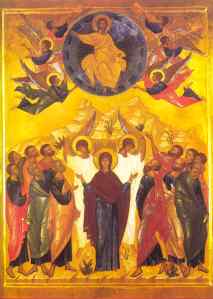
 ascension-pskov-pecheryA sermon for the Sunday after Ascension Day (Year C)

Last week it was  the creator of the cosmos, the hand that ‘flung stars into space’; the big bang,  the idea that the laws of physics are part of God. This week it’s the splendour of God. In the reading from Acts, and the psalm, we hear of God’s mighty acts of liberation. Between these two Sundays, on Thursday we celebrated the Ascension. Some people find the Ascension embarrassing. How can you believe, they ask, that someone went to heaven, disappearing from view, feet disappearing through the clouds? A celestial stair lift. Some people find this even more difficult to deal with than the idea of Jesus rising from the dead. It’s easy to ridicule Christian doctrine if you take everything literally.

So, don’t take it literally. Think instead of the symbolic meaning—of what the story means for you and me. Think of phrases we use: aiming for the stars; scaling the heights. This is what Ascension is about.

Think of the Ascension as Christmas in reverse. At Christmas we celebrate the Divine Lord coming in human form. Heaven to earth. Through Jesus’ life we have Divine and human fused, experiencing all human pains and pleasures. At the Ascension, all this human experience is taken back to the source of Divinity. It was the wounded Jesus who ascended, taking with him all the pains as well as the pleasures of human life. All our human life is made divine.

Irenaeus

Irenaeus

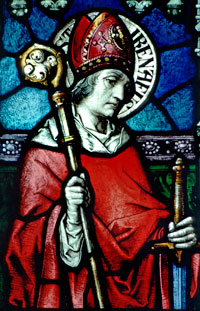
St Irenaeus said something like: God became what we are, in order that we may become what he himself is. In the Christmas Gospel, St John says something similar: as many as received him, to them gave he power to become the sons of God. More Irenaeus: The glory of God is a living person, and the life of man fully alive is the vision of God.

The message of the Ascension is that our lives, lived to the full, are a vision of God. By living life to the full we ‘ascend’ toward the heights of divinity, aiming for the stars, scaling the heights. And that is something reflected in today’s Gospel, Jesus says: Father, I desire that those also, whom you have given me, may be with me where I am. The splendour of God is seen in the splendour of human life lived to the full.

See yourself as a hot air balloon powered by the fire of the Divine Lord. What does the balloonist do to become airborne? (1) turns up the heat; (2) chucks out the weights and cuts the ropes that tether the balloon to the ground. Turning up the heat can be left to next week when fire and flames are part of the story. Today, think about chucking out the stuff that weighs us down and tethers us to the ground.

There are things we do that we wish we didn’t. These weigh us down. There are things we want to do but never get round to. This weights us down. St Paul knew all about these when he said that he knew what he should do but often couldn’t manage it, and found himself doing the things he knew he shouldn’t.
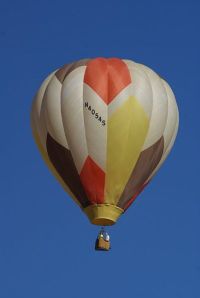
401px-Joy_Ride_hot_air_balloonThere are things we carry with us that weigh us down: shame, regrets, guilt. Confess them – bring them to the surface, tell someone else. This is what people often do when they know they are dying. It’s always a relief.

There is pride that makes us think we are better than other people, or that other people or groups or races matter less than we do. There is pride that prevents us seeing ourselves as we are. This pride is not the sort of pride that we take in someone’s achievement, but the pride of hubris – pride and arrogance that shows a loss of contact with reality and an overestimation of our own competence or capabilities. We see it in a few politicians, in some bankers, in all abusers. We see it in people who take delight in shaming and humiliating others. We see it, if we are honest, in ourselves. When we think we are better than others, we belittle them, and this leads to abuse, sectarianism, theft, stealing.

These are some of the things to chuck out of the balloon.

We can also help the balloon to rise by giving things away. We can share our gifts and our love with others. The interesting thing about this is that no matter how much we give away, the reservoir always seems to have more left in it. And these things appear to be weightless. In the words of St Peter: Be generous with the different things God gave you, passing them around so all get in on it. Be content with who you are, and don’t put on airs. As we work on this generous giving and sharing, we ascend towards the divine.

The point of the Ascension is to help us to realise that we approach the divine when we are fully human, each of us playing to our strengths and giving to the world what only each one of us can give. Man fully alive is the Glory of Creation. The divine light is in us all, and as St Matthew has it, Let your light so shine that all may see it and glorify your father in heaven. The Ascension is inside us, the kingdom of God is inside us. Don’t worry about showing off: we are all meant to shine, as children do. We were born to make manifest the glory of God that is within us. And as we let our own light shine, we unconsciously give other people permission to do the same. As we are liberated from our own fear, our presence automatically liberates others. (Marianne Williamson)
Lancelot Andrewes

Lancelot Andrewes

This is why we need the Ascension: to rekindle, restore our sense of hope. The splendour of man is the splendour of God. This is a great gospel for inspiring us for the future.

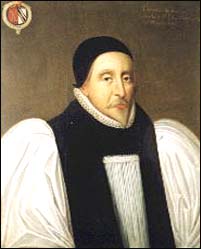
Hear  what Bishop Lancelot Andrewes saith on Christmas Day 1605: It is most kindly to take part with Him in that which He took part in with us, and that, to no other end, but that He might make the receiving of it by us a means whereby He might “dwell in us, and we in Him;” He taking our flesh, and we receiving His Spirit which He imparteth to us; so we by His might become “partakers of the Divine nature.”

Anabolism and diabolism

hard-heart-wire-frame1-1024x682I’ve been told by a well-wisher that s/he looks forward every month to my writings in the Diocesan magazine. Not only that, they get better each month. This is a comforting message. It builds me up: it is anabolic, and I need that. It comes at a time when I hear that some parishioners scan my every word in the magazine and on this blog for something they can use to have me drummed out. It comes the day after one complaint that parish accounts were not available (a pile of them were in the church porch for over a month), and another, surprisingly vicious, that the pewsheet had the wrong readings in it (year B, not year C). It would have been helpful had the complainant offered to be responsible for pewsheet production.

The well-wisher said that s/he did not know of a Church of Ireland parish in which all was sweetness and light, and knew of several that were riven with discord. S/he wondered how anyone these days could stick the hassle of being a Rector. I knew the Church of Ireland between 1988 and 2003 and then again from 2011. Someone in early 2012 asked me what it was like coming back, to which I replied ‘I forgot just how unpleasant some members of the C of I can be to each other.’ Fortunately, for all the vexatious members there are more delightful ones. Ministering to all is a privilege, and ministering to the delightful is a pleasure.

You would think that the church would be less prone to fault-finding than other organizations. Sadly, the opposite seems to be the case—spectacularly so in the C of I. I recall complaints brought against the Revd Michael Bland, the Rector of Buckland with Snowshill (Gloucestershire), in the 1960s. When asked about the angry emotions felt by some of his congregation, he said: ‘Quite right. Get the violence off the street and into the Church where it belongs.’ Why the aggro? Is it because church is the place for power-games? Is it because church is the tribal totem? I can’t see what the discord has to do with the man in sandals. Perhaps the church has a death wish: they forget nothing, they learn nothing, as it was reputedly said of the Bourbons.

Seeking whom he may devour

Seeking whom he may devour

Grumbling and gossip are diabolical. They splinter—that’s what diabolical means. The shards of glass from the devil’s mirror at the beginning of Andersen’s The Snow Queen turn the heart to ice and corrupt the vision. Guilt and shame harden the heart. As for corrupting the vision, look into the eyes. The retina is the only bit of the central nervous system that is visible to an observer. The eye is the window of the soul: eye structure and personality are linked, researchers suggest, because genes responsible for the development of the iris also influence how the ‘personality part’ of the brain is wired up. And notice how shame and guilt affect the way that people hold their heads and move their eyes.

Hardness of heart is what the psalmist warns us about. It makes us insensitive to the woes of others. It makes us obsess about self. And the harder it gets, the greater will be the mess when it eventually shatters–as certainly it will.

Speed these lagging footsteps; melt this heart of ice.