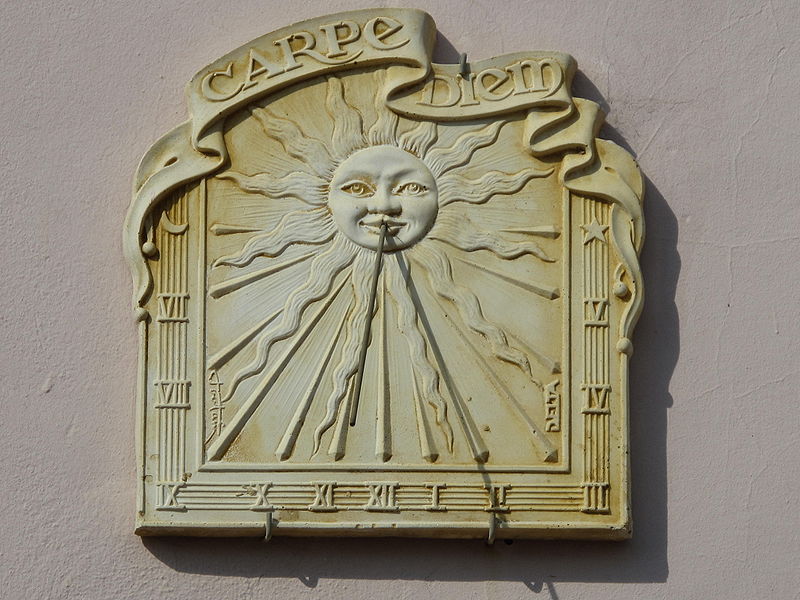
Carpe diem, humanity and Holy Week

800px-Carpe_DiemTwo people have told me in as many days that they wish they had made more of their youth. They wish they had not squandered opportunities that came their way to finish this course, or take up that hobby. Telling them that squandering opportunities is what young people do didn’t seem to help. I wish that I’d taken up rowing more seriously when I was at Cambridge. I very nearly did, but it was fear that stopped me. Fear of jumping into the unknown, fear of stepping into a milieu populated by those who’d rowed at school and who all spoke with posher accents than my flat-vowelled Cumbrian voice. Cowardice, ambivalence, fear of being ridiculed.

We are too hard on ourselves. We have reasons for doing, or not doing, what we do, or don’t do. Our choices may reflect disordered thoughts, faulty logic, or fear, but they are nevertheless entirely understandable given our circumstances and the forces that have shaped us.

Not long ago I was the invited speaker at a medical school reunion: people I’d taught when I was in my late 20s and early 30s, barely ten years older than them. At the time of the reunion, they were in their mid-40s and well-established in their careers, on astronomical salaries, living in gaffs with tennis courts and swimming pools. It’s always the ‘successful’ ones that go to reunions. Can’t think why. I started my speech by commiserating with them that they were just about to find that they were at a difficult time of life: all has gone well so far, in the main, but trouble will soon start as kids hit adolescence, as relationships start to creak and as confidence begins to wane. Oh, how confidence wanes.

And how would you describe yourself?

And how would you describe yourself?

I was at a job interview recently at which someone asked me how I would describe myself. That rather took the wind out of my sails. (Interviews, by the way, get much harder as one ages. You would think the opposite would be the case, but not for me.) It’s difficult to answer because I need so many qualifying clauses and verbal explanatory brackets, and a few seconds were all I had. A fatuous question, of course, but interviewers are full of fatuous questions. Anyway, the question set me thinking.

The first thing I remember wanting to be, and howling at the top of the stairs because I wasn’t, was a boy singing on the TV. Then I ‘wanted’ to be a doctor—but that was to please my parents, especially my mother. Then I wanted to be a cathedral organist. That lasted a long time—indeed, it’s still there inside me: in my darker moments I’m still a failed cathedral organist. Next, I wanted to go to Cambridge (managed that one, God only knows how, since my A level results were spectacularly mediocre: an E in biology, I ask you). I’m conscious that I never lived up to parental expectations: they saw me as a wealthy GP living in a big house on Beacon Edge in Penrith, or as a medical consultant with rooms in, say, Portland Square, Carlisle. All I managed was a second rate academic with a poky office in Nottingham medical school. I certainly was a teacher, and a good one too in the sense that I provoked people to think. Since I taught them, I moved on to a good job in Dublin by charming the selection panel, and then managed to write two textbooks, neither of which sells terribly well, for they are too gloriously idiosyncratic to appeal to those responsible for recommending them to students. And now I am a clerk in holy orders in the Irish midlands.

Some people look at this story and say: ‘he likes getting qualifications, he must have an inferiority complex’. Others say: ‘he likes dressing up and lording it over others’, and hint at some dark secret. Some think ‘he’s restless and can’t settle at anything.’ Yet others say ‘he’s a dilettante’ (not a compliment). Well, all I can say is: guilty as charged on all counts (except for the dark secret, of course, depending on what you call dark). My life has been rich, and it ain’t over yet.

At the interview, I mumbled something about other people seeing me as gifted, but that I didn’t see it that way, for I am just me. I have all these fears and insecurities, and lots more. I am just me, like all humans, wonderfully and deeply flawed. At the risk of sounding complacent, I’ve stopped worrying about lost opportunities, and now wish only to make the best of what comes my way. Perhaps that’s the product of being 62 rather than 42. I’ve stopped worrying about my ‘kids’ as much as I used to: when I was their age, I managed without parents worrying about me, because they were both dead.

It’s Holy Week. One of the risks of being churchy in Holy Week (and there are many) is that we will feel, or be made to feel, guilty about the fact that we betray like Judas, we deny like Peter, we squirm like Pilate, we are cruel like Herod, we are economical with the actualité like Pharisees, we sometimes follow the mob. In other words, we are human. I have a Judas, a Peter, a Pilate, a Herod, a Pharisee, a mob, living inside me. They are part of me. I hear the passion stories no longer as guilt-inducing because I’m not perfect, but as comforting (that is strength giving) because I will never be perfect and I can stop trying. No matter how hard I try, I will never be able to stop being human. If I say hello to all the different parts of me—the Judas, the Peter, the Pilate, the Herod, the Pharisee, the mob—and give them a hug and look them in the face, then divine light can love the hell out of them, out of me, and out of you if you do likewise. There is nothing to fear, and everything to gain.

Whatever happens, there is something bigger than me, and you, and we are not in control. Despite this the world keeps on turning and the sun keeps on shining. A happy Holy Week to you all.

Life, the universe and everything – again

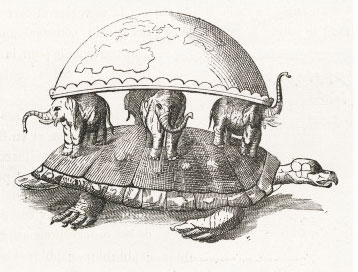
turtle-earthScientists have announced that the universe may be inherently unstable. Billions of years from now, a new universe could open up and replace the one we’re in at the moment. I picture a tiny pinprick of matter expanding so that our universe is squashed up against the edges of the cosmos and then disappears in a puff of something or other. Does the universe have edges? It’s never been clear to me what exactly the universe is in. What’s outside it? It’s a well known fact that the earth is flat and rests on at least one turtle and maybe some elephants. But what is the turtle sitting on? It’s also been suggested that the cosmos is cyclical and that the Big Bang Universe we think we know is just the latest version in a permanent cycle of events.

I find all this uncertainty quite delightful. We’re a cosmic joke. It reminds me that there is really no point fretting. What will be will be. When the cosmos returns to chaos we won’t be in it because the sun will long since have run out of steam, or helium, and before that we’ll either have frozen to death or been wiped out through our own silliness. So don’t worry, even if we don’t succeed in planetary annihilation, cosmic physics will. What a joy.

Gort and Klaatu (Mr Carpenter)

Gort is really big but far away.
Like the cows in Fr Ted.

Did you ever see The Day the Earth Stood Still? The 1950s version with Michael Rennie, not the recent one with Mr Woodenface Keanu Reeves. Yer man Rennie plays Klaatu, a Christ-like figure who gives himself the earth-name Mr Carpenter (geddit?). He comes from another planet with his robot Gort to tell our leaders that if they don’t stop being so fractious, the cosmic powers will sort us out. They don’t listen of course. Klaatu and Gort disappear off into the great unknown and the film ends. Spooky. It’s a terrific film. Next time it’s on the box, watch it. But for God’s sake avoid the Keanu Reeves version. That will seriously damage your health and your aesthetic sensibility.

So, boys and girls, live in the moment. Enjoy what you can when you can. Klaatu barada nikto.I bet a fair few Rectors could do with Klaatu and Gort to sort out their contradictious parishes. Do you think scientists will ever be able to explain everything? I hope not.

My daughter threatens not to speak to me again. She prefers to see the positive in Mr Reeves.

Dust thou art and to dust thou shalt return

800px-CrossofashesJoel 2: 1-2, 12-17. Psalm 51: 1-18. 2 Corinthians 5: 20b – 6:10. Matthew 6: 1-6, 16-21

Blow the trumpet. Listen before it’s too late. Do you say one thing and do another? Do you show off so that others feel worse about themselves? Do you let other people’s opinions stop you from doing what you know in your heart is right? Who doesn’t?

Ash Wednesday is one of the best days of the year. It’s a great festival of being human. One day—who knows when?—you’re going to die. Maybe tomorrow. It’s time to get your life in order. How do you want to be remembered? What do you want to be going through your mind as you shuffle off this mortal doodah? Shame? Regrets? Now is the time to give up the things you do that eat away at your conscience. Give them up for all time, not just for Lent. Get your priorities right.

Dust thou art and to dust thou shalt return. Now is the time to turn away from trivia towards what really matters: faith, hope, charity. And the greatest of these is charity. Love in all its forms. Love as nurturing, love as sharing, love as humility, love as warning. Love as justice without which there will never be peace. Getting our priorities right is the way to have life in abundance. It’s a great message on a great day.

I wish you all a very happy feast of Lent.

Metamorphosis

Or if he pleaseth, through it pass

Or if he pleaseth, through it pass

Sermon for Sunday next before Lent, 2013

Exodus 34: 29-35. Ps 99. 2 Cor 3:12 to 4:2. Luke 9: 28-36

I like an early Easter. It gives a sense of progress and movement to the year. Today’s readings have a sense of movement. Over the last few weeks we’ve had a series of manifestations of the Divine: to shepherds, to magi, to Jews, to non Jews. First, Jesus was a baby, then at the Baptism an adults, then last week a baby again, and today he’s an adult again? What’s occurring? We have the same gospel reading on the feast of the Transfiguration in August. Why today as well, on the Sunday when we go round the corner from Christmas and Epiphany to face Lent and Easter?

Well, that’s why – we go round the corner from Christmas and Epiphany to face Lent and Easter. It’s about movement and sense of purpose. It’s the point that moves us from what Jesus has been and is, to what he will become. The becoming. The metamorphosis. The time, if you like, when he enters the chrysalis in order to burst out at resurrection/ascension.

  • Jesus looking backwards, to Moses and Elijah. ‘Do you want to stay there in houses that I build for the three of you?’ asks Peter. ‘No, we’ve work to get on with. No living in the past for me.’
  • Jesus in the present with the voice of God booming out his approval of Jesus. He is declared the anointed one who has come in fulfilment of all that the Israelites longed for, to take the past on to greater glories.
  • Jesus in the future as he sets his face to go to Jerusalem – to the crucifixion.

‘Sets his face to go’ – the crucial phrase turning us from past to future, safety to danger. Face, image, the principal organ of communication. In a few pages time we have the face of agony, Jesus on a different hill, with different companions. A different kind of glory. From glory to glory. Moses’ face shining, after being in the presence of God, shining like a storage heater that continues to glow after being removed from the source of energy. But Moses’ face was veiled from the Israelites. Writing this sermon in the last couple of days I had a revelation. A veil was lifted from my eyes. I was blind and came to see this in a new way. The veil is between Moses and Israelites. but it’s not put there by Moses, or by the Lord. It’s put there, unknowingly by the Israelites, who because of their pride, hardheartedness and moaning refuse to see the plain truth.

Is this why our view of the Divine is so difficult to glimpse? Is it because of the veils or barriers we erect? Barriers of pride? Barriers of pretending we’re better than we are, or stronger than we are, or less vulnerable than we are? Barriers that make us seem we have no problems, no worries? Barriers that makes us hard-hearted as the Israelites were hard hearted (Venite: harden not your hearts …)? The barriers that dull the glow of the shining divine face?

The gospel says ‘Peter and his companions were weighed down with sleep; but since they had stayed awake, they saw his glory’. I think that it’s when I’m tired and at the end of my tether and my defences are down that I am at my most open. Blessed are the poor in spirit – those who lack spiritedness. When you’ve lost all you have, you’ve nothing else to lose, and you can stop pretending. When we remove the veil of self, of me me me, we glimpse the divine.

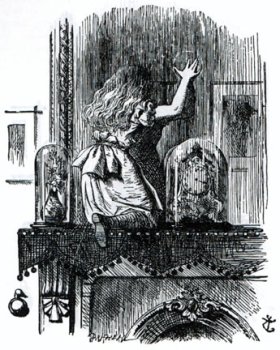
Which takes me to the epistle. ‘And all of us, with unveiled faces, seeing the glory of the Lord as though reflected in a mirror, are being transformed into the same image from one degree of glory to another’. We look into a mirror, and what do we see? Let me quote the great preacher Charles Spurgeon:

Our own judgment of our own character usually errs on the side of partiality to ourselves. Nor is the evil so readily cured as some suppose, for the gift of seeing ourselves, ‘as others see us,’ is not so corrective as might be supposed. Some persist in seeing us through the coloured spectacles of prejudice and ill- will. And this injustice is apt to create in us a further partiality to ourselves. If other men make mistakes about us who can see us, they probably do not make such great blunders about us as we do about ourselves, since we cannot see our own faces! The truth is that we are very fond of ourselves and have our own characters in high esteem—therefore we are unfair judges on points of difficulty about ourselves.


We think the world revolves around us. Me me me. We do damage in small and subtle ways until perhaps we realize that the cumulative effect has been catastrophic and that we have destroyed a life—our own—and maybe someone else’s as well, and that we are left with nothing of value to hand back to the Lord when we pass through the glass, when we look into the mirror and glimpse ourselves—not as others see us, and certainly not as we see ourselves, but as the Lord sees us. Paul calls for transformation, and the word he uses for this is metamorphoumetha. Metamorphosis. Pupation, maturation, caterpillar to butterfly, ‘ugly duckling’ to swan. A becoming as William Blake says.

Rabbi Zusya said, ‘When I come to die, God will not ask me why I was not Moses, he will ask me why I was not Zusya.’ Becoming the very best, as individuals, that the Lord made us to be. This is what we are to seek as Christian disciples. And we need to help others to be the best that they can be.For this we need humility, we need perseverance and we need a sense of constant reliance upon the other—that is, to accept that we are not in control. We need to let go of the pretences that veil our faces so we cannot see clearly. Maybe this is what Lent can be about: not giving up things like chocolates, but giving up those things that veil our view of the world. Giving up, perhaps, the idea that nobody else’s opinion matters as much as our own.

‘A man that looks on glass, on it may stay his eye, or if he pleaseth, through it pass, and then the heavens espy.’ If he pleaseth – the road is open to all. Maybe all we have to do is to stop resisting.

The way it used to be

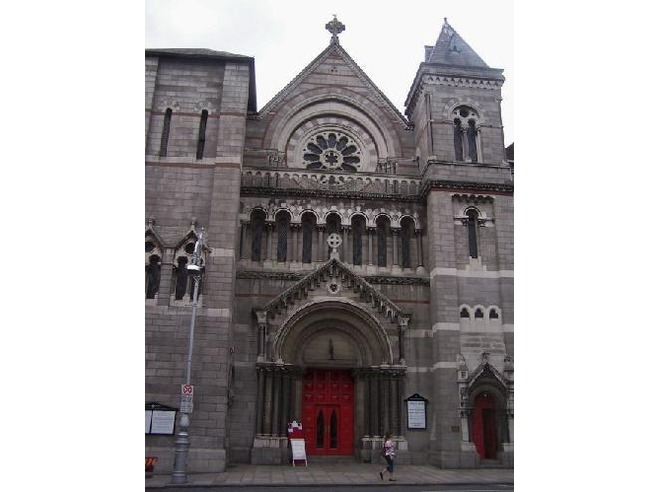
3276135-St_Anns_Church_DublinAs choirmaster at St Ann’s Dublin, now many years ago, I inherited a set up that was still very much in thrall to the choirmaster who died about a decade before. Many Irish church musicians have reason to be grateful to what he taught them. He’d been in post so long that I suspect the men of the choir, who had grown up with him, were still mourning his passing. I arrived on the scene and it was soon made apparent to me that I would never measure up to his memory. My feet were in my shoes and not his, so I just about withstood the onslaught. Since his death there had been a succession of choir directors, none of whom had stayed more than a couple of years, and pretty quickly I understood why—there comes a time when you realize that bashing your head against a brick wall is unproductive. A particularly fond memory was hearing that as the men were queuing up to enter the church, they were kept waiting by someone or something, and were muttering about how long they’d been there. My 16 year-old son, irreverent and fearless, who had been drafted in to lend some accuracy and quality to an otherwise rather wet-dishcloth-like tenor line, could take this no longer and said, very loud, ‘and I’ve been here since 1654’. I suppose you had to be there.

Anyway, the point I’m getting round to is that here I’m much more aware of ‘the way it used to be’ than ever I was in England. This is surprising in a way, for the culture in which I grew up was almost Wahabbi – rural, isolated, conservative, women largely confined to kitchens and bedrooms. In church terms, while women make up the bulk of the congregation, and do most of the work, in some parishes and church institutions it’s all but impossible to get people to vote for them. I refer you to the blog of a neighbouring Rector who is much more trenchant about this than I am.

It’s a human characteristic to hark back to glory days that never existed, but some people seem very good at it. Perhaps it’s because in the old days the tribes were more clearly defined, and comfort was to be had within the fences they provided. The trouble is that the fences are pretty scrappy now: the trumpet blast of increasing transparency and mobility has brought down the walls of Jericho. And a good thing too, for such conservatism, whatever its benefits, stifles creativity and imagination. It can even be dangerous when its adherents refuse to accept that what was appropriate years ago may, because of legislation and changing standards of good practice, be inappropriate now.

To finish the story about St Ann’s, I quickly came to see that the choir of men and boys had had its day. Recruitment of boys was a mug’s game, what with changing family expectations and the move of schools and people from the city centre. Girls were introduced. Mutter mutter grumble grumble. Even that was not sustainable, so a semi-professional group was employed and the Vicar retired the men. I think, on the whole, they were relieved. There comes a time when enough is enough and we grudgingly have to accept that a decent burial is the right thing. In Jesus’s words loosely paraphrased, there’s no point flogging a dead horse*: move on, there’s work to be done.

* though quite a lot have been flogged – as beef.

Magdalene martyrs

Martyrs

Martyrs

From the epistle for today:

My child, do not regard lightly the discipline of the Lord, or lose heart when you are punished by him; for the Lord disciplines those whom he loves, and chastises every child whom he accepts.’ Endure trials for the sake of discipline. God is treating you as children; for what child is there whom a parent does not discipline?

In the week when the report into the Magdalene laundries is published (here), it’s chilling to imagine this kind of text being used to subdue the poor young ladies in those institutions. This is not just an Irish Catholic problem. The first such laundry was set up for Protestant girls. I had a teenage great aunt who, in a close knit Methodist community in northern England, became pregnant outside wedlock. She was thrown out. Her three sisters were all but locked up by their parents, and their mother lived ever thereafter in self-imposed purdah, not even attending Chapel. In those days, and even in my childhood, that was quite something. It’s not just Irish Catholicism that needs to repent.

How long will people continue to twist Holy Scripture in order to oppress? How long will we continue to dissemble? How long will we continue to refuse to acknowledge our shame? Try this for a good read.

In one sense it’s all very sad. In another it’s hopeful. Bringing things into the open is never a bad thing, no matter how painful it might be at the time.

The Laois sleeper

Ballybrophy

Ballybrophy station

I took the train to Dublin today to talk to a dear friend about things that were bothering me. We had lunch, I bored the pants off him, he spoke the truth to me and helped to dispel some illusions, we had tea in the august establishment where I used to work, I conversed with former colleagues, then I took a taxi (I’d cut it a bit fine) to Heuston for the 1525 to Limerick, third stop Port Laoise. So far so good.

At Kildare I fell asleep. I must point out that no alcohol had been taken at lunch, and neither had hypnotics been consumed. I was vaguely aware of Portarlington. I woke just as we were pulling out of Port Laoise. Next stop Ballybrophy, where at about 1630 I alighted. The next train back was not until after 7 pm. Ballybrophy—and I mean no disrespect to the worthy inhabitants—is not what you might call a thriving metropolis. A few cars, a few potholes in the road, and a few cow pats. Taxi ranks are conspicuous by their absence. The Irish Rail gentleman was most courteous, and mildly amused at my predicament. He might have charged me for the extra journey, but did not. He assured me obligingly, and helpfully, that I would have been better staying on the train, alighting instead at the stop beyond Ballybrophy, namely Thurles, since more trains stop there for the journey back to Port Laoise. I smiled sweetly. Having consulted the timetable, I see the sense of that, and have noted it for the future.

As luck would have it, Ballybrophy is in the parish of a neighbouring Rector, so I rang him and told him of my situation. After he’d stopped wetting himself, he was able to contact some good Samaritans, who metaphorically fed and clothed me and transported me home.

What do I learn from this? Sleeping on trains is dangerous. Mobile phones are wonderful. Good Samaritans are alive and well in Co Laois, and I thank the Lord for them. Does the parable of the wise and foolish virgins say anything to me? Not really, for had I been a wise virgin, I would not have had the chance to meet these lovely people.

All in all, an interesting afternoon. Could it happen again? It could. It might.

‘An Englishman abroad’

West Kensington

West Kensington

Back in 1988, when I’d recently arrived from Nottingham to work in Dublin, an intellectual asked me why I’d come to Ireland to take a job that could have been filled by an Irishman. This raised questions of Irishness, charity, welcome, and his cerebral stenosis. And my sanity. Back then things were not so good economically as they became a decade later, so maybe the inquisitor was mindful of inherited notions of poverty that, if you believe what you hear, only Ireland has suffered. Self-pity is a wondrous thing. At that time we lived in a money-pit in Co Wicklow, and I worked in Dublin with, amongst others, inhabitants of West-Kensington-by-the-Liffey, whose knowledge of poverty, I can only assume, must have been truly profound. Once these people established that I was related to nobody that mattered and nobody they knew, I became invisible. This allowed me space to observe. And observe I did. Fortunately, I found good friends who had a surer grasp of Dublin’s latitude and longitude.

I come from part of England that has been trampled afoot by conquistadores from Scandinavia, Rome, Scotland, Normandy, Scotland (again and again) and Westminster. And now Brussels. The BBC thinks it’s part of the same region as Liverpool and Manchester. Other institutions regard it as part of Newcastle-upon-Tyne. People assume that my accent comes from Yorkshire. They are all wrong. The churches of the region are dedicated to people like Oswald, Ninian, Kentigern (Mungo), Hilda, Columba and—wait for it—Patrick (how that must sting!). Yet my worthy assailant felt that I was an unwelcome interloper.

I’ve been confronted by a similar question recently from someone who resents eastern Europeans taking Irish jobs. His family depended years ago on one of them finding work in London. Geneticists tell us that there is no such thing as pure Irishness, or pure Celticness, or pure anything. The Celts came from way over east. Aran islanders, I’m told, have genes from Cromwellian soldiers. This must be truly shocking. At a recent Remembrance Sunday political speech, I heard about the sufferings in the two world wars of the French, Germans, Belgians, and Irish, but only of oppression by ‘our near neighbour’. I heard nothing about the sufferings of the Russians who suffered more than the rest put together, but that’s for another day maybe. The faux-Irishness that has infected this culture seems to have grown up really as an anything-but-Englishness.

It’s undoubtedly difficult for outsiders to settle in these parts. Everyone is related to everyone else. Nobody will tell it as it is for fear of offending neighbours and relations. Valley of the squinting windows. This is all the more reason why outsiders are needed—to point out what needs to be pointed out, because locals won’t. Yesterday we heard that Jesus was hounded out for daring to tell his folks that they were getting no special favours from him just because they were his kinsmen. Scriptural readings emphasized that we are all in this together. Plus ça change …