An anxious desire for irrelevance

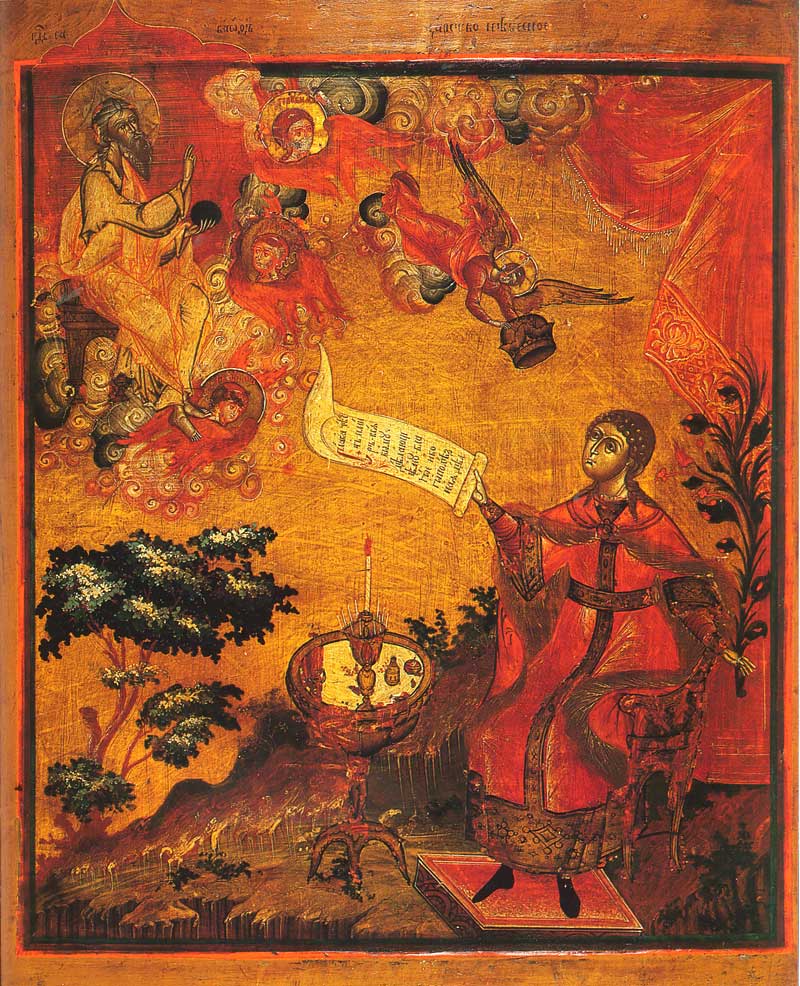
Kingdom_of_Heaven_icon_(19_c._S-Peterburg)Church Times this morning: several things catch my eye.

On the one hand, the ‘Church urgently needs a grown-up debate about theology’, and on the other, ‘the afterlife is vital to the affirmation of a God of love’. Are these contradictory?

Is it reasonable to claim to be a Christian without believing in an afterlife? As it happens, I think it is, but for me, today, it doesn’t seem that important. Eternal life is not about life after death, in preparation for which we take out an insurance policy of pious beliefs and actions. Eternal life, ex-temporal, out of time, ex-stasis, in the timeless present—a quality of life, here and now, that we glimpse in the here and now as a result of ego-erasure. This is what death on the cross is partly about as limited self dies and unlimited cosmic reality rises.

Where does this leave what people call the afterlife? I don’t know. I rather think that when the time comes I shall look into the face of the Divine and see myself. I shall not be able to bear the sight, a bit like Gerontius. But I shall take what comes as a result of trying to live life. After all, sin is life unlived.

A great deal of doctrine and dogma that we’ve inherited was drawn up by people in a particular culture with a particular world-view in an attempt to express the inexpressible. SInce then, words and ideas have been translated and pummelled to the limits of elasticity—maybe beyond. Some of this doctrine and dogma has passed its sell-by date. But it doesn’t matter: it can be honoured for what it is—poetic imagery, much of very great beauty. I will not try to pin it down to twenty-first century interpretations in an ‘anxious desire for relevance’. To describe God is to limit God.

Which brings me on to two other issues from today’s Church Times. Angela Tilby says what I’ve felt for ages: the traditional Lord’s Prayer is easier to say and remember than the modern versions, largely because new versions were drawn up by people without appreciation of musical patterns of speech.

SONY DSC

A quality cope

And lastly, vestments. There are moves afoot to do away with rules about what clergy are required to wear. Already bishops turn a blind* eye to widespread flouting of the rules. What is a uniform for? I was in a primary school yesterday where the male teachers (hurrah!) wore collars and ties (hurrah!). How can pupils respect what a teacher stands for if s/he is scruffy?

As I typed the first draft of this, the word bling* appeared instead of blind. So today we have a picture of thoroughly modern Bishop dressed in a newly commissioned cope that puts me in mind of Stonehenge and satanists. I’m not a great cope-wearer myself, though they lend a bit of dignity and respect at a funerals, weddings and of course at Benediction, but when I wear a cope it’ll be one that looks like a quality carpet wrapped round the shoulders and is decorated with traditional symbols. It will not be one that shouts ‘look at me, look at me, look at me’. Which takes me back to death on the cross as ego-denying behaviour.

Mission through tradition is the strapline for me.

Exchanges

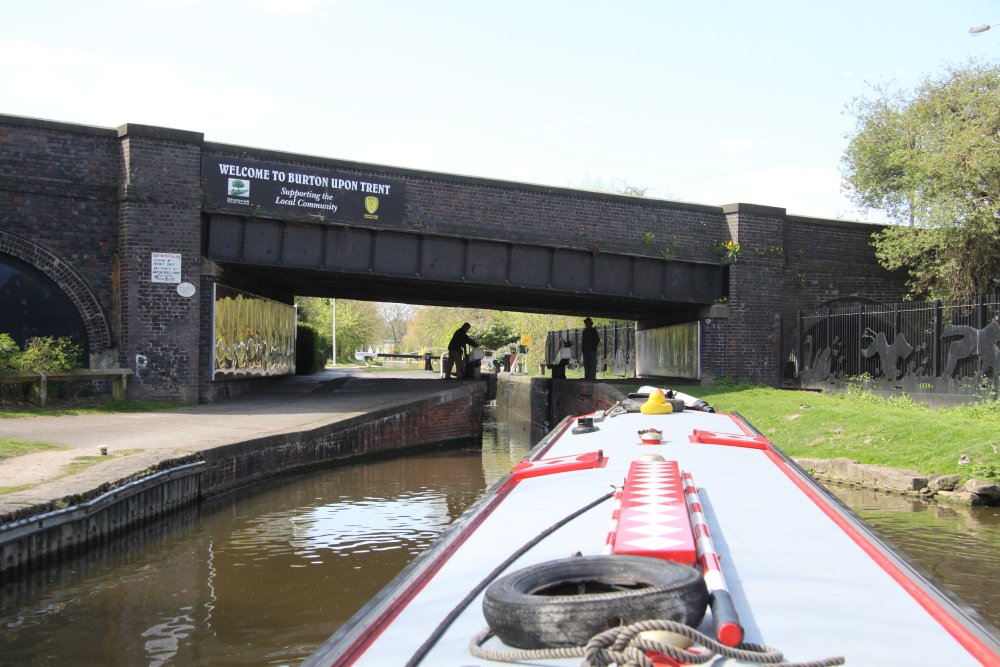
Dallow Lock (copyright Tuesday Night Club)

Dallow Lock (copyright Tuesday Night Club)

We exchanged our UK driving licences for Irish ones only last year. When we knew we were moving, we wished we hadn’t. But full marks to the DVLA: one phone call without hours of tinny Vivaldi, one form, one photo and new licence by return of post. Simples. I wish I could say the same for utilities and car insurance.

The Trent and Mersey canal is a few streets away. Barges, holiday makers, fry-ups at Shobnall Marina café, watching and helping at Dallow Lock, gardens backing on to the towpath. I’m put in mind of the Cam. Colour, gentle movement, industrial archaeology, swans guarding their territory and hissing at Og the dog, moorhens and chicks, ducks and ducklings. Delightful.

People talk about beauty of moor and mountain, but a rural Cumbrian childhood in the 1950s was mind-numbingly monochrome. The Lake District (Sunday drives) was slate grey, conifers and rain. Fellside village culture was repressive and lonely for a boy who liked neither football nor cricket. Perhaps this is why I like colour and variety. Richness. Religion too: ritual, colour, fine sights, fine sounds, fine smells, with prayer and lots of parties. No more sensory deprivation.

On the one hand:

Protestantism – the adroit castrator
Of art; the bitter negation
Of song and dance and the heart’s innocent joy –
You have botched our flesh and left us only the soul’s
Terrible impotence in a warm world.
R S Thomas 1995

… and on the other:

Wherever the Catholic sun doth shine,

There’s always laughter and good red wine.

At least I’ve always found it so.

Benedicamus Domino!
Hilaire Belloc

Retreating

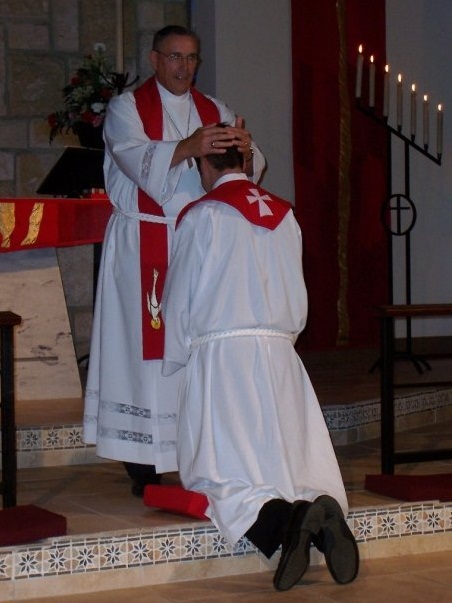
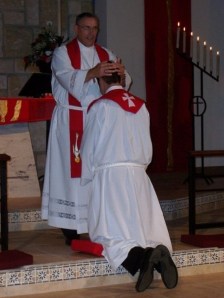
Lcms_lutheran_pastor_being_ordainedI recently led a retreat for an ordinand and four readers about to be licensed. Here is the sermon I preached at the ordination. I have changed one name.

One of the things Elijah was asked by the Lord was ‘why are you here?’

Why am I here? It’s been a real delight to have been with you all over the last four days, and I thank you for the invitation to be part of it. We’ve spent much of the last few days exploring aspects of what it means to be human. Not the artificial hail-fellow-well-met sort of humanness that you get at meetings and social gatherings where people are trying to impress each other, façade speaking to façade, but the heart speaks to heart humanness that is actually divine. Yesterday, we celebrated St Irenaeus, one of whose most famous utterances is God the Logos became what we are, in order that we may become what he himself is. To be fully human is to approach the divine.

When we live life to the full, we approach the divine. In the words of Charles Wesley, made like him, like him we rise. That is what the festival of the Ascension is about: our humanity – all of it, every jot and tittle – shared by Jesus – is taken to heaven, that is, made Divine.

Being fully human is what the priest needs to be. To give his all, all the time. Being fully human doesn’t mean we do what we like: it means we use our God-given talents to the full. We all have the Divine spark embedded within us like a divine pilot light, so becoming fully human means letting that divine pilot light expand to fill us from the inside, squeezing out what St Paul calls the flesh—that is ego, selfishness, pride, conceit, pomposity, ‘all the vain things that charm me most.’ When heart speaks to heart, the divine core inside does the work, and the resultant pastoral encounter is powerful beyond measure. I concentrate on pastoring for that is what I sense Peter’s principal calling is, and it is what he thinks it is.

Pastoring is not about telling people what they want to hear. Pastoring does not mean tolerating nonsense from people who should know better. One of the functions of the priest, as we shall soon hear, is to admonish. Warn. Point out consequences of foolishness where it exists – and it is widespread in the church. Members of congregations don’t like it when the priest admonishes them, but, Peter, don’t be put off. If people are acting childishly—and there is something about the church that infantilizes people—they need to be told, and it is the priest’s job to tell them. Good luck with that.

If you walk into the sacristy of an RC church, you will certainly see a picture of the Pope. If you walk into the vestry of a Methodist church, a picture of one or both Wesleys. In a Presbyterian church, a picture of Calvin perhaps. What do you see in an Anglican vestry/sacristy? I hope you don’t see a picture of the Bishop – they’re exalted enough. In Portlaoise vestry I could gaze upon the faces of almost all my twentieth century predecessors, for it is well known that the foremost authority on all things is the previous Rector. But in an Anglican vestry I bet you anything you will see a mirror.

Imago deiPeter, you need to spend time gazing into that mirror. Not simply to check that vestments are on properly, important though that is. Certainly not to give yourself airs and graces and big yourself up with what in Portlaoise they call notions. But to look into your own eyes, and heart, and ask yourself ‘what am I doing here?’

What are you doing here? What are you doing here? What are you doing here?

Who is you?

How does your face show forth the divine core inside? What is the relationship between them? For the priest to function authentically, it’s essential that the part of the Divine Lord that exists as the pilot light in you is allowed to reach the surface and shine out.

Peter works with people. He has always worked with people. I have observed him over the last four days. He knows how to listen. I have listened to him. His observations and reflections come from deep within; they are not superficial or meretricious. They are not calculated to ‘show off’: they are profound enough naked, as it were. And most importantly of all, unlike many church people, he knows when to shut up. He has a natural openness, and my guess is that he is a good comforter—not in the sense of sickly sweet there, there, but in the true meaning of comforter, that is, strengthener.

It seems to me that Peter is on that road that Irenaeus wrote of when he said: The glory of God is a living person and the life of man is the vision of God. He will be, I predict, a robust and authentic pastor. Good luck with that.

He is a man of science. Before I was ordained I was a medical school teacher of anatomy and embryology, so I predict that he will be asked to justify church teaching that goes against all known facts of biology. He will be asked why the House of Bishops seems to believe that there have been no developments in biology since Aristotle. My advice to him is: don’t try. It’s simply not possible. He must develop his own strategy for coping with the church’s headlong rush into a new Galileo debacle. Good luck with that.

He brings to ministry his humanity, his authenticity, his love for the Lord. He brings his eccentricity. And he brings his sensitivity. The big challenge is not to let pastoral energy and sensitivity be drained away. There are three things that will do just that if you’re not careful.

The first is an institutional problem. Although the number of people attending church is falling, and the number of Indians is falling, the number of chiefs is not, the number of initiatives is not, and the amount of paperwork is not. I’ve found that my most useful office accessory is a large box by the side of my desk into which I ‘accidentally’ drop stuff that ends up in the recycling bins. It doesn’t seem to matter.

Then, there are personal issues that sap energy and disable gifts. And the greatest of these is stress. I’ve been a doctor, a medical school teacher, and a Professor, but there’s a relentlessness and emotional involvement about this job that is more demanding than anything else I’ve done. Hospital doctors have time off, leave the hospital and get drunk. Lecturers go home. Clergy are always expected to be available, and perfect. Relentless is the right word.

Most clergy stress is not caused by what you have to do, but by what you don’t do, but think you should. Much of this guilt arises because we have to bear the expectations of others that developed in past days when clergy were much thicker on the ground. Only you live in your skin. Only you can know what your priorities are. If parishioners are offended by something you’ve done, or not done, in good faith, that is their choice, not your responsibility. Try and ignore expectations that others dump on you. One of the things I find most difficult—you see, I fail as a vicar—is dealing with people who think that my sole purpose on God’s earth is to help them find the grave of their great great great grandmother. No matter how often I tell them, they just don’t get it that I don’t care.

The third trap into which you may fall is that you may, just may, be tempted to be nice. For the best of reasons, usually, we want people to think well of us. But Deacon Evagrios back in the 4th century wrote that the worst demon of all, because it leads to all the others, is that which incites us to seek the approval of other people. It is NEVER worth having. Our task, it seems to me, is not to please other people but to reflect the Master to the world. Jesus was not nice. St Paul was not a nice man! The bishop of Carlisle said not too long ago that the CoE was in danger of dying through too much niceness. Jesus was challenging, impatient, provocative, almost rude on occasion. He goaded people to confront reality. This is what healing is, and it is what Jesus’ whole ministry was about—healing. The process is not nice: it is about seeing the world full on, straight on, face-on. A face that is uncovered lets the real you shine out to the world. A face that speaks the truth.

Speaking the truth, and exposing one’s thoughts and fears is exhausting. And that is why you need to be careful to follow Jesus’ example and take frequent solitary R and R breaks. Say no. Slow down. We can’t reflect Jesus if we don’t spend time with him. Good luck with that.
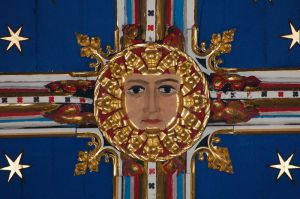
Eyes that see do not grow old

Eyes that see do not grow old

There’s no need for you to be perfect. St Peter was certainly not perfect. We do a better job when the soft and vulnerable centre is exposed to the world, rather than the smooth exterior. Like chocolate éclairs: that lovely moment when the goo inside is reached. If you put a lamp inside a large plant pot, you will not see the light unless there is a defect in the pot. A crack will let the light out. You must be a crackpot. Only through your cracks, defects, wounds, will your true humanity shine out and be able to do the work of a priest. And remember, true humanity is divine, as Irenaeus said. Find a soul friend to whom you can expose yourself – metaphorically I think – and of course you have your family. Expose yourself to your wife and family. Good luck with that.

And lastly, Peter, never allow yourself to become instutitionalized, and never cease pricking the bubbles of pomposity.

At this ordination service we are giving thanks. We are affirming your ministry and commending it to the future. We affirm ourselves, too, and commending ourselves to the future with you, supporting you in every way possible. Here are some words of St Paul.

I wish you all joy in the Lord. I will say it again, all joy be yours. Let your generosity of spirit be manifest to all. The Lord is near; have no anxiety, but in everything make your requests known to God in prayer and petition with thanksgiving. Then the peace of God, which is beyond our understanding, will keep guard over your hearts and your thoughts in Christ Jesus. And now, my friends, all that is true, all that is noble, all that is just and pure, all that is loveable and gracious, whatever is delightful and admirable—fill all your thoughts with these things; … and the God of peace will be with you.

And now, go forth upon your journey from this place, in the name of God the Father Almighty who creates you; in the name of Jesus Christ who redeems you; in the name of the Holy Spirit who strengthens you; in communion with the blessed saints, and aided by angels and archangels, all the armies of the heavenly host, and by the thanks and prayers of all of us who know and love you.

Oremus pro invicem. Blessed be God for ever. Amen, Amen, Amen!
Belly button theology

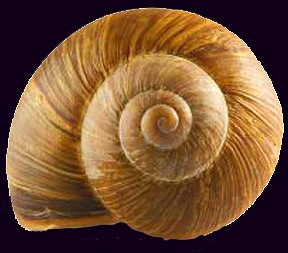
SnailShell45Emmaus road in Assembly this morning. The seniors stay back afterwards and we explore some ramifications. Then we consider the umbilicus. Is there a connexion? I’ll get to that in a minute. The thing is, you see, that I’d had occasion to draw attention to a young man’s visible belly button to get him to sit upright. So, the umbilicus.

Anybody know what it’s for?

For a cord.

Connecting to what?

Mammy.

OK, says I. Really, it goes to the placenta, which then plugs into mammy. Has any of you seen horses or calves or pups being born? And some of them had. (No cats: cats should never be born).

I find the belly button very useful. When you’re eating in bed, you can put the salt in it to dip your food into.

They recognized this as a joke.

And, says I, if you get a screwdriver you can unscrew the umbilicus so that your bottom drops off. Yes, cynical reader, I did indeed use the word bottom, though it wasn’t the word that first came to mind.

They did not recognize this as a joke. I had to confess. Then they thought it uproariously funny. Strange isn’t it? eating salt they did, unscrewing they did not.

Emmaus and umbilicus—is there a connexion?

New life, nurturing, feeding, serving. The two-way traffic of nutrients going one way and waste products the other. One universe contracting down enabling another to open up. Cosmic renewal, the means of refreshment, exchange, vivification.

Admirabile commercium.

One hell of a ride


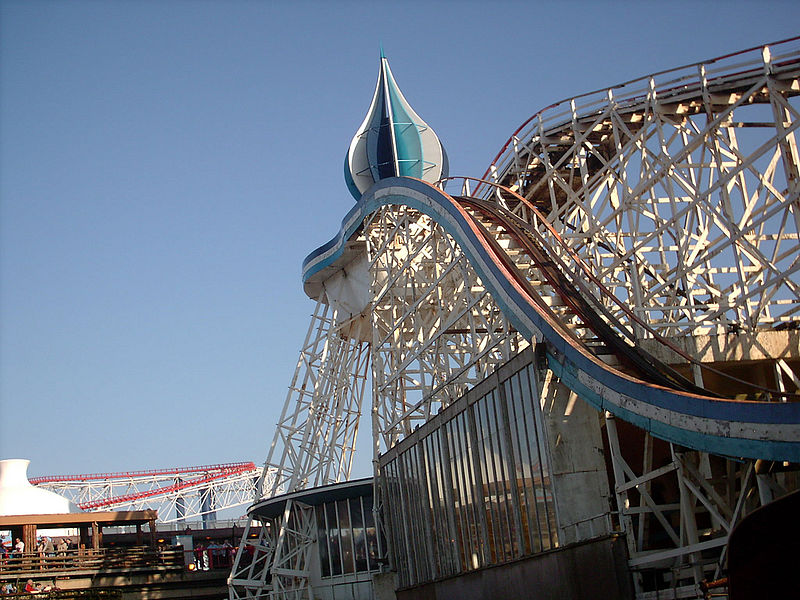
Blackpool Pleasure Beach. Bliss!

Blackpool Pleasure Beach. Bliss!

Easter Sermon 2014

Picture the last supper. You are Jesus. Around the table are the motley crew of people who have attached themselves to you. Maybe you don’t like some of them. Maybe they’re not all that keen on you, but something makes them stick. You know that some of them plot behind your back. You know that some of them jostle for the place of deputy. Some of them have mammies and possibly daddies who are not above trying to get favours for their little darlings. They say one thing to your face, and something else behind your back. Some of them do the dirty on you. And all of them dissolve into thin air when the going gets tough. There is something of Satan in them all.

This, girls and boys, is us. In a few minutes time we will kneel at the altar and share in the holy mysteries. Next to you will be someone in one or more of those categories—and so are you.

Get over it. Getting over it is resurrection.

Forgiveness is resurrection. Put the past behind you. Don’t forget, but rather learn from whatever happened. If we do not forgive, we hurt ourselves more than we hurt the person we think has offended us.

Imagination is resurrection. Think how things could be better. Think what might increase the amount of delight in the world and work for it. Work, that is, from where we are, not from where we would like to be, or where we used to be. This means beginning by taking stock of reality.

Breaking down barriers is resurrection. We spend our lives building our own tombs, constructing them from the inside.

  • We’re careful about how we seem to our friends – Facebook is designed for life in the tombs.
  • We’re careful not to think too much or too deeply about anything, especially about ourselves and who we are.
  • We’re careful not to say too much or to show our thoughts.
  • We kid ourselves that we’re making ourselves safe as we build our tomb stone by stone. Stones of possessions, attitudes, notions, postures, bank balances, club memberships, prejudices. Then when we put the last stone in place, we reach that moment when we feel completely safe. Smug. We cut out the last ray of light from the outside, and we sit in the artificial light of the windowless room. There we stay, physically alive and spiritually dead.
  • We shut ourselves off from life and from the Divine. We inclose ourselves in our own fat. We are so careful about controlling our lives that we exclude everything and everybody.

Those who want to save their life will lose it, and those who lose their life for my sake will find it. Two different sorts of life: one risk free but spiritually dead, the other vulnerable and risky but alive. Like standing on the top of Everest and shouting ‘I’m alive, I’m alive, I’m alive!’ This is the real me living life to the full.

Resurrection is about breaking down barriers. The chick smashes its way through the shell. Nobody can see the light if you hide it. Nobody can see it unless you smash the pot it’s in. As we demolish barriers, we will feel vulnerable. When we are most vulnerable we are most in touch with, and completely safe in, the Divine. Some of you think I talk too much about death. That pleases me, for the main job of the priest is to prepare people for death. It’s good to get to the end of life feeling that it’s been one hell of a ride.

And that’s perhaps the best way of looking at resurrection: making life one hell of a ride. A very happy Easter to you all.

Chucking and clubbing

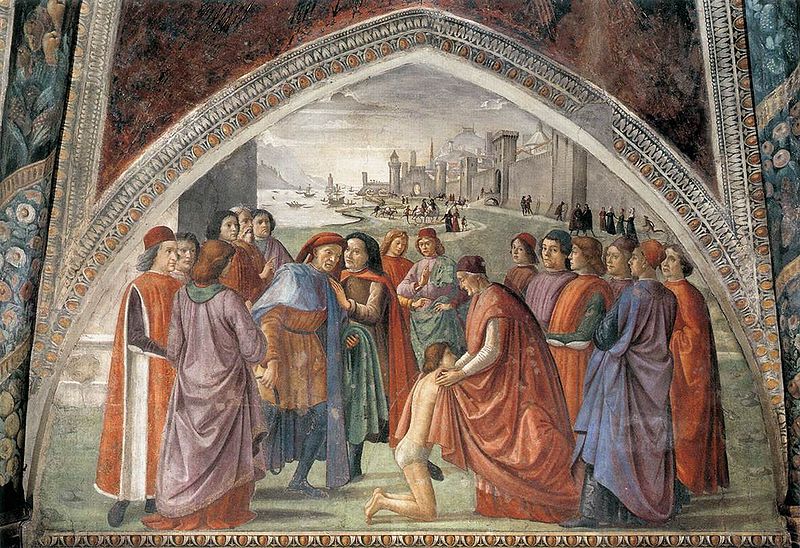
800px-Cappella_Sassetti_Renunciation_of_Worldly_GoodsSWMBO is a hoarder. I’m a chucker out. So we have rows.

In the last 15 years we’ve moved six times, chucking out each time. But then we accumulate more, and it’s not from parents for they were dead 20 years ago. Before we die we’ll likely as not be in a two up, two down, and we’re chucking out now.

I can’t speak for her indoors—wouldn’t dare, though I know she finds it painful (‘books are my friends’), but I think it liberating to see the back of stuff I don’t need any more. There’s nothing like a bonfire.

Take my books. Over the years I’ve collected a vast number. Lots of them signified a club I thought I wanted to belong to: organ building, Greek, Latin, Sanskrit (how stupid is that?), a bit of philosophy, theology, medicine of course, embryology. Organ and piano music too. When I was a teenager and wanted to be a cathedral organist I stocked up on all sorts of music. I look through the library and think ‘I’ve never touched that in the last 20, 30, 40 or even 50 years; I’m not likely to in the next 20 if I live that long (family history not encouraging there), so out it goes.

And it has. I’m very grateful for the ‘ministry’ of Sue Ryder, theological colleges and musical friends. I’ve kept stuff that interested me when I was a child (zoology), music that I could well get round to playing, and  books that speak of beauty and that I might find useful (some theology). But that’s all.

The question is: why did I want to belong to those clubs? Why do we want to join sports clubs or golf clubs (I’m not old enough to play golf) or drinking clubs or backslapping clubs where we stitch up local business to our own advantage? Is it because we feel we have no identity unless we are part of a mob? The story we read on Palm Sunday says a good deal about the mob.

Maybe it’s because we become infected by a demon. Back in the fourth century AD Evagrios the Solitary wrote that the demons that fight us in the front line are those entrusted with the appetites of gluttony, those that suggest avaricious thoughts, and those (worst of all) that incite us to seek the esteem of men. I think it’s the last one that makes us want to join clubs: the craving for recognition by those whose recognition is not worth having. He knew a thing or two did Evagrios the Solitary.

Out goes the rubbish. Maybe I’ll end up sanyassi.

Sex in Swords

288px-Kynodesme_imagePeople from three C of I dioceses met today at the Emmaus Centre in Swords, County Dublin, to discuss sexuality. I’m not sure why. Simply exchanging views perhaps. The dioceses involved were Connor (north-east Ulster including much of Belfast), Kilmore, Elphin & Ardagh (north central Ireland including Cavan and Sligo) and this diocese (the ‘sunny’ south east). There was a wide spread of opinion, since it’s a fairly reliable rule of thumb that in the C of I south is liberal and north conservative. Here are some thoughts.

  • Some people don’t believe in evolution, one giving as justification the ‘fact’ we don’t have tails. He was serious. Does he know that at a certain stage of embryonic development, we do have tails?
  • Some think the Bible to have been ‘written by God’.
  • Some take the first creation story literally: ‘Adam and Eve, not Adam and Steve’ – yes someone actually said that, but are silent about whether Adam was one rib short after surgery.
  • One person was ignorant of the facts of biology and was determined to remain so. I enjoyed, though, discussing with a farmer the ways that cows and bulls play with each other’s genitals.
  • Many felt that of St Paul’s list of sins in 1 Corinthians 6, one—homosexuality (a dubious translation but the one that was used)—should be taken seriously, while others could be glossed over. This is probably just as well since the list includes greed, and there were plenty posh cars in the car park and fat people in the room. As for others on Paul’s list, for robbers think bankers and for slanderers think gossiping after services. And as for church members resorting to law to settle disputes, which Paul hammers, you wouldn’t believe what goes on if I told you.

The conference took place on the day gay marriage became legal in England and Wales. The Bishop of Buckingham, a courageous man, is reported as having said that several English bishops are in civil partnerships, but have not admitted it publicly. So much for honesty there.

Members of the Church of Ireland have a choice. They could continue as now, some of them convinced that they alone know the mind of God, and spitting venom at people who disagree with them. Or they could accept that there will never be agreement, that what consenting adults do with their bodies to express loving and faithful commitment is no business of anyone but those involved, and deal instead with stuff that really matters: economic evil, exploitation, greed, avarice, and spiritual wickedness in high places.

A day wasted, and at my age I can’t afford any more of them.

Spooky

Bohr and Einstein

Bohr and Einstein

Nigel and I were discussing spooky events. He was telling me that people he once knew popped into his mind for no apparent reason, and shortly afterwards he heard that they’d died. I was remarking on how often I’d felt compelled to contact people who came into my mind, only to find that they were having a really tough time. This was particularly so for family members.

Normal electrical activity in the brain influences the environment to the extent that if you put electrodes on someone’s head, you can pick up brain waves more than 5 mm away. So, if someone is experiencing extreme emotions, could it be possible for the intense electrical brain activity to affect the physical environment? Does this account for poltergeist activity?

I’ve never knowingly encountered poltergeist activity, even though I’m convinced things move after I’ve put them down, but I’ve listened to several people who witnessed such phenomena and whose word or sanity I have no reason to doubt.

What’s occurin’?

Imagine two particles (electrons, say) from same source. Now let them be separated by a large distance. If the ‘spin’ of one of them is changed, the ‘spin’ of the other changes—even though the particles are so far apart that any information passing from one to the other would need to travel faster than the speed of light. You might say it would have to travel infinitely fast.

Quantum physics demands phenomena like this that operate external to time (e-ternal, ec-stasis), or at least ignore time as they ignore distance. Niels Bohr, one of the developers of quantum theory, is reputed to have said ‘anyone who is not shocked by quantum theory has not understood it’.

Can anyone understand what’s going on?

If all humans came from one, or a few, ancestors, then we share particles from the same source. The notion that what affects one affects all is then by no means unlikely. Every one of us carries around material from the primeval soup: nucleic acids, elements, electrons, quarks or whatever. The notion that what affects one affects all is then by no means unlikely. Perhaps this is why dogs know when you’re upset.

Think twice about swatting a fly: it might be intimately connected to you in ways that you can’t imagine.

Albert Einstein played the violin, and his cousin Alfred (a respected musician and musicologist) accompanied him on the piano. After one session, Alfred chided his cousin, saying ‘the trouble with you, Albert, is that you have no sense of time’. A good story, but piffle.