Still small voice of calm

galilee-3A homily for Proper 14. 1 Kings 19: 9-18. Matthew 14: 22-33.

At creation, the spirit hovers over the waters. The spirit brings order to chaos. In Holy Scripture, water, waters, the sea always signify risk, danger, turmoil, the tendency to entropy. We talk of being up to our necks, out of our depths, going under.

Elijah was in it up to his neck. His personal circumstances were to say the least a bit sticky. He found the spirit of wisdom not in the noise, the storm, the wind, but in the silence.

Life is a bit sticky. We fall out with people, sometimes their fault, sometimes ours, usually both. We struggle with fractious families, tedious jobs, unyielding rules, unreasonable expectations, addictions, and more. Will we find wisdom in more noise, more words, more busy-ness? Will we find wisdom in a bit of solitude and silence? How can we hear the still small voice if we crowd it out with noise and crackle? The spirit came to the disciples as they were in it up their necks. Calming wisdom bringing order to disorder, cosmos to chaos.

Sit back. Silent. Still. Perhaps the answer to the question the Lord asked of Elijah will become clearer to you.

What are you doing here?

Making waves

4604300082_a0f1293f46Baroness Warsi has been hitting nails and nerves with her comments about public school toffs in the UK cabinet.

It puts me in mind of 1969, a new boy at Cambridge. Students from public schools were at home from day one. College was simply more of what they’d been used to at school. There were quads, courts, chapels, libraries. There were common rooms, ‘screens’ and ‘staircases’. There were gowns, gyps and bedders (no, not like that). There were shared toilets and no hot water. For these boys, the  jargon, the culture and the ethos were just more of the boring same-old-same-old.

For me, it was exotic and exciting and romantic. And not a little daunting. More daunting still was my reaction to noticing the ennui of the posh boys. It took some effort not to be cowed by it and them, and their tiresome efforts to mimic a northern accent so that I could feel at home.

Despite this, it was membership of an élite club. Or so I thought.

I guess the atmosphere at Westminster is the next step on the ladder from public school and Oxbridge. Despite the influx of women, I don’t suppose it’s changed much. In fact, maybe because of the influx of women the Hooray Henrys have become more hooray-henry-ish in at attempt to keep their end up, so to speak. All very silly.

I’m reading again The Raj Quartet by Paul Scott (Jewel in the Crown for TV buffs). Hari Kumar was ‘too English for the Indians, too Indian for the English’. Baroness Warsi comes to mind, and indeed everyone who is too big to fit into little boxes all the same and made of ticky-tacky that are manufactured for them by unimaginative apparatchiks.

Trespassers will not be prosecuted

il_340x270.433804045_renxWe’re going back to the ‘old’ Lord’s Prayer. When I announced this at a PCC meeting, there were smiles and several utterances of ‘oh good’.

The rhythm of the ‘old’ rolls off the tongue more easily. It’s more like poetry, and so is easier to say, easier to remember, and it more quickly becomes familiar.

The ‘new’ is neither one thing nor the other. It ‘modernizes’ some things and not others. The trouble with modernizing is that it needs to be done regularly as words and concepts change meaning. This strikes a blow at the idea of having a text known by all ages in all places, and it detracts from the notion that The Divine is immortal, invisible, in light inaccessible, the Ancient of Days – which must be true because we sing it with gusto. The new version retains hallowed but ditches thee, thy and thine. Hallowed is not in daily use, but thee, thy and thine are in many parts of England. Your will be done on earth as in heaven implies that it is not done in heaven, but might be one day. Give us today implies a grasping entitlement that excludes the sense of tomorrow and yesterday that comes with daily.

The ‘old’ form is that used in English-speaking Roman Catholic churches and many other denominations. It’s used in most schools that teach it, and that includes Shobnall and Holy Trinity. Because it’s an Anglican translation, and one that even then is used in only some Anglican churches, it’s like the membership song of a posh club. It excludes people rather than includes them. This matters at funerals and weddings and other big occasions.

Enough!

If you prefer the new one, you can have it back when I’ve gone. Until then, enjoy trespassing.

Conspiracy or cock-up?

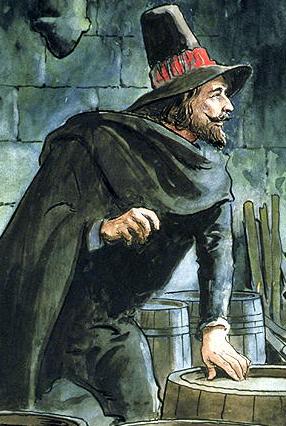
Guy Fawkes

Guy Fawkes

I’m reading Hack Attack: How the Truth Caught Up with Rupert Murdoch by Nick Davies. It’s a relentless switchback of the apparently power-obsessed Mr Murdoch and his empire’s standards. It is at the same time gripping and depressing, two words that came to mind about Alastair Campbell’s memoirs of Blair’s government and Damian McBride’s of Brown’s (which left me feeling sorry for Gordon).

Chris Denning, a former BBC DJ, admits charges of child molestation. Rolf Harris is found guilty of similar charges. Jimmy Savile is condemned posthumously. Cyril Smith is accused, Danczuk’s book being another sad read. There are rumours, easy to find on the internet, that allegations could be made of other public figures, and that super-injunctions have kept them quiet so far.

We all have our problems. I don’t comment on the urges—addictions really—of all these people: we’re all in recovery from something, whether we recognize it or not. But I draw attention to one thing and it is this: the police knew something but did nothing until they were forced to. In Hack Attack we are told that the police hid evidence, or revealed it only very reluctantly, or repeatedly made light of it.

Is this conspiracy or cock-up?

Are we looking at secret societies of the rich and famous, or merely at rectal problems (‘can’t be a**ed’) in the law enforcers? SWMBO says that she has never seen anything more chilling than A Very British Coup by ex MP Chris Mullin (watch it free on 4OD) for a nasty combination of secrecy and malice used to cling to power.

In Alan Bennett’s The History Boys, Rudge wonderfully described history as ‘just one f**king thing after another’. That same sense of relentlessness accompanies these revelations. ‘A blow upon a bruise’, time after time.

As the rich and powerful become richer and more powerful, it doesn’t bode well. Is this really Land of Hope and Glory, Mother of the Free?

Coming to light

1388992556_FreeGreatPicture.com-29281-waiter-tray-positionChucking out has yielded fruit.

At St Aidan’s I found a complete set of maniples. The maniple is the vestment that the priest wears over his left arm, rather like the towel you see on a waiter’s arm in a posh restaurant. And that is exactly what it is. Of all the vestments, the maniple is the one signifying that Christian ministry is about service and waiting. For the life of me I don’t know why it fell out of use. It’s now back in use at St Aidan’s and at St Paul’s, where there’s also a complete set.

Dalmatic

Dalmatic

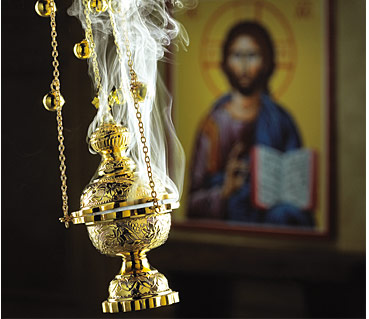
St Aidan’s has been given a book of readings for the lectern, a Book of Gospels to carry in procession, and – praise be – a thurible and stand for incense on special occasions. This is wonderful. Holy Scripture duly honoured.

St Paul’s, not to be outdone, has been given a green dalmatic. This is the vestment worn by the deacon (assistant) at mass. There are several white and gold dalmatics and one purple one, but until now no green one, and no red one. Anyone out there like to give us a red one? Don’t hang back. Whatever the dalmatic’s function is or was, it looks lovely. We do well to remember that beauty of all sorts is part of the Divine.

I wonder what other treasures will come to light.

God bless this mess

MouldyBooksWent to the dump this morning.

I like dumps. I like the mess. I like the outskirts of towns with the randomness of buildings and telephone poles and wires. I like the scattering of car shops, tyre shops, furniture shops, bathroom shops, burger shops. I like Derby road in Burton. It’s all so normal somehow.

It’s sad to see farming villages neat and tidy. ‘Cotswoldized’ is the word I use. They should have dogs barking and cows mooing and cow dung decorating the roads. And smells. That’s what farming villages are for. It’s depressing when the chattering classes move in with their A-K-ya accents, their Chelsea tractors and their notions. It’s all so sterile. We’re too clean. No wonder our immune systems don’t cope like they used to—they’re not challenged enough.

Some people have a vision of heaven that’s ordered beauty. A Midsomer village where one’s friends live in ochre-cloured cottages along the banks of the stream, behind Kentucky-fried Georgian doors. I hope not.

censer-incense-burner-01Sunday Mass is heavenly. Sounds, sights, smells. Incense smoke curling up through stained glass sunlight. It’s a mood altering substance: it alters mine anyway. Music to aid devotion rather than simply excite. Order, certainly, but with a joyful tendency to entropy. Acolytes doing their own thing, the occasional wanderer from the pathway brought back with a quiet hiss to attract attention. Then giggles. Where is the thurifer? Where are my specs? I’m in the wrong place again. I forget a book and have to ask someone to pass me it. And then, charismatic soul that I am, I do something spur of the moment. Loosely ordered humanity. I hope this is more what heaven’s like.

Down with cleanliness, down with tidiness. Eat dirt—it’s good for you.

Mary Magdalene ruminations

rp7200717050917arc_phtGenesis: In the beginning, creation.

Genesis: Eve and Adam: separation from the Divine; expulsion (death) from a garden.

John at Christmas: In the beginning, creation.

John on Good Friday: death in a garden, fracture, alienation.

John at Easter: early on the first day … in a garden. The second Adam. New creation.

John at Easter: Mary (that is, humanity) reunited with the second Adam. Restoration. In from the cold. If Mary the Mother of God is the feminine of the Divine, Divine Sophia (wisdom), a type of humanity, might not Mary Magdalene be also a different type of humanity?

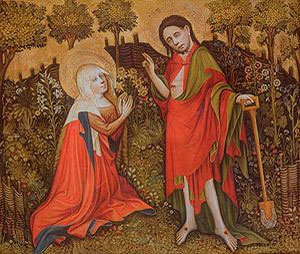
Jesus said ‘Mary’ and she knew who he was. New creation.

Mary Magdalene was right—he is the gardener. Lancelot Andrewes Easter Sermon 1620:

A gardener He is then. The first, the fairest garden that ever was, Paradise. He was the gardener, it was of His planting. So, a gardener.

And ever since it is He That as God makes all our gardens green, sends us yearly the spring, and all the herbs and flowers we then gather; and neither Paul with his planting, nor Apollos with his watering, could do any good without Him. So a gardener in that sense.

But not in that alone; but He it is who gardens our ‘souls’ too, and makes them, as the prophet saith, like a well-watered garden;’ weeds out of them whatsoever is noisome or unsavoury, sows and plants them with true roots and seeds of righteousness, waters them with the dew of His grace, and makes them bring forth fruit to eternal life.

But it is none of all these, but besides all these, no over and above all these, this day if ever, most properly He was a gardener. Was one, and so after a more peculiar manner might take this likeness on Him. Christ rising was indeed a gardener, and that a strange one, Who made such a herb grow out of the ground this day as the like was never seen before, a dead body to shoot forth alive out of the grave.

 Jesus refuses her touch: Do not go on touching me … there’s work to be done. Go and tell the others … Resurrection and ascension are one process in John.

Jesus and Mary Magdalene are Adam and Eve, reunited, in the garden. The lover and the beloved in the Song of Songs in the garden of love. Mary Magdalene is in Paradise, and so are we, if only we can see it. Jesus’ reborn body is the Holy of Holies, for the veil of the Temple has been destroyed. Now at dawn, redeemer and redeemed are together again in new Eden. ‘all creation is made new’.

Frances Hodgson Burnet’s The Secret Garden has resonances.

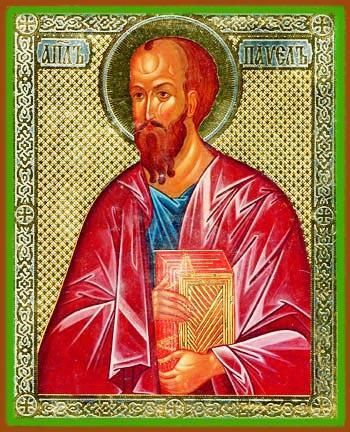
St Paul

$(KGrHqUOKkME4mZZv,)gBONZKivDDg~~0_12The Epistle for this coming Sunday goes on a bit. It demands amputation. A decision about the incision site will be made on Sunday morning. But setting aside the need to keep up a sense of liturgical movement, as I read more of Paul I am more and more in awe.

He gets a bad press. Some see him as misogynistic, repressive and peremptory. I see him as a Boxer pup with boundless energy. He nips your ankles and jumps up and down, pestering and licking you like young Fido trying to attract your attention to get his message across. He doesn’t give up.

He repeats himself time and again. He says the same thing in different ways, each directed to his particular audience: rescue (from drowning) for seafarers, redemption (of loans) for businessmen, liberation for captives, justification (getting things straight) for craftsmen and draughtsmen. And so on. All different ways of saying the same thing: salvation. Sanctification was John Wesley’s term—and he is usually spot-on. Theosis is the term I like: God the Logos became what we are, in order that we may become what he himself is. A becoming, groaning in pain as we are changed from glory to glory. Metamorphosis.

He can be bad-tempered. I’m with him in that. Take the Epistle to the Galatians. Paul is exasperated, astonished—incandescent even—that people could have been so stupid. It grieves me to hear it read ‘flat’ in church. It needs welly, and plenty of it  Paul is impatient. I’m with him in that too. Life is short and opportunities must not be missed. There might not be another.

Paul is reckless, a bit psychopathic even. I guess he needed to be to do what he did. An easy working companion? I guess not, but then pearls need grit. His apparent bossiness and misogyny to my mind are all simply about trying to stop the fledgling Christian communities from drawing attention to themselves in places where to have done so would have led to persecution and shunning. That’s all.

So what is Paul about? One four letter word.

No, not that one.

Love.

paul-bone_1433084c

Love, pure and simple. One word with so many meanings and resonances. Sharing, encouraging, warning, admonishing, rescuing, caring, nurturing, forgiving … and more. Paul is the apostle of love. His conversion is forgiveness as his past is left behind.

That experience tells us what Paul really is. A mystic. His letters to the people of Corinth and Rome are full of beautiful mystical writing: mirrors, seeing in a glass darkly, knowing as we are known. And Romans chapter 8. It’s stupendous stuff if you see it big-picture.

Quite the most memorable part of a trip to Rome a few years back was St Paul’s Outside the Walls, where he is reputed to be buried. Never mind if he wasn’t, it felt as if he was.