The way it used to be

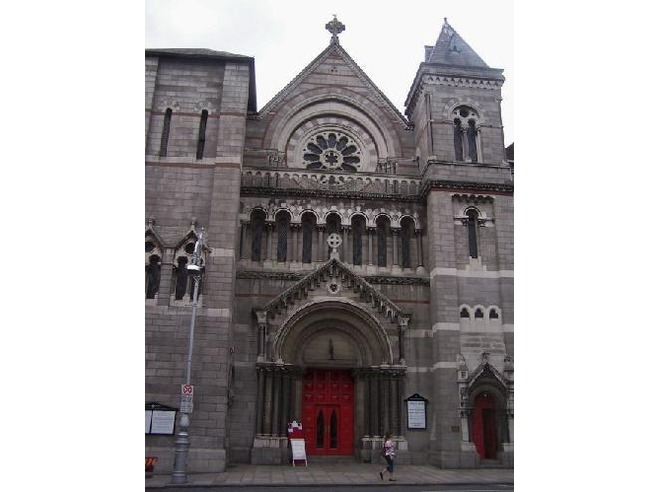
3276135-St_Anns_Church_DublinAs choirmaster at St Ann’s Dublin, now many years ago, I inherited a set up that was still very much in thrall to the choirmaster who died about a decade before. Many Irish church musicians have reason to be grateful to what he taught them. He’d been in post so long that I suspect the men of the choir, who had grown up with him, were still mourning his passing. I arrived on the scene and it was soon made apparent to me that I would never measure up to his memory. My feet were in my shoes and not his, so I just about withstood the onslaught. Since his death there had been a succession of choir directors, none of whom had stayed more than a couple of years, and pretty quickly I understood why—there comes a time when you realize that bashing your head against a brick wall is unproductive. A particularly fond memory was hearing that as the men were queuing up to enter the church, they were kept waiting by someone or something, and were muttering about how long they’d been there. My 16 year-old son, irreverent and fearless, who had been drafted in to lend some accuracy and quality to an otherwise rather wet-dishcloth-like tenor line, could take this no longer and said, very loud, ‘and I’ve been here since 1654’. I suppose you had to be there.

Anyway, the point I’m getting round to is that here I’m much more aware of ‘the way it used to be’ than ever I was in England. This is surprising in a way, for the culture in which I grew up was almost Wahabbi – rural, isolated, conservative, women largely confined to kitchens and bedrooms. In church terms, while women make up the bulk of the congregation, and do most of the work, in some parishes and church institutions it’s all but impossible to get people to vote for them. I refer you to the blog of a neighbouring Rector who is much more trenchant about this than I am.

It’s a human characteristic to hark back to glory days that never existed, but some people seem very good at it. Perhaps it’s because in the old days the tribes were more clearly defined, and comfort was to be had within the fences they provided. The trouble is that the fences are pretty scrappy now: the trumpet blast of increasing transparency and mobility has brought down the walls of Jericho. And a good thing too, for such conservatism, whatever its benefits, stifles creativity and imagination. It can even be dangerous when its adherents refuse to accept that what was appropriate years ago may, because of legislation and changing standards of good practice, be inappropriate now.

To finish the story about St Ann’s, I quickly came to see that the choir of men and boys had had its day. Recruitment of boys was a mug’s game, what with changing family expectations and the move of schools and people from the city centre. Girls were introduced. Mutter mutter grumble grumble. Even that was not sustainable, so a semi-professional group was employed and the Vicar retired the men. I think, on the whole, they were relieved. There comes a time when enough is enough and we grudgingly have to accept that a decent burial is the right thing. In Jesus’s words loosely paraphrased, there’s no point flogging a dead horse*: move on, there’s work to be done.

* though quite a lot have been flogged – as beef.
Magdalene martyrs

Martyrs

Martyrs

From the epistle for today:

My child, do not regard lightly the discipline of the Lord, or lose heart when you are punished by him; for the Lord disciplines those whom he loves, and chastises every child whom he accepts.’ Endure trials for the sake of discipline. God is treating you as children; for what child is there whom a parent does not discipline?

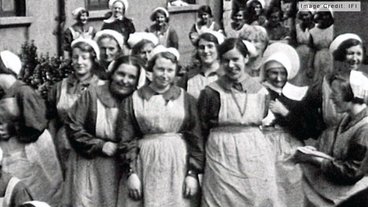
In the week when the report into the Magdalene laundries is published (here), it’s chilling to imagine this kind of text being used to subdue the poor young ladies in those institutions. This is not just an Irish Catholic problem. The first such laundry was set up for Protestant girls. I had a teenage great aunt who, in a close knit Methodist community in northern England, became pregnant outside wedlock. She was thrown out. Her three sisters were all but locked up by their parents, and their mother lived ever thereafter in self-imposed purdah, not even attending Chapel. In those days, and even in my childhood, that was quite something. It’s not just Irish Catholicism that needs to repent.

How long will people continue to twist Holy Scripture in order to oppress? How long will we continue to dissemble? How long will we continue to refuse to acknowledge our shame? Try this for a good read.

In one sense it’s all very sad. In another it’s hopeful. Bringing things into the open is never a bad thing, no matter how painful it might be at the time.

Two spiritual autobiographies

Homecoming

It took me a while to overcome a Kindle aversion. All sorts of reasons: Amazon exploiting the book market, inveigling its way into my mind through cookies, and so on and so forth. And then I thought ‘sod it’ and bought one. So far I haven’t spilt tea on it.

Good for stuffing in your pocket of course. Good for taking on holiday. Good for reading in bed: not as unwieldy as a book. Not good when SWMBO wants the light out and I want to continue reading, for mine is not one of the sexy back lit jobbies. I have a light on a clasp, but that seems to have a life of its own in that the light comes and goes, and so does the whole thing when the spring clasp decides to rearrange itself. Trouble is, though we’ve downloaded a fair number of free books, (for yes, dear reader, Susan acquired one too), most books I’d like to read are not free. So considerable, and where books are concerned rare, self-discipline is called for.

Before I fell asleep on the train yesterday I was reading (kindling?) the second volume of art critic Brian Sewell’s autobiography, Outsider: Always Almost: Never Quite. It covers, amongst other things, the Anthony Blunt saga. Whatever else Sewell may be, and some say snobbish, elitist, offensive, immoral, and much, much more (‘we pee on things and call it art’), he is uncompromisingly honest and without a shred of self-deception. He has the guts to tell it as it is about so-called works of art lauded by the chattering classes. He has taste and discernment, and for that he is pilloried by the luvvies. It’s not the sort of book you’d leave for your 10 year old to read, however. Sewell’s sexual activities are – what’s the word I’m looking for here? – ah yes, educational. He is utterly matter-of-fact about them. As I muse on them, and their significance, I’m reminded that we have no coherent theology of pleasure.

‘Uncompromisingly honest and without a shred of self-deception’ is a phrase that must be used to describe Ruth Burrows. Whether or not you pick up Brian Sewell’s book, I most strongly recommend anything, everything by Ruth Burrows. In her autobiography Before the Living God, this Carmelite nun unflinchingly dissects her human and emotional experiences, the battles that rage in her head, and her responses to them. She shows that prayer is, more than anything else, God’s work, not ours, enabling a journey into self, letting the onion skins fall off as one penetrates ever deeper, in order that the divine within can merge freely with the divine without, no more layers blocking the exchange. (Talk of onion skins puts me in mind of the donkey in Shrek and parfaits. Oh, never mind.) This requires courage and honesty to see ourselves as we really are. More than any other contemporary writer, I think, Ruth Burrows shows that to be holy is to be fully human, hiding nothing, accepting everything about ourselves in order to let the hell be loved out of us. Love your enemies, especially the enemies that live in us.

Eyes that see shall never grow old

Eyes that see shall never grow old

So, then, could Brian Sewell be called holy, or fully human? I suppose that depends on what he thinks of the battles that go on in his head, and only he can know that. We all have these battles. Some are more aware of them than others. When I take out my brain to look at the stuff that goes on in my head, I begin to glimpse what Ruth Burrows has known for a long time, that liberation means freedom from, not freedom to. We might ask ourselves: freedom from what?

What next?

To be avoided

To be avoided

I’ve been in this post for over one full year. It has been an extraordinary year, with pleasures and problems that I expected, and pleasures and problems that I most certainly did not. I could write a book about it, and maybe one day I will. I could certainly write a piece comparing and contrasting life in the Church of Ireland with that in the Church of England, and maybe I’ll do that too.

I’ve done everything here once. What next? Some people readily adapt to doing the same things over and over again—some of my colleagues have been in the same post since dinosaurs walked the earth. Others are easily bored and relish new challenges from time to time. Some people are good at steady maintenance, others at being agents of change. The Church of Ireland seems to be more concerned with stasis rather than change, maintenance rather than mission. Mission perhaps implies seducing people from another denomination, and for all sorts of historical and cultural reasons, that’s just not on in Ireland. Apparently.

The trouble is that without mission and without change, there will be less and less to maintain. There will come a point when bills will go unpaid and buildings fall into disrepair. In rural England I came to the view that people cared more about the graveyard than the church. After all, the graveyard was somewhere they hoped to end up, and where relatives went to talk to people they perhaps misjudged when they were alive. Graveyards will survive long after churches become roofless.

Pendolino near Penrith

Pendolino near Penrith

Speaking personally, I would like to be burnt and my ashes scattered by the railway anywhere between Tebay and Carlisle, feeding the earth where the Pendolinos whizz past between London and Glasgow. I want no memorial, no plaque, no headstone. But when push comes to scatter, the family will do what it wants, not what I want. And that’s absolutely right. I’ll be dead, I won’t care.

What priorities should I have for 2013? I’ll ask the parishioners what they would like. I’ll ask them what they think they need, even if they wouldn’t like it. Maybe they want no change. The trouble is that in the blood stream, stasis leads to clotting, clots cause blockage, and blockage often means dysfunction. Or,  another medical analogy, in the guts, stasis leads to constipation. Either way, it’s curtains.

‘An Englishman abroad’

West Kensington

West Kensington

Back in 1988, when I’d recently arrived from Nottingham to work in Dublin, an intellectual asked me why I’d come to Ireland to take a job that could have been filled by an Irishman. This raised questions of Irishness, charity, welcome, and his cerebral stenosis. And my sanity. Back then things were not so good economically as they became a decade later, so maybe the inquisitor was mindful of inherited notions of poverty that, if you believe what you hear, only Ireland has suffered. Self-pity is a wondrous thing. At that time we lived in a money-pit in Co Wicklow, and I worked in Dublin with, amongst others, inhabitants of West-Kensington-by-the-Liffey, whose knowledge of poverty, I can only assume, must have been truly profound. Once these people established that I was related to nobody that mattered and nobody they knew, I became invisible. This allowed me space to observe. And observe I did. Fortunately, I found good friends who had a surer grasp of Dublin’s latitude and longitude.

I come from part of England that has been trampled afoot by conquistadores from Scandinavia, Rome, Scotland, Normandy, Scotland (again and again) and Westminster. And now Brussels. The BBC thinks it’s part of the same region as Liverpool and Manchester. Other institutions regard it as part of Newcastle-upon-Tyne. People assume that my accent comes from Yorkshire. They are all wrong. The churches of the region are dedicated to people like Oswald, Ninian, Kentigern (Mungo), Hilda, Columba and—wait for it—Patrick (how that must sting!). Yet my worthy assailant felt that I was an unwelcome interloper.

I’ve been confronted by a similar question recently from someone who resents eastern Europeans taking Irish jobs. His family depended years ago on one of them finding work in London. Geneticists tell us that there is no such thing as pure Irishness, or pure Celticness, or pure anything. The Celts came from way over east. Aran islanders, I’m told, have genes from Cromwellian soldiers. This must be truly shocking. At a recent Remembrance Sunday political speech, I heard about the sufferings in the two world wars of the French, Germans, Belgians, and Irish, but only of oppression by ‘our near neighbour’. I heard nothing about the sufferings of the Russians who suffered more than the rest put together, but that’s for another day maybe. The faux-Irishness that has infected this culture seems to have grown up really as an anything-but-Englishness.

It’s undoubtedly difficult for outsiders to settle in these parts. Everyone is related to everyone else. Nobody will tell it as it is for fear of offending neighbours and relations. Valley of the squinting windows. This is all the more reason why outsiders are needed—to point out what needs to be pointed out, because locals won’t. Yesterday we heard that Jesus was hounded out for daring to tell his folks that they were getting no special favours from him just because they were his kinsmen. Scriptural readings emphasized that we are all in this together. Plus ça change …

Christmas 2012

nativity_HorenboutBut as many as received him, to them gave he power to become the sons of God

Imagine the shed. Imagine the cold, the sense of being alone. Let’s assume there were animals there. Imagine the creatures, the smells, the dung. Imagine the placenta, the umbilical cord, the blood. Since neither parent was, as far as we know, a qualified midwife, imagine the fear of getting things wrong and the baby suffering. What a mess!

Life is a mess. Relationships don’t do what you expect. Things don’t work out. Actions, or inactions, have consequences. Like a row of skittles where one knocks over the next, and the next, and the next …. actions and consequences repeating themselves endlessly and uncontrollably. This is the glorious mess of being alive.

If the divine was prepared to jump into this mess of humanity, then we don’t need to worry about it. To begin to know the innermost part of the mess that is yourself is to begin to encounter the Lord. Relax into yourself, as you are—after all, you are made in God’s image. Then you will start to see what you can be. Christ is born in you today. That’s the Christmas message. We are all sons and daughters of the Divine Lord.

Christmas is coming, so get stuck in

Get stuck in

Get stuck in

At Christmas we welcome to our churches those who don’t come very often. This bothers some people. It doesn’t bother me. It gladdens my heart. Some so-called Christians mutter about people coming only because they like the sentimentality of candlelight services, or of being reminded of childhood warmth and home. I say, what’s wrong with a bit of sentimentality? Such reminders are part of our longing for something ‘other’ – something that lifts us up from the daily grind. Something, in fact, that gives us a glimpse of heaven (which is not about the afterlife). Bringing heaven to earth. Clouds coming down. ‘Drop down ye heavens from above’. Divinity comes to earth. The exchange when, at the Ascension, humanity ascends to heaven. Charles Wesley’s astonishing hymn: Let earth and heaven combine, Angels and men agree, To praise in songs divine The incarnate Deity, Our God contracted to a span, Incomprehensibly made Man.

Christmas is not about camels, stable, shepherds, ox, ass, star. Much of this evocative paraphernalia is not in the Gospels, though it connects the story to Old Testament Messiah prophecies. The real Christmas message is that the world is transformed when we allow new life and childlikeness to grow within us. This transformation takes place not ‘in them, out there’, but ‘in me, in here’. In Advent we heard of John Baptist calling us to complete honesty of self-examination. The unpredictable supermarket trolley of our psyche, for ever veering waywardly, needs realignment so that, as the Christmas hymn says, ‘O holy child … be born in us today’. When we heed Jesus’ call to childlikeness, and live with straightforwardness, guilelessness, honesty, openness, and willingness to explore, we will transform our view of the world, and so transform the world.

This is not easy and will not be popular. John Baptist so irritated Herod that he was put in clink. The  message of Christ ‘has not been tried and found wanting. It has been found difficult and left untried’ (G K Chesterton). After the end-of-year festivities, we have to gird up our loins for the challenges ahead. There are plenty of them. We have to dredge up endurance and perseverance if we are to hold onto our souls. The New Testament Greek word we translate as endurance does not mean long-suffering patience, taking things lying down and passively, but rather standing up and dealing with the challenges. It means rolling your sleeves up and getting stuck in, using your ‘talents’ to survive, keeping your wits about you. Søren Kierkegaard wrote ‘preparation for becoming attentive to Christianity does not consist in reading many books … but in fuller immersion in existence.’ Which means: get stuck in. Archbishop William Temple wrote: ‘It is a mistake to assume that God is interested only, or even chiefly, in religion.’ Which means: get stuck in.