Self and social

Homily for Proper 6 Year A, 18 June 2023

Last Tuesday three people were killed in Nottingham.  One of them was a first year medical student.  Her parents had been students of mine in Dublin and her maternal grandparents colleagues.  You may have seen her parents on TV.  It will not surprise you to know that I found their words and delivery deeply affecting—not only because of the personal connexion, but also because seeing and hearing distraught parents speaking in public vividly brought back to me memories I wish I didn’t have.

The following day I read that in Worcestershire a nine year old boy had been killed by his mother and her partner.  His death came after a prolonged months-long period of physical and mental abuse.  I want you to imagine that for a moment.  A nine-year-old boy.  Not a baby, but a nine-year-old boy, kicked, beaten with belts and hard objects, having his head bashed and submerged in the bath as punishment.  Imagine what it felt like for that young boy.  Can you even begin to imagine what was going through the minds of his mother and her partner?

Yesterday morning I felt yet more impotent rage at UK honours.  A few days ago it was Johnson’s jollies for mates, and then in the King’s birthday honours it’s to them that have shall more be given.  Compare the vastly wealthy rewarded for charitable work with the people with next to nothing faithfully serving the homeless at shelters, food banks and the like.  I seem to remember that a wise man made a similar comparison about two thousand years ago.

You might ask why God allows this evil and corruption?

God has nothing to do with it.  

It all comes down to human behaviour.  The basic underlying problem is the trinity of greed, avarice, and approval-seeking.  In a word, ego.  In another, pride.

Because of our egotistical vanity we imagine that our opinions and desires are more important than anyone else’s, and therefore that we have every right to bulldoze and bully our way through life.  We see it in international politics, national politics and individual relationships.  Be quite sure of this, sisters and brothers: you are no more than a tiny pimple on the face of the earth.  Don’t get too big for your boots.

The perpetrator in Nottingham, for whatever reason, felt that his only course of action was to impose his will on people who were in his way.  As a result of being at the wrong place at the wrong time, three people were killed and several injured.  

The couple in Worcestershire, who were supposed to be looking after the nine-year-old boy were so wrapped up in their egotistical desires that they ignored their responsibilities to a vulnerable human being and performed appalling acts of barbarity on him.  It’s the worst example I can recall of parental abuse since 2008 when a man near Doncaster snapped his baby daughter’s spine over his knee to stop her crying.

And now the honours list.  “Rabbit’s friends and relations” divvying up the Emperor’s New Clothes among themselves. How they love themselves.

It’s all about egotistical vanity in one way or another.  Pride, the root of evil.  Unbridled ego, the root of evil.  

Don’t imagine for one moment anyone in this church is free from it.  Every time you moan at somebody else for being slow you’re putting your own needs before theirs.  Every time you sit at the traffic lights behind some old trout who’s apparently waiting for a particular shade of green, you’re putting your own needs before theirs.  Every time you are late for a meeting for no good reason you are putting yourself before others.  Magnify all that, and you are quite capable in the right circumstances—or the wrong ones—of sticking the knife into someone else.

There is an answer to this abusive behaviour, and it’s called self-sacrifice.  

We heard about it not long ago in the garden of Gethsemane story when Jesus wrestled, first saying—and I am putting words into his mouth—take this cup from me, I can’t go through with it, before accepting it, saying resignedly OK, let it be as you say, by the way, echoing Mary’s response to Gabriel at the Annunciation.  This is the renunciation of pride and self so that selflessness can flourish for the common good.  

I’m not saying that we must always choose the way of self-sacrifice.  We are animals and self preservation requires us to be mindful of self for our safety and to avoid becoming food for predators.  But we are social animals and that demands a degree of looking out for others—altruism if you like. As with much of life an equilibrium is called for: we must always have an eye on the creatures around us and try to imagine the consequences of our actions for them.

In today’s gospel we hear Jesus giving advice on how to do it: tend the sick, cheer the despairing, feed the hungry.  Have an eye on those around you.  Put yourself in their position.  Ask if there’s anything they’d like you to help them with.  Jesus told us to start local—there’s no need to be too ambitious, just deal with what you encounter day by day.  There’s plenty to do here in Burton.  I said in my Maundy Thursday homily that it is not until we immerse ourselves in serving others that we begin to feel in our guts our own true humanity, for there isn’t room for it to grow until we’ve first shoved out our own self-obsessed wishes.  

As a friend said, all any one of us can do is try to neutralize the ego-pride we encounter by doing what we hope is good in our own small spheres.  Each of us can only do a little.  And as another friend put it, this will help to preserve the timeless values of wisdom, hope and authentic earthed humanity.

Meanwhile, there are grieving people.  Perhaps you’re one of them.  Remember them.

Church and gym

Phoenix rising

I’ve joined Instagram.  It’s the only way I can communicate with some of the guys at the gym.  My IG page has a few photos of me from former lives and clearly some gym “bros” have found them.  Last week one of them—I’ll call him Steve—came over and said “so you’re a priest”.   “Indeed so” I intoned, “though now retired”.   He said “I’m a Christian.  Which churches were you at?” I told him.

I asked Steve if he had a home church.  He told me he used to attend a big independent evangelical church in a nearby town and then for a while a smaller one nearer home, but no church at present.  “So you’re looking for something that suits you?” I said.  He nodded.  

Steve is tall, good looking, in excellent shape, mid 30s, well-spoken, highly intelligent, literate, imaginative, thoughtful, enthusiastic and vigorous.  He runs local businesses catering largely to people of his age group.

Can I suggest a local C of E church?

Not all local churches are the same: some are bigger in every sense and more active than others. Questions go through my mind, some relevant to this church, others to that.

What would Steve make of a huge church with at most twenty people?  Where there’s nobody under the age of sixty-five?  Where music is under-rehearsed and singing half-hearted?  Where readings are inaudible and some readers barely literate? Where preaching lacks a clear message? Where proceedings are unseemly? Where there is no sense of the numinous? Where cringeworthy in-jokes abound?  Where the heating is woeful?

What would Steve make of a congregation that says it’s welcoming, but that in truth welcomes only those who fit its preconceptions of appropriate appearance and behaviour?  What would he make of people cowed by conventions that have resulted in joy and spontaneity being replaced by repressed timidity?  What would he make of a church that’s become an arm of the Evergreen Club or the Women’s Institute?

Steve aside, for he was open about his faith, I wonder about most of his generation.  

Does anyone who had their formative experiences after the late 1960s have any need for God at all?  Ruined castles and abbeys have more meaning for them than cathedrals and churches which are, like homes and gardens featured in Country Life, merely showpieces in the landscape.  

Post-WW2 generations have no need of church for religious and numinous experiences, for these are provided by hobby groups and other associations.  Football is an example.  It has its own cathedrals, bishops, priests, wardens, acolytes, rituals, chants, denominations, rivalries, and public displays.  And football clubs do astonishing work in schools and the local community—far more than churches do.  People of Steve’s age are at least as altruistic and active in community welfare as are churchgoers.  But fund raising in church is about paying the bills and propping up the diocese—there’s nothing left for altruism. Anyway, what decent person of any age would support an organisation that has shielded abusers and whose hierarchs try to wriggle out of responsibility when victims seek truth and justice?  And yet the C of E thinks in its entitled arrogance that a few gimmicks will lead to people like him flocking to church.

I met Steve in a gym, so let’s consider gyms.  Church and gyms have things in common: community, rituals, teachers.  Both focus on ideals: spiritual and physical.  Let no-one suggest that the pursuit of physical health is solipsistic or self-obsessive: care of the flesh is at least as important as care of the inner kingdom.  Churches, in contrast, seem deliberately to foster ill-health with their farinaceous fare and, in some, gossip that murders the spirit.  

Churches claim to care for the mental well-being of members.  I fail to see how the emphasis on being unworthy and miserable sinners achieves that end.  Gyms do better: disciplined physical activity is well known to aid mental health.  Many of us are there for precisely that reason.

I’m amazed at how many gym members confide in me—far more than in churches where it seemed people were terrified that they might reveal something of themselves.  What have we priests done to wound people so?  There is not a great deal of discussion of ethical issues in the gym, but then neither was there in churches, and the urban churches from which I retired were so exhausted trying to survive that there was no energy for other matters.

Gyms encourage discipline and a sense of achievement as we aim for and reach goals.  There is no fat-shaming or any other kind of shaming.  There is no behind-the-hand whispering.  Is this true of churches?  Gyms include all sorts and conditions—women, men, young, old (at nearly 73 I’m not quite the oldest), fat, thin, muscly, skinny, tall, short, 4-limbed, 3-limbed, deaf, partially sighted.  There is no criticism or judgment, just support. 

Does church offer anything that the gym does not?

Struggle

For St Paul’s magazine May 2023

When I was ordained I vowed that I would only ever say from the pulpit what was true for me, personally. In this I am following the example of Anglican theologian and monk Harry Williams. I never met him but to read his writings is to get some idea of the man. You can glimpse his inner turmoil, his difficulties in finding God (his autobiography has the inspired title Some day I’ll find you), and his struggles with the conventions of society, with the conventions of religion, and with the conventions of church.

Maybe because of all this his joie de vivre shines through, effervescent and impish, pricking pomposity and getting to the heart of the matter. After a difficult time in a London parish he resolved he would never say anything that was not wrought from his own experience. I admired that when I first read it and I admire it still.

I will preach only homilies that are born from my experience. I will never preach sermons that demand merely, as so many do, that we worship Dear Leader, as if broadcast from loudspeakers in Pyongyang. My confession after the drama of Holy Week and Easter is that I’m left feeling drained. There are plenty that would condemn me for this honesty. Surely, they say, clergy should be on a high after Easter so “there must be something wrong with you”. 

It’s in these struggles and this suffering that we get down to the real you and me. Not by hiding the difficulties, but by acknowledging them. You can’t cure an abscess by ignoring it: it needs lancing to let the pus out. The problem with hiding our problems is that we then put on a false front. We pretend that things are better than they are. Propaganda. Spin. This is familiar to us as we read and listen to the news. 

Why do we give in to this temptation to ‘spin’, to big ourselves up?

Fear and insecurity certainly, which we think will be eased by having the approval of others. Human behaviour is much as it was 4000 years ago (to take a figure at random), and certainly 2000 years ago, and when I read early Christian authors, I’m struck by just how relevant are their little nuggets to me here and now, centuries later. 

One such writer was Evagrios (AD 345-399) who maintained that the sins that most sap our strength are gluttony, avarice, and the need to seek the esteem of others—to suck up to them. Interpret gluttony more widely than just greed for food, and interpret avarice broadly as wanting what is not yours. These three “demons” are the root of pride. 

Now, look at the world; look at the mess we’re in. The evil advertising industry is built upon our inability to resist gluttony and avarice for possessions. We are avaricious too for perfection. This is in part a noble longing: we ache for things to be better. The trouble is that we forget that perfection for us is likely to mean making things worse for someone else. Our latest fashions come at the price of people in sweatshops. Our quest for the perfect body, or the perfect anything, can lead us to neglect or harm our families, friends, and ourselves. And I write this knowing full well that I am afflicted. We are surrounded by the things that Evagrios warns us against.

Life on the planet is difficult. There are difficult decisions and hard choices to be made daily. Of course, things will never be just as we want them, and we have to live with this imperfection. But we also need to speak out and bring it into the open. This is prophecy, and the Hebrew root of the word is ‘to make things bear fruit’. It is revolutionary.

Jesus was a prophet, both spiritual and revolutionary—two sides of the same coin. Prophets ask painful and upsetting questions to reveal the true situation. Children are prophets by their openness and honesty.  People who speak against governments are rarely thanked. Whistleblowers are often prosecuted. But healthy society needs loyal dissent. We need look no further back than the twentieth century to see what happens when prophets are silenced. When something is wrong, we need people to say so, and we can’t do this if we want the approval of the majority. 

So what can we do about it?

As a minister I have only one message really, and it’s that we all have Christ within—the divine core like a pilot light on a gas stove. We begin to get glimpses of the Divine when we start to know ourselves through self-examination. This involves distressing internal turmoil as Harry Williams well knew. It involves soul-searching, the discarding of images from the past, discarding the expectations of others and the need to seek approval from them. It involves discarding the layers we use to big ourselves up, that cover up the Christ-within. My experience is that however far down into myself I go, I never seem to reach the bottom of the barrel: there’s always yet more muck hiding in a corner. 

Letting the divine core within take over our whole selves makes us all divine. That’s what the two great festivals of the church coming up are  all about. The Ascension is taking our human-ness into the realms of the divine, and Whitsuntide is about the divine being available to everyone, everywhere.

That’s something to look forward to as we struggle with the daily irritations and frustrations that life brings. 

Let your light so shine before men, that they may see your good works, and glorify your Father which is in heaven.

Or as Dolly Parton might say, “if you’ve got it, flaunt it”.

Stolidity or imagination

A homily for Easter 3 Year A at St Paul’s, Burton on Trent

Acts 2:14a, 36-41; Psalm 116:1-4, 12-19. 1 Peter 1:17-23. Luke 24:13-35

In the beginning was the Word, and the Word was with God, and the Word was God .…  And the Word was made flesh, and dwelt among us … full of grace and truth.

And a very happy Christmas to you all.

No, I’ve not lost my marbles. I’m drawing your attention to a wonderful exchange in which, as St Irenaeus wrote, “the Word of God … did become what we are, that He might bring us to be what He is Himself”. Or as Charles Wesley wrote in the hymn we’ve just sung “Made like him, like him we rise”.  Fr Columba Marmion, an Irish Benedictine, wrote a few decades ago “What the Word Incarnate gives in return to humanity is an incomprehensible gift … In exchange for the humanity which he takes, the Incarnate Word gives us a share in his divinity; he makes us partakers of his divine nature”. The Divine assumes the human in order to lift the human to the Divine.

This is the wonderful exchange recalled privately by the priest in the moments before Holy Communion. 

Today on the road to Emmaus the disciples are gloomy like Eeyore, and obsessing about the past, not recognizing their fellow traveller. Then just as they do so, he vanishes.

For me this is the completion of the wonderful exchange. He vanishes because he is incorporated into them—into all humanity. Or maybe all humanity is incorporated into him. Either way it’s a metaphor for us being made divine as the Divine and the human merge. There’s no more need for Jesus to be visible because he is part of us all, though in some cases rather well hidden by our pride.

Now, if you accept all that—and I think it’s a lovely idea—you should ask: “so what?”.

So this.

The theme of Easter is renewal. The Holy Week story is about a group of people who were so threatened by new ideas that they killed the originator. Look at the world today and see the same forces at work, all because governing cliques are threatened by new ideas. It’s a failure of imagination, a lack of courage, and most of all it’s about the entitlement and pride of the powerful.

At Easter Jesus opens the tomb of imprisonment in the past so that we can rise with him. At Easter Jesus tells Mary Magdalen not to cling to him—not to cling to the past if you like—for he has work to do. As we heard last week, Jesus disposes of the past when he says to the frightened and ashamed disciples “peace”. He forgives them. He wipes the past clean. 

Today I see the the disciples obsessing about the past, unable to see what is before their eyes, blind to the present and future. When their eyes are opened they begin to see things through his eyes. I hope we do too. “Don’t be afraid. Stop clinging to the past. Use your imaginations—you’ve got work to do.”

And that is what I want to say to you as you soon, I hope, advertise for a new incumbent. I’ve said it to St John’s and now I say it to you. 

Remember that though Burton has many good points it is not high on the list of desirable places to live. For every vacancy in the south east there may be five or more applicants, but north of a line between Gloucester and Ipswich you’ll find maybe one or two, or even none. The interviews are more about applicants judging you than about you judging the applicants.

So I ask you:

  • Are you forward looking? Or do you want to stay stuck in the past?
  • Are you hankering after the certainties of bygone days, or the ways of other churches you once attended?
  • Are you willing to imagine what the future could be?
  • Are you willing to ask young people what they would like or are you going to tell them what you think they need?
  • Given all the things people could be doing on a Sunday, is it worth their coming here? Is it safe? Is it comfortable? Is it warm? Is the PA system adequate? Are the readers, musicians and servers competent?
  • Is there joy in this place?

For example, when people our age start thinking about modifying churches for community use, they think of kitchens and bogs and not much else. All that is decades out of date. What you should be thinking about includes:

  • making space by getting rid of pews and clutter;
  • having the church fitted for Wi-Fi;
  • being able to send text, pictures and documents to people’s phones. Today’s people are not used to handling paper—they have screens in their hands. 
  • And more.

That’s just one example of the way in which congregations of crumblies like us are unable or unwilling to grasp the opportunity that modern culture presents. 

You could sit tight and carry on as you are. St John’s could do the same. As the local population becomes less and less Christian, which is inevitable, then I would predict that within 10 years, only one of the two churches will still be open for regular services.

Or you can grasp the opportunities offered by today and make the best of them using your imaginations and listening to the people you’re trying to attract. 

Jesus says: cast out into the deep; fear not; take risks for the Kingdom. 

Are you going to be stolidly human or divinely imaginative?

The choice is yours.

Easter!

Easter joy

An Easter homily inspired by the sermon preached by Bishop Lancelot Andrewes before King James at Whitehall on Easter Sunday 1609.

The New Testament word for sepulchre, tomb (as in empty tomb) is mnema. It’s the word that gives us memorial, memory, and mnemonic. The stories in the gospels about Jesus expelling demons from men living in tombs are for me about freeing them from living in their memories, from living in the past.

People who live in the past cling to resentments, unable to let go, unable to forgive, unable to move on. They are entombed in the past. Think of Miss Havisham in Great Expectations. Think of parents who live through the achievements of their offspring. Think of sad men propping up sports club bars boring all and sundry with tales of their sporting achievements decades ago before their bellies started hanging over their belts.

Now think of the Easter story. The stone is rolled away. The contents of the tomb have escaped.

Can you see that this is an invitation for us to let go of the past? If we are to live life abundant then we have to let go and move on. The empty tomb means the past is cleansed. It is forgiven.

Think of people who refused to support Jesus, who deserted him, who told lies about him to save their skins or to curry favour with authority, who joined the chanting mob. How many of the Palm Sunday supporters joined that baying crowd? Now think how shocked they must have been to hear that the man they’d condemned wasn’t dead and gone, but might meet them in the street. It’s like gossiping with a friend about a mutual acquaintance who, just as you’ve made the most utterly bitchy remark, appears round the corner and cheerfully greets you. You want the ground to open up and swallow you.

How does Jesus react when he meets his so-called friends again? Does he berate them? Does he take them to court? Does he arrange for some big fellers from the local pub to kneecap them?

No, none of this. All he says is “Peace”. It’s like he says, “never mind the past, friends, let’s get on—we’ve got work to do”. They—we—are forgiven.

Now, think of those times you’ve gossiped, betrayed, told half-truths to get you out of a tight corner, or blindly followed the crowd. The story is not just about 2000 years ago. It’s about human nature, yours and mine, NOW. It’s about death of pride and ego and self in order that selflessness can ascend. We need to, we must, forgive and let go, otherwise we become entombed in living death. This is not about life after death—it’s about life abundant before death.

The most difficult person you’ll ever have to forgive is yourself. Some of us like wallowing in it, turning masochism into an art form. But life is to be lived. People make the mistake of thinking that forgiveness will just happen. It won’t. It’s hard work. We have to practise it like we have to practise any skill. We have to keep telling ourselves that we are forgiven. We have to brainwash ourselves. This is important as we get older because the brain circuits that deal with long-term memory are more robust than those that deal with short-term memory, so we old people are more prone to dwell on the distant past than on last week, and it becomes harder to imagine the future. (There are benefits—species preservation—but that’s another story.)

Forgiveness doesn’t mean you escape the consequences of your actions, but it helps you to move on and make the best of—confront—the hole you’ve got yourself into. It helps you to escape the tomb and see the big wide world: eyes that see shall never grow old.

The penalty for living in the past is to become wizened, resentful, odious, and mendacious. We risk becoming deeply unattractive miserable gits. If we behave like that, people will avoid us, and rightly so. The only person I harm by living in the past is me.

As Andy and Red say in Shawshank, “get busy living or get busy dying”. The choice is yours.

Happy Easter.

Cosmic

Homily for Holy Thursday 2023

If you watch the coronation of George VI in 1937 (https://www.youtube.com/watch?v=g6U6EC_ivBo) you might be struck as I was by how very “Old Testament” are the robes he wears (Exodus 28 and Leviticus 8 tell you more). I assume that Charles III will be similarly attired next month and doubtless we’ll hear Handel’s anthem “Zadok the priest and Nathan the prophet anointed Solomon king” at the high point.

It is as if in the coronation ritual all past history is gathered up, concentrated into the moment of anointing the monarch, before being propelled into a new future. Space-time compressed into an instant then launched like fireworks into a transformed world.

That is exactly what I think tonight is about.

It is part of a process in which history is wrapped up into a single event—the agony in the garden—before exploding into a new world.  We humans can’t make the most of this transformed world if we live in tombs weighed down by memories of past mistakes and resentments, so as Jesus says the Last Supper is about forgiveness, freeing us from the past. 

It is not Jesus having “supper with his friends” as the dreadful prayer in Common Worship has it. It is far broader and deeper than that. The mass is not about you and me feeling good because we’ve partaken of a bit of wafer and a sip of wine. It’s not about how you feel. It’s not “me, me, me”. It is far broader and deeper than that. It’s about God, not you.

It is cosmic.

In Greek, chaos means disorder, cosmos means order.  At creation chaos is transformed into cosmos. Tonight we celebrate the renewal of that process as the forgiveness offered by the host at the Last Supper enables us to live life abundant with divine order and beauty and opportunity and hope.

It is or should be an ecstatic revelation of the Divine when as Isaiah says clouds of incense fill the holy place.

That is why I think that this mass should be celebrated with awe and majesty and beauty and colour and enthusiasm and joy and the best sights, smells and sounds possible. That is why I think it should be celebrated at the high altar with the priest facing God, not as a shared snack for members of a cosy club with the minister facing his customers like an “Open all hours” shopkeeper.

This is cosmic glory, cosmic transformation. 

But there is more to come. 

Transformation of the cosmos can only come when we recognise that we are part of it—part of community, part of something much bigger than self. Transformation of the cosmos can only come when we respond as Jesus did in the garden of Gethsemane by putting aside self for selflessness. His transformation was a struggle. In the agony in the garden his humanity said “please don’t make me do this” then he submitted, saying “let it be as you wish”. Jesus let go of human self-regard, allowing it to be enveloped by divine selflessness. 

And so for us. Our transformation comes when we renounce self-regard for selflessness. 

What better way to symbolise that than by washing each other? We are very prudish about our bodies and reluctant to let others touch us, but people in Biblical times were much less troubled than we are. Washing feet in those days, given the state of the footpaths, the weather, the dust and the lack of stout brogues, was a utilitarian and compassionate act of care. Today we might wash the face, or hands (you never know where mine have been).

Until we’re allowing someone else to minister to us, and until we’re ministering to others similarly, we will not enter into the fullness of this cosmic transformation. So set aside your Hyacinth Bucket notions of pride and prissy propriety and get your shoes and socks off. Now.

Cosmic glory.

Choices

Homily for 12 February 2023

Ecclesiasticus 15:15-20. Psalm 119:1-8. 1 Corinthians 3:1-9. Matthew 5:21-37

In preparing for today I looked at the readings set in the revised common lectionary for the second Sunday before Lent. So far so good. That lectionary is used by most of the western churches, including the Church of England most of the time. Unfortunately, the CofE sometimes goes it alone and today is such a Sunday when it paddles its own canoe. By the time I realised my mistake I’d already chosen two hymns so I’ve stuck with the “wrong” readings. Though we’re out of step with the CofE, we’re in step with the bulk of Catholic Christendom. Got it?

In the epistle, Paul is cross with the Corinthians. He is berating some for saying they are followers of Apollos, and others for saying that they are followers of himself, Paul. They’re all in trouble because they can’t or won’t look beyond their noses and see that whether or not they follow Apollos or Paul they are all followers of Jesus. They choose not to see the wood for the trees. They choose not to take a big-picture view. 

Now the gospel. It’s possible to read it as a series of bad-tempered, headmasterly warnings about what we should and shouldn’t do. Many people do indeed read it that way—as a list of instructions about keeping on the right side of an irascible sky pixie in order, I suppose, to get a more comfortable seat in the afterlife. If there is one. 

But if you pay attention to the text, reading it several times with imagination, you will see that this interpretation is, again, failing to see the wood for the trees.

Let’s take a couple of examples.

I suspect most people would agree that it’s wrong to kill someone, except possibly some politicians. “I’ve got a little list of society offenders who might well be underground and never would be missed” but I doubt I’d have the guts to rub them out.  So let’s assume killing is verboten. Unfortunately. Pretty easy to keep that rule, you’d think.

But, Jesus says, if you spread malicious gossip about somebody, you are in a very real sense killing them. If they become aware of the malicious gossip, they certainly feel deeply wounded. I doubt that there is a parish priest in the land that has not suffered from this sort of malice. I have, and even in retirement still do. So, Jesus says, it’s not enough to keep the rule in practice if you’re murdering people through gossip.

Here’s another example. A man who has sex with someone else’s partner is committing adultery and leading the other person similarly astray. Fair enough you might think. But Jesus says if you look lustfully at someone else’s partner, never mind that you’re only looking, you are guilty of committing adultery in your mind. If, sisters and brothers, you have ever looked at someone and thought “coo, I fancy him/her” you are, Jesus says, committing adultery in your mind.  

So is there anyone who has never committed adultery? Show of hands not necessary.

The message is, as so often with Jesus, don’t you dare to condemn anyone else until you have done a thorough and exhaustive inventory of what’s going on in your own mind. Every act begins as a thought. Every harsh or mean act begins as a thought. Every compassionate act begins as a thought. Choose wisely.

These are but two examples. This passage is used by churchy jobsworths to make people feel guilty and miserable. In truth I think that Jesus is much more compassionate than that—he says “look guys, nobody is perfect—and certainly not those who think they’re the bees’ knees—since everybody falls foul of some regulation in their thoughts. So stop judging and be compassionate with others. Forgive them as you yourself would like to be forgiven”.

We often misinterpret scripture because we don’t appreciate middle-easern ways of thinking and speaking, and the way they use colourful metaphors and repeated ideas in order to hammer home their points. The suggestion that Jesus makes to tear out your eye is a good example: it’s not to be taken literally, but rather a dramatic way of saying “take a fresh look, try and see things differently from another point of view, be imaginative”.

I could go on but I shan’t. Instead I’ll summarize the gospel message by saying that since nobody is perfect we should all be compassionate with others who fall foul of rules and regulations. We all do.

You can choose to take a superficial and literal view of the text. You can choose to be merciless and cruel in enforcing rules and regulations. Or you can choose to look beyond the literal meaning—to look at the wood not the trees—and apply it with imagination displaying judgment and wisdom. It’s hard work to examine one’s thoughts and conscience. It’s easy to think superficially and have a list of “mechanical” rules about what to do. But that so often results in harsh injustice as individual circumstances are not taken into account. So be imaginative, be compassionate, be loving. 

In the first reading the writer says we can choose either fire or water. To my mind, water is the easy option, colourless, inoffensive, comfortable. Making the right choice, the wise choice, the compassionate choice is like choosing fire. It’s uncomfortable, painful, destructive—but you can’t rebuild until you’ve destroyed. Jesus is fire. He cauterises our thoughts. He burns away our pretences. He makes our hard hearts malleable. He brings compassion, love, tenderness.

Let’s not be rule-bound jobsworths who In the words of the first hymn “make his love too narrow by false limits of our own, and … magnify his strictness with a zeal he will not own”. 

Reject that.

Instead, remember that “the love of God is broader than the measure of man’s mind; and the heart of the Eternal is most wonderfully kind”.

God is tenderness, and those that live in tenderness live in God and God lives in them.

You choose.

Felix dies nativitatis

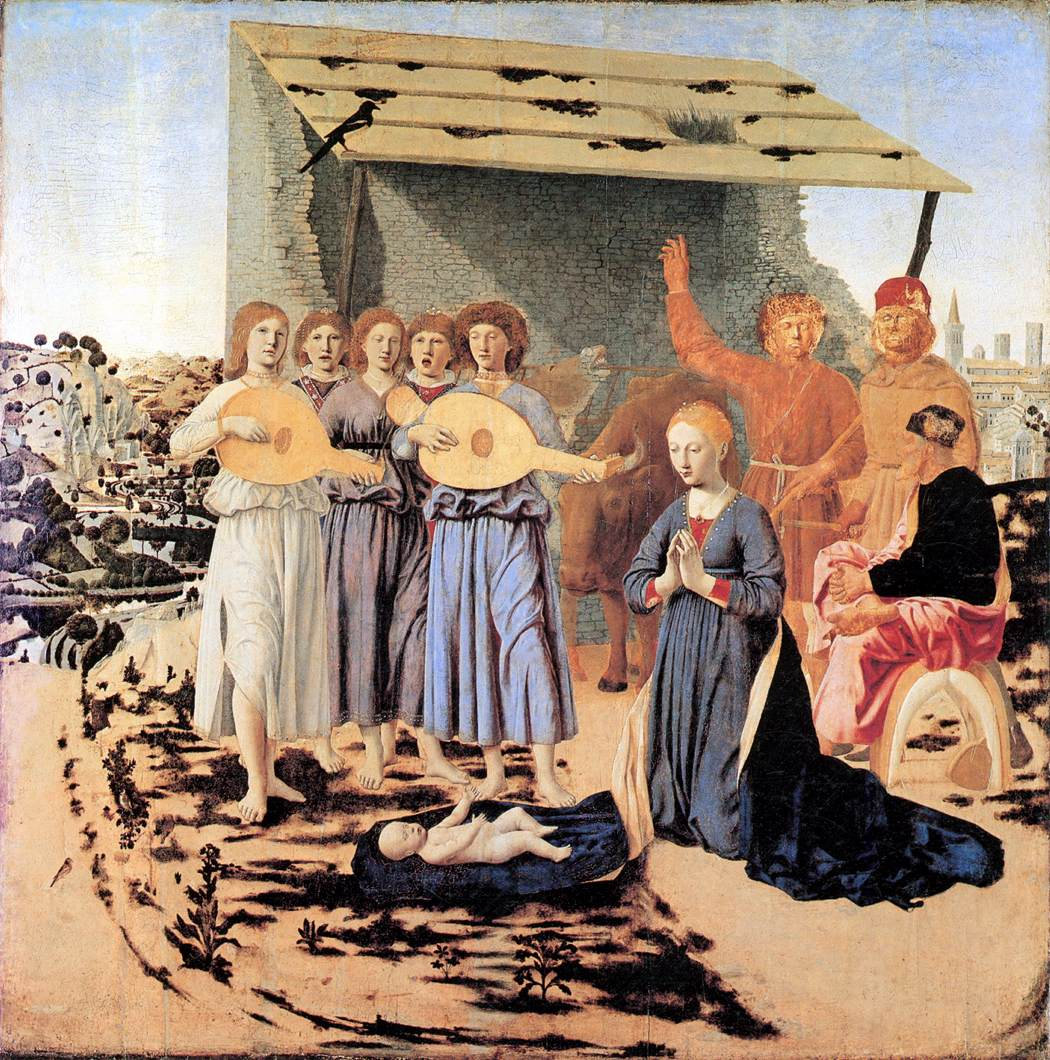
Imagine the birth. Mary pushing, shoving, moaning, yelling. Imagine the placenta, umbilical cord, blood, fluid. Imagine for a moment that the stable and animals are not fiction. Imagine the noise, the animal dung, the smells, the hay getting places it shouldn’t.

Imagine the mess.

The nativity is messy. The infant is born into mess. My life is messy. Your life is messy. If you say it’s not, I don’t believe you. Being human is messy. But being human is what the nativity is all about.

People try to clean up Jesus. People try to clean up God. But the truth is that God is not present only in things that are cleaned up. God does not demand tidiness or purity. God does not demand cosmetics or fig leaves to cover up bits of us that we would like to be hidden away. God does not demand that we pretend. If God were to demand anything (which it doesn’t), it would be that we hide nothing – that we accept the reality of the mess we’re in.

God is present in you and me, in your mess and mine — the mess of the world. God works with mess: disorder to order, chaos to cosmos. We have no need to pretend. Pretending is exhausting. I have no energy left to waste on pretending. As it says at the beginning of St John’s Gospel, every single one of us is a child of the Divine. I am. You are.

The message of the incarnation is that you and I are like Mary — agents of the divine. Let Jesus grow in you as Mary let it grow in her. As it says in verse 4 of “O little town”, O holy child of Bethlehem … be born in us today. Everything you do to make life a bit better for somebody else is you acting as God’s agent. Everything you do to make life more difficult or unpleasant for somebody else is you acting as Satan’s agent. Choose well.

You will make mistakes. You will get things wrong. You are not perfect. Get over it. Enjoy being human. Help others to enjoy being human. Help others to glimpse joy and delight, even if only for a moment. Then, you are letting the holy child be born in you again and again.

The Christmas message is not about making yourself sick on chocolates, or stuffing your face, or arguing about what to watch on TV, or about reliving your childhood. The Christmas message is about bringing joy to the world — and helping others do likewise.

Happy Christmas. Mess is made divine,