The immoral church?

Aside

450px-Gargoyle_Dornoch_CathedralMore from Windsor. Informal conversations have brought home to me, with unexpected force,  the extent to which the church is vilified by today’s young people. They see it as fundamentally unjust because of its attitudes to, for example, women and gays. The movers and shakers of tomorrow consider the church to be less just and less ethical than the society in which they live. It is no longer fit to regard itself as a guardian of standards, let alone a preacher.

I hear from an impeccable source that no C of E bishop was willing to go on air to defend the official position on gay marriage. I wonder how many C of E bishops refuse publicly to acknowledge their own sexuality, and condemn those who do.

Is this relevant to the Church of Ireland? I rather think it is. It’ll be interesting to hear how some of its bishops explain the reasons why they’re in favour of ‘exorcising’ gay people. One even hears of church people who look forward to the identification of the ‘gay gene’ so that fetuses that have it can be rubbed out.

This, it seems, is the gospel of love. Kyrie eleison.

Pillars of salt

The Dead Sea

The Dead Sea

Part of my job as Rural Dean involves visiting local churches for ‘stocktaking’. I’ve been church crawling since I was about 13 and have seen most large churches and many small ones in England, Scotland and Ireland. I’ve seen more than a few in France and some in Germany.

The great churches of the Cotswolds, Norfolk and Somerset tend to be open. Likewise in France and Germany. They show signs of being used by the community, often with evidence of activities that wouldn’t be regarded as ‘churchy’. People drop in throughout the day. The churches are certainly treasured.

Local churches here are treasured too. But in the main the ‘treasuring’ takes a different form. It seems that the focus is on preservation—as if people are saying ‘churches must remain as they were when I was young. The last thing we should do is share these buildings with outsiders.’

Many of them are pretty much as they would have been 100 years ago, apart from electricity and nasty carpets (they ruin the acoustics—chuck ‘em out). One of the Laois churches seems not to have changed a jot since 1750. I can’t decide whether this is charming or sad. I don’t need to decide: it’s both charming and sad. But everything is about looking back, and nothing about looking forward.

I drive to Limerick and see signs advertising 1000 (I think) years of history in Roscrea. Soon after that there’s the sign near Moneygall advertising ‘President Obama’s ancestral village’. It’s all about the past. Does this matter?

If people and places and churches fix their eyes on the past, looking back like Lot’s wife, they risk becoming pillars of salt. Much as I like salt, it’s not a fate that appeals to me. Is this obsession with the past one of the reasons that young people emigrate?

One thing I’ve picked up from my peregrinations is thankfulness for the three churches I go to week by week. They’re clean and bright. There are some signs of present and future.

Nil illegitimi carborundum

Before

Before …

Local clergy met this morning to hear a talk about stress in clergy families.

Stress provokes growth and adaptation. Stress keeps us alert and on our toes and enables us to respond to emergencies. In short, stress in sharp doses is good. But when it’s prolonged, it leads to ill-health, immune system depression, gastrointestinal problems, cancers, mental burnout, and more.

Clergy stress results from all sorts of things: lack of boundaries, unreasonable expectations of, and by, self and others, feeling one has responsibility without authority, living in a goldfish bowl (‘I demand to know the colour of your bowel movements today, Rector’). In some cases, clergy bring stress on themselves by wanting to be needed – in itself a personality disorder. But worse is the effect of stress on clergy wives, clergy husbands, and clergy children. A clergy spouse effectively becomes a one-parent family in a busy parish. The phone rings at unsocial hours. ‘I know it’s the Rector’s day off, but ….’ Well, you might know it, but clearly you don’t respect it. Get off the phone now this minute, and ring tomorrow at a reasonable hour.

None of the things that have caused me grief in seven years of ordained life was dealt with in theological training. All of them are largely ignored by the organisation, such is its corporate hypocrisy and its ability to pretend that black is white. Here are some of them.

  • Enquiries about ancestors and complaints about graveyards. I was ordained to serve the living not the dead. I do not care about graveyards.
  • Legal matters about buildings and land. I have no legal training and am not a property manager. I am not interested in title deeds, and if I have to be, I want the proper fee.
  • Conflict between mission demands, such as, the organist is so bad s/he needs to be sacked, and pastoral demands, if s/he is, the rest of the community will be offended because s/he’s related to them all.
  • People choosing to take offence.
  • Being dumped on by those higher up in the food chain who seem to justify their existence by finding hoops for increasingly hard-pressed parish clergy to jump through. This is a Church of England thing. Thankfully, the structure and finances of the Church of Ireland mean that the few people up the food chain are so busy that they don’t have time for this.
  • People thinking that everything is the Rector’s job. If you want it done, do it yourself, and stop bellyaching at me.
  • People thinking that it only counts if the Rector does it. Ordination is magic.
  • Petty squabbles. Some people need to grow up.
  • Self-appointed ‘royal’ families in a parish. These cause awful problems.
  • Refusals to accept that the law of the land means that old ways of doing things are no longer legally acceptable.
  • Refusals to accept the church’s regulations.

Over the last seven years, these are some of my experiences:

  • phone calls at unsocial hours about ancestors;
  • mother in law moaning about wedding arrangements;
  • stroppy letters about the state of the graveyard;
  • nuisance calls, several at 2 am;
  • being shouted at and shunned in public;
  • complaints about preaching the gospel;
  • a threat of physical violence;
  • callers ‘needing’ a bus fare to somewhere or other, stinking of booze (lots of these, and actually, I don’t mind them – at least these souls know they are needy);
  • powerlessness and perplexity about legal affairs;
  • sleepless nights, anxiety, diarrhoea, stress-related gobbling, incipient despair …. and more.
I hardly think a caption necessary

… and after

I have it easy compared to some, who are driven to resignation or early retirement. Some clergy find meetings and minutes and agenda and rules difficult to cope with. I do not. But all this nonsense detracts from my caring for the sick, helping the afflicted, reading, reflecting, preparing teaching and sermons, burying baptizing, marrying, and making sure worship is seemly and inspiring.

Fortunately, my pre-ordination life experience has given me the buoyancy to keep my head above water most of the time. Maybe putting this in writing will help others.
Summer music

Irish Midlands Chamber Orchestra in St Peter's

Irish Midlands Chamber Orchestra in St Peter’s

The Portlaoise lunchtime concerts have grown. People thank me for brightening up lunchtime as if I were some sort of philanthropist. Little do they know me! The truth is, of course, that I started the concerts last year for my benefit, to get a bit of culcha. They have the added value of bringing a bit more music to a town that in some respects needs it. They get people into the church-—and this is a good thing, for there are still some out there who haven’t quite lost the notion that they might go to hell if they come in. And they raise a bit of money for the Hospice, Dunamaise Arts Centre and the church. But first and foremost they revive my sometimes drooping spirit!

This summer we’ve had some spectacular performers: organ, violin and cello were lovely, trumpet and organ were thrilling, ladies close harmony was charming, organ-alone concerts have been refreshing, and today’s Midlands Concert Orchestra was terrific. There were about 80 people there. Toe-tapping tunes. You could see people’s bodies moving to the beat of Dvorak, Bizet, Offenbach, Lennon/McCartney, and marches from the movies. Organ music has featured most, not surprising given my background and contacts, but then St Peter’s has an organ that sounds well and is good to play.

Visiting musicians comment on the lovely church and its sense of intimacy, the brightness of the place, and an acoustic that gives a bit of bloom to the sound. And, I hope, the welcome. It’s particularly good to have young players, and several have said how much they value the experience of giving a public performance. For organists in particular, it’s gratifying to play music that people actually listen to, rather than merely talk over. There’s plenty of talent about, and it’s great that people are willing to come to St Peter’s.

It’s a truth universally acknowledged that if you please yourself, then some others will be pleased with you. Here’s to the rest of the 2013 season.

Our ways

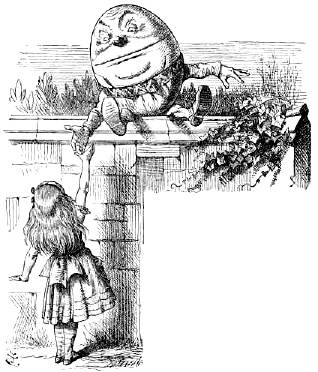
'When I use a word,' Humpty Dumpty said, in rather a scornful tone, 'it means just what I choose it to mean — neither more nor less.'

‘When I use a word,’ Humpty Dumpty said, in rather a scornful tone, ‘it means just what I choose it to mean — neither more nor less.’

Following a letter I wrote to the Church of Ireland Gazette a few weeks ago, which was a shortened version of this, a retired bishop responded in that worthy publication by intimating that as a recent English import I should not presume to express my views because I do not know what he called ‘our ways’.

Since then, that same publication printed a story in which the Church of Ireland rejected President Obama’s description of education in Northern Ireland as ‘segregated’, particularly since that word had resonances with apartheid in South Africa. Indeed it does.

It’s people’s perceptions that we have to deal with, and until we do, facts are almost irrelevant. If President Obama perceives education in NI as segregated, then presumably others do too, and simply denying those perceptions is not a realistic strategy. (If the Laois Nationalist is to be believed, funeral care in this town might soon be segregated too.)

If I want a fresh opinion, I will seek it from a critical friend – someone who is not part of the club. Is it really the case that the Church of Ireland is so insecure that it responds to such critical friends by belittling them? The parable of the good Samaritan tells us, amongst other things, that we do well to accept all help, no matter whence it cometh.

Perhaps I am indeed as yet unfit to serve in the Church of Ireland. How long will it be before I have absorbed enough of what the retired bishop, of whom I yield to no-one in my admiration, refers to as ‘our ways’ to be allowed to express my views? Until then I shall remain silent. On the other hand, when I see in the news what ‘our ways’ have been responsible for, perhaps I shan’t.

Being shot, stuffed and put in a glass case

pulled in so many dimensions

pulled in so many dimensions

One of my readers sent me this comment in response to Church militant? Church irrelevant, the blog about the recent Church of Ireland General Synod: ‘You seem to be carving out a reputation for being the St John the Baptist of the C of I. I admire you for that; though it is a lonely calling. … You are a rare breed and will probably suffer the fate of such species, i.e. being shot, stuffed and put in a glass case for the purposes of mildly diverting amusement!’

St John the Baptist was beheaded. Does that fate await? The church, like many organizations, has another way of dealing with ‘troublemakers’. Promotion. In the Church of Ireland, I suppose this means a bishopric—the equivalent of being stuffed and put in a glass case. The bishopric of Meath and Kildare is still vacant. Perhaps that would keep me out of trouble. The advantage of having me is that I wouldn’t be there too long: I am 63 this week, so death or decrepitude would limit any damage I could do. The C of I already has two courageous bishops so we don’t need any more. The last thing the church—any church—needs is realism. The church thrives on good news only. Read any church or diocesan magazine: churches are always full, people are always charitable, and sun always shines on the tray-bakes. I would wear a mitre that at first covers my eyes that I see not, then my ears that I hear not, then my mouth that I speak not.

Can you imagine how frustrating it must be to be a bishop? Having no spiritual centre, no ‘home’ church and congregation, clergy bothering you morn, noon and night, dealing with complaints from ‘disgusted of Tunbridge Wells’, criticized for being courageous, criticized for not being courageous enough, pulled in infinite dimensions. Responsibility without power. Having to be a focus of unity when what the church cries out for is prophetic disturbance.

We are blessed here with a bishop with courage, integrity and vision. Deo gratias.

Being made to think

Watchtower in the Eden Valley

Watchtower in the Eden Valley

I was doing my sermon. Tring, tring, triiiiiiiiiiing went the door bell. Woof-woof, woof-woof went Og the king of Basan. Og the dog really, but one dreams. I heave my creaking and overweight body out of its groove on the sofa where I do most of my writing with the computer resting on the sofa arm and Og the dog lying beside me. I stomp to the door. I’m greeted by two neatly dressed gentlemen and a young child. They are smiling. I restrain Og the dog who, despite being a good barker, is one of the more timid of things creeping innumerable, both small and great beasts.

‘Good morning, Sir.’

I reciprocate by offering them my heartiest felicitations on this the first day of flaming (hollow laughter) June.

‘Could we interest you in this?’

They proffer a leaflet. I readily accept it with thanks. I quickly look at the back page and see that it’s from Watchtower Publications. Jehovah’s Witnesses are quite numerous in Portlaoise. Seeing the face of one of the men, noting the Watchtower connexion, and putting two and two together makes something in my brain go clunk, clunk, clunk. I’m delighted to say that I know two of his children. They attend Maryborough school. I tell him that they are good fun and little treasures. He demurs somewhat, his diagnosis of their condition being not so much treasures, but more ‘live-wires’. He says this with a somewhat wry expression on his face. The pains of parenthood. We exchange more pleasantries and I say I’d love a chat, but they hoof it, pitter patter, back to Coote Street whence presumably they came.

Not long after, I had time to read the leaflet. You can imagine the content: what does the Bible say, sort of stuff. Nothing to which I took exception.

A number of things about the encounter rather shamed me. Their commitment, their neatness, their smiles, their evident goodness and lack of guile. I wondered how much time they spent having to deal with property and legal issues, with internecine feuds, with leaking roofs, with graveyards and complaints, with church furnishings. I made some personal resolutions. And then I began to fantasize about would happen if we followed the example of my callers and visited every home in our parishes with a leaflet about what we do, and what we offer. I began to wonder what exactly is it that we do offer to those who are not already in the club?

Maybe this is something to think about over the summer. The leaflet is the easy bit.

Aim high

618px-Cosmic_Heavyweights_in_Free-For-All-_One_of_the_most_complex_galaxy_clusters,_located_about_5.4_billion_light_years_from_Earth.I was thinking of starting a campaign to get people to stop chatting in church for five minutes before the service starts. I was foolish enough to labour under the apprehension that people come to worship and learn, and for spiritual refreshment, whereas in fact the service is but a short rest from the exhausting rigours of socializing. I don’t even mind people being late: I would hate to think that church attendance was interfering with gossip.

In the Exodus from Egypt the Israelites were freed from slavery not to build an ideal society, not to campaign for FairTrade, not to care about the environment, but to worship freely in accordance with the divine command. We recall this every time we say or sing the Benedictus Dominus in Morning Prayer.

For me, worship should speak of mystery, majesty and glory. It’s not just about how much I love Jesus, or Jesus loves me. There must be a sense of ‘otherness’. However unfashionable it may be to say so, Christianity is a supernatural religion that commands us to look deep into ourselves, and way beyond ourselves, to the invisible and intangible. It is about spiritual things, forgiveness primarily, and self-forgiveness particularly, but such forgiveness is to my mind pretty useless unless we each begin to glimpse our own need for it.

We are right to build up church community—that is, the body of Christ—and pursue justice without which there will never be peace. But our first priority is worship, and worship exists to give us glimpse of the Divine. Liturgy matters. The biggest enemy is mediocrity. If worship is mediocre, then faith is mediocre. If worship is half-hearted, then God becomes a half-hearted creation of our own, not the cosmic Lord. Many modern hymns and choruses are about me (Here I am Lord); golden oldies are principally about God (Immortal invisible). We need both, but we don’t need self-indulgence. We need to lift our eyes out of self and above the humdrum. That is why I’m suspicious of calls for worship to be ‘relevant’. Worship is not about leaving us feeling cosy and comfortable. Energized, yes; smug, no. And maybe slightly unsettled.