Church parasites

Heartworms

Heartworms

Today’s Church Times announces that the good old C of E is thinking about using human resources managerial strategy to train people for high office. Nothing has quite spoiled my Friday morning as much as this has – not even the prospect of a politically correct Christingle for a non-church and significantly Muslim school later in the day.

I know from selection conferences when I was an Assistant Diocesan Director of Ordinands that people, even at that very early stage, are labelled as potential high fliers. This is woeful enough in an institution that claims to be about service. But to institutionalize it is shameful.

The problem about wearing the clothes of other creatures is that one picks up their parasites, and in this case the parasites that come with the coats of corporate managerialism will at best disable and at worst consume the host. This is the sort of policy that drives me towards the former ‘flying’ bishops for a vision of the church that accords with what has been handed down to us.

I suppose the people that come up with this are so struck with guilt about what they have allowed to happen to the church – or rather, they should be – that they now flail about like headless chickens. ‘Something must be done’ they say. Maybe, but Ye Gods not this.

It’s like medical education. You qualify as a doctor (it’s a conveyor belt – don’t let anyone tell you otherwise – there’s no intellectual content, it’s all memory), then you train in obs & gynae, GP, physician, surgeon etc. Then you get 8-10 years under your belt and find yourself approaching divorce, middle age etc. And you are BORED. You have done 5 gall bladders a day every day. You have looked up the orifices of 7 zillion people and you are NUMB. So then you take to the bottle, or whatever, and start to attend meetings (with expenses of course) at the Royal Colleges where you sit around in panelled rooms on committees that interfere in things that don’t need interfering with. You impose your ‘new’ ideas and force reorganizations and generally foul things up even more. But at least you are not bored any more, and you can wait in line for your gong.

Now put all that in the context of the church. I’m long enough in the tooth to say to Church apparatchiks that I shall go on as I am. By the time they get round to disciplining me for not going along with unimaginative fads I shall be either dead or retired. But I pity the poor souls who are at the beginning of their ministry.
Fair perceptions

S Modwen's in the background

S Modwen’s in the background

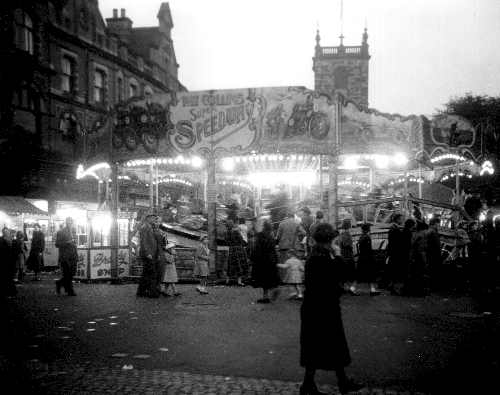
Today I blessed Burton’s Statutes Fair. A 600-year history I gather. The Mayor spoke, I blessed, children from Holy Trinity School prayed and cut the ribbon, and I splashed a lot of Holy Water about. There was no need of this actually, for plenty of the natural stuff was dropping as the unstrained quality of mercy.

On my way to the ‘green room’ beforehand I bumped into the President of the Showmen’s Association of Great Britain who pointed to the showmen’s prayer on the back of his card. I was wondering what I would say at the grand opening, having left my preparation in the hands of the Holy Ghost, and so this was a gift from heaven. ‘Coincidence is God’s way of remaining anonymous’ Albert Einstein is reputed to have said, so this happenstance must prove that there is a God and that she was listening to my concerns.

The quote about coincidence is also attributed to Lauren Pederson, of whom I had not heard. Is it another name for Einstein? or vice versa? I wonder if Lauren and Albert were ever in the same room at the same time. Would that have been coincidence?

Anyhoo, back to the plot. The circus owner, who had himself been President of the Showmen’s Association, told me the story of how that prayer came to be. At an Association meeting in Rome, members were told gather in a certain place at a certain time. They were taken in a bus with police escort to the Vatican and in due course issued into the Presence. Lengthy and enthusiastic conversations ensued, and the chain of office much admired by His Holiness. That is where the prayer comes from, a product of Pope John Paul II.

Chatting to civic dignitaries after the Fair blessing, I was sounding them out about increasing the profile of S Modwen’s in the town, and how best to make it known that the church was at the service of the town and everyone in it. After all, the building is in the Market Square, and it’s a real shame that it’s locked most of the time. The dignitary was sympathetic and helpful, but agreed that we are up against the widely held perception that the church as a whole was standoffish and stuck up. The same thing was said to me in similar circumstances in Portlaoise about the Church of Ireland.

I remember the first time that it really dawned on me that perceptions were often more important than facts, because it’s perceptions that we have to deal with. It was at the Royal College of Surgeons in Ireland when a colleague and I were discussing some issue that was causing great student unrest. My colleague was holding to facts, while I said  facts didn’t much matter because what we had to counter were widely held perceptions.

O wad some Pow’r the giftie gie us
To see oursels as ithers see us!
It wad frae mony a blunder free us,
An’ foolish notion:
What airs in dress an’ gait wad lea’e us,
An’ ev’n devotion!

 We have work to do.

Trespassers will not be prosecuted

il_340x270.433804045_renxWe’re going back to the ‘old’ Lord’s Prayer. When I announced this at a PCC meeting, there were smiles and several utterances of ‘oh good’.

The rhythm of the ‘old’ rolls off the tongue more easily. It’s more like poetry, and so is easier to say, easier to remember, and it more quickly becomes familiar.

The ‘new’ is neither one thing nor the other. It ‘modernizes’ some things and not others. The trouble with modernizing is that it needs to be done regularly as words and concepts change meaning. This strikes a blow at the idea of having a text known by all ages in all places, and it detracts from the notion that The Divine is immortal, invisible, in light inaccessible, the Ancient of Days – which must be true because we sing it with gusto. The new version retains hallowed but ditches thee, thy and thine. Hallowed is not in daily use, but thee, thy and thine are in many parts of England. Your will be done on earth as in heaven implies that it is not done in heaven, but might be one day. Give us today implies a grasping entitlement that excludes the sense of tomorrow and yesterday that comes with daily.

The ‘old’ form is that used in English-speaking Roman Catholic churches and many other denominations. It’s used in most schools that teach it, and that includes Shobnall and Holy Trinity. Because it’s an Anglican translation, and one that even then is used in only some Anglican churches, it’s like the membership song of a posh club. It excludes people rather than includes them. This matters at funerals and weddings and other big occasions.

Enough!

If you prefer the new one, you can have it back when I’ve gone. Until then, enjoy trespassing.

Coming to light

1388992556_FreeGreatPicture.com-29281-waiter-tray-positionChucking out has yielded fruit.

At St Aidan’s I found a complete set of maniples. The maniple is the vestment that the priest wears over his left arm, rather like the towel you see on a waiter’s arm in a posh restaurant. And that is exactly what it is. Of all the vestments, the maniple is the one signifying that Christian ministry is about service and waiting. For the life of me I don’t know why it fell out of use. It’s now back in use at St Aidan’s and at St Paul’s, where there’s also a complete set.

Dalmatic

Dalmatic

St Aidan’s has been given a book of readings for the lectern, a Book of Gospels to carry in procession, and – praise be – a thurible and stand for incense on special occasions. This is wonderful. Holy Scripture duly honoured.

St Paul’s, not to be outdone, has been given a green dalmatic. This is the vestment worn by the deacon (assistant) at mass. There are several white and gold dalmatics and one purple one, but until now no green one, and no red one. Anyone out there like to give us a red one? Don’t hang back. Whatever the dalmatic’s function is or was, it looks lovely. We do well to remember that beauty of all sorts is part of the Divine.

I wonder what other treasures will come to light.

New blood?

Ducreux__YawnLocal election results here are rather gloomy. The same old faces, many of whom look about 30 years older in person than they do on publicity posters.Some say that it’s better to go for experience, but the trouble is that ‘experience’ has brought us to a place that most folks would rather not be. I hope that those with ‘experience’ will not allow the same old crooks to go on milking the system. What power do local politicians have anyway? I gather that the answer is ‘pretty much none’, in which case, why are they so expensive?

We see the same phenomenon in church elections: select vestries, diocesan synods, diocesan councils. Same old names, same old faces. How do we get new blood and new thinking on to tired and listless committees?

It’s said that the emigration of young people from Ireland will be reduced by providing more jobs. Will it? Maybe they emigrate because they’re tired of the same old faces perpetuating the battles of the past without, it seems, the ability to look ahead with imagination and vigour.

I’m just a humble clerk in holy orders, but I really do think that a bit of ‘inexperience’ might serve us better than the narcoleptic complacency of ‘experience’.

The Beaker Folk of Husborne Crawley

Beaker Header Trees Henge. newA subversive streak is something to be cherished, so if you’ve got one I recommend an occasional visit to The Beaker Folk for refreshment. Flooding Caused by Gay Marriage, is particularly good.

My regular reader will know that a while back in Brave new world I chided the Archbishop of Canterbury for seeming to belittle the work of the parish priest. I put these sentiments into a courteous email to him. After 10 days or so I had a reply from the Archbishop’s Acting Correspondence Secretary, a retired Archdeacon, saying, in essence, push off and get used to the new regime, and stating that the traditional model of parish ministry was failing. The questions I raised about expectations and administrative burdens, however, were ignored.

One thing amused me. The retired Archdeacon, despite being a fully paid-up member of the new iconoclasm, appended ‘The Venerable’ to his signature.

Titles and status remain so very important in the brave new Church.

Brave new world

A good vicar

A good vicar

According to the UK Daily Telegraph yesterday, the Archbishop of Canterbury’s idea of a good vicar (Church of England jargon for parish priest) is one who holds services in ‘non-traditional venues like pubs and clubs’ and ‘in all kinds of strange places.’

I’ve worked in the Church of England and so can say with some confidence that the administrative demands imposed by the Archbishop’s colleagues and the institution on the one hand, and the pastoral role demanded by the community and by those who already support the church on the other, mean that few if any vicars could possibly be regarded by the Archbishop as good. Unless, that is, they refused to deal with correspondence, initiatives, circulars, questionnaires, funerals, weddings, baptisms, and five or six services a Sunday … and so on.

I must accept that I was not, and still must not be, a good vicar. I don’t have the wherewithal or confidence to evangelize in a pub or club or ‘strange place’ for I am not given to facile answers to difficult questions. I am given to pastoral and intellectual exploration that begins in joy and sorrow and ends in wonder and mystery. I am given to an appreciation of beauty and the liturgy. I am able to hold two opposing viewpoints and still function, I think and hope, reasonably well.

Delight and agony of Africa

ghjhg

From Church News Ireland

The Bishop has been to Swaziland. He said ‘the poignant thing was I was such an old man there … because of HIV and other factors most men are dead before they are 50.’

He’s right. If he’d gone to Malawi he’d feel even older. Despite that, I expect he was in the midst of laughter, welcomes, smiles, and liturgies where people want to be involved. There would be few if any shoulds and oughts. People just get on with the job and are glad to be alive. They are not bothered about ‘the way we do things here’ – because all the people who know how we do things are dead.

Digression alert. I did a session on ‘ethics of decision making’ for the diocesan certificate course and asked how many of the middle-aged people were on diocesan synods. All but one put their hands up. I said, ‘it’s time you came off to make room for younger people’. I keep saying that the church is run by people without a future, A self-limiting problem.

Back to the plot. My visit to 6 am Mass in English at St Paul’s, Blantyre, was notable for all those things I mention, but most of all for the uninhibited enthusiasm emanating from the hall next door where the choir was rehearsing for the 9 am Mass in Chichewa.

African Anglicans come to church in Portlaoise. I wonder what they make of it. What can we offer them? All I have is the liturgy, myself, and, since I have some inkling of what it is like to ‘mourn in lonely exile here’, my friendship.

The Bishop has imagination and a fine intellect. How will he survive back here having seen the delight and agony of Africa?