Intourism 1987

Sergeyev Posad

The Great Panagia of Yaroslavl, pictured here, reminds me of an Intourist trip to the Soviet Union in 1987. On the way from Moscow to Zagorsk, now Sergeyev Posad, we passed a road sign that said something like Zagorsk 25 Km, Yaroslavl 220 Km, Arkangelsk 1120 Km – not the kind of distance you’d see on road signs round here. As Sugar Kane says in Some Like it Hot, ‘it makes a girl think.’ Distance, limitless, a sort of freedom.

My father had died, and the solicitor had sent us a cheque. How shall we use it? Nothing ‘safe’, that’s for sure. I know: we’ll take the five of us to Russia. What more natural place for a family holiday with children aged 7, 9 and 11 than Moscow and Leningrad? Landed at Sheremetyovo, bus to the Hotel Cosmos—in Russian, KOCMOC, which raised a titter with the boys. Next day the Intourist Guide said ‘you will come on city tour.’ No, says I, we’ll explore on our own. ‘You will come on city tour, please’. No, explore on our own. This went on for some while. We ended up exploring on our own. Metro stations, giant wheel, GUM, VDNK. We did Red Square and Lenin with the guide, of course, and jolly interesting it was too. But the trip to Zagorsk was memorable for the beautiful churches, the road sign and the lunch – for the wrong reason: a kind of chicken Kiev without the chicken. Edward, no longer 7 years old, remembers the Soviet toy store with something approaching alarm. I will see if I can get him to put those memories into print.

Then to Leningrad by train through miles and miles of forest. The children behaved impeccably. Big round orange ‘caviar’ served on the train. Samovar. Leningrad (as was) is stunning, but no matter how hard I try I can not switch it to St Petersburg in my head. A visit to the bookshop on Nevsky Prospect in the former Singer (sewing machine) building included an exchange with the shop ‘assistant’ that went something like this:

Me, pointing at 9 year old Hugh: Gdye twallette, pazhalusta? (where are the toilets please?)
Assistant: Nyet.
Me: as above, but louder and more insistent.
Assistant: Nyet.
Me, to Hugh: the lady says no, so just go into the corner and pee on the floor.
Assistant: come with me.
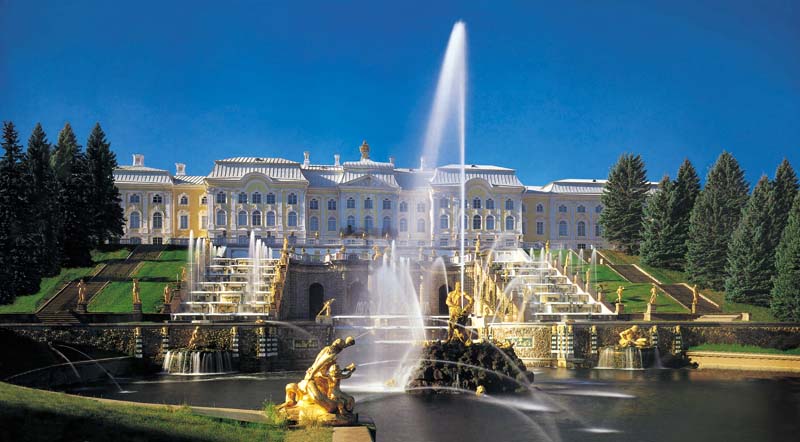
Petrodvorets (Peterhof) near Leningrad

There must be some theology in that somewhere. The picture book for this holiday brings back so many memories: the palaces, the wonderful colours, the scale of the place, the Hermitage, the Russian Orthodox liturgy in the monastery opposite the Leningrad hotel. The adventure. And I was thin then.

Dunamase beats Cashel

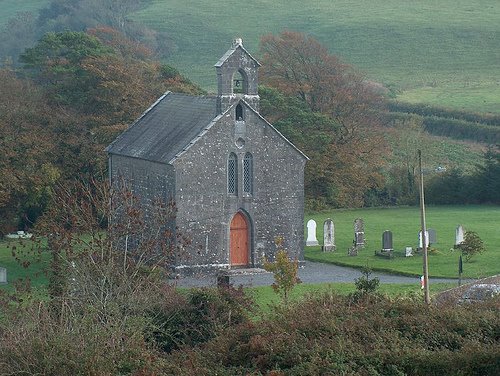
Scissors, paper, rock. Keen readers will have noted this blog’s disappointment with the Rock of Cashel and its bored-looking staff (see below: What a welcome). A couple of days after the Cashel non-experience we took the Texans to the Rock of Dunamase. That was a great hit: ‘much better than Cashel’ they chorused. More exciting, more left to the imagination, more nooks and crannies, more unkempt. Please keep Dunamase a secret otherwise they’ll start charging, and one will have to fight through turnstiles and so on. When you’re up there, you can understand its strategic military value. Great views to the Wicklows, the Slieve Blooms,  towards Nenagh, towards Kildare and the bogs. It puts me in mind of the castle on Kirrin Island (Enid Blyton Famous Five, remember?). Oh, happy days.

I can understand why people want to be buried in the graveyard next door (one of ‘my’ churches). You feel in touch with the spirits of history in that place. When Susan and I came to look at the this job back in March 2011, I was pretty much bowled over by the spirit of Dunamase. It  puts the parish pump politics of the Church of Ireland in their right place – which, dear Reader, is probably best left to your imagination.

Memory boxes and idols

Carlisle looking east

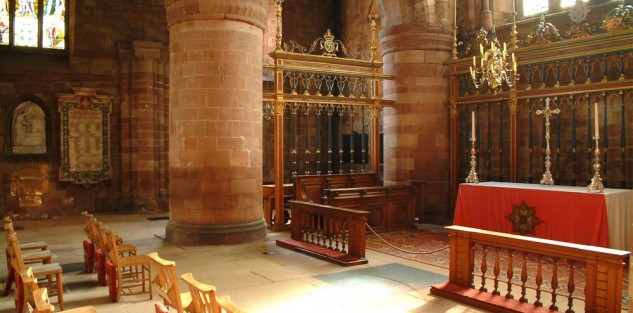
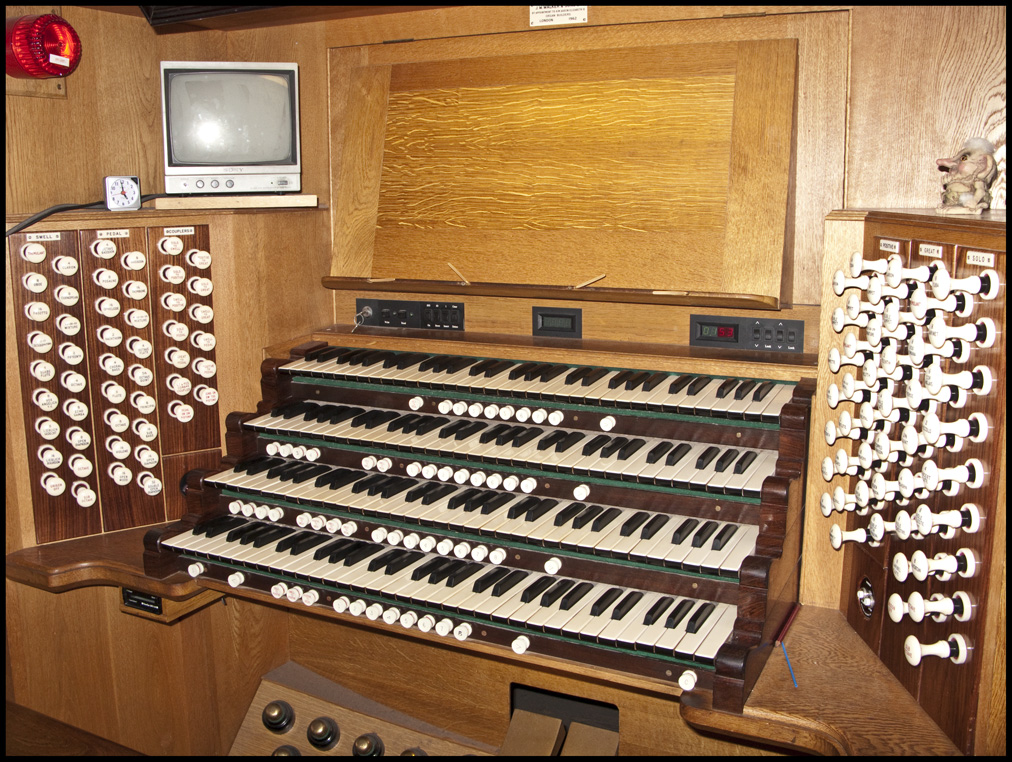
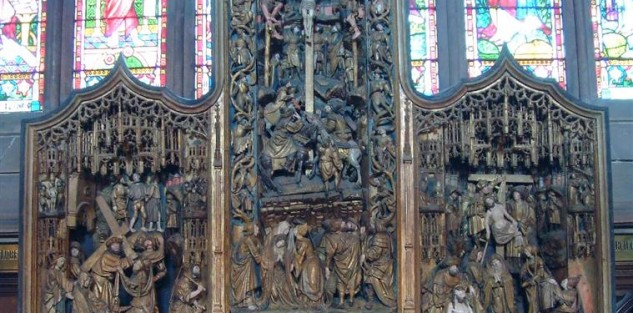
This is the ceiling of Carlisle Cathedral. The city of my birth, the place of my artistic awakening. This is where I had organ lessons, sang in the choir, and occasionally played the organ for services. It is a magical place in my memory box. Although small, thanks to Cromwellian thugs, and somewhat unprepossessing from the outside, going in is like entering a jewel box. It has been cared for and furnished by two of the 20th century’s most judicious church architects: Charles Nicholson and Stephen Dykes Bower. In a recent book on Dykes Bower, the architectural writer Anthony Symondson describes Carlisle as the least spoilt of England’s ancient cathedrals. The ceiling was originally painted in the 19th century, and was brought to vivid life in 1969/70 under Dykes Bower’s supervision.  I remember Evensong being sung accompanied by the occasional interruptions – amusingly welcome to the tittering teenager – of the craftsmen at work above the temporary false ceiling. On this page there are some more examples of Nicholson and Dykes Bower’s work at Carlisle.

Dykes Bower at Carlisle

We all have these memory boxes. For my daughter and sons, I suspect, they are things of which I don’t wish to know too much. We are well served by our memory boxes when we draw on them and their place in our development in order to fortify us for the here and now – when we can look on them with satisfaction and realize how well they have served us and nourished us. They become idols when we put them on pedestals and think that nothing will ever match up to them. When we judge the rest of life against them, and find it wanting, we are letting them destroy us.

Carlisle ‘cockpit’

These ‘awakenings’ tend to occur in our youth when we are most impressionable, when we are in our physical prime, and when our hopes and dreams are as yet intact. They shape us for ever. We all know people who live on their memories and bore the world with them. We know people who live through their children’s youth in order to try to recapture their own. We may even have done this ourselves until we saw the error of our ways. This is idolatry that leads to abuse. Given that our memories always embellish past reality in one way or another, these idols are always false.

Carlisle organ
east side

I see people in churches objecting to anything that changes their memory boxes. This is at the root of objections to redecoration, to the moving or removal of pews (a late invention in church terms), to changes of any description. They too are making idols of their memories, idols that fly in the face of reality. I struggle with wanting to rekindle the emotions that Carlisle Cathedral evokes in me. I return there in the flesh with trepidation, for I know that it will not be as I remember it. When I am tired, or feel attacked, or plain depressed, I echo the psalmist’s ‘Oh for the wings of a dove … far away would I roam’ – to Carlisle, and to the discovery long ago of the glory of English cathedrals.

Canopy by Charles Nicholson

But not the cathedrals of now with their heritage-industry and welcomers and self-justifying boards showing how they are ‘relevant’ to the life of the city (surely the point of the spiritual is to lift us out of the humdrum?). It’s the cathedral of ‘then’ to which I would return, to the womb where my mind was opened to art, music, colour, liturgy, comradeship and a sense of belonging. To beauty and delight, in fact. For a boy brought up in the drab 1950s in a drab farming village where you didn’t count unless you were knee deep in cow dung and cared about soccer and cricket, this was truly a glimpse of heaven.

Carlisle organ
west side

Jesus says a great deal about not living in the past. He tells his disciples not to flog a dead horse. He tells people not to bother about the dead, but to work for the living. We in the church are very inclined to ignore these commands of the Master.  We idolize the past just as we idolize our memory boxes.

Make no mistake: we need our memory boxes. Long may we have them. But let us never insist that they be imposed on other people. Let us never use them to oppress, to abuse, to stifle, to fly in the face of reality. Let us never allow them to take hold of us so that we become blind to life in the here-and-now.

Heaven knows, it can be difficult.

From Antwerp to Carlisle

What a welcome

Unwelcoming rock

The son and granddaughter from Texas are with us for two weeks. We went to Cashel. At the reception desk at the Rock we were met with bored looking staff who told us quite sharply that they did not take cards, only cash. It is clearly a privilege for us to pay money to Heritage Ireland, and we must do it on their terms, not ours. Whatever happened to the notion that the customer might sometimes be right? This must be a great experience for foreign visitors.

I wonder what sort of welcome visitors to our churches get? Are they confronted by a group of people in conversation in front of the books? Do they have to fight their way through people blocking the doors? Is the pre-service atmosphere one of socialising or reverence? Is the organ music actually audible? Are newcomers confronted by a sense of the Divine glory and joy, or simply a group of people who are intent on maintaining the attitudes and resentments of the past? Does any of this matter? If it does matter, for how much longer will it matter?

Orlick and me

Seeking whom he may devour

My memories of childhood include Sunday afternoon TV serials such as The Secret Garden, The Silver Sword, David Copperfield, and Great Expectations. Memory plays tricks, but I have a distinct impression that the productions of the 1960s were long enough to be more faithful to the novels than many subsequent shorter versions. Last month’s Great Expectations, spread over three hours, covered aspects of the story that don’t feature at all in shorter films, such as the attack on Mrs Jo, and the characterisation of Orlick.

I home in on Orlick because in that recent production I was struck as never before that Orlick is the dark side of Pip. You could regard Great Expectations as an exploration of Pip’s self-deception, of the way in which he falls victim to the attraction of money, status, the high life—seduced by glamour in fact—but all the time this dark character haunting him and reminding him of his past.

There may be people around who are permanently sunny, unsullied by dark corners, people who are entirely pure and without stain. As I say, there may be—though I’ve never knowingly met one. And I’m certain that I’m not one. My dark side is alive. Like Orlick, he sometimes disappears from view and I kid myself that he’s gone. But he hasn’t: he struts back into the picture at inappropriate moments.

I hear people pray for all stress to be removed from their lives. The hymn Dear Lord and father of mankind, which people seem to like, but I don’t (it’s the tune they like), has that fatuous line ‘take from our souls the strain and stress … ’—can you imagine anything more utterly boring? (And while I’m on this rant, the last verse, Breathe through the heats …  is silly as well. Do you want to be emasculated?) We need to struggle to confront the darkness within, the demons that are the enemies of our good selves. Life is a struggle, and part of that struggle is to enable light to overcome the darkness—to let the light bleach the hell out of us. Love the hell out of us is perhaps is a more helpful phrase (sadly, not original). Jesus tells us to love our enemies, and there is a great temptation to forget that our most pernicious enemies are not other people, but are actually parts of ourselves, those inner demons that incite us to pride, the lust for power, and insincerity (all Dickens’ villains). The inner demons that prevent us from being fully ourselves. The inner demons that steal our liberty because we become slaves to them, addicted and dependent.

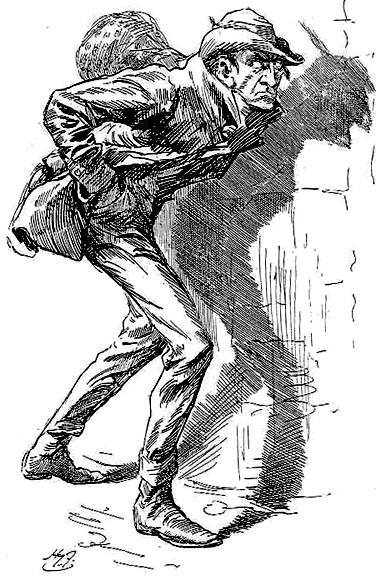
This is the spiritual warfare of Paul’s epistles. Spiritual wickedness in high places—not ‘out there’ but ‘in here’. It is a message of John’s epistles. It is what Christianity is about. In Great Expectations Pip’s ‘redemption’ is balanced by Orlick’s unmasking and arrest, and our happiness and fulfilment will begin only when we acknowledge the Orlick within.

Deliver us from the evil parts of ourselves. 

Tourette’s

I hardly think a caption necessary

What shall I do about my Tourette’s? People say it’s very entertaining when my outrageous comments issue forth. One day, though, if they haven’t already, they’ll get me into terrible trouble. Are my Tourette tendencies eruptions of some long-suppressed frustrations? Evagrios (4th century) said: The demons that fight us in the front line are those entrusted with the appetites of gluttony, those that suggest avaricious thoughts, and those that incite us to seek the esteem of men. Is this my problem: the need to show off to others, the craving of recognition by those whose recognition is not worth having? If so, I suppose the first step is to recognise the embryonic urge to utter forth in glorious voice something that would best be left unuttered, and nip it in the bud.

Or perhaps my brain is wired that way, and this is an expression of me. If it were suppressed, would I cease to be me? Are the brains of comedians and performers – like clergy – wired in such a way that we need some degree of Tourette’s in order to do our work? Neuroscientists and pyschologists must have opined on this.

A common image of Jesus is, to quote from hymn and carol, someone meek and mild, obedient and good. The Jesus of Holy Scripture is charismatic, elusive, revolutionary, sometimes offensive, physical, thoughtful, sympathetic, empathetic. He rarely if ever answers a question directly. He is described by others as a glutton and a drunkard. These two sets of images do not match. Why not?

The church seems to emasculate men. It often seems very ‘girly’. Perhaps theological colleges have a burdizzo (look it up). No wonder men and boys are deserting the church. Which would you rather do: play sport or be passive in church? Of course, church needn’t be passive, and it’s possible to do both church and sport (or whatever), but in this case, Sunday morning ain’t a good time for getting folk in.

Maybe it’s this conflict between what I feel I am, and what people expect me to be, that’s the cause of my pseudo-Tourette’s. On reflection, though, I think I’ve always been like this. Maybe it’s hardwired in and I should live with it, enjoy it. When I and my colleagues were ordained, the Bishop told us that we must never lose our humanity. The hand that made us is divine.

Healing and research

“They don’t like it up ’em!” said Corporal Jones

I wrote recently about healing, in theological terms, being about acceptance of reality, preparation for the future, liberation, rather than about medical cure. Heal = salve = save. Here are some more phrases: healing as coming to terms with, at-one-ment. I’ve been provoked to think more about this as a result of discovering that the Burzynski Clinic in the US is attempting to silence a 17 yr old young man for having the temerity to point out to the world on his blog that the clinic’s claims of offering a cure for cancer are not founded on robust scientific evidence. The young man has gone so far as to call Stanislaw Burzynski ‘a quack and a fraud’.

Why do we invest so much in doctors and drug companies? Why are they paid so much? At least part of the reason is that people can’t come to terms with the fact that life is a terminal condition. We imagine that the next new drug, or treatment, or whatever, will allow us to live for ever—or at least, for that bit longer. Now, let’s imagine you’re expecting to kick the bucket any day, then a new drug unexpectedly becomes available and you are told you have an extra month. What will you do in that extra month? Will you travel to where you’d always wanted to go? Will you write your life story? Will you watch more TV? Will you make sure that the people you think are eejits know your opinion of them? (That’s a very tempting option.) Perhaps you will try to make peace with people you know you’ve offended or hurt. You might even try to let people who’ve hurt you know that you bear them no ill will. You would then, in your last days, have a lighter heart, carry fewer burdens, and die more serenely. You—we—can start this now, by living each day as ‘twere our last. Because it might be. Life—to repeat—is terminal, and we never know when the game’s up. Wiping out this disease today means we die of something else tomorrow.

This takes me back decades to when I was a medical student and junior hospital doctor in south London. I ministered to dying babies, children and adults, and to their to parents and families. I began to wonder about the distinction between medicine as easing suffering, medicine as restoration, and medicine as prolonging a life of suffering or even unconsciousness. I witnessed the switching off of life-support systems for people who had effectively ‘died’ months earlier. I witnessed ‘treatments’ that were little short of medical experiments dressed up as false hope.

Research in medicine has enabled us to move on from surgery as practised in mediaeval times—see the illustration at the top. Most medical research is of the highest ethical standards, but some is driven by the need for researchers to climb the greasy pole of career advancement. Peer-reviewed assessment can result in the stifling of innovative thought because it challenges accepted wisdom, threatening to diminish the reputations of reviewers. Research funded by drug companies should always be most closely scrutinized in case commercial concerns have distorted methods and/or findings (see or read Le Carré’s The Constant Gardener). And of course, medical research is always at the mercy of charlatans. When people are at their lowest, they are at their most vulnerable. That is why quacks and frauds must be exposed for what they are.

You are perhaps beginning to see that I was never cut out to be a researcher.

Trip to Jerusalem

It’s a pub in Nottingham, at the foot of the cliff under the castle. The story is that the pub got its name in 1189 because it was founded at the time Richard I (‘Lionheart’) came to the throne, who was active in the crusades to claim Jerusalem for the Christians. Despite living in Nottingham from 1976 until 1988, it’s not a pub I ever went to so I can’t tell you anything about its facilities, its atmosphere or its beer. But I can tell you that in January this year, Susan and I went with about 30 others from Derbyshire on our own trip to Jerusalem with altogether more peaceable intentions than those of Richard and his mates. The weather was cold and sunny, the company congenial, and the food middle-Eastern—that is to say, healthy and toothsome. All the holy sites have been so built-on over the centuries that its difficult to imagine them as they might have been. There comes a point when an alleged site and an archaeological dig becomes just another a pile of rubble in a field. But we saw the steps that Jesus was dragged up for torturing. ‘Terribly sad story that’, as (Lord) R A Butler said of the St John Passion. The site of Calvary, the church of the Holy Sepulchre, is shared by Catholics, Coptics, Orthodox and Armenians. It’s good to be reminded that English churches are just a minor part of Christianity. Sunday morning at the Anglican Cathedral was lovely: service in Arabic, with hymns, prayers and responses by them in Arabic and by us simultaneously in English: a glorious babble. Why do we so often insist on reverent silence in our churches?

We also had a few days in Galilee. It’s very beautiful. Green and hilly, like round here, but on a bigger scale. Why would an itinerant speaker like Jesus draw such crowds? A prophet? A subversive? A healer— yes, that’s it, surely—people would flock to a healer. We stood in the ruined synagogue in Capernaum, where the paralysed man was healed. We sang in the warm acoustic of the church over St Peter’s house, and celebrated Mass by the sea of Galilee.

There were some disturbing sights. The 9-metre high concrete so-called ‘peace wall’ separating members of the same family, separating Palestinians from their means of earning a livelihood. The new road that Palestinians may not use, but that they can see tunnelling under their city. Unemployment. Water and power only 3 days week in Palestinian settlements like Bethlehem, Bethany and Jericho. The prosperity of the Jewish settlements. Old Testament prophets bewail the plight of the oppressed: well, think about the Palestinians of today. I was reminded of the recent history of South Africa. In the midst of this, I met the holiest woman I have ever seen: Alice Sahar whose family runs homes for abused, tortured and abandoned children in Bethany, the town of the risen Lazarus.