Thank you to all who were able to attend Stan’s memorial service last week. Our huge thanks to Rev’d Canon Paul Arbuthnot and all at St. Ann’s for their gracious hosting. We were delighted that Rev Dr. Adrian Empey was able to attend and also to say a few wonderful words of tribute. We are also indebted to Dr. David O’Shea for his exquisite playing of the organ. Finally, our eternal thanks and praise to Eric Clarke for his eulogy.
I’m delighted to say that all have allowed the Monkhice to publish their words so here they are in the order they occurred in the service.
Eulogy for Stanley: St Ann’s Dawson Street
November 9th, 2023
Good evening to you all. My name is Eric Clarke and I have had the great pleasure of knowing Stanley and his family for most of my adult life. I am very grateful to the Monkhice (to use the plural) Susan, Victoria and Ed for asking me to speak at this service, thank you.
Needless to say, I can feel the comforting yet firm hand of the Reverend Professor Doctor William Stanley Monkhouse on my shoulder right now as I speak,…………whispering softly to me “JFDI” and “For Christ’s sake Eric, don’t mess it up”.
I feel I should get some housekeeping issues out of the way first. I would like to assure you all that there will be no colourful language from me this evening. I would also be most grateful if the more excitable guests gathered would refrain from heckling or sharing any mischievous but well intended interruptions until after the service.
So, with that said, I would ask you all just to pause for a moment and consider how utterly impossible it would have been for Stanley to keep his mouth shut right about now.
Ireland
Susan, Victoria, Hugh, Ed and Stanley arrived in Ireland in December 1987. As Ed described it to me recently “it was a very dark and moody early morning when we disembarked from the ferry, the hotel towering over Dun Laoghaire harbour, as one might expect in a Hitchcock movie with a thunderclap and some choice lightning”. A dramatic entrance if ever there was one.
Susan, Victoria, and Stanley moved into their new family home in Kilmacanogue, Ed and Hugh stayed in the UK a while longer as choristers in Ripon Cathedral and Southwell Minister respectively. By 1991, all of the Monkhice were resident in Ireland.
Back in 1987, I first got to know Stanley as he prepared to move to Ireland after he had accepted the post of Professor of Anatomy at the Royal College of Surgeons in Ireland. Stanley was 37 years old, very young for a departmental head, he was ready and more than willing to shake things up.
From the very outset, it was clear to us in the Anatomy department that Stanley was different, more Alan Bennett than James Joyce, and as we quickly learned, a big fan of, and willing to quote the widely acclaimed work of Norman Hudis and Talbot Rothwell.
(As Stanley might advise, you can all google that later).
Soon after he arrived in RCSI, things started to move very quickly indeed. Stanley set about modernising the Anatomy department physically and academically. As members of staff, we were encouraged to travel, to make connections, to visit and learn from other anatomy departments, with Stanley providing travel notes on what churches to visit while away.
Under Stanley’s direction, we became an open and accessible department with a lively beating heart, Tea was drank by the gallon. Students were our top priority we were told, and Stanley advocated on their behalf whenever he could.
Stanley led a basic sciences curriculum review and was responsible for a complete revamp of the anatomy teaching programme and the anatomy room itself.
With a twinkle in his eye, Stanley hung “Soviet styled” posters in the dissection room bought on a family holiday to Moscow. I know rumours that communism was taking hold in an RCSI department filled Stanley with great joy.
Weekly viva exams were part interrogation and part social event for the students. Ever the showman, Stanley would thunder down the wooden stairs into the dissection room to join the fray. It was clear that Stanley loved what he was doing, and the students in turn loved him back.
As we will all know, Stanley had an alarming honesty and direct approach to most things. His RCSI plans were welcomed by most, but perhaps inevitably they also met with some resistance. Stanley’s response to this was to cheekily apply his overruling trade union block vote (over 1 million votes in total, he claimed) and to reassert that he was in charge and whomever didn’t like his ideas had two options, one of which was to get used to it.
To some, his decisions may have appeared to be made on a whim or in a hurry, they were not of course. Care was always taken, plans were made and remade, details were considered and poured over. When something did not go Stanley’s way, he would record his disagreement, at length and in writing, and then move on.
Stanley was also preclinical Vice Dean of the medical faculty, this in a time when there was only one preclinical vice dean, which was just how Stanley liked it. In that role, Stanley often told students that while it appeared he was in charge, they were in fact in charge, as they paid his salary.
Most importantly perhaps, if Stanley was wrong, he would admit it, several times and again at length and in writing, just to be sure. To quote a graduate: “Stanley actually listened to us, he would admit when he had made a mistake or could do something better. Stanley was humble and brave to admit defeat in front of 250 students.”
Stanley cared, it was as simple as that, he could quickly identify where support and connections could and should be made to bring comfort to others. As members of staff, we were encouraged to attend the funerals of those who had donated their remains to the department, providing an opportunity to pay our respects to the donors themselves and to express our gratitude to their families.
Stanley also initiated a regular multifaith service of thanks for those who had donated their remains to RCSI. This provided an opportunity for staff and students alike to connect to donor families and to reflect on the importance of their loved ones’ final wishes. It was a great privilege.
Ahead of his time, Stanley progressed to the role of Professor of Medical Informatics and Chairperson of the College Information Technology Committee, this when online learning was still in it’s infancy and there were no mobile phones. Stanley was instrumental in the development of online learning programs for both undergraduate students and surgical trainees.
While Stanley was in that role, we attended an eLearning conference in Manchester. During one session, I could see Stanley getting bored and restless. By now, I had some insight into of what a bored and restless Professor Monkhouse might do next, and I held my breath wondering how the speaker might react or survive if Stanley chose to make a comment.
Luckily for the speaker, Stanley leaned towards me and whispered, “Bugger this for a game of soldiers, let’s get a train somewhere”.
Soon after, we were at a local train station where I was in awe of Stanley’s knowledge of the architecture of the rail network and his ability to understand the timetable. We travelled to Carlisle and back to Langwathby, a small village in the Eden valley, Northern Cumbria where Stanley grew up. It seemed to me that he knew every inch of the journey.
As Stanley closed the gate of Langwathby station behind us, he set off at a marching pace towards Penrith, 5 miles away. As I kept up, Stanley described how the route from Langwathby to Penrith delivered him to a place of sanctuary in the church. He also recalled his frequent escapes to Carlisle Cathedral for organ lessons. Stanley was clearly in love with the church, organ music, incense, and the vestments which only he could get away with calling “nice frocks”. I will never forget the conviction and honesty Stanley shared with me on that day.
Then one day, out of the blue, with his usual disarming directness, Stanley approached me in RCSI and said “I can’t do anything more here, I am going to resign”. Very like the way Stanley used a telephone, he walked off/hung up just as quickly as he approached me, leaving me to figure out what he had just told me. It all sounded very spontaneous, but I know now it was nothing of the sort.
In 2003, Stanley and Susan returned to the UK. Stanley took the position of foundation anatomist at the graduate medical school in Derby. By that time, Hugh, Edward and Victoria had become honorary Dubliners and there were frequent visits between the UK and Ireland.
In 2004, it may have come as a surprise for many to hear that Stanley had started training with the East Midlands Ministry, to others this was no surprise at all. For me, Stanley was just going to do what he had always loved in the first place.
Stanley was ordained in Derby in 2006, he and his family were all happy and proud, he looked fantastic in his ornate frock. Stanley put his new powers to good use immediately and baptised his Granddaughter Abby on the same weekend that he was ordained. I know he was proud of that. And of course, he was proud to bless Victoria and Shane when they were married.
After his ordination, Stanley went on to become a curate in Wirksworth, Derbyshire. He then moved on to become vicar in Old Brampton, Chesterfield and then later returned to the old sod as vicar in Portlaoise. Sadly, during his last post as vicar in Burton on Trent, in 2015, Stanley’s son Hugh died in Texas, a catastrophe for all of the family and one that Stanley never recovered from.
A week or so ago, as I sat down to write, and in the hope of some inspiration, I listened to a recording of evensong from St Luke’s in Chelsea, London. I should declare it was news to me that Saint Luke is the patron of physicians, but I took that to be a good omen and fond memories of Stanley the gifted musician urged me on. That and him telling me to “JFDI”.
Stanley set up, reassembled, disrupted, directed and lead choirs in all of his parishes and also in RCSI. He played the organ at the weddings of his colleagues, mine own included. Music filled his house, and perhaps sometimes the houses of his neighbours on Neville Road in Rathgar. Wherever Stanley went, there was always a church or church organ to visit, or most likely revisit for a second or third time, such was his passion.
On a trip to we took to Copenhagen, he somehow managed to get the key for a church and locking the door behind us, he played the organ for an hour. Then, Stanley shouted, any requests Eric? I replied and, without missing a beat, he obliged by playing a short excerpt from John H. Glover-Kind’s enduring 1907 classic.
(Once again, as Stanley might advise, you can all google that later).
I think that Stanley might not be happy to hear me use the word legacy, but a legacy there certainly is. Fortunately for me in preparing this eulogy, Stanley’s legacy as a musician, academic, vicar, family man and friend is vast and some of it readily accessible online due to his own innovative methods.
Stanley’s unique, creative, and mischievous mind is readily apparent. Particularly so on his web site, rambling rector, which provides a wonderful archive of his sermons, a peek into parish life and also other matters very dear to his heart.
Indeed, who in the Wirksworth team ministry will ever forget Thursday 18 October 2007 when Stanley posed the question, where is God in sex and lust?
There are 3 “Stanleyisms” I would like to share;
….. The first will be very familiar to all as it provides a clear signal of what was to come.
“The reader will probably detect a whiff of cynicism when I say…….”
The second and third quote belong together and sum Stanley up for me perfectly.
Stanley’s second quote
“Does my zoological mind really accept that humans are more special than any other creature of the earth?
And the third quote
“Does my scientific mind really believe in the miracles that Jesus is claimed to have performed?”
Since Stanley moved on from RCSI, I have had frequent and countless conversations with Stanley’s friends, his students, and his colleagues. All of these conversations are unique but share common themes of fun, bravery, and of course care.
There is a striking similarity between Stanley’s sermons and his open letters to students published in RCSI year books. The tone is direct, mildly risqué of course, funny, disarmingly truthful but most of all they are imbued with caring and great fondness for the intended audience.
In one of his letters to students, Stanley says he feels “singularly ill-equipped to give advice” but nonetheless goes on to advice that the class that …..telling them that…
they should look after themselves, keep the twinkle in their eye, not to believe their own publicity, and, above all, and this bit was in bold text – don’t be boring.”
Stanley looked directly at and engaged with anyone who came close to him, he stopped, he listened. Stanley could spot the disturbed and provide them with comfort and as we all know, he took it as his duty to disturb the comfortable.
It was a wonderful experience and lots of fun to know Stanley while he was in RCSI, and a great privilege to continue a friendship with him and his family over the years. Thank you once again to Susan, Victoria, Edward, Abby and Shane and Dee. I know you will take great comfort in seeing so many old friends here this evening and I am sure Hugh would too.
Thank you.
Eric
—
Thank you, Eric. Next up, the sermon from Rev’d Canon Paul Arbuthnot.
In the name of God, Father, Son, and Holy Spirit. Amen.
We live in an age where it is difficult to know what truth is. Postmodernity encourages you to ‘speak your truth’, rather than speak ‘the’ truth.
This combined with the advancing tide of distortion which the worrying excesses of Artificial Intelligence software has brought to the world, places us in an age of deep confusion.
But we gather here to celebrate the life of a man whose currency was truth.
A man who offered something countercultural to what he saw around himself. I am sorry that I never met him, although I did dip into his wonderful blog, ‘A Rambling Rector’. If you haven’t read it – google it. It’s a beautiful memorial to him and testament to his questioning faith.
From his writing you could easily see that he was propelled by the spirit of truth. This spirit of truth led him into all truth.
Of course, proclaiming the truth requires intellectual and moral bravery. In the church, you need that bravery in abundance to tell the truth.
He had it. And we thank God that he did.
In an interview with the Church Times in 2017, he remarked: ‘Telling the truth is the most serious sin a priest can commit; for many people simply want you to confirm their prejudices while you drink their tea.’
Stanley was right about this – and by his own yardstick he sinned, and he sinned boldly. And he was all the better for it.
If you wanted to hear the truth, Stanley would share it with you. And because of that openness and honesty, he was free to draw people into the mystery of God.
He did not deal in certainty, but in truth. There’s a big difference.
And it was this truthfulness which he possessed which led him to ask hard, but valuable questions of all of us. In, I think, what was his last blog post, he asked the following:
‘Do I actually believe that Jesus was born to what we call a virgin? Or is that simply a reworking of far more ancient myths about the birth of gods and goddesses, used by Matthew and Luke to “big up” Jesus?’
‘Does my zoological mind really accept that humans are more special than any other creature of the earth?’
‘Does my scientific mind really believe in the miracles that Jesus is claimed to have performed? Or are they simply fairy stories expressing profound truths using idioms familiar to the writers and readers of two thousand years ago?’
‘What has kept me hanging on to the Christian story for so long, if only by the skin of my teeth?’
‘The answer is quite simply the psychological authenticity of the gospel. By that I mean Jesus’s teaching displays authentic human psychology and is without doubt the best way to live life. It’s a pity it’s never been tried.’
There can be no doubt – he spoke the truth as he found it.
Unvarnished, plain, shocking, yet stimulating. But above all, rooted in the faith which he clung on to despite all the injustices of the institution to which he was ordained and served.
We now trust and pray that he now abides in the ultimate truth – that of the infinite, unchanging, and glorious God. The God whom he served as a medical professional, church organist, and priest in his church.
May Stanley rest in peace. May he rest in the truth which led him throughout his earthly life.
In the name of God, Father, Son, and Holy Spirit. Amen.
—
Wonderful words from Rev’d Canon Paul Arbuthnot. Thank you. I’m very pleased that Adrian was able to attend the service and we are all very grateful that he was kind enough to share some words of tribute. Which now follow.
STANLEY MONKHOUSE: OBITER DICTA
As a former vicar of St Ann’s, my remit is to say some words about the most unusual Organist and Director of Music this church ever experienced in its 300-year history: Stanley Monkhouse. [I would endorse everything that has already been said about him by Eric: behind all the bravado there lurked a was searingly honest and deeply caring man]
My first encounter with Stanley was in the Dissection Ropom in Surgeons, where as Professor of Anatomy Stanley reigned supreme in a style reminiscent of Richard Gordon’s medical novel, Doctor in the House. My mission was to interview him as a possible candidate for the vacant position of Director of Music. Everyone who knows Stanley knows he loved to shock people, so I imagine the introductory tour of the dissection room was intended to relieve me of my breakfast.
I realised straight away that Stan was my man, because finding the right person to change the culture of the choir was exactly what I needed, regardless of what musical talent that candidate might or might not have possessed. Organists had come and gone, defeated by the pervasive presence of a long-deceased predecessor, who had reigned supreme for fifty years, and whose picture in the choir room looked down disapprovingly on his luckless successors. Our Stan cut the Gordian knot by turning the picture against the wall and announcing – in a not so sotto voce – that he was dead!
Stan was given to be frank in matters concerning the choir’s performance. Among his more literary assessments was: ‘That was S-H-I-T-E.’ Such expressions of disapproval were not always received in the spirit in which they were offered, particularly by the more senior members. Needless to say, they were greeted with glee by the boys and girls, who absolutely loved him.
Apart from his distinctive rhetorical gifts, he was a brilliant organist. He was called upon with a few days notice to perform Fauré’s requiem mass in St Ann’s, accompanied by the Lloyd Weber’s cast from The Phantom of the Opera in the Point Theatre when, tragically, one of the members of the cast died suddenly. This he did with such brilliance that the cast said it was the best performance they had experienced in Europe.
All of which is to say what we all know: he was a man of extraordinary talent, who could have drawn on his intellectual capacity to have done anything he set his mind to. It is good to know that his family share abundantly in his musical gifts. But at the end of the day, we will a remember him simply as ‘Stanley’.
In conclusion his gifts as an Anglican priest were as no less remarkable, despite the fact that his unique take on pastoral theology would probably not have passed clause 1 of the deliberations of the Church fathers assembled in Nicaea in 325 AD. I leave you with one example of his pastoral advice: ‘Neurotics make castles in the air; psychotics live in them, and psychiatrists collect the rent. Have a nice day’
I leave the final words to Catullus: ‘Hail and fare you well, my brother, now and for all time: Atque in perpetuum frater, ave atque vale.
—
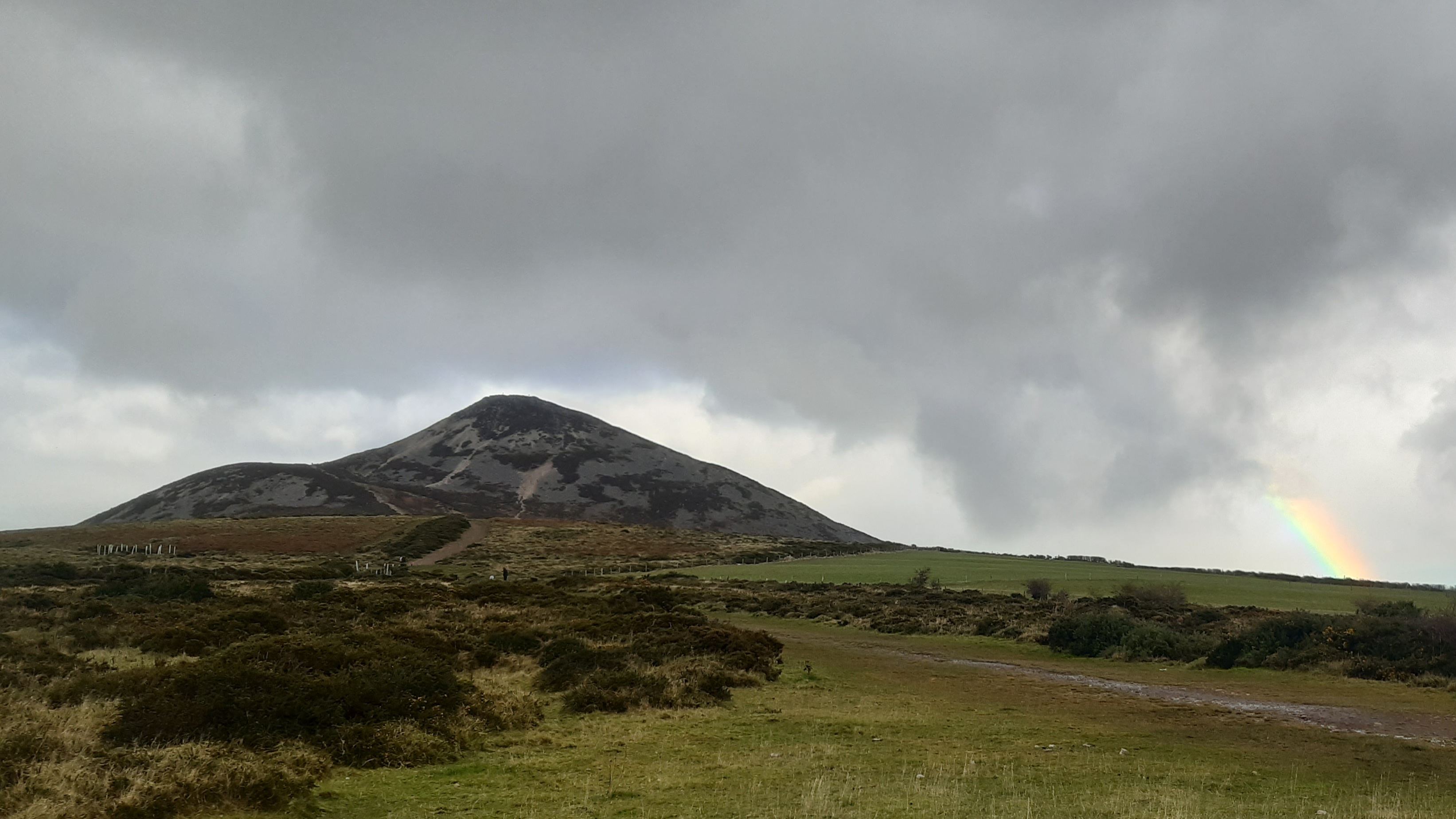
Finally, we scattered Dad’s ashes on Sunday (12.11.23). In dad’s own words “…scattering them where I/we scattered Hugh’s seems as good as anything“. So we did. While getting ready to leave the house on a very wet morning, something of the timing occurred to me. After a moments research, the niggling feeling proved right. Eight years ago, on the same Sunday of November (15.11.15), we had scattered Hugh’s ashes in the same spot (or as close as we could fathom). Coincidence? It certainly was not planned. In addition, I could mention the pair of birds swooping around the hillside soon after, or the rainbow that brightened the event, or the fact that dad’s empty urn was singing to us in the wind as we returned to the cars as insights into some greater universal Godly sign, but I can just imagine what dad would say to any of that! Still, lovely touches for us on a bleak day.
 Rambling Rector Retired
Just to note that the memorial service raised EUR 600 for the Simon Community. Special thanks to David O’Shea for his generous contribution in lieu of his fee.
Wonderful tribute and captures Stanley perfectly – thank you !
So very good to be able to read these tributes. Thankyou. Where can I find Stanley’s essay on Where does God stand on Sex and Lust?
I think it might be this one… https://ramblingrector.me/2011/02/09/restlessness-lust-delight/
Many thanks. Will read with interest.
What a magnificent tribute to The Great Man. His sense of fun and honesty will never leave me. I knew him for far too few years, but what a privilege to have crossed his path one year at Easter. His Lent group this year was inspirational. How sad there will never be another.
Thank you for sharing and thank you Stanley for just being You.